Key Takeaways
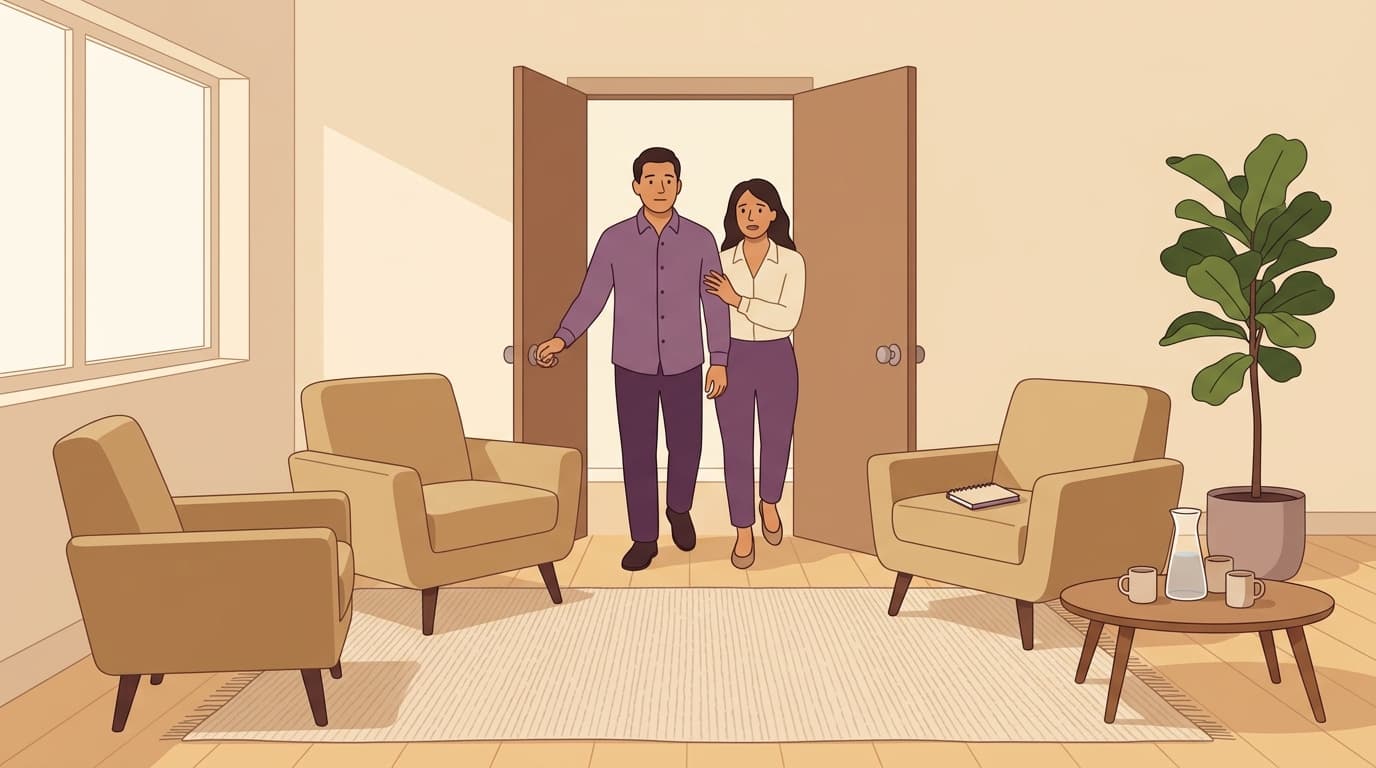
The best time for couples therapy is before you're in crisis. The average couple waits six years too long. This covers what the research says about the major modalities, what the first session is really like, and what to do if your partner refuses to go.
There's a widespread belief that going to couples therapy means your relationship is in trouble. That it's the step before the breakup. That healthy couples don't need it.
This is roughly as logical as believing that going to the dentist means your teeth are falling out. Therapy is maintenance, not just emergency repair. And the data on when couples actually show up versus when they should show up tells a damning story about how that myth plays out.
Dr. John Gottman's research found that the average couple waits six years after serious problems emerge before seeking professional help. Six years. By the time most couples walk into a therapist's office, they've already built up years of resentment, entrenched negative patterns, and emotional distance that could have been addressed when the problems were still small.
The couples who benefit most from therapy are the ones who go early, when they notice a pattern forming, not after the pattern has calcified into the relationship's foundation.
Does couples therapy actually work?
Yes, with caveats. The effectiveness depends heavily on the modality used and the skill of the therapist.
Emotionally Focused Therapy (EFT), developed by Dr. Sue Johnson, has the strongest research base. A meta-analysis of EFT studies found that 70-75% of couples move from distress to recovery, and approximately 90% show significant improvement. EFT focuses on attachment bonds: the idea that most relationship conflict is actually about whether partners feel safely connected. It's particularly effective for couples stuck in pursue-withdraw cycles (one partner chases, the other shuts down).
Gottman Method Couples Therapy is built on four decades of observational research. Gottman's lab literally measured couples' heart rates, facial expressions, and cortisol levels during arguments to identify what predicts divorce. The therapy targets specific patterns: the Four Horsemen (criticism, contempt, defensiveness, stonewalling) and their antidotes. Research shows significant improvement in relationship satisfaction, with effects maintained at follow-up.
Imago Relationship Therapy, created by Harville Hendrix, focuses on how childhood wounds show up in adult partnerships. Its central tool, the Imago Dialogue, is a structured conversation format where one partner speaks and the other mirrors, validates, and empathizes before responding. The research base is smaller than EFT or Gottman, but available studies show improvements in communication satisfaction and empathy.
Discernment Counseling is specifically designed for couples where one partner wants to work on the relationship and the other is leaning toward leaving. It's not therapy; it's a structured process (typically 1-5 sessions) to help both people gain clarity and confidence about the direction they want to go. Developed by Dr. Bill Doherty at the University of Minnesota, it fills a gap that traditional couples therapy doesn't address well.
The important thing: not all therapy is equal. An untrained therapist doing "couples work" without a structured, evidence-based framework can actually make things worse. Research by Dr. William Doherty found that couples therapy conducted by therapists without specific couples training had a success rate barely better than doing nothing. The modality and the therapist's training matter.
What are the signs it's time for couples therapy?
Most people wait for a crisis: an affair, an ultimatum, a moment where everything falls apart. By then, the work is harder and the odds are worse. Here are the earlier signals that therapy would help:
You keep having the same argument. Not occasionally revisiting a topic, but circling the same fight every few weeks, with the same escalation pattern, the same hurt feelings, the same resolution that doesn't stick. Gottman's research shows that 69% of relationship conflicts are perpetual. They never fully resolve because they're rooted in fundamental personality differences or life dreams. The goal isn't to solve them. It's to learn how to talk about them without damaging each other. Therapy teaches that.
You've stopped talking about what matters. The conversations are logistical: who's picking up the kids, what's for dinner, when is the plumber coming. The deeper stuff, how you're feeling, what you're worried about, what you want, has gone underground. This is what therapists call "functional distance," and it's a precursor to feeling like roommates.
Contempt has entered the chat. Eye-rolling, sarcasm, name-calling, mockery. Gottman identified contempt as the single strongest predictor of divorce, more predictive than infidelity, financial stress, or sexual dissatisfaction. If you're regularly expressing disgust toward your partner (or receiving it), that's not a rough patch. That's an emergency.
One of you has checked out. Not actively unhappy, just indifferent. The opposite of love isn't hate; it's apathy. If you've stopped caring about whether your partner is happy, stopped being curious about their inner life, stopped being bothered by the distance, that flatness is a signal that something critical has atrophied.
You're considering an affair (or recovering from one). Either direction, the pull toward someone else or the aftermath of it, is better handled with professional support than willpower alone.
There's been a major life transition. New baby, job loss, relocation, health crisis, retirement. These transitions stress even strong relationships because they disrupt established roles and routines. Therapy during transitions is preventive, not reactive.
Your sex life has changed significantly and neither of you is talking about it. A dead bedroom is rarely just about sex. It's usually about connection, resentment, body image, power dynamics, or unprocessed anger that has migrated into the physical relationship. Avoiding the topic makes it worse.
What does the first session look like?
The first session is an assessment, not a deep dive. Most therapists use it to understand the landscape before doing any intervention work. The general structure:
Intake questions. The therapist will ask about your relationship history: how you met, when things started feeling off, what you've already tried. They'll ask about individual backgrounds: family of origin, mental health history, previous relationships. This isn't small talk. Attachment patterns from childhood directly influence adult relationship dynamics, and a good therapist needs that context.
Each partner's perspective. Most therapists give each person uninterrupted time to share what brought them in. This can feel uncomfortable: hearing your partner describe the relationship from their side, especially if their version is different from yours, hits differently with a neutral third party listening.
Goal setting. The therapist will ask what you're hoping to get out of therapy. Specific answers ("We want to stop fighting about money" or "We want to feel connected again") are more useful than vague ones ("We just want things to be better"). But vague is fine at the start. Part of the therapist's job is helping you clarify what you actually need.
Logistical details. Frequency (usually weekly to start, shifting to biweekly as progress is made), session length (typically 50-90 minutes), expectations about homework between sessions, and policies around individual contact with the therapist.
What it's not: a courtroom. A good therapist isn't there to determine who's right. They're there to identify patterns, not villains. If your first session feels like the therapist is taking sides, that's a red flag about the therapist, not about your relationship.
Most people report that the first session is less scary than they expected. The anticipation is worse than the reality. Just showing up is the hardest part.
How do you find the right therapist?
This matters more than people realize. The therapeutic relationship, whether you feel understood, respected, and safe with this specific person, is one of the strongest predictors of therapy outcomes across all modalities.
Questions to ask during a consultation
Most therapists offer a free 15-minute phone consultation. Use it. Ask these questions:
"What modality do you use?" You want to hear a specific answer: EFT, Gottman Method, Imago, or another evidence-based framework. "Eclectic" or "I use a variety of approaches" can mean well-trained and flexible, or it can mean no structured framework at all. Ask follow-up questions about their training.
"What specific training do you have in couples therapy?" A license to practice therapy doesn't mean expertise in couples work. Many therapists are trained primarily in individual therapy and see couples as a sideline. You want someone who has specific, advanced training in a couples modality, ideally certification, which requires supervised practice and demonstrated competence.
"How do you handle it when one partner is more resistant than the other?" This question reveals whether the therapist can hold space for both people, even when they're in very different places emotionally.
"What does your typical course of treatment look like?" A good therapist should be able to describe a general arc: assessment, identifying patterns, building skills, practicing in real conflicts, and gradually reducing frequency. "It depends" is an honest answer, but they should still be able to give you a rough framework.
"Have you worked with couples dealing with [your specific issue]?" Whether it's infidelity, cultural differences, blended families, LGBTQ-specific dynamics, or sexual concerns, experience with your specific situation matters.
Red flags in a therapist
- They consistently take one partner's side
- They encourage venting without redirecting toward solutions
- They seem uncomfortable with conflict in the room (a couples therapist who can't handle tension is like a surgeon who faints at blood)
- They pathologize one partner ("Your husband is clearly a narcissist")
- They don't assign homework or work between sessions. Change happens in life, not in the office
- After several sessions, you can't articulate what the treatment plan is
Practical considerations
- Insurance coverage varies widely. Many couples therapists are out-of-network, which means higher out-of-pocket costs. Ask about sliding scale options.
- Frequency matters. Weekly sessions, especially at the start, build momentum. Biweekly or monthly sessions are maintenance mode, not treatment mode.
- Both partners should feel reasonably comfortable with the therapist. It's normal for one person to click more than the other, but if either partner actively distrusts the therapist after 2-3 sessions, try someone else.
What if your partner won't go?
This is common. One partner sees the need; the other sees therapy as an admission of failure, a threat, or unnecessary. Dragging an unwilling partner to therapy doesn't work. They'll sit there with their arms crossed, give monosyllabic answers, and confirm their belief that the whole thing is pointless.
Instead:
Name it without pressure. "I think we could benefit from talking to someone together. I'm not saying anything is catastrophically wrong. I just think we have some patterns we can't break on our own, and I want us to be better." This frames therapy as a growth tool, not an indictment.
Address the specific objection. If it's "we don't need it," share specifically what you've been struggling with. If it's cost, research sliding-scale options. If it's "talking to a stranger about our problems," acknowledge that it feels weird and suggest starting with a single session to see how it feels.
Invite, don't ultimatum. "I'd really like you to try one session with me" lands differently than "If you won't go to therapy, I'm leaving." Ultimatums might get someone in the door, but they poison the process.
Go alone if necessary. Individual therapy can help you develop better relationship skills, understand your own patterns, and gain clarity about what you need, whether your partner participates or not. Sometimes when one partner starts changing, the dynamic shifts enough that the other partner becomes willing to engage.
Use other entry points. Some people who resist "therapy" are open to a workshop, a couples retreat, a book, or even a structured conversation practice. These aren't substitutes for professional help when it's needed, but they can be a bridge, a lower-stakes way to start working on the relationship that feels less intimidating. Having hard conversations without fighting is a skill that can be practiced without a therapist, and sometimes learning one skill opens the door to wanting more support.
Therapy isn't the only tool
Professional therapy is the most effective intervention for serious relationship distress. But it's not the only way to invest in your relationship, and it works better when it's supplemented by daily practice.
The couples who get the most out of therapy are the ones who don't treat the therapist's office as the only place relationship work happens. They practice between sessions. They have regular check-ins. They stay curious about each other even when it's inconvenient.
A daily question practice, one intentional moment where you actually engage with each other beyond logistics, reinforces the skills therapy teaches. It's a small thing. But relationships are built on small things.
Frequently asked questions
How long does couples therapy usually take?
It varies, but a typical course is 12-20 sessions over three to six months. Some couples see significant improvement in 8-10 sessions; others need longer, especially if there's been infidelity or deeply entrenched patterns. EFT research shows that most couples achieve meaningful change within 8-20 sessions. The key is consistency: weekly sessions produce better outcomes than sporadic ones.
Can couples therapy make things worse?
It can, in two scenarios. First, if the therapist is poorly trained or uses an approach not suited to your situation. Second, therapy sometimes surfaces truths that have been buried: one partner's desire to leave, for instance, or resentments that have been suppressed for years. This can feel like things are getting worse when they're actually getting more honest. A skilled therapist can hold that process. An unskilled one can't.
Is online couples therapy as effective as in-person?
Research during and after the pandemic suggests that online therapy is comparably effective for most couples. The main advantages of in-person are the therapist's ability to read body language more fully and the physical separation from home (which can make the session feel more like a dedicated space). The main advantages of online are accessibility, scheduling flexibility, and comfort. Most therapists now offer both. Choose whichever format makes it more likely that you'll actually show up consistently.
What if we tried therapy before and it didn't work?
That could mean the modality wasn't right, the therapist wasn't well-matched, or the timing wasn't right (one partner wasn't ready). It doesn't mean therapy itself doesn't work for you. Try a different therapist, preferably one with specific certification in EFT or Gottman Method. The difference between a generalist doing couples work and a specialist can be dramatic.
Aperi: one question a day
A daily question app that adapts to you and your partner, and goes deeper the more you use it.


Free to start. Available on iPhone and Android.
Explore question packs
Related articles
Why personal growth sometimes threatens your relationship
When one partner grows, the relationship system gets disrupted. Why that happens and how to handle it.

The difference between needing and wanting your partner
Is it better to need or want your partner? The real answer is more complicated than Instagram quotes suggest.

Building self-worth that doesn't depend on your partner
When your self-worth depends on your partner's approval, every interaction becomes high-stakes. Here's how to build an internal foundation.
When you project your insecurities onto your partner
Projection makes you fight about things that aren't real. How to catch it, understand where it comes from, and stop.

Why boredom in your relationship isn't always bad
Relationship boredom gets a bad reputation. Sometimes it signals safety. Sometimes it signals stagnation. Here is how to tell the difference.
When you and your partner speak different love languages
You show love your way, not theirs. How to close the gap when you and your partner express affection differently, beyond the quiz.