Key Takeaways
Relationship anxiety, the persistent need to analyze, reassure, and evaluate your partnership, is usually driven by attachment patterns and intolerance of uncertainty, not by actual relationship problems. The fix isn't more analysis. It's learning to tolerate not knowing.
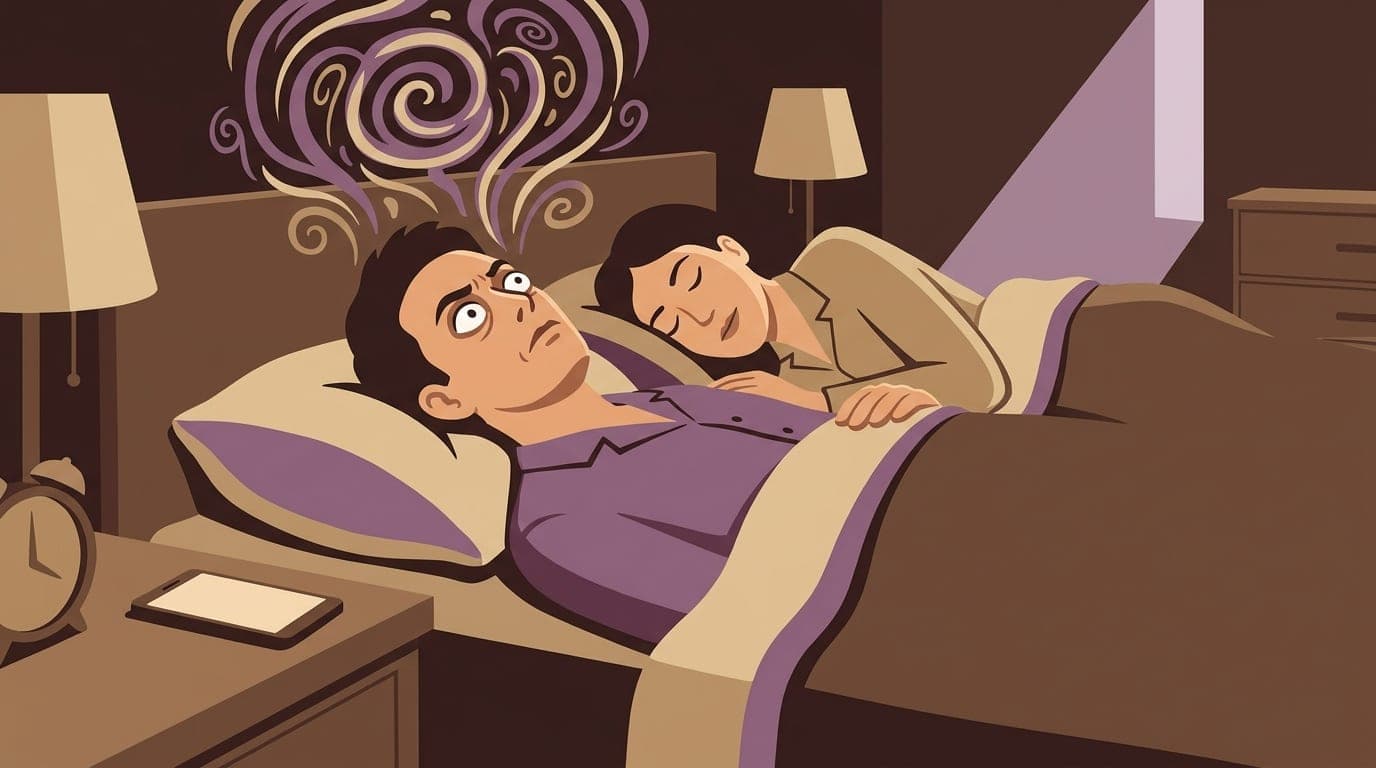
It starts with a thought. A small one.
They didn't text back as fast as usual.
Then another.
They seemed distracted at dinner. Were they annoyed?
Then the spiral.
We haven't had a deep conversation in a while. Is the spark gone? Do they still love me the same way? Am I settling? Are they? What if this isn't the right relationship? What if I'm wasting their time? What if I'm wasting my time?
Three hours later, you've mentally litigated your entire relationship, read four articles about "signs your relationship is over," and you feel worse than when you started. Your partner has no idea any of this happened. They were just tired.
If this sounds familiar, you're not broken. You're experiencing relationship anxiety, and it's way more common than people admit. Especially among people who are thoughtful and care about doing relationships well. (Which is a little unfair, honestly. The people who worry most about their relationships tend to be the ones least likely to actually be bad partners.)
What relationship anxiety actually is
Relationship anxiety is a pattern of persistent doubt, rumination, and reassurance-seeking about your romantic relationship. It's different from having real concerns about red flags or incompatibilities. The distinction is in the pattern:
Legitimate concern: "My partner yelled at me during an argument and it scared me. I need to address this." Specific. Grounded in something observable. Leads to action.
Relationship anxiety: "My partner seemed slightly less enthusiastic when they said 'I love you' tonight. What does that mean? Do they still mean it? Am I reading too much into this? But what if I'm not?" Vague. Interpretation-heavy. Leads to more analysis instead of action.
The thing that defines relationship anxiety is that no amount of evidence resolves the doubt. Your partner can tell you they love you ten times today, and a small part of your brain will wonder if they meant it. You can have a wonderful weekend together, and by Monday you'll find a new data point to worry about. The goal posts keep moving because the anxiety isn't really about the evidence. It's about your relationship with uncertainty itself.
Why it happens (it's not about your partner)
Attachment patterns
Attachment theory is probably the clearest way to understand relationship anxiety. People with anxious attachment developed their relational wiring in childhood environments where caregivers were inconsistent, sometimes available, sometimes not. The child learned to be hypervigilant about their caregiver's emotional state. Always scanning for signs of withdrawal.
Fast forward to adulthood, and that same hypervigilance shows up in romantic relationships. Every small shift in your partner's mood, every delayed response, every ambiguous comment gets run through a threat-detection system that was calibrated for an unstable environment. The system isn't broken. It's applying childhood logic to an adult context where it no longer fits.
This isn't a life sentence. But understanding where the anxiety comes from is how you start loosening its grip.
Intolerance of uncertainty
There's a growing consensus in psychology that anxiety disorders share a common thread: difficulty tolerating uncertainty. Relationship anxiety is one version of this. The anxious person isn't necessarily worried about a specific bad outcome. They're uncomfortable with the fact that they can't know for certain that the relationship is okay.
"Is this the right relationship?" has no definitive answer. No relationship comes with a guarantee. For most people, that ambiguity is manageable, just part of being human. For someone with low uncertainty tolerance, it's unbearable. So they analyze, seek reassurance, compare. All trying to manufacture a certainty that doesn't exist.
And here's the cruel part: the analysis itself generates more doubt. The more you examine your relationship under a microscope, the more imperfections you find (because every relationship has them), which triggers more anxiety, which triggers more analysis. It feeds itself.
The comparison trap
Social media didn't cause relationship anxiety, but it's poured gasoline on it. You see curated highlight reels of other couples, the proposal videos, the anniversary posts, the "my partner surprised me with..." content, and your brain automatically compares your Tuesday-night-on-the-couch reality to their Sunday-best performance.
That comparison is always unfair. You're comparing your inside to their outside. You know every awkward silence, every petty argument, every moment of doubt in your relationship. You know none of that about the couples in your feed.
Study after study on social comparison and relationship satisfaction finds the same thing: the more you compare your relationship to others (especially on social media), the less satisfied you feel, regardless of how good your relationship actually is.
The reassurance trap
The most natural response to relationship anxiety is seeking reassurance. You ask your partner: "Do you still love me?" "Are you happy?" "You'd tell me if something was wrong, right?"
Your partner says yes. You feel better for about 45 minutes. Then the doubt creeps back.
This cycle has a name in clinical psychology: reassurance-seeking behavior. And it makes anxiety worse over time, not better.
When you seek reassurance and get it, your brain registers the sequence as: danger detected, safety-seeking behavior, relief. This reinforces the initial danger signal. Next time, the anxiety comes back faster and stronger.
It also exhausts your partner. Being asked "do you love me?" once is sweet. Being asked every week is a weight. Over time, your partner starts feeling like their consistent presence and affection aren't enough, that nothing they do will quiet the doubt. This can create real distance in a relationship that didn't have a problem before the anxiety invented one.
And maybe most importantly, it outsources your emotional regulation. When your partner's "yes" is the only thing that soothes the anxiety, you've made them responsible for managing your internal state. That's too much to put on anyone.
What to do instead
Name it as anxiety, not intuition
Learn to recognize relationship anxiety as anxiety, not as your gut telling you something is wrong.
Anxiety is extremely good at disguising itself as intuition. "I just have a feeling something is off" is almost always the anxiety talking. Real intuition tends to be quieter. It doesn't need three hours of mental deliberation to make its case. If you're spiraling, that's information about your nervous system, not about your relationship.
This doesn't mean dismiss every negative feeling. But consider the source. Is this thought coming from something observable and specific? Or from the part of your brain that's always scanning for threats?
Sit with the discomfort
When the anxiety says "analyze this NOW," the therapeutic move is to do nothing. Not because the relationship isn't worth thinking about, but because thinking about it in an anxious state never produces useful conclusions. You already know this, probably. You've never spiraled your way to clarity.
In cognitive behavioral therapy, this is called distress tolerance. You notice the anxious thought ("they seemed distant today"), you acknowledge it ("my anxiety is activated"), and you choose not to engage ("I'm going to let this thought exist without solving it"). The anxiety will spike. It'll feel urgent. And then, if you don't feed it with analysis, it passes.
This builds your capacity, slowly, to tolerate the ambiguity that relationships just contain. You stop needing certainty to feel safe.
Replace analysis with connection
When you catch yourself spiraling, redirect the energy from analysis to action. Instead of mentally dissecting your partner's tone from earlier, ask them something. Not a reassurance question ("Are we okay?") but a real curiosity question ("What's been on your mind lately?" or "What's something you've been looking forward to?").
This does something interesting: it replaces the anxious narrative in your head with actual information from your partner, and it creates a moment of real connection that your nervous system registers as safety.
Question-asking in relationships seems to work partly because curiosity is fundamentally incompatible with anxious rumination. You can't simultaneously analyze whether your relationship is failing and be genuinely curious about your partner's inner world. One displaces the other.
Notice the small stuff
If your anxiety says "they don't care," try keeping a running note, mental or literal, of evidence to the contrary. Not as a reassurance tool you pull out during spirals. More as a practice of noticing what's actually happening instead of what your anxiety says is happening.
They brought you coffee without being asked. They remembered the thing you said about your coworker and followed up three days later. They reached for your hand during the movie. These are bids for connection, and if you're busy analyzing the relationship, you miss them entirely.
Figure out what's yours versus what's theirs
Some relationship anxiety is legitimate signal. If your partner is genuinely inconsistent, emotionally unavailable, or dismissive of your needs, the anxiety is telling you something real.
But if you've been anxious in every relationship you've had, if the doubt follows you from partner to partner, always finding a new thing to latch onto, then the anxiety is yours. It's about your relationship with uncertainty, with vulnerability, with the risk that comes with actually loving someone, not about this particular partner.
That's not a criticism. It's just useful to know, because it tells you where the work actually is.
When to get help
Relationship anxiety exists on a spectrum. Occasional doubt is normal, just part of being in a relationship. But persistent, intrusive rumination that interferes with your daily life or your ability to actually be present with your partner? That's worth exploring with a therapist, specifically one trained in CBT (cognitive behavioral therapy) or ERP (exposure and response prevention).
Worth mentioning: ROCD (Relationship Obsessive-Compulsive Disorder) is a recognized subtype of OCD where the obsessions center on the relationship. "Am I with the right person?" "Do I love them enough?" "What if I'm not attracted enough?" If your doubts feel compulsive, if you can't stop the thoughts even when you want to, if you find yourself doing mental rituals to try to resolve them, this may be what's going on. A specialist can help a lot here.
You don't need to be in crisis to see someone. If anxiety is consistently stealing your ability to enjoy a relationship that is, by all evidence, good, that's reason enough.
Frequently asked questions
How do I know if it's anxiety or a real problem?
Ask yourself: Is this based on a specific, observable behavior? Can I describe what happened without interpretation? If yes, it's probably a real concern worth discussing. If the doubt is vague, keeps shifting targets, and persists even after reassurance, it's more likely anxiety. Another useful test: have you felt this exact way in previous relationships? If the pattern follows you, the source is probably internal.
Should I tell my partner I have relationship anxiety?
Usually yes, but frame it carefully. Not "I'm constantly worried you're going to leave me" (which places the burden on them) but something like "I experience anxiety about relationships in general, and I'm working on it. It's not about you, and if I seem like I need reassurance sometimes, that's what's happening." Context without responsibility.
Will relationship anxiety go away on its own?
It waxes and wanes with stress, life transitions, and relationship milestones. It often spikes during periods of change (moving in together, getting engaged, having kids). But without active work on the underlying patterns, whether that's attachment work, distress tolerance, or CBT, it usually comes back in some form.
My partner's behavior is actually inconsistent. Is it still anxiety?
Both things can be true at once. If your partner is genuinely inconsistent, attentive one week and distant the next, making promises they don't keep, avoiding difficult conversations, that's a real issue that deserves a direct conversation. The anxiety question is about how you process it: do you address it directly, or do you spiral in private? Both the relationship pattern and the anxiety pattern might need work.
Aperi: one question a day
A daily question app that adapts to you and your partner, and goes deeper the more you use it.


Free to start. Available on iPhone and Android.
Explore question packs
Related articles
Building self-worth that doesn't depend on your partner
When your self-worth depends on your partner's approval, every interaction becomes high-stakes. Here's how to build an internal foundation.
When you project your insecurities onto your partner
Projection makes you fight about things that aren't real. How to catch it, understand where it comes from, and stop.
Why boredom in your relationship isn't always bad
Relationship boredom gets a bad reputation. Sometimes it signals safety. Sometimes it signals stagnation. Here is how to tell the difference.
When you and your partner speak different love languages
You show love your way, not theirs. How to close the gap when you and your partner express affection differently, beyond the quiz.

What research says about age gap relationships
Age gap relationships attract strong opinions. What does the data actually show about satisfaction, power dynamics, and stigma?
Grieving together without growing apart
Partners often grieve differently and asynchronously. How to support each other through loss without losing your connection.