Key Takeaways
Emotional safety is the invisible foundation of every healthy relationship. It's about knowing your partner will respond to your vulnerability with care, not avoiding conflict. Without it, depth is impossible. With it, almost everything else becomes easier.
There's a question that reveals more about a relationship than almost any other: Can you say the awkward thing?
Not the easy kind of honesty, like "I don't like that restaurant" or "I prefer the blue one." The harder kind. "I'm scared about money and I haven't told you." "Something you said last week hurt me and I've been sitting with it." "I'm not sure I'm happy, and I don't know why."
If your gut reaction to those sentences is I could never say that to my partner, you have an emotional safety problem. And that problem is quietly shaping everything else in your relationship: the depth of your conversations, the quality of your conflict, the degree to which you actually know each other.
Emotional safety is arguably the most important variable in a romantic relationship, and it's the one that gets the least airtime. We talk endlessly about communication, love languages, attachment styles, and conflict resolution. But all of those things depend on a substrate of safety that most couples never examine directly.
What is emotional safety in a relationship?
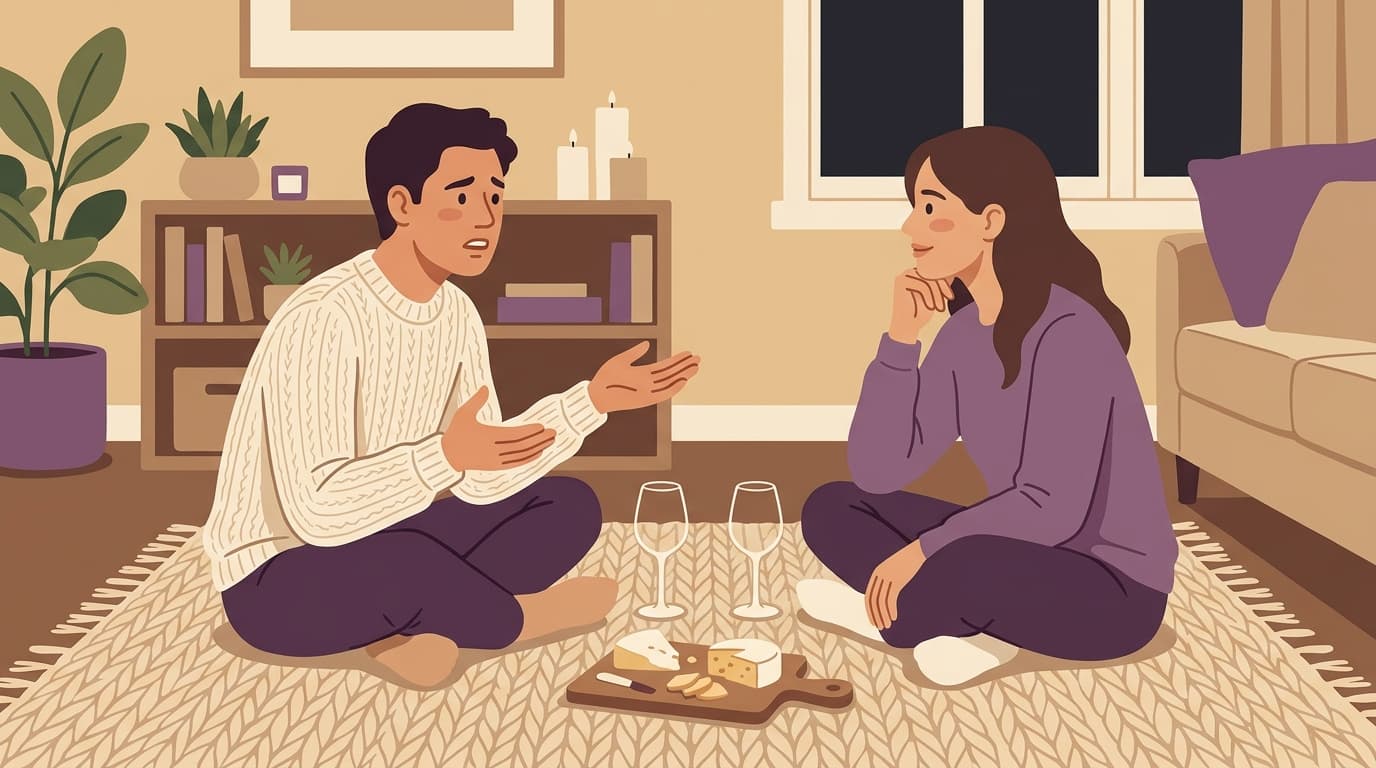
Emotional safety is the felt sense that you can be vulnerable with your partner without being punished for it. That you can share difficult emotions, unpopular opinions, fears, and half-formed thoughts without those things being used against you, dismissed, or met with contempt.
It's not the same as conflict avoidance. This is the most common misunderstanding. Couples who never argue aren't necessarily safe; they might just be suppressing. Emotional safety doesn't mean the absence of disagreement. It means the presence of trust that disagreement won't be weaponized.
Sue Johnson, the developer of Emotionally Focused Therapy (EFT) and one of the most cited researchers on adult attachment, frames it this way: emotional safety is the answer to the question, "Are you there for me?" Not in a logistical sense (will you pick up the kids, will you pay the mortgage). In an emotional sense: if I fall apart, will you catch me? If I tell you something I'm ashamed of, will you still love me?
Johnson's research, spanning over thirty years and multiple clinical trials, shows that relationship distress almost always traces back to a perceived threat to this bond. Couples don't fight about dishes and schedules. They fight about whether they can depend on each other. The dishes are just the surface.
How does safety change the brain?
The neuroscience makes the case even more directly. Stephen Porges' Polyvagal Theory describes how the autonomic nervous system evaluates safety through a process he calls neuroception, an unconscious assessment of whether the current environment, including the people in it, is safe, dangerous, or life-threatening.
When your nervous system reads your partner as safe, your ventral vagal system engages. This is the state associated with social engagement: facial expressiveness, vocal warmth, the ability to listen, empathy, creative thinking. You can be present because your body isn't bracing for threat.
When your nervous system reads your partner as unsafe, even subtly, even when there's no conscious thought of danger, the sympathetic (fight/flight) or dorsal vagal (shutdown) systems activate. In this state, you lose access to the very capacities that make good relationships possible. You can't listen well when you're defensive. You can't be vulnerable when you're braced for impact. You can't be curious when your brain is scanning for attack.
This isn't metaphorical. Brain imaging studies show that the presence of a securely attached partner literally changes neural response to threat. A 2006 study by James Coan at the University of Virginia found that when participants held their partner's hand during a stressful experience, their brain's threat response was significantly reduced, but only when the relationship was high quality. A low-quality relationship partner's hand didn't help. The brain distinguishes between safe and unsafe bonds at a neural level, and it responds accordingly.
This explains why some couples can have difficult conversations that bring them closer while others have the same conversations and end up further apart. The difference isn't communication skill. It's whether the nervous system is in a state that allows communication to work.
What are the signs of emotional unsafety?
Emotional unsafety isn't always dramatic. In fact, the most common forms are quiet enough that people often don't identify them as a problem. They just experience the downstream effects.
Walking on eggshells. You monitor your partner's mood before deciding whether to bring something up. You've learned that certain topics are off-limits, and you route around them automatically. You might not even think of this as fear. It feels more like strategic timing. But the underlying calculation, is it safe to say this right now?, is a safety assessment.
Self-censoring. You edit your thoughts before sharing them, not for clarity but for protection. You leave out the parts you think your partner won't handle well. Over time, this creates a gap between who you are internally and who you present to your partner. The gap feels lonely.
Performing. You present a version of yourself that you think your partner wants to see. You suppress sadness because they don't handle your sadness well. You pretend to be fine when you're not. You laugh at things that aren't funny to you. This is adaptation to an unsafe environment, and it's exhausting.
Anticipatory anxiety. You rehearse conversations in your head, preparing for every possible negative reaction. You delay bringing things up because you're dreading the response. The dread itself is the data. It tells you that past experiences with this person have taught your nervous system to expect threat.
Minimizing your own needs. You tell yourself that what you want isn't important enough to mention. You've internalized the message, whether explicitly stated or implicitly demonstrated, that your needs are inconvenient. This is learned unsafety.
If these patterns are familiar, they're not just personality quirks. They're signals. And understanding your attachment style can shed light on how much of this pattern comes from the current relationship versus old wiring from earlier experiences.
How do you build emotional safety?
Safety isn't built through one conversation or one grand gesture. It's built through repeated small experiences that teach the nervous system: this person is reliable. This person responds to my vulnerability with care. Three mechanisms drive this:
Predictability
Not in the boring sense, but in the safety sense. Your partner needs to be able to predict how you'll respond to their vulnerability. Not the exact words, but the category of response. Will you listen or dismiss? Will you get defensive or stay curious? Will you bring it up later as ammunition?
Predictability is built through consistency. If your partner shares something hard and you respond with empathy nine times out of ten but with irritation on the tenth, the irritation is what the nervous system remembers. It only takes a few unpredictable responses to teach someone that vulnerability is risky.
This doesn't mean you have to be perfect. It means you have to be reliable. And when you're not, when you do snap or dismiss or get defensive, you have to repair it quickly and genuinely. Which brings us to the next mechanism.
Repair
Ed Tronick's "Still Face" experiment, originally conducted with infants and caregivers, demonstrates something that applies directly to adult relationships. In the experiment, a mother engages warmly with her baby, then suddenly goes emotionally blank. The baby becomes distressed, tries to re-engage the mother, and eventually withdraws. When the mother re-engages warmly, the baby recovers, but the recovery is through the rupture, not around it.
Tronick's finding: it's not the absence of rupture that creates secure attachment. It's the reliable repair after rupture. This holds for adult romantic relationships too. You will hurt your partner. You'll miss bids, say the wrong thing, be dismissive when you're tired. Safety is about what happens next, not never screwing up.
Good repair includes: acknowledging what happened ("I was dismissive when you told me about your day, and I'm sorry"), taking responsibility without deflecting ("I was stressed, but that's not an excuse for not listening"), and re-engaging with the original bid ("Tell me again. I want to hear it properly").
Johnson's EFT model calls this the "hold me tight" conversation: the moment when one partner says, effectively, "I need to know you're there for me," and the other responds with reassurance and presence. These moments of repair don't just fix the immediate rupture. They build safety, because they demonstrate that the bond can survive strain.
Attunement
Attunement is the ability to sense what your partner is feeling and respond appropriately. It's not mind-reading. It's paying attention. Noticing that they've been quieter than usual. Picking up that their "I'm fine" wasn't actually fine. Responding to the emotion under the words, not just the words themselves.
Daniel Siegel describes attunement as "feeling felt": the experience of having someone understand your internal state without you having to explain it. In practice, attunement sounds like: "You seem off today. What's going on?" or "I can tell that conversation with your mom got to you." It communicates: I'm paying attention to you. Your inner world registers with me.
Attunement requires what Gottman calls Love Maps: an up-to-date mental model of your partner's inner world. You can't notice that something is off if you don't know what "on" looks like for them.
What's the relationship between safety and depth?
This is the connection that ties everything together: you cannot go deep without safety. The capacity for emotional intimacy, the kind of progressive mutual vulnerability that research identifies as the core of lasting connection, depends entirely on whether both people feel safe enough to take the risk.
Think of relationship depth levels as floors in a building. Level 1 is surface-level exchange. Level 4 is sharing your core fears, unresolved shame, and deepest desires. You can't get to Level 4 by pushing through discomfort. You get there because safety dissolves the discomfort, making it possible to share things you'd never say to someone who might hurt you with them.
This is why couples who've been together for decades can still be emotionally shallow. Time doesn't equal depth. Safety equals depth. A couple who's been together for three years with high emotional safety will know each other more deeply than a couple who's been together for twenty years in an environment of subtle unsafety.
It also explains why the early stages of a relationship sometimes feel deeper than later stages. Not because the relationship was actually better, but because the neurochemistry of new love (elevated oxytocin, dopamine, reduced amygdala activity) temporarily mimics safety. When those chemicals normalize, the actual safety level of the relationship becomes apparent. If the underlying environment isn't safe, depth recedes as chemistry fades.
How does past experience shape current safety?
Attachment theory, developed by John Bowlby and later extended to adult relationships by Cindy Hazan and Phillip Shaver, explains why some people find it harder to feel safe in relationships even with a responsive partner.
If your early caregivers were inconsistently responsive, your attachment system may have adapted by becoming hypervigilant (anxious attachment) or by shutting down the need for closeness altogether (avoidant attachment). These adaptations made sense in the original environment, but they create friction in adult relationships.
An anxiously attached person may need more reassurance to feel safe, not because their partner is doing something wrong, but because their nervous system has a higher threshold for "enough." An avoidantly attached person may resist vulnerability even when the environment is safe, because their system learned early that vulnerability leads to disappointment.
Understanding this doesn't excuse harmful behavior, but it does explain why building safety sometimes requires patience and persistence beyond what feels proportional. Your partner's safety threshold is set by their history, not just your actions. For more on how this works, see the guide on attachment styles in relationships.
What does safety look like in practice?
Safety is less a thing you have and more a thing you do. It's maintained through ongoing behavior, not a one-time achievement. A few concrete markers:
Both partners can bring up hard topics without rehearsing for days. If something bothers you, you can say it within a reasonable timeframe without building a legal case first.
Conflict doesn't feel existential. You can disagree, sometimes strongly, without either person questioning whether the relationship will survive. Arguments are about the issue, not about the bond.
Vulnerability is met with warmth, not advice. When one partner shares something difficult, the default response is "I hear you" rather than "Here's what you should do." Vulnerability in relationships requires a specific kind of response, and safe couples have learned what that looks like.
Repair happens quickly. When someone messes up, they acknowledge it, apologize genuinely, and re-engage. There's no extended silent treatment, no score-keeping, no "I'll make them come to me."
Both people feel like they can be themselves. Not a performative version. Not an edited version. The actual version, including the parts that are messy, uncertain, or in progress.
The Deep End pack is built around questions that test and build this kind of safety: prompts designed to take conversations below the surface, but only in the context of a relationship where both partners have signaled they're ready for that depth.
Building safety is a daily practice
Emotional safety isn't a destination. It's a practice, similar to physical fitness. You don't build it once and coast. You maintain it through daily micro-interactions: responding to bids, repairing quickly, staying attuned, being predictable in your warmth.
Aperi supports this by giving couples a daily shared question that gradually increases in depth as the relationship's comfort level grows. The progression is deliberate: you don't get Level 4 questions on day one. Safety is built through the repeated experience of answering, revealing, and being met with your partner's honest response. Each day is a small deposit into the safety account, and over time, those deposits make conversations possible that would have felt too risky before.
Frequently asked questions
How do I know if my relationship is emotionally safe?
The most reliable test is internal. Ask yourself: can I share a difficult emotion, an unpopular opinion, or a personal fear with my partner and expect to be met with curiosity rather than judgment? If the answer is "usually, yes," the relationship has a reasonable foundation of safety. If the answer is "it depends on their mood" or "only certain topics," there are specific areas where safety needs to be built. If the answer is "no," the relationship has a fundamental safety gap that needs direct attention.
Can emotional safety be rebuilt after it's been broken?
Yes, but it takes time and consistent behavior. Trust research by John Gottman shows that rebuilding trust after a violation requires attunement, transparency, and repeated positive experiences over an extended period. The nervous system doesn't update based on promises. It updates based on accumulated evidence. One conversation doesn't rebuild safety. Months of consistent, reliable, responsive behavior does. Couples therapy, particularly EFT, can accelerate this process by providing a structured environment for the repair conversations.
Is it possible to have too much emotional safety?
Not in the way people usually mean this question. Sometimes people worry that too much safety will make the relationship boring or that some productive discomfort will be lost. But the research is clear: safety and passion aren't inversely related. In fact, Sue Johnson's work shows that secure emotional bonds increase sexual desire and satisfaction because both partners feel free enough to be fully present and expressive. What feels like "exciting" unsafety in early relationships is often just anxiety mislabeled as chemistry.
What if I'm the one making the relationship emotionally unsafe?
Recognizing it is the first and hardest step. If your partner walks on eggshells around you, or if you notice that they've stopped sharing difficult things, that's data. The behavioral shifts that build safety are specific: respond to vulnerability with warmth rather than judgment, take responsibility when you mess up, keep your reactions predictable, and resist the urge to use past disclosures as ammunition during arguments. If these patterns feel deeply ingrained, working with a therapist, particularly one trained in EFT, can help you understand the underlying dynamics and change them.
How is emotional safety different from feeling comfortable?
Comfort is about ease. Safety is about trust. You can feel comfortable in a relationship that avoids all hard topics. That's comfort through avoidance, and it's actually a sign of low safety. Real emotional safety isn't the absence of discomfort. It's the confidence that you can move through discomfort together and come out intact. Safe relationships regularly have uncomfortable conversations. The difference is that both people trust the process and trust each other.
Aperi: one question a day
A daily question app that adapts to you and your partner, and goes deeper the more you use it.


Free to start. Available on iPhone and Android.
Explore question packs
Related articles

Why vulnerability feels dangerous
Your brain treats emotional exposure like a physical threat. That's why vulnerability feels dangerous, and why building trust has to be gradual.
Emotional intimacy: what it means and how to build it
Emotional intimacy isn't about being nice. It's mutual vulnerability plus responsiveness, and you can build it on purpose. Eight ways to start.

Why personal growth sometimes threatens your relationship
When one partner grows, the relationship system gets disrupted. Why that happens and how to handle it.

The difference between needing and wanting your partner
Is it better to need or want your partner? The real answer is more complicated than Instagram quotes suggest.

Building self-worth that doesn't depend on your partner
When your self-worth depends on your partner's approval, every interaction becomes high-stakes. Here's how to build an internal foundation.
When you project your insecurities onto your partner
Projection makes you fight about things that aren't real. How to catch it, understand where it comes from, and stop.