
Key Takeaways
Evenings are the most underused window for connection. The transition from work to partner mode doesn't happen automatically; you need a deliberate ritual. Here are eight options with specific instructions for each.
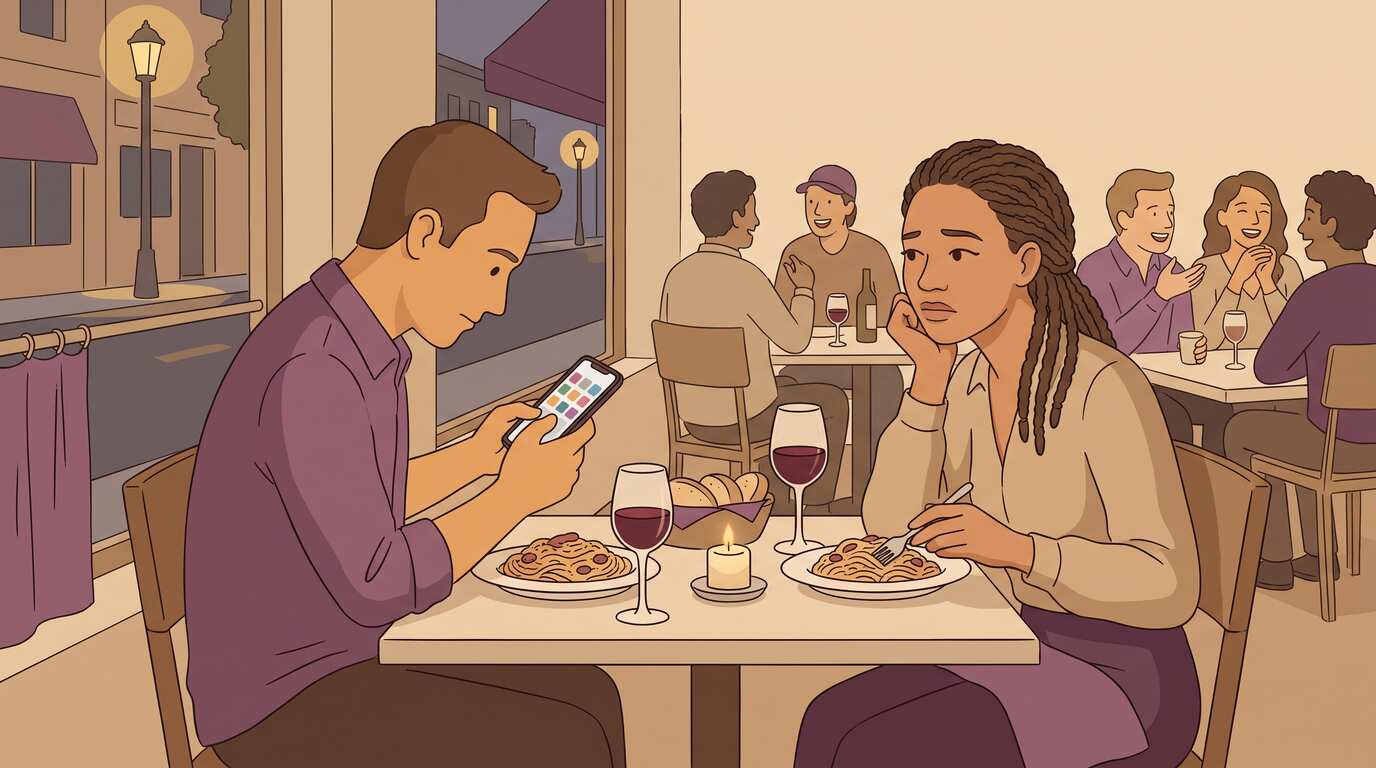
You get home. You're tired. Your partner is tired. You both default to screens, parallel couch sitting, and maybe a "how was your day" that gets a "fine" in return. You eat, you scroll, you sleep. Tomorrow you do it again.
This is how most evenings go for most couples. And it's slowly eroding the relationship without either person noticing.
Why evenings are the most underused relationship window
Mornings are rushed. Weekdays are consumed by work. Weekends get filled with errands, social obligations, and the accumulated logistics of running a life together. That leaves evenings, roughly 7 PM to 10 PM, as the largest consistent block of time most couples share.
And most couples waste it.
Not maliciously. Not even consciously. It's just that nobody teaches you how to transition from being a worker, a parent, a commuter, or a solo individual back into being a partner. The shift is supposed to happen automatically. It doesn't.
John Gottman's research at the University of Washington found that the way couples reconnect at the end of the day is one of the strongest predictors of long-term relationship satisfaction. He specifically studied what he calls the "stress-reducing conversation," a daily check-in that isn't about the relationship itself but about each partner's external world. Couples who consistently had this conversation showed markedly higher stability and satisfaction over time.
The key finding: the conversation needs to happen before anything else. Before logistics, before chores, before complaints about the relationship. First, you land. Then you connect. Then you deal with everything else.
The transition problem
The reason evenings go wrong is straightforward. You've spent 8-10 hours in a fundamentally different mode of operating. Work demands a particular version of you: task-focused, boundaried, performative. That version doesn't just switch off when you walk through the door.
Psychologists call this "role transition" or "boundary crossing," and research by Blake Ashforth and colleagues shows it takes genuine effort. The more absorbing or stressful your work day was, the harder the transition. You bring the residue of the day home with you: the unfinished email you're mentally composing, the meeting that went sideways, the general depletion.
Your partner is doing the same thing. Two people carrying work residue into a shared space, each expecting the other to somehow be available and present. It's a setup for mutual disappointment.
The fix is embarrassingly simple: you need a transition ritual. Something that explicitly marks the shift from "out there" to "in here." It doesn't have to be elaborate. It just has to be intentional and consistent.
Eight evening rituals that actually work
These aren't theoretical suggestions. Each one is grounded in specific research or clinical practice. Pick one or two that fit your life. The worst thing you can do is try to implement all eight. That turns connection into a checklist.
1. The real debrief
"How was your day?" is the most useless question in the English language. It's too broad, too automatic, and it invites "fine" as a response. The question has been so emptied of meaning that it functions more as a greeting than an inquiry.
Replace it with something specific. Gottman's stress-reducing conversation works like this: each partner gets to talk about their day while the other listens. Genuinely listens, without problem-solving, competing, or redirecting to their own stuff.
The ground rules:
- Take turns. One person talks for 10-15 minutes. Then switch.
- The listener's job is understanding, not fixing. Ask follow-up questions. Say "that sounds frustrating" or "what happened next?" Do not say "well, have you tried..." or "that reminds me of my thing."
- Take your partner's side. Even if you think their coworker had a point. Even if they're being unreasonable. This is not the moment for balanced perspective. This is the moment for solidarity.
- Use better openers. Instead of "how was your day," try: "What was the hardest part of today?" "Did anything make you laugh?" "What's sitting with you from today that you haven't processed yet?"
For more on replacing "how was your day" with questions that actually open a conversation, see our guide to better daily questions.
2. The gratitude exchange
This one takes two minutes and has outsized effects. Each partner names one specific thing they appreciated about the other that day. Not generic ("you're great"), but specific ("you handled that call with the school so I didn't have to, and I noticed").
Sara Algoe's research on gratitude in relationships found that expressed gratitude serves as a "booster shot" for relationships. It makes the expresser feel more connected and makes the receiver feel more appreciated and invested. The benefit is bidirectional.
The specificity matters. "Thank you for existing" is nice but empty. "Thank you for making coffee before I woke up. I was dreading the morning and that made it easier" lands differently because it says: I see you. I noticed the specific thing you did. It mattered.
3. The question ritual
One question per evening, answered by both partners. Not logistics. Not problem-solving. A real question: something about values, memories, feelings, dreams, or the relationship itself.
This works because of what Arthur Aron's research demonstrated: progressive self-disclosure builds intimacy. A single question per day is a small dose of self-disclosure that keeps the channel open without feeling overwhelming.
You can pull from a question deck, use an app, or keep a running list. The format matters less than the consistency. One question, every evening, becomes a ritual that both partners can rely on as a guaranteed moment of connection.
4. Screen-free last hour
This is the hardest ritual on the list and the one with the most research behind it. The hour before bed, no screens. No phones, no tablets, no laptops, no TV.
The research case is twofold. First, blue light from screens suppresses melatonin production and disrupts sleep quality; that's well-established. But the relationship impact is equally significant. A study from Baylor University found that "phubbing" (phone snubbing, or using your phone in your partner's presence) is directly associated with lower relationship satisfaction and higher rates of depression.
When you're both on your phones in bed, you're physically together and emotionally absent. You're in the same room but in different worlds. The screen-free hour forces you to be in the same world, even if all you do is sit quietly together.
Practical tips: charge phones outside the bedroom. Get a cheap alarm clock so "I need my phone for the alarm" stops being an excuse. If an hour feels impossible, start with 30 minutes and expand.
For more on building screen-free time together, see our screen-free date night guide.
5. Physical reconnection
Non-sexual touch is one of the most underrated tools in relationship maintenance. Research by Dacher Keltner at UC Berkeley has shown that brief physical touch (a hand on the back, a hug that lasts longer than the perfunctory greeting version, sitting with legs touching) communicates care, safety, and belonging more efficiently than words.
The ritual: a deliberate, unhurried hug when you first see each other in the evening. Not the three-second side hug on the way to the fridge. A real one. Stan Tatkin, a couples therapist who studies the neuroscience of attachment, recommends what he calls a "welcome home" ritual: a full-body hug lasting at least 20 seconds, long enough for oxytocin release.
Twenty seconds sounds short. Time it. It feels like a long time when you're used to the quick-squeeze version. That awkwardness fades after a few days, and what replaces it is a genuine sense of landing, of arriving back in the relationship, physically.
You can extend this beyond the greeting. Sitting close enough to touch during dinner. A shoulder rub while watching something together. Holding hands on the couch. The point is that physical proximity becomes an active choice rather than a coincidence of shared furniture.
6. The planning moment
Logistics are inevitable. Bills, schedules, kid stuff, home maintenance: it all needs to be coordinated. The problem isn't logistics. The problem is when logistics become the relationship. When every conversation is about what needs to happen and none are about who you are together.
The planning moment contains the logistics. Five minutes, once per evening, you coordinate tomorrow. Who's doing what, what needs to happen, any handoffs or decisions. You get it done. And then it's done. The rest of the evening is logistics-free.
This works because it prevents the drip-feed of administrative interruptions that fragment connection. Instead of "Oh, I forgot to tell you, we need to..." popping up every 20 minutes, you batch it. Batching logistics protects the remaining time for everything that isn't logistics.
7. Reading together
Not reading the same book (though that's fine too). Just being in the same room, each reading your own thing, in comfortable silence.
This sounds counterintuitive as a "connection" ritual; you're not even talking. But relationship researcher Esther Perel distinguishes between "being together" and "being together doing something." Parallel activity in shared silence creates what she calls "comfortable closeness," the particular intimacy of being fully yourself in someone else's presence without the need for performance or engagement.
It's the antidote to the pressure that every shared moment needs to be "quality time" filled with meaningful conversation. Sometimes the most connecting thing you can do is exist quietly in the same room.
8. The worry download
Anxiety is isolating. When you carry worries alone, they grow in the dark. This ritual gives them somewhere to go.
Before bed, each partner gets two minutes (timed) to dump whatever's weighing on them. No solutions needed. No reassurance required. Just: "Here's what I'm carrying." The other person's only job is to listen and say, "I hear you."
This is loosely based on the concept of "containment" from psychodynamic therapy: the idea that having someone receive your anxiety without trying to fix it reduces its power. It also prevents the common pattern where unspoken worries turn into nighttime rumination, poor sleep, and morning irritability that your partner absorbs without understanding where it came from.
Ground rule: the listener does not try to solve the worries. Not "have you tried...", not "it'll be fine," not "you shouldn't worry about that." Just presence. The download is about being received, not being fixed.
How to choose the right ritual for your relationship
Don't try to do all of these. That's a recipe for resentment and a very regimented evening that feels like a relationship boot camp.
Instead, start with what's missing. If you're feeling disconnected, start with the physical reconnection and the real debrief. If you've slipped into the roommate rut where every conversation is logistics, try the question ritual and the planning moment (to contain the logistics). If screens are the issue, the screen-free last hour addresses it directly.
Try one ritual for two weeks before adding another. Habit research consistently shows that stacking too many new behaviors at once causes all of them to collapse. One ritual, practiced consistently, will do more for your evenings than five rituals attempted sporadically.
And be honest about what's realistic. If you have young kids and your evenings are chaos, the 20-second hug and a single question might be all that fits. That's enough. Two minutes of deliberate connection is infinitely more than zero minutes of autopilot.
FAQ
What if our schedules don't align and we're rarely home at the same time?
Adapt the rituals to whatever window you do share. If you only overlap for 30 minutes before one of you falls asleep, pick the single ritual that matters most and protect that time. The gratitude exchange can happen via text. The worry download works over a phone call. The underlying principle, intentional connection at the end of the day, is what matters, not the specific format.
My partner just wants to decompress alone after work. How do I not take that personally?
Needing solo decompression time isn't a rejection. It's an attachment style and temperament difference. Some people recharge through solitude before they can connect. The fix is to honor the decompression and build in connection afterward. Try: "Take your 30 minutes. Then let's do our check-in at 8." This respects the need without sacrificing the ritual.
We've tried evening routines before and they always fall apart. What's different?
Probably scope. Most couples try to overhaul their entire evening at once. That lasts a week. Pick one ritual, the one that addresses your biggest pain point, and do it for a month before evaluating. Also, name the ritual. "Our evening question" or "the download" gives it identity, which makes it easier to prompt ("ready for the download?") than a vague intention to "spend more quality time together."
Do these work for couples with kids at home?
Yes, but timing shifts. The rituals happen after bedtime, not during the chaos of dinner-bath-stories. Even if you're both exhausted by 8:30 PM, a two-minute gratitude exchange and a deliberate hug take almost no energy and still register as connection. Scale the rituals to your reality. The families in Gottman's research who maintained strong relationships weren't spending hours on evening rituals. They were spending minutes, but doing it consistently.
Your evenings are already happening. The question is whether they're happening to you or whether you're shaping them on purpose. One small, deliberate ritual, practiced most nights, not perfectly, changes the default from parallel decompression to actual connection.
Aperi's daily question feature gives you and your partner one meaningful question each evening, calibrated to your relationship's depth. It's one way to build the question ritual into your nights without having to come up with the prompts yourself.
Aperi: one question a day
A daily question app that adapts to you and your partner, and goes deeper the more you use it.


Free to start. Available on iPhone and Android.
Explore question packs
Related articles
Rituals of connection: the small acts that hold relationships together
Relationship rituals are more than habits. They are how couples create identity, predictability, and meaning. How to build ones that last.

Being alone together without feeling lonely
Parallel presence is a sign of security, not disconnection. How to share space without sharing every activity.
Why couples stop having fun together
Fun in relationships fades because of logistics and hedonic adaptation. Here is why play matters and how to bring it back.
Feeling close when you're both exhausted
Exhausted couples don't need date nights. They need 5-minute micro-connection strategies backed by Gottman's 'small things often' research.
Creating a shared calendar that works for your relationship
A shared calendar isn't just logistics. It's the difference between 'I told you about that' and actually being on the same page.
Social media rules for couples
Social media creates real relationship problems. Research-backed rules for handling posts, exes, and phone time together.