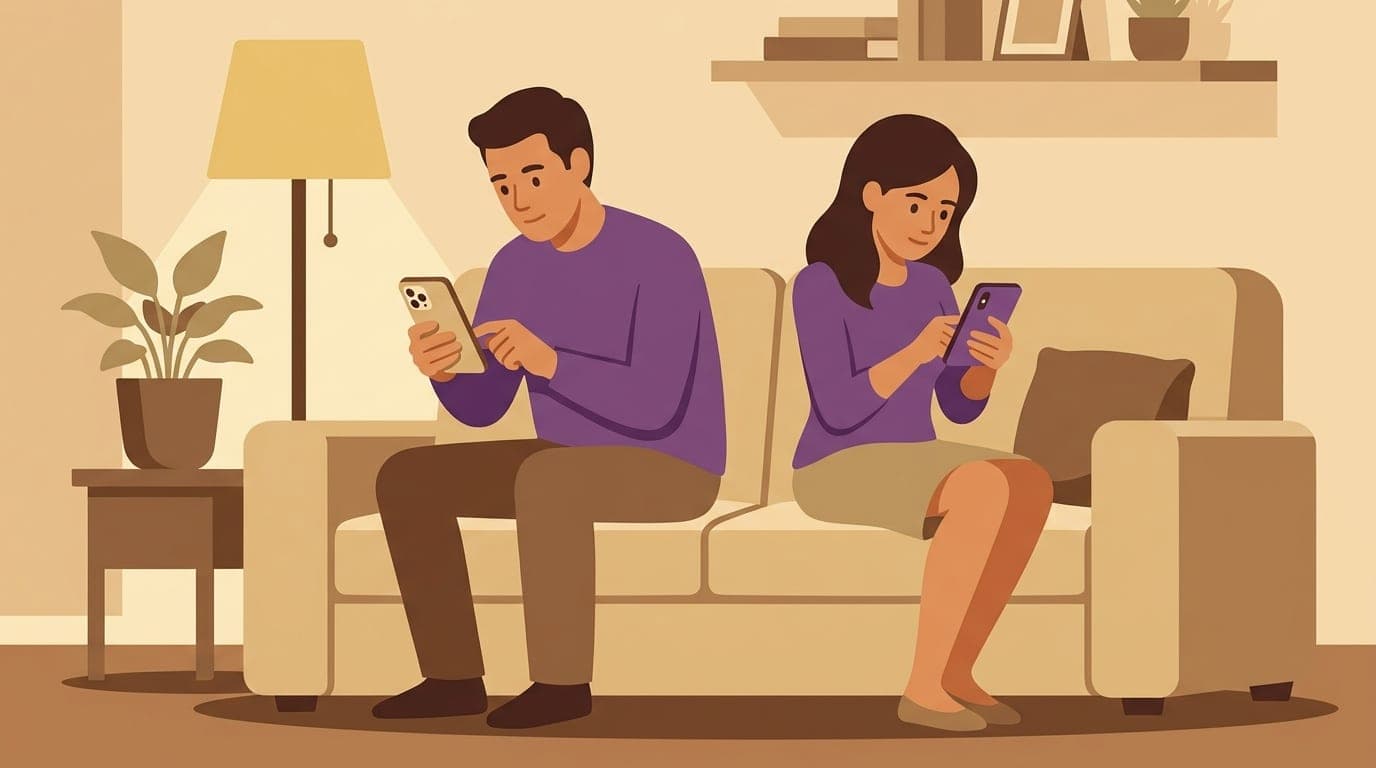
Key Takeaways
Texting is great for logistics and terrible for anything emotional. Research shows couples who use texting to manage conflict report lower satisfaction, and the negativity bias in reading tone means your partner is probably reading your neutral text as hostile.
You've had this fight. The one that started over text.
Someone sent a message that was meant to be straightforward. The other person read it as cold, dismissive, or passive-aggressive. A clarification text made things worse. Three screens of rapid-fire messages later, you're in a full argument that wouldn't have happened if you'd been in the same room.
This isn't a failure of your relationship. It's a failure of the medium. Texting is an extraordinarily efficient tool for sharing information and a remarkably bad one for sharing feelings. The problem isn't that couples text too much. It's that they text about the wrong things, in the wrong moments, and don't realize how fundamentally the medium distorts the message.
What happens when you remove nonverbal cues?
Albert Mehrabian's research at UCLA in the late 1960s produced one of the most cited (and most misused) statistics in communication: the "7-38-55 rule." The claim, as it's popularly stated, is that communication is 7% words, 38% tone of voice, and 55% body language.
That's a misrepresentation of what Mehrabian actually found. His studies were specifically about communicating feelings and attitudes, not all communication. If someone asks "What time does the movie start?" the words carry 100% of the meaning. Mehrabian himself has repeatedly said his findings are misapplied.
But the core insight is real and relevant: when the message is emotional (expressing affection, frustration, disappointment, excitement, hurt) the words are the smallest part of how the message is received. Tone of voice, facial expression, body posture, eye contact, and proximity all carry information that the receiver processes automatically, often without conscious awareness.
Texting strips all of that away. You're left with words alone, and words alone are ambiguous. "Fine" can mean "I'm good," "I'm not good but don't want to talk about it," "I'm angry at you," or "I genuinely don't have a strong opinion." In person, you'd know which one it is instantly. Over text, you're guessing.
And when you guess, you tend to guess wrong, in a specific direction.
Why does "K" feel hostile?
There's a well-documented phenomenon in psychology called the negativity bias: humans pay more attention to, and are more affected by, negative stimuli than positive or neutral ones. This bias evolved for good reasons (noticing threats was more survival-relevant than noticing pleasant scenery) but it has awkward consequences in the digital age.
When we read a text message, the negativity bias fills in the missing context. A message with ambiguous tone is more likely to be read as negative than positive. Researchers Justin Kruger at New York University and colleagues demonstrated this in a 2005 study published in the Journal of Personality and Social Psychology. Participants who sent emails expected their intended tone (sarcastic, serious, funny) to be obvious. Receivers correctly identified the tone only about 56% of the time, barely better than chance.
The senders were confident their tone was clear. The receivers were confident in their interpretation. Both were wrong roughly half the time. And when the interpretation was wrong, it skewed negative.
This is why "K" feels hostile, "Sure" reads as passive-aggressive, and "We need to talk" triggers a panic response even though the person who sent it might genuinely just need to discuss what to have for dinner. The absence of tone invites the reader's worst-case interpretation.
In relationships, where emotional stakes are high and insecurities are close to the surface, the negativity bias in text interpretation is especially damaging. You're not reading your partner's message as if a neutral stranger sent it. You're reading it through the lens of your attachment patterns, your recent interactions, and whatever you're feeling right now. If you're already stressed or insecure, a perfectly neutral text can trigger a disproportionate emotional response.
What did Coyne's research reveal about texting and relationships?
Sarah Coyne, a professor at Brigham Young University, has published several studies on how technology affects romantic relationships. Her 2011 study surveyed over 270 young adults about their texting habits and relationship satisfaction.
The findings were specific. Using texting for affection ("I love you" messages, "thinking of you" check-ins) was associated with higher relationship satisfaction for women (the effect was smaller for men, possibly because men in the sample texted less overall). Using texting for logistics (scheduling, planning, coordinating) had no negative effect.
But using texting to manage conflict, make decisions about the relationship, apologize for something serious, or discuss emotionally loaded topics was associated with lower relationship satisfaction for both partners.
The issue isn't that bad communicators text more. It's that the medium itself degrades the communication. When you text about conflict, you lose the repair mechanisms that exist in face-to-face interaction. In person, if you say something and see your partner wince, you can immediately soften: "That came out wrong. What I meant was..." Over text, you send the message, it lands however it lands, and by the time you realize it landed badly, three more messages have already been exchanged and the situation has escalated.
Lori Schade, also at BYU, found in a related study that higher volumes of texting were associated with lower relationship quality in women. She suggested that heavy texting might substitute for deeper, face-to-face connection, giving the illusion of communication without the substance.
When does texting actually work?
Texting isn't all bad. It has real strengths that make it valuable in relationships when used for the right purposes.
Logistics and coordination. "I'll be home by 6." "Can you grab milk?" "Running 10 min late." This is texting at its best: efficient, clear, low emotional complexity. No tone is needed because the content is purely informational.
Quick affection. A short "thinking about you" in the middle of the day, a funny photo, a link to something that reminded you of them. These small bids for connection work well over text because they don't require a response beyond acknowledgment, and the positive intent is usually clear.
Playful exchanges. Inside jokes, banter, teasing: these can work over text when both partners have a well-established dynamic and can read each other's humor reliably. The key word is "established." What works between a couple who's been together for years and knows each other's comedic rhythms might not work for a newer couple still calibrating.
Low-stakes planning. "Want to try that new place on Saturday?" "Should we invite Jake and Mia?" Planning social activities, date nights, or weekend logistics over text is efficient and fine.
When does texting make things worse?
Conflict of any kind. If you're upset with your partner, do not text about it. You will write something in the heat of the moment that you wouldn't say to their face, or you'll write something measured that they'll read as cold. Either way, you're working against yourself. If a conflict surfaces via text, the best move is: "This feels important. Can we talk about it tonight in person?"
Emotional disclosures. Sharing something vulnerable ("I've been feeling lonely," "I'm worried about my dad's health," "I think I want to change careers") deserves the full bandwidth of in-person communication. Your partner's facial reaction, their body language, the hug they might give you. All of that is part of how you receive support. Text can't deliver it.
Apologies. A real apology requires sincerity, and sincerity requires presence. "I'm sorry" in a text reads as performative at best, dismissive at worst. If you owe your partner a real apology, do it face-to-face. Look them in the eye. Let them see that you mean it.
Relationship discussions. "Where is this going?" "I think we need more quality time." "Are you happy?" These conversations require nuance, back-and-forth, and the ability to read how your partner is processing in real time. Text turns them into declarations and responses, which is a fundamentally different and less productive dynamic.
Anything requiring tone. Sarcasm, gentle teasing, playful provocation, sympathy: anything where how you say it matters as much as what you say shouldn't be in a text, unless both partners have an extremely well-calibrated text dynamic.
What should your couple texting rules look like?
I'm not against rules, but I'm against complicated ones. Here are five that cover most situations:
1. Conflict goes to in-person. The moment a text exchange starts feeling tense, one partner sends: "I want to talk about this, but not over text. Tonight?" This isn't avoidance. It's choosing the right medium for the conversation.
2. Don't read tone into short replies. Agree on this explicitly. "Sometimes I reply 'ok' because I'm in a meeting and it's the fastest confirmation, not because I'm annoyed." If you're unsure about tone, ask ("Is everything okay? Your text seemed short") rather than building a narrative in your head.
3. Voice note for anything emotional. If you need to share something that has emotional weight and you can't be in person, a voice note preserves tone and is far less likely to be misread. It's a middle ground between text and face-to-face.
4. Don't use texting to avoid hard conversations. It's tempting. Texting gives you a buffer: you can compose your thoughts, avoid the other person's reaction, maintain control. But that buffer comes at a cost. The conversation you're avoiding doesn't go away, and having it over text almost always makes it worse. We've written about having hard conversations without fighting if you need a framework for the face-to-face version.
5. Put the phone down during in-person time. This seems obvious, but research on "phubbing" (phone snubbing, i.e. ignoring your partner in favor of your phone) shows that it's associated with lower relationship satisfaction and greater conflict. James Roberts at Baylor University found that partner phubbing predicted greater conflict, lower satisfaction, and higher depression scores. Your phone is a relationship competitor, and it's winning more often than you think.
Is the phone call making a comeback?
There's some evidence that younger adults are starting to rediscover voice calls, not because they're retro, but because they've experienced enough text-based miscommunication to recognize its limits.
A 2021 study by Amit Kumar and Nicholas Epley, published in the Journal of Experimental Psychology: General, found that people consistently overestimate how awkward phone calls will be and underestimate how connected they'll feel afterward. Participants who were randomly assigned to call a friend (instead of emailing) reported feeling closer and more bonded, even though they'd predicted the call would be uncomfortable.
In relationships, a 5-minute call during the day can replace 20 back-and-forth texts and leave both people feeling more connected. You hear your partner's voice. You catch the laugh in their tone, the tiredness, the excitement. All the information that text strips away comes rushing back.
You don't have to abandon texting. But the next time you find yourself typing a paragraph-long text about something that matters, consider whether it would land better as a call. Or even better, wait until you're home.
If you're looking for ways to make your in-person communication more meaningful once you put the phone down, or if you want to break the "how was your day" loop with better questions, Aperi gives couples a daily question designed for the kind of face-to-face conversation that texting can't replicate.
FAQ
Is it okay to argue over text if we're long-distance?
Long-distance couples don't have the luxury of always waiting for in-person time. The next best thing is video calls, which preserve facial expressions and some body language. If you must discuss something tense over text, agree on ground rules: no sending multiple messages before the other person responds, assume good intent, and use "I feel" language rather than accusations. But prioritize video for anything emotional. The small delay in connection quality is worth the massive gain in communication quality.
My partner and I text constantly throughout the day. Is that a problem?
Not inherently. The question is what you're texting about and whether it's substituting for real connection. If you text all day but feel disconnected when you're actually together, that's a signal. Schade's BYU research suggested that high-volume texting can create an illusion of intimacy without the substance. A useful experiment: try texting less for a week and see if your in-person conversations get richer. If they do, you were probably using texting as a substitute.
How do I tell my partner their texting style bothers me without sounding controlling?
Frame it as your experience, not their fault. "When I get a one-word reply to something I thought was important, I feel dismissed, even though I know that's probably not what you mean. Can we talk about how we use texting?" You're expressing a need, not controlling their behavior. You might discover that they genuinely don't realize how their texts come across, or that they have a different set of texting norms that you haven't discussed.
Are emojis actually helpful for conveying tone?
They can be. Research by Monica Riordan at Chatham University found that emojis function as nonverbal cues in digital communication, reducing ambiguity in tone interpretation. A smiley face after "Sounds good" changes the reading from potentially passive-aggressive to genuinely positive. But they're an imperfect substitute. They can't convey the complexity of facial expression, and they carry different connotations for different people. If your partner thinks the thumbs-up emoji is dismissive and you think it means "all good," you have a translation problem. Talk about it.
Should I text "we need to talk" or just wait until I see my partner?
Never text "we need to talk" without context. Those four words trigger the negativity bias at maximum intensity. Your partner will spend the intervening hours imagining worst-case scenarios. If you need to flag that you want to discuss something, provide enough context to prevent catastrophizing: "I want to talk about how we're splitting holiday plans, nothing bad, just want to get on the same page." Or better yet, bring it up naturally when you're together.
Aperi: one question a day
A daily question app that adapts to you and your partner, and goes deeper the more you use it.


Free to start. Available on iPhone and Android.
Explore question packs
Related articles
Setting digital boundaries in your relationship
Phubbing, doomscrolling, and Instagram comparisons are eroding your relationship. How to set digital boundaries that actually stick.
The couple's budget: managing money without resentment
Money is the #1 predictor of divorce, ahead of sex and in-laws. How to talk about it without someone sleeping on the couch.
Supporting your partner's dreams without losing yours
Great relationships help both people become their ideal selves. Here's how to support your partner without losing yourself.
Communication in marriage: how the years change the conversation
Communication in marriage erodes through efficiency, not conflict. What the years change, which patterns predict real trouble, and what daily practice looks like.
Lack of communication in a relationship is rarely a skills problem
Lack of communication in a relationship: what the breakdown looks like in practice, what causes it (rarely skills), and the scripts that rebuild it.
50 couples therapy questions, in the order a therapist would ask them
50 couples therapy questions sequenced like a real session: history, patterns, needs, repair, future. Plus an honest look at when a list is not enough.