Key Takeaways
The healthiest relationships require two whole people, not two halves making a whole. Maintaining your identity (your interests, friendships, goals, and sense of self) is what makes sustained intimacy possible, not selfishness.
There's a moment in many relationships where you look up and realize you can't remember the last time you did something just for yourself. Not for the relationship, not for your partner, not for the life you've built together. Just for you.
Maybe it was a hobby you dropped because it didn't fit the shared schedule. A friendship that faded because all your social energy went into couple friends. A career ambition you quietly shelved because it didn't align with the life plan you built together. A part of your personality you softened or silenced because your partner didn't get it.
This happens gradually. It rarely feels like a sacrifice in the moment. It feels like love. It feels like compromise. It feels like growing up. And then one day you're 5 or 10 or 20 years in, and you feel vaguely hollow, present in the relationship but absent from yourself.
This isn't a rare experience. It might be the most common unspoken struggle in long-term relationships.
Why does closeness sometimes cost you yourself?
Murray Bowen, the psychiatrist who developed Family Systems Theory, called it differentiation: the ability to maintain your own sense of self while remaining emotionally connected to others. Bowen argued that differentiation is one of the most important psychological capacities a person can develop, and that most people operate at a lower level of it than they realize.
Low differentiation looks like this in a relationship:
- You can't disagree with your partner without feeling like the relationship is threatened
- Your mood is entirely dependent on your partner's mood
- You've abandoned interests, opinions, or friendships to avoid conflict
- You feel guilty doing things independently
- You define yourself primarily through the relationship ("I'm [partner's name]'s girlfriend/husband") rather than through your own identity
Bowen would say this is fusion, not closeness. And fusion feels like love right up until it starts feeling like suffocation.
The paradox is counterintuitive but well-supported: the more differentiated each partner is, the closer they can genuinely be. Two people with a strong sense of self can be vulnerable with each other without feeling consumed. Two people who are fused can't risk real vulnerability because any threat to the relationship is a threat to their entire identity.
What's the difference between enmeshment and intimacy?
Enmeshment and intimacy look similar from the outside. Both involve closeness, shared time, emotional investment. The difference is in the mechanism.
Intimacy means choosing to share yourself with someone from a position of wholeness. You have a self. You reveal it. Your partner has a self. They reveal theirs. The vulnerability is voluntary, and both people retain their core identity.
Enmeshment means the boundaries between self and other have dissolved. You don't share yourself because there's less "self" to share. Your identity has merged with your partner's or with the relationship itself. The closeness isn't chosen; it's compulsive. And the cost is that neither person is fully known, because neither person is fully there.
Esther Perel puts it sharply: "Love enjoys knowing everything about you. Desire needs mystery." If you've fully merged with your partner, same friends, same opinions, same daily routine, same emotional temperature at all times, there's no space left for desire, curiosity, or the kind of attraction that keeps long-term relationships alive. We've written about this dynamic in our piece on keeping curiosity alive, and the root cause is often this collapse of individual identity.
How do relationships grow you instead of shrinking you?
Arthur Aron's Self-Expansion Theory proposes that one of the primary motivations for entering relationships is to expand the self: to gain new perspectives, resources, experiences, and identities through connection with another person. When a relationship is working well, both partners grow. You pick up new interests, see the world through different eyes, develop capacities you didn't have before.
Aron's research found that couples who engage in novel, challenging activities together experience higher relationship satisfaction, not because the activity itself matters, but because the experience of expanding together reinforces the bond.
But self-expansion has a shadow side. When the relationship stops offering new growth, when it becomes routine, constricted, or defined entirely by obligation, the expansion stalls. And if one or both partners have given up their own growth sources (hobbies, friendships, career challenges) in favor of the relationship, there's nowhere left for expansion to come from.
The result is that familiar hollowness. You're not unhappy exactly. The relationship isn't bad exactly. But something vital has gone quiet. This is the starting point for what many couples experience as the roommate phase, not a collapse, but a plateau that feels like one.
Have you lost yourself? A self-check
These aren't diagnostic criteria. They're prompts for honest self-reflection.
- Can you name three interests or activities you pursue that have nothing to do with your partner?
- When was the last time you spent a full day doing exactly what you wanted, without consulting or accommodating anyone?
- Do you have at least one or two close friendships that exist independently of your relationship?
- Can you articulate personal goals that are yours alone, not shared couple goals?
- Do you hold opinions that differ from your partner's, and do you express them?
- When your partner is busy or away, do you feel energized by the freedom or anxious about the absence?
- Could you describe who you are without referencing your relationship?
If several of these gave you pause, it doesn't mean your relationship is broken. It means this is an area worth attending to, and attending to it will make the relationship better, not worse.
How do you rebuild your individual identity?
Reclaim or discover interests
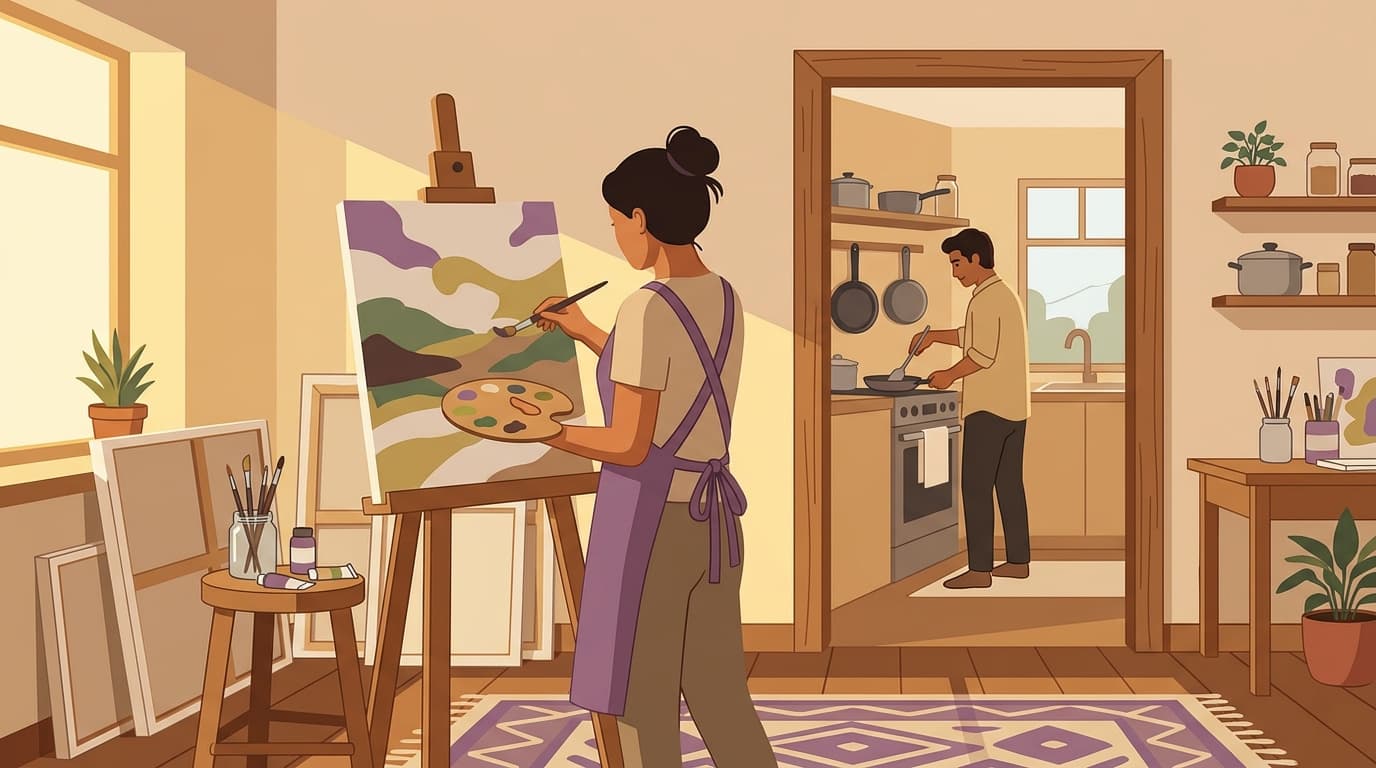
Think back to what you enjoyed before the relationship. Did you paint? Run? Read voraciously? Play in a band? Go to art shows? Some of those may no longer fit who you are, and that's fine. But some of them were abandoned for convenience, not for lack of interest.
If nothing from the past calls to you, try new things. Take a class in something you know nothing about. Join a group that has nothing to do with your partner. The point is the experience of doing something that belongs to you.
Maintain friendships outside the couple
Couple friends are great. But friendships that exist independently, your friend, not "our" friend, serve a different function. They're mirrors that reflect who you are outside the relationship. They remind you of parts of yourself that your partner doesn't see or doesn't bring out. And they provide a sounding board that isn't invested in the relationship's outcomes.
If your independent friendships have atrophied, rebuild them deliberately. It might feel awkward at first. Do it anyway.
Set personal goals
What do you want to accomplish that's yours? Not "we want to buy a house" or "we want to travel more," but what do you want? A career change? A fitness milestone? A creative project? Learning a language?
Personal goals serve two purposes: they give you a sense of forward motion that's independent of the relationship, and they make you more interesting to your partner. People who are growing individually bring new energy into the relationship. People who have stagnated individually have less to offer the partnership.
Protect some alone time
Solitude isn't loneliness. Time alone, real alone, not "partner is in the next room" alone, is essential for processing, recharging, and reconnecting with your own thoughts. If you never spend time alone, you never have the chance to miss your partner, and missing each other is part of what maintains desire.
This doesn't require elaborate arrangements. A morning walk alone. An evening at a coffee shop with a book. A weekend afternoon in a different room, doing your own thing. Small doses of solitude, consistently practiced.
How do you talk to your partner about needing space?
This is where most people get stuck. Saying "I need space" in a relationship feels dangerous. It sounds like the precursor to a breakup. It sounds like rejection. It sounds like "I don't want to be around you."
None of that has to be true. But your partner might hear it that way if you don't frame it carefully.
What not to say:
- "I need space from you." (Sounds like you're the problem.)
- "I feel suffocated." (Dramatic and alarming.)
- "I need to find myself." (Cliche and vague.)
What to try instead:
- "I've realized I've let some parts of myself go, and I want to bring them back. That'll mean I'm doing some things on my own, and it's because I want to show up better in our relationship, not because I'm pulling away."
- "I want to start [hobby/activity] again. It's something that's important to me, and I think having my own thing will actually make our time together better."
- "I love our life together, and I also miss having some time that's just mine. Can we talk about how to build that in for both of us?"
The key principle: frame independence as something that serves the relationship, not as an escape from it. Because it does serve the relationship; you're just making that explicit.
For the deeper version of this conversation, especially if your partner reacts with anxiety, the emotional intimacy guide covers how to stay connected while creating healthy space.
What is the Michelangelo Effect?
Psychologist Caryl Rusbult coined this term for one of the most beautiful dynamics in healthy relationships: the Michelangelo Effect. Just as Michelangelo described sculpting as revealing the figure already inside the marble, Rusbult found that good partners "sculpt" each other toward their ideal selves.
When your partner sees the best version of you, the person you're trying to become, and treats you as if you're already there, you actually move closer to becoming that person. Rusbult's research found that partner affirmation of someone's "ideal self" predicted movement toward that ideal over time.
This only works when both partners have an ideal self. When you've lost your identity in the relationship, there's no vision for your partner to affirm. The Michelangelo Effect requires raw material: goals, aspirations, a sense of who you're becoming. Without that, even the best partner has nothing to sculpt.
The implication is that maintaining your identity isn't just good for you. It gives your partner something to support, encourage, and be excited about. It creates a positive cycle: you grow, they support your growth, their support makes you feel loved and known, which deepens the bond, which gives you the security to grow further.
Frequently Asked Questions
Is it selfish to prioritize your own interests in a relationship?
No. It's necessary. A relationship where one or both partners have abandoned their individual identity is a relationship running on borrowed time. The resentment of self-sacrifice eventually surfaces, either as passive withdrawal or active conflict. Taking care of your own growth is how you stay capable of genuine, non-depleted giving.
How much independence is too much?
There's no formula, but there's a test: does your independence enhance or undermine the connection? If your "me time" consistently comes at the expense of meaningful couple time, that's avoidance disguised as independence. If it refills your tank and you return to the relationship with more energy and presence, that's healthy differentiation.
What if my partner feels threatened by my independence?
Their anxiety is understandable but shouldn't be the final word. A partner who can't tolerate any separateness may be operating from an anxious attachment style or from enmeshment patterns learned in their family of origin. Reassure them clearly and specifically: "I'm not pulling away. I'm adding something to my life, not replacing you." If the anxiety persists, couples therapy can help both of you explore the underlying attachment dynamics.
Can you lose yourself in a relationship and get it back?
Absolutely. Identity is more like a muscle than a fixed resource. It atrophies with disuse but strengthens with exercise. The process of reclaiming yourself often brings a period of adjustment and possibly some conflict as both partners adapt to the new dynamic. That's normal. Push through it.
How do you maintain identity in the early, intense phase of a new relationship?
This is the hardest time to do it, because new relationship energy makes you want to merge. Deliberately maintain your routines, friendships, and interests even when every cell in your body wants to spend all your time with the new person. The relationship will still be there when you come back from your run, your dinner with friends, or your Saturday morning spent doing your own thing. And it'll be healthier for it.
The relationships that last and stay alive aren't the ones where two people became one. They're the ones where two people stayed two, and chose each other, daily, from the fullness of who they actually are. If you want a daily reminder to stay curious about each other (and yourselves), Aperi's questions are built for exactly that: one question a day that keeps you both known and knowing.
Aperi: one question a day
A daily question app that adapts to you and your partner, and goes deeper the more you use it.


Free to start. Available on iPhone and Android.
Explore question packs
Related articles
Building self-worth that doesn't depend on your partner
When your self-worth depends on your partner's approval, every interaction becomes high-stakes. Here's how to build an internal foundation.
When you project your insecurities onto your partner
Projection makes you fight about things that aren't real. How to catch it, understand where it comes from, and stop.
Why boredom in your relationship isn't always bad
Relationship boredom gets a bad reputation. Sometimes it signals safety. Sometimes it signals stagnation. Here is how to tell the difference.
When you and your partner speak different love languages
You show love your way, not theirs. How to close the gap when you and your partner express affection differently, beyond the quiz.
What research says about age gap relationships
Age gap relationships attract strong opinions. What does the data actually show about satisfaction, power dynamics, and stigma?
Grieving together without growing apart
Partners often grieve differently and asynchronously. How to support each other through loss without losing your connection.