Key Takeaways
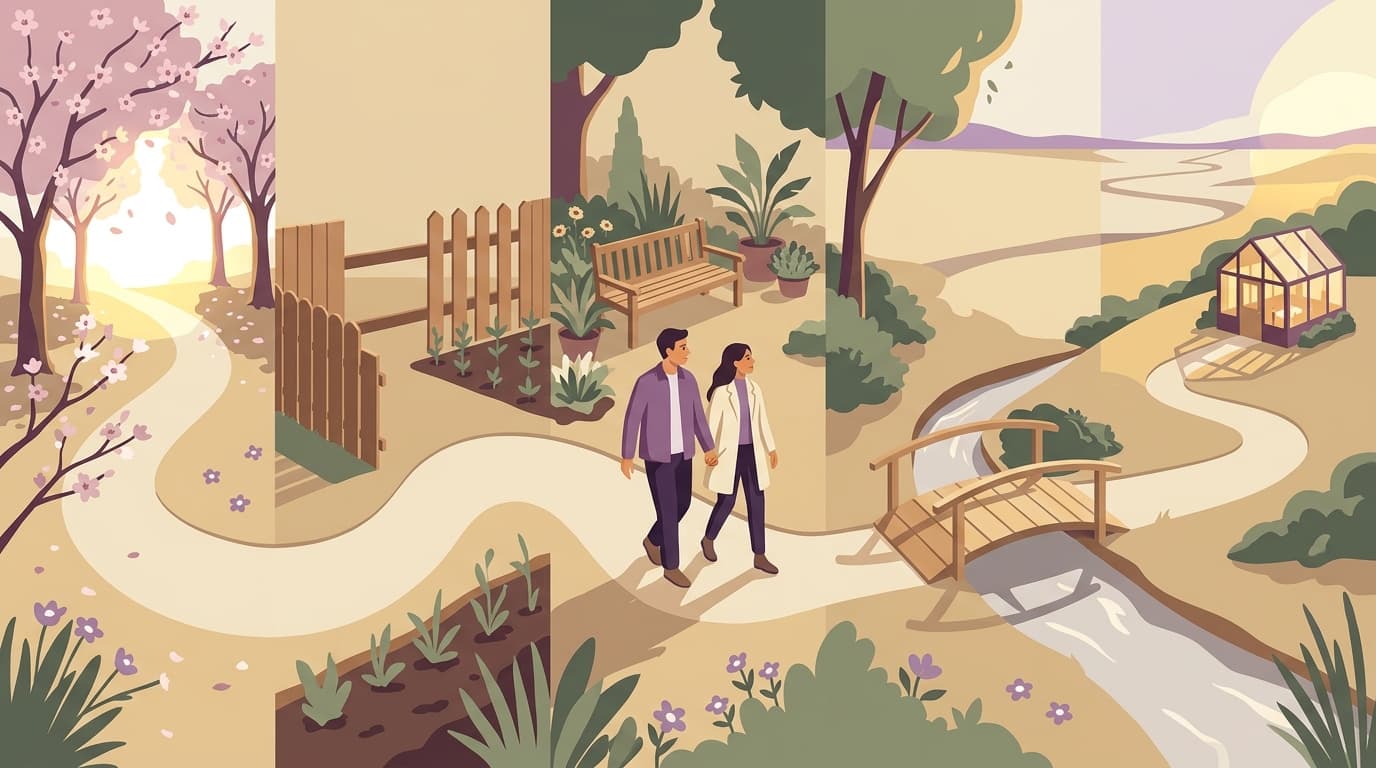
Relationships move through five stages (infatuation, building, stability, commitment, and co-creation), each with different neurochemistry and different needs. Understanding where you are tells you what your relationship needs right now, not what worked six months ago.
Every couple who's been together for more than two years knows the feeling: the relationship you're in now is not the relationship you signed up for. The person hasn't changed (much). You haven't changed (much). But the thing between you, the dynamic, the energy, the way you relate to each other, is fundamentally different from what it was at the start.
This isn't a problem. It's a pattern. Researchers have been studying relationship stages for decades, and the data shows that romantic partnerships move through predictable phases, each with its own neurochemistry, challenges, and requirements. The trouble is that most couples don't know this. They interpret a natural stage transition as something going wrong ("we lost the spark," "we've grown apart," "I fell out of love") when what actually happened is that the relationship evolved and they didn't update their approach.
Understanding the stages won't prevent the hard parts. But it will prevent you from mistaking a stage transition for a death sentence.
What does the research say about relationship stages?
Two theoretical frameworks do the heavy lifting here. Mark Knapp's Relational Development Model, developed in the 1970s and refined over decades, describes relationships as moving through stages of "coming together" and "coming apart." Robert Sternberg's Triangular Theory of Love describes how three components (intimacy, passion, and commitment) wax and wane over time, creating qualitatively different experiences of love at different points.
Neither model is perfect. Relationships are messy and don't always follow a clean progression. But both models, supported by longitudinal research, identify patterns that are consistent enough to be useful. What follows synthesizes both frameworks, plus contemporary research on relationship neuroscience, into five stages that map onto what most couples actually experience.
Stage 1: Infatuation
This is the stage everyone remembers. It's also the stage that is, neurologically speaking, the least rational.
Anthropologist Helen Fisher scanned the brains of people in early-stage love and found activation patterns strikingly similar to those seen in addiction. The ventral tegmental area floods the brain with dopamine. Norepinephrine spikes, creating the racing heart and obsessive thinking. Serotonin drops to levels comparable to those observed in people with obsessive-compulsive disorder, which explains why you can't stop thinking about the other person.
Dorothy Tennov coined the term "limerence" in 1979 to describe this state: the involuntary, obsessive fixation on another person accompanied by acute longing for reciprocation. Limerence typically lasts between 18 months and three years, though it can be shorter. It's not a choice. It's a neurochemical event.
During this stage, the brain is essentially running a propaganda campaign for the relationship. Flaws get minimized. Compatibility gets exaggerated. The other person seems endlessly fascinating because your brain is literally drugging you into fascination.
What this stage needs: Enjoy it, but don't make permanent decisions based on it. The worst time to decide whether someone is your life partner is when your brain's reward circuitry is hijacked. This stage needs time more than anything else: time to let the initial neurochemical surge subside so you can see the actual person underneath your projections.
The questions that matter here are basic but important: Do you share core values? Can you disagree without it feeling catastrophic? Do you like who you are around this person? A getting-to-know-you question pack helps because it creates structured opportunities for real discovery rather than relying on the brain's dopamine-filtered version.
Stage 2: Building
The dopamine haze starts to thin. You see each other more clearly: the irritating habits, the incompatibilities, the ways you handle stress differently. This is where many relationships end, because people interpret the loss of limerence as the loss of love. It's not. It's the beginning of love. Limerence was the appetizer.
Sternberg's model describes this stage as the transition from passion-dominant love to intimacy-dominant love. The obsessive thinking fades and is replaced (in healthy relationships) by a growing sense of genuine knowing. This is when you start building what Gottman calls Love Maps: a detailed, accurate picture of your partner's inner world.
The neurochemistry shifts too. Oxytocin and vasopressin, bonding hormones associated with attachment rather than attraction, become more prominent. The relationship feels less like a rollercoaster and more like a foundation being laid. Less exciting, but far more durable.
What this stage needs: Intentional curiosity. The discovery that happened automatically during infatuation now requires effort. You have to choose to keep learning about your partner rather than assuming you already know them. This is the stage where couples either develop the habit of asking real questions or slide into comfortable assumption.
It also needs honest conversation about differences. During infatuation, differences were cute or invisible. Now they're real. The question isn't whether you have differences (every couple does) but whether you can discuss them without it becoming an attack. Learning how to communicate effectively becomes directly relevant here.
Stage 3: Stability
You've built the foundation. The relationship is comfortable, predictable, secure. You know each other's rhythms. You've developed routines. The relationship works.
And this is exactly where it gets dangerous.
Stability is a prerequisite for long-term partnership, but it comes with a built-in trap: hedonic adaptation. The brain stops responding to familiar stimuli. The things your partner does, the care, the consistency, the daily acts of love, become invisible. Not because they stopped doing them, but because your brain stopped registering them.
Arthur Aron's research on self-expansion is crucial here. His studies found that relationship satisfaction correlates with the degree to which each partner feels the relationship is expanding their sense of self by adding new perspectives, experiences, and growth. During infatuation and building, expansion is automatic. During stability, it requires deliberate effort.
This is the stage where the roommate rut lives. Conversations shrink to logistics. Date nights become routine rather than novel. Sex becomes predictable or infrequent. The relationship isn't bad; it's just flat. And flatness, left unaddressed, eventually becomes dissatisfaction.
What this stage needs: Novelty and challenge, deliberately introduced. Aron's research found that couples who regularly engaged in new, challenging activities together maintained higher satisfaction than those who stuck with familiar pleasant activities. The newness doesn't have to be dramatic: a new restaurant, a different walking route, a question you've never asked before. What matters is that it breaks the pattern enough to re-engage the brain's reward system.
This stage also needs gratitude. Active, specific, expressed gratitude that counteracts the hedonic adaptation trying to make your partner's efforts invisible. Research on gratitude in relationships shows that it's not a nice extra. It's a maintenance mechanism.
And it needs depth. Many couples stall at Stage 3 because they've stopped going deeper emotionally. The surface is comfortable, so they stay there. But comfort without depth breeds restlessness. The questions at this stage should push below logistics: What are you afraid of right now? What do you wish we talked about more? What's something you've wanted to tell me but haven't? The Deep End pack is designed for exactly this moment.
Stage 4: Commitment
Commitment is the least romantic stage and the most important one. It's the stage where you choose to stay, not because of chemistry, not because everything is easy, but because you've decided that this relationship and this person are worth the effort.
Sternberg's model places commitment as a conscious decision that may or may not accompany passion and intimacy. You can have commitment without passion (a companionate marriage). You can have passion without commitment (an affair). The fullest form of love, what Sternberg calls "consummate love," requires all three.
What makes commitment different from the earlier stages is that it's tested. Life throws things at couples: financial stress, health crises, career upheaval, family conflict, the grinding exhaustion of parenting. During these times, the question isn't "Do I feel in love?" but "Am I choosing this?"
Gottman's research on what he calls "positive sentiment override" is relevant here. In relationships with high overall positivity (the 5:1 ratio), couples give each other the benefit of the doubt during hard times. A forgotten anniversary is interpreted as stress, not indifference. In relationships with low positivity, the same event is interpreted as evidence of not caring. Commitment without a positive emotional foundation becomes grim endurance rather than chosen partnership.
What this stage needs: Explicit recommitment. Not just "I'm still here," but "I'm choosing to be here, and here's why." Some couples find that regular conversations about what they value in the relationship, not just what needs fixing but what's working, sustain the sense of chosen investment. The questions to ask before marriage are relevant not just before the wedding but periodically throughout the relationship as a recommitment practice.
It also needs repair skills. Every long-term relationship accumulates hurts. The couples who survive Stage 4 aren't the ones who never hurt each other. They're the ones who know how to acknowledge it, take responsibility, and rebuild. Repair is the skill that turns ruptures into deeper trust rather than accumulated resentment.
Stage 5: Co-creation
This is the stage that most relationship advice ignores, because most relationship advice is focused on fixing problems rather than building something. Co-creation is what happens when two people have a stable, committed, intimate partnership and start directing their collective energy outward, building something bigger than the relationship itself.
It might be raising children with shared values. Starting a project or business together. Contributing to a community. Creating art. Traveling with shared purpose rather than escapism. Building a family culture with its own traditions, language, and meaning.
Gottman's Sound Relationship House theory places "Create Shared Meaning" at the very top of the structure. It's the culmination, the stage where the relationship becomes not just a source of personal fulfillment but a source of purpose. Couples in this stage often report the highest satisfaction, because the relationship is no longer just about each other. It's about what they're creating together in the world.
Erik Erikson's developmental framework supports this trajectory. His concept of "generativity," the concern with establishing and guiding the next generation, typically emerges in midlife and aligns with the co-creation stage. Couples who find shared generative outlets report greater satisfaction both individually and relationally.
What this stage needs: Shared vision. Regular conversations about where you're headed together, what you want to build, and what your life together means. These conversations don't happen naturally. They require intention, which is why keeping curiosity alive matters even more the longer you're together.
It also needs continued emotional intimacy. The trap of co-creation is becoming so focused on the external project (kids, business, cause) that the internal connection atrophies. The relationship still needs its own oxygen supply: regular attention to each other's inner worlds, continued vulnerability, sustained curiosity. The shared meaning is built on top of emotional closeness, not instead of it.
Why the stages aren't linear
All stage models are both useful and incomplete, because real relationships don't move through these stages in a clean forward progression. You cycle. You regress. You revisit.
A couple in Stage 5 who goes through a major life disruption (a move, a loss, a betrayal) may find themselves back in Stage 2, rebuilding. A couple in Stage 4 may experience a renewed burst of limerence after a period of reconnection. A couple in Stage 3 may skip back to Stage 1 energy after a vacation that breaks the routine.
This cycling is normal and even healthy. The problem isn't revisiting earlier stages. It's not recognizing which stage you're in and what it needs. Trying to reignite Stage 1 passion through sheer willpower won't work because that's not how neurochemistry operates. Trying to force Stage 5 co-creation before Stage 4 commitment is built leads to fragile projects on weak foundations.
The practical takeaway: periodically assess where you are. Not where you want to be, not where you think you should be, but where you actually are. Then give the relationship what that stage needs.
What questions should you ask at each stage?
Each stage responds to different types of questions. The emotional intimacy guide covers depth levels in detail, but here's the stage-specific version:
Infatuation: Factual discovery. "What's your family like?" "What do you care about?" "What's a deal-breaker for you?" These questions feel less exciting than the limerence-fueled intensity, but they give you actual data about compatibility.
Building: Preference and values exploration. "How do you handle conflict?" "What does a good relationship look like to you?" "What are you most proud of?" These questions deepen the Love Map beyond surface facts.
Stability: Pattern-breaking depth. "What's something you've been thinking about but haven't brought up?" "When do you feel most connected to me?" "What do you wish was different about our daily routine?" These questions interrupt the autopilot.
Commitment: Existential and future-oriented. "What keeps you here?" "What do we do well together?" "Where do you see us in ten years, honestly?" These questions reinforce chosen investment.
Co-creation: Legacy and meaning. "What are we building together?" "What do we want our family culture to be?" "What do we want people to say about us?" These questions direct shared energy outward.
Aperi's daily question practice is designed to cycle through these types over time, adapting to where your relationship is rather than assuming every couple needs the same thing. Some days the question is light. Some days it goes deep. The progression matches the research on how emotional closeness actually develops: not in a straight line, but in a gradual spiral, returning to familiar territory at deeper levels. The Rekindling pack is specifically designed for couples in Stage 3 or 4 who want to reintroduce the intentional curiosity that earlier stages provided for free.
Frequently asked questions
How long does each relationship stage last?
It varies widely. Infatuation typically lasts 18 months to 3 years (Fisher's research). Building can last one to three years. Stability, commitment, and co-creation don't have fixed durations; couples can spend years in any of them, and the boundaries between stages are fuzzy. What matters isn't the duration, but whether you're giving the current stage what it needs rather than what a previous stage needed.
Can a relationship skip stages?
Not really, at least not healthily. Couples who try to jump from infatuation to commitment (getting engaged after three months) skip the building phase where real compatibility is tested. Couples who try to reach co-creation without solid commitment build on sand. Each stage creates the foundation for the next. Skipping stages doesn't save time. It creates gaps that surface later.
What if partners are in different stages?
This is common and doesn't mean the relationship is doomed. One partner may still be in building mode while the other feels solidly in stability. The key is communication about where each person is and what they need. Problems arise when the gap is large and unacknowledged. For example, one person is in commitment while the other is still figuring out building. That gap needs direct conversation, not assumption.
Is the "roommate rut" in Stage 3 inevitable?
It's not inevitable, but it's extremely common. Hedonic adaptation is a biological process, not a choice, so the pull toward flatness is real. What's not inevitable is staying there. Couples who intentionally introduce novelty, maintain emotional depth, and practice active gratitude can move through Stage 3 stability without falling into the rut. The couples who get stuck are usually the ones who assume that if the relationship is "fine," no effort is needed.
How do you know if you're in the wrong stage for your relationship length?
There's no strict timeline, but red flags include feeling like you're still discovering basic things about your partner after years together (stuck in building), feeling flat and disconnected despite having been together a relatively short time (premature stability), or finding that all your relationship energy goes into external projects while your emotional connection withers (co-creation without maintenance). The stage should roughly match the depth and duration of the relationship, though exceptions exist.
Aperi: one question a day
A daily question app that adapts to you and your partner, and goes deeper the more you use it.


Free to start. Available on iPhone and Android.
Explore question packs
Related articles
Building self-worth that doesn't depend on your partner
When your self-worth depends on your partner's approval, every interaction becomes high-stakes. Here's how to build an internal foundation.
When you project your insecurities onto your partner
Projection makes you fight about things that aren't real. How to catch it, understand where it comes from, and stop.
Why boredom in your relationship isn't always bad
Relationship boredom gets a bad reputation. Sometimes it signals safety. Sometimes it signals stagnation. Here is how to tell the difference.
When you and your partner speak different love languages
You show love your way, not theirs. How to close the gap when you and your partner express affection differently, beyond the quiz.
What research says about age gap relationships
Age gap relationships attract strong opinions. What does the data actually show about satisfaction, power dynamics, and stigma?
Grieving together without growing apart
Partners often grieve differently and asynchronously. How to support each other through loss without losing your connection.