Key Takeaways
One-word answers usually signal depletion or difficulty, not disinterest. The fix isn't pushing harder. It's asking better questions, ones that are specific, memory-based, and low-pressure.
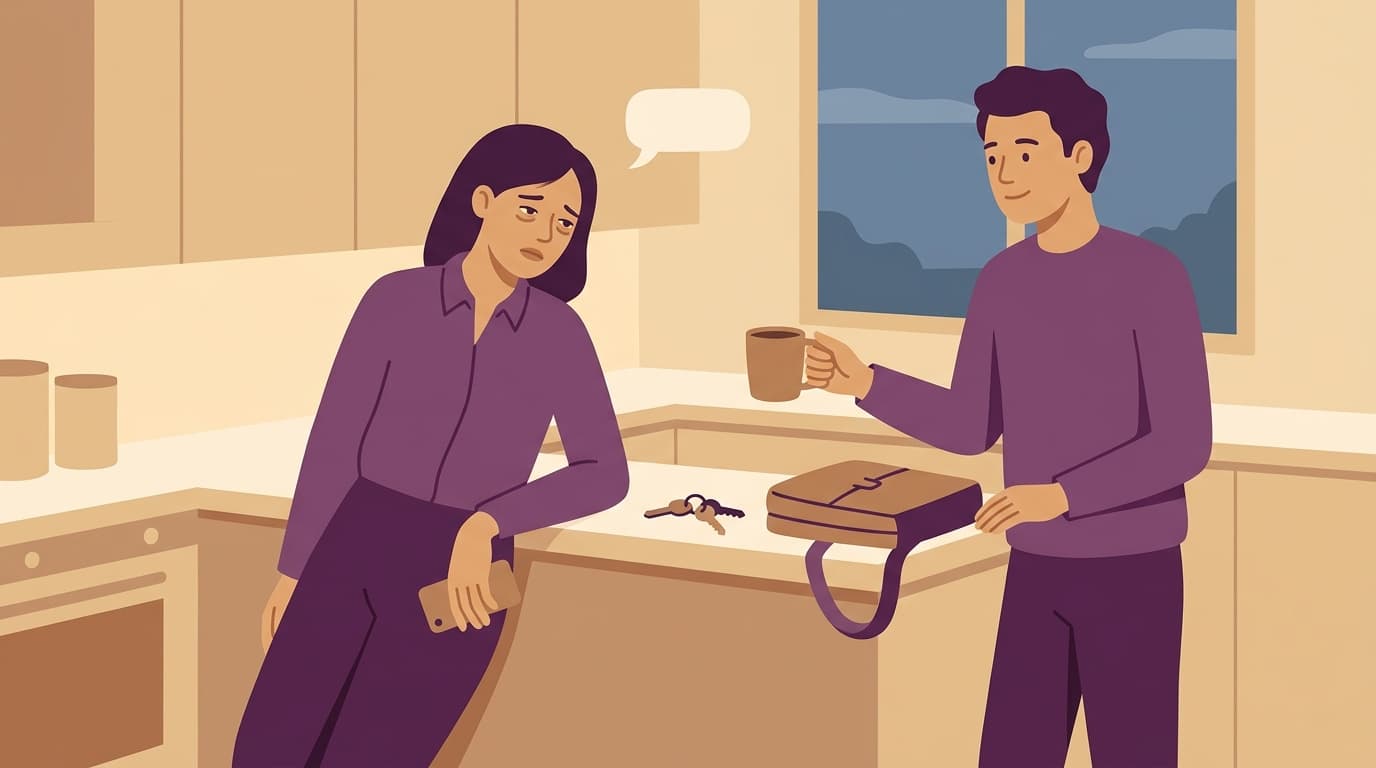
You ask "How was your day?" and get "Fine." You try "What's on your mind?" and get "Nothing." You reach for "Is everything okay?" and get "Yeah."
Three questions. Three dead ends. And now you're sitting across from someone you love, feeling like you're talking to a stranger who happens to live in your house. The worst part isn't the silence. It's the story your brain starts writing: they don't want to talk to me. They're checked out. They don't care.
That story is almost always wrong. But the frustration is real, and it builds. Night after night of monosyllabic exchanges can make you question the entire relationship. Before you do that, it helps to understand what's actually happening when your partner goes verbal-minimum.
Why people give one-word answers
There's no single explanation, and your partner might be dealing with more than one of these at the same time.
They literally can't find the words
Alexithymia is a personality trait characterized by difficulty identifying and describing emotions. It affects roughly 10% of the general population, according to research published in Comprehensive Psychiatry, and it's significantly more common in men. People with alexithymia aren't withholding. They're not being passive-aggressive. When you ask them how they feel, there's a genuine gap between their internal experience and their ability to translate it into language.
If you ask someone with alexithymia "How do you feel about that?", they're not choosing "fine" to shut you down. They're choosing it because it's the closest word they can reach in the moment. The emotional data is there, somewhere. The verbal access point isn't.
Their brain is spent
Cognitive depletion is real and measurable. A study by Baumeister and colleagues demonstrated that self-regulation, decision-making, and active communication all draw from the same limited pool of mental energy. After a day of meetings, emails, and problem-solving, your partner may have genuinely exhausted their capacity for verbal processing.
Think of it like a phone battery. They left the house at 100%. Work drained it to 8%. And now you're asking them to run a high-bandwidth app. The operating system isn't broken. It's just out of power.
Decision fatigue compounds this. Research from the National Academy of Sciences found that judges made significantly worse decisions later in the day, not because they cared less, but because the cognitive machinery was depleted. Your partner's one-word answers at 8 p.m. aren't the same person who texted you paragraphs at lunch.
The question is the problem
This is the one nobody wants to hear, but it's often the most fixable factor. "How was your day?" is a terrible question. It asks someone to compress 8-12 hours of experience into a single evaluative summary. Most people can't do that on the spot, so they default to "good" or "fine" because those words buy them an exit from an impossible task.
"What's wrong?" is even worse. It presupposes a problem, puts the other person on the defensive, and demands emotional labor in the form of diagnosis and explanation. If something is wrong and they don't have words for it yet, the question just adds pressure to a system that's already struggling.
The architecture of the question determines the quality of the answer. We'll get to the fix in a moment.
Sharing feels unsafe
Some people grew up in environments where expressing emotions led to dismissal, criticism, or punishment. Attachment researchers call this avoidant attachment, and it affects roughly 25% of the adult population. For avoidant individuals, emotional withdrawal isn't a strategy. It's a reflex that was wired in before they could talk.
When you ask an avoidant partner to share what they're feeling, their nervous system reads the request the same way it read similar requests in childhood: as a setup for disappointment. The one-word answer isn't hostile. It's protective.
This pattern is worth understanding in depth. If you suspect attachment style is playing a role, our guides on why partners won't open up and attachment styles in relationships go deeper into the mechanics and what actually helps.
They're physiologically flooded
Dr. John Gottman's research at the University of Washington found that when emotional arousal pushes heart rate above 100 beats per minute, the prefrontal cortex (responsible for language, empathy, and reasoning) starts shutting down. He calls this "diffuse physiological arousal," and it happens more quickly than most people realize.
Your partner doesn't have to be visibly upset for flooding to occur. A stressful commute, a tense interaction with a boss, or even accumulated low-grade anxiety can push someone into a state where verbal processing is genuinely compromised. The one-word answer is their brain in power-saving mode.
Gottman's data showed that 85% of stonewallers in his studies were men, not because they care less, but because they tend to reach physiological flooding faster during interpersonal exchanges and take longer to come back down.
The question architecture that gets real answers
If the question is often the problem, then better questions are often the solution. This is about removing the barriers that make answering difficult, not manipulation or tricking someone into talking.
Specific beats broad
"What was the most annoying part of your afternoon?" is answerable. "How was your day?" is not, or at least not in any meaningful way. Specificity narrows the search space. Instead of asking someone to scan their entire day for a summary judgment, you're pointing them at a particular slice and asking for a report.
The difference is like asking someone "What's in your house?" versus "What's on your kitchen counter right now?" One requires an overwhelming inventory. The other requires a glance.
Memory beats analysis
"Tell me about a moment from today that stuck with you" works better than "How do you feel about our relationship?" The first question asks someone to recall a concrete experience. The second asks them to perform real-time emotional analysis, which is exactly the kind of processing that depleted or alexithymic people struggle with.
Memory questions bypass the emotional labeling problem entirely. Your partner doesn't have to know how they feel. They just have to remember what happened.
Multiple choice beats open-ended (for depleted partners)
"Was today more frustrating or more boring?" gives someone rails to ride on. It's a recognition task, not a generation task, and recognition is cognitively cheaper. You're not asking them to produce language from scratch. You're offering two options and asking them to pick the one that fits better.
This works especially well in the first few minutes after they walk in the door. Once they've answered one low-effort question, the conversational engine often warms up on its own.
Playful beats serious when they're shut down
"What's the dumbest thing that happened today?" invites a different kind of engagement than "How are you feeling?" Humor lowers the stakes. It signals that this conversation isn't going to be heavy or demanding. For a partner who associates emotional questions with pressure, playfulness is a side door.
External beats internal
"What did your coworker say about the new policy?" is easier to answer than "How do you feel?" because it asks about the world, not about the self. External questions don't require introspection. They're reporting tasks, and most people can report even when they can't reflect.
Start external. Follow the thread inward if they give you something to work with.
15 questions that consistently get more than one word
When they're tired
-
"What was the best thing you ate today?" Food is concrete, sensory, and low-stakes. Almost everyone can answer this even when running on empty.
-
"Did anything funny happen at work?" The word "funny" primes a different neural pathway than "stressful" or "hard." It invites a lighter recall.
-
"Was today a 3 or a 7 out of 10?" Numeric scales are easy to process. And the number they pick almost always leads to "Why that number?" naturally.
-
"What's one thing you want to do this weekend?" Future-oriented questions pull attention away from the depleting day they just had. It's a small mental reset.
When they're stressed
-
"What part of this week are you most ready to be done with?" This validates that things are hard without requiring them to unpack everything. It's targeted venting.
-
"Do you want to talk about it, or do you want to just sit here?" Offering the opt-out paradoxically makes people more likely to opt in. Removing pressure creates space.
-
"What would help right now, even something small?" This turns the conversation from diagnostic ("What's wrong?") to practical ("What do you need?"). It's easier to answer because it's action-oriented.
When you want to connect emotionally
-
"What's something you've been thinking about that you haven't mentioned?" This is a gentle invitation, not a demand. The phrasing acknowledges that they have an inner world and you're curious about it, without insisting they expose it.
-
"When was the last time you felt really relaxed?" Memory-based, positive-valence, specific. This pulls up a good moment and the details around it tend to flow once the memory is accessed.
-
"Is there something I do that makes your day better? I'm genuinely asking." Direct, vulnerable on your end, and it reframes the conversation as appreciation rather than problem-solving.
-
"What's something you're looking forward to, even if it's small?" Anticipation is easier to articulate than current emotional states. A coffee order, a show, a Saturday plan. Small answers still count.
When you want to keep it light
-
"What's something you saw online today that you almost sent me?" This is a window into what caught their attention. It's easy, low-pressure, and often leads somewhere interesting.
-
"If you could cancel one obligation this week, what would it be?" Mildly cathartic. People enjoy complaining about specific things more than summarizing general dissatisfaction.
-
"What's a random memory from childhood that popped into your head recently?" Unexpected enough to break the autopilot response. Childhood memories tend to carry stories with them.
-
"Would you rather have a two-hour nap right now or a two-hour meal at your favorite restaurant?" Hypotheticals are play. They don't require real-world stakes or emotional processing, and the answer usually reveals more than you'd expect.
The depth ladder
Starting with "What's your biggest fear?" after your partner has worked a 12-hour day is like asking someone to sprint when they haven't warmed up. It's not the wrong question. It's the wrong sequence.
The depth ladder is a concept from conversational psychology: start at the surface and work your way down, one rung at a time. Each answer gives you information about where your partner is right now and how far they're willing to go.
Level 1 is factual and external. "What happened in your meeting?" No emotional labor required.
Level 2 is opinion-based. "What did you think about it?" This asks for a mild judgment, which requires slightly more engagement but still doesn't demand vulnerability.
Level 3 is emotional. "How did that make you feel?" Now you're asking for internal processing. Only go here if the previous levels got real answers.
Level 4 is relational. "Does that connect to anything between us?" This is the deep water. It requires trust, energy, and safety. It's where the most meaningful conversations happen, but you can't start here.
If you follow the app Aperi or have used structured question tools, this progression might look familiar. It mirrors the depth levels (L1 through L4) that are designed to meet people where they are rather than where you wish they were. The principle is the same whether you're using an app or navigating a Tuesday evening conversation: match the question to the person's current capacity.
Most one-word answers happen because someone jumped to Level 3 or 4 with a partner who's still at Level 1. Read the room. Start low. Follow the thread.
What to do with the one-word answer you do get
The counterintuitive part: when you get a one-word answer, the best response is often "Cool, thanks." Then move on.
Don't push. Don't sigh. Don't follow up with "That's all?" or give them a look that communicates disappointment. Every time you penalize a short answer, you make the next answer shorter. Every time you receive a short answer with warmth (or at least neutrality), you make the next answer a little longer.
BJ Fogg's behavior design research at Stanford shows that habits form through repetition of small actions, not occasional bursts of effort. The goal isn't to have one breakthrough conversation tonight. It's to make answering questions feel safe and easy, so that over weeks and months, the answers naturally expand.
Consistency matters more than depth in any single exchange. A partner who gives you one sentence every night for a month is building a habit of engagement. A partner who gives you a two-hour emotional download once and then goes silent for three weeks is not.
Think of it as an investment account, not a slot machine. You're not trying to hit the jackpot on any given pull. You're making small, regular deposits that compound.
If your partner gives you "fine" tonight, say "okay" and ask about dinner. Try a different question tomorrow. Try another one the day after. The cumulative effect of safe, low-pressure questions asked consistently is more powerful than any single perfectly worded question asked once.
When one-word answers might signal something bigger
Sometimes short answers aren't about depletion or question design. Sometimes they're a symptom of something that needs more direct attention.
If your partner used to be communicative and has gradually gone quiet over months, that's a different pattern than someone who has always been a person of few words. Gradual withdrawal can signal depression, relationship dissatisfaction, or unresolved resentment. It's worth noting the trajectory, not just the current state.
If one-word answers are accompanied by irritability, loss of interest in activities they used to enjoy, changes in sleep or appetite, or social withdrawal beyond just you, depression is worth considering. A conversation with a doctor or therapist is more appropriate than better questions.
If short answers only happen with you but they're animated and talkative with friends, coworkers, or family, that's information about the relationship specifically. It doesn't necessarily mean something is wrong, but it's worth a direct, non-accusatory conversation: "I've noticed you seem more talkative with other people than with me. I'm not saying that as a criticism. I just want to understand what's happening."
FAQ
Is my partner being dismissive or are they genuinely unable to answer?
Watch for context clues. If they give one-word answers to you but have animated conversations with others, the issue is likely relational. If they're short with everyone after work but more engaged on weekends or mornings, it's probably depletion. If they've always struggled to articulate emotions regardless of circumstances, alexithymia or avoidant attachment may be involved. The pattern matters more than any single instance.
How long should I wait before trying a different approach?
Give a new question strategy at least two to three weeks of consistent use before evaluating whether it's working. Behavioral change is slow, and your partner needs time to notice (unconsciously) that the conversational dynamic has shifted. If you try a specific question, get a short answer, and immediately switch tactics, you're not testing anything. You're just cycling through approaches too fast for any of them to land.
Should I tell my partner I'm trying to ask better questions?
It depends on your relationship's communication style. Some partners respond well to transparency: "I read that the questions we ask affect the answers we get, so I'm going to try asking different kinds of questions." Others will feel self-conscious or managed. If your partner tends toward avoidance, narrating your strategy might make them feel like a project. If they're generally open but just depleted, naming what you're doing can feel collaborative. Use your judgment.
When should we consider couples therapy?
If you've consistently adjusted your approach for several months and your partner remains monosyllabic, especially if the pattern is worsening or accompanied by other signs of disconnection, professional help is worth exploring. A therapist can identify dynamics that are hard to see from inside the relationship. Emotionally Focused Therapy (EFT) has strong evidence for helping couples stuck in pursue-withdraw patterns, with success rates around 70-75% according to Dr. Sue Johnson's research.
One-word answers are frustrating, but they're rarely the whole story. They're usually a signal about capacity, not about caring. The fix isn't louder questions or more of them. It's better questions, asked consistently, received without judgment, and allowed to do their work over time.
For more on communicating with a reserved or withdrawn partner, read our guides on helping a partner open up, breaking the roommate rut, understanding stonewalling, and conversation starters for date night.
Aperi: one question a day
A daily question app that adapts to you and your partner, and goes deeper the more you use it.


Free to start. Available on iPhone and Android.
Explore question packs
Related articles
When you and your partner speak different love languages
You show love your way, not theirs. How to close the gap when you and your partner express affection differently, beyond the quiz.

The Zeigarnik effect: why unfinished conversations haunt your relationship
Why unresolved conflicts keep looping in your head, and how to close the open loops that create resentment.

ADHD and relationships: what both partners need to know
ADHD doesn't just affect focus. It reshapes relationship dynamics in ways both partners need to understand to stop the blame cycle.
The mental health conversation every couple needs to have
Why mental health is a relationship topic, how to bring it up, and how to build a mental health plan as a couple.

Active listening: the most underrated relationship skill
What active listening really means, why most people get it wrong, and specific techniques backed by decades of research.

Rebuilding trust after it's been broken
Trust isn't rebuilt by promises. It's rebuilt by changed behavior over time. Here's what the research says about the process.