Key Takeaways
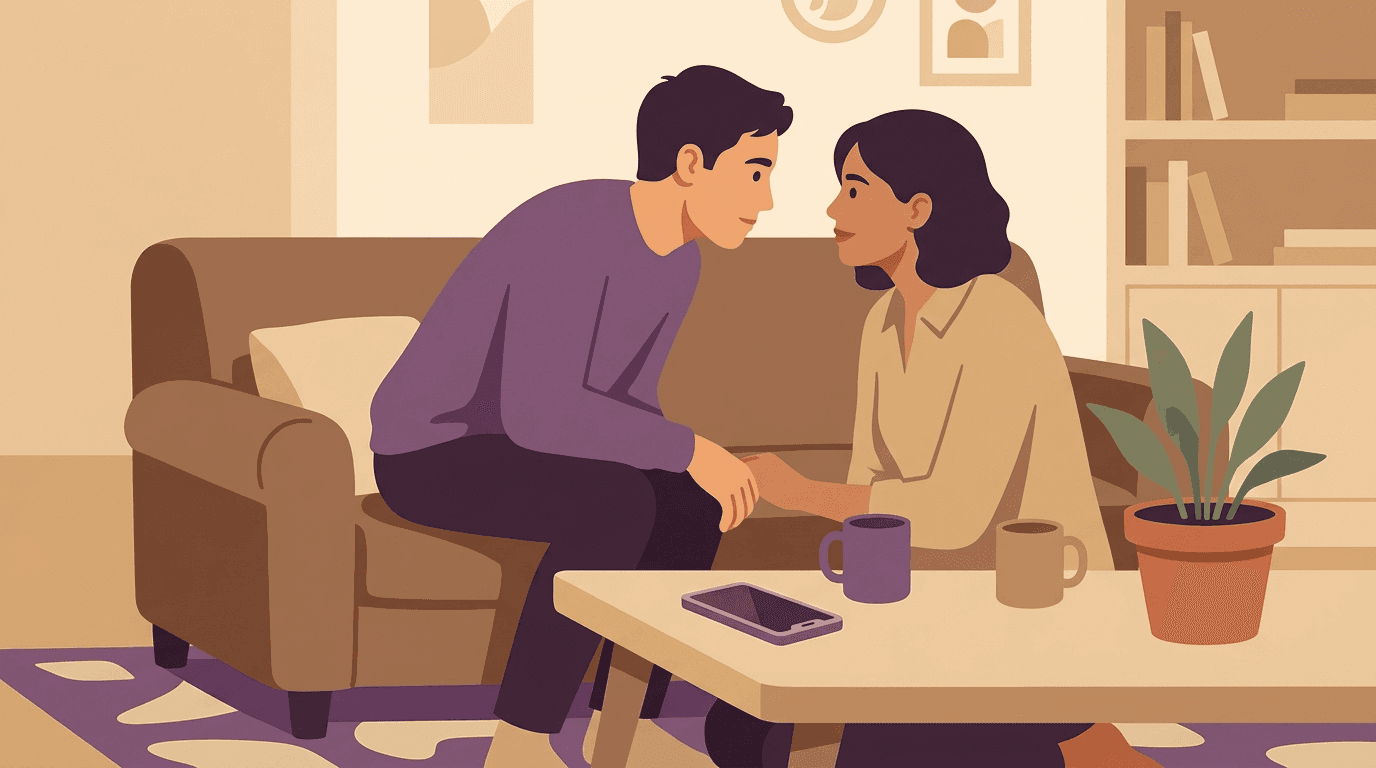
Active listening isn't repeating back what someone said. It's a full reorientation of attention that changes how your partner's brain processes the interaction, and it's the single strongest predictor of whether people feel understood in relationships.
Most people think they're good listeners. They're wrong. Research consistently shows that the average person retains about 25% of what they hear in conversation, according to work by Ralph Nichols at the University of Minnesota, one of the earliest academics to study listening as a distinct skill. That was in the 1950s, and if anything, the number has gotten worse since smartphones entered the picture.
In relationships, poor listening is the complaint behind the complaint. When your partner says "you don't care," what they usually mean is "you don't listen." When they say "we never talk," they often mean "you hear my words but miss what I'm saying." The gap between hearing and understanding is where most relationship friction lives.
Active listening, the real thing, not the corporate training version, is the most reliable way to close that gap. It's also harder than it sounds, because it requires you to do something your brain actively resists: stop thinking about yourself while someone else is talking.
What did Carl Rogers actually mean by active listening?
The term "active listening" traces back to Carl Rogers, the psychologist who developed client-centered therapy in the 1940s and 1950s. Rogers didn't use that exact phrase in his early writing; it was coined by his colleagues Richard Farson and Carl Rogers in a 1957 paper for the University of Chicago Industrial Relations Center. But the concept was built on Rogers' therapeutic framework, particularly his idea of "unconditional positive regard."
Rogers argued that real listening requires three conditions: empathy (genuinely trying to understand the other person's experience), congruence (being authentic rather than performing interest), and unconditional positive regard (accepting what the person says without judgment, even when you disagree).
This is wildly different from what most people mean when they say "active listening." The popular version has been diluted into a technique: make eye contact, nod, repeat back what you heard. Those behaviors can be part of it, but they're the surface. You can do all three while mentally composing your grocery list. Rogers' version demands something deeper: a temporary surrender of your own perspective in order to genuinely inhabit someone else's.
That distinction matters in relationships more than anywhere else. Your partner can tell the difference between performed listening and real listening. They can feel it. And that difference determines whether a conversation brings you closer together or leaves someone feeling more alone than before.
Why does feeling heard change your brain?
The reason active listening matters so much isn't just psychological. It's physiological. Naomi Eisenberger at UCLA has spent over a decade studying how social experiences register in the brain. Her research using fMRI imaging found that social rejection and physical pain activate overlapping neural regions, particularly the dorsal anterior cingulate cortex and the anterior insula.
The flip side is equally powerful. When people feel understood and validated by someone they care about, stress responses measurably decrease. James Coan's research at the University of Virginia demonstrated this directly: in his hand-holding experiments, participants who held the hand of a trusted partner while anticipating a mild electric shock showed significantly reduced threat-related brain activity. The presence of a connected partner literally dampened the brain's alarm system.
Feeling heard is a form of social connection that operates on the same circuitry. When your partner listens, really listens, your nervous system registers safety. Cortisol drops. Heart rate stabilizes. The defensive posture that makes honest conversation so difficult starts to relax.
This is why Gottman's "turning toward" research is so striking. In his longitudinal studies at the University of Washington, Gottman found that couples who stayed happily married responded to each other's bids for connection 86% of the time. Couples who divorced responded only 33% of the time. A "bid" can be anything: a comment about the weather, a sigh, a question about dinner. Turning toward means acknowledging it. Turning away means ignoring it or brushing it off.
Active listening is turning toward, concentrated. It's a sustained bid-response loop where your partner feels continuously tracked and valued. The compound effect of that, day after day, is what Gottman calls a "positive sentiment override," a baseline assumption that your partner is on your side, which makes everything else in the relationship easier.
What's the difference between hearing and understanding?
Hearing is automatic. If your auditory system works, you hear. Understanding requires effort. It means processing not just the words but the meaning, the emotion, and the context behind them.
A simple test. Your partner says: "I had a terrible day at work." If you hear that, you might respond with "That sucks" or "What happened?" Both are fine. But if you understand it, if you notice their tone, their body language, the fact that they've been stressed about this project for two weeks, you might say: "Is this the thing with your manager that's been weighing on you?"
The second response demonstrates that you're holding a model of your partner's inner world. Gottman calls this a "love map," your mental representation of your partner's worries, hopes, stresses, and joys. Couples with detailed, up-to-date love maps handle conflict better, recover from setbacks faster, and report higher satisfaction.
Keeping that map current requires listening at a level that goes beyond the literal content of what's being said. It means tracking themes across conversations, noticing what your partner doesn't say as much as what they do, and updating your understanding as they change over time. People change. If you're still listening based on who your partner was three years ago, you're hearing a person who doesn't exist anymore.
How do you actually practice reflective listening?
Reflective listening is the technique most directly associated with Rogers' approach. It has three levels, each building on the last.
Level 1: Parroting. You repeat the last few words your partner said. "I just feel overwhelmed with everything." "Overwhelmed with everything." The least effective form, but it signals you're tracking the words.
Level 2: Paraphrasing. You rephrase in your own words. "It sounds like you've got too much on your plate and it's getting to you." Better, because it demonstrates you processed meaning, not just sounds. It also gives your partner a chance to correct you: "No, it's not the amount. It's that nothing feels meaningful."
Level 3: Reflecting feeling. You name the emotion beneath the content. "You seem exhausted and maybe a little defeated, like you've been pushing through and running out of steam." This is where real connection happens. When you accurately name an emotion your partner hasn't explicitly stated, it creates a powerful sense of being seen.
Getting it wrong can feel worse than not trying. If your partner is angry and you say "you seem sad," it feels dismissive. If you're unsure, frame it as a question: "Are you frustrated, or is it more like you're disappointed?"
Howard Markman and Scott Stanley formalized a version of this in the PREP program at the University of Denver. Their "speaker-listener technique" adds structure: one person speaks, the other paraphrases, the speaker confirms or corrects, and only then do they switch. It feels mechanical at first, but research in the Journal of Family Psychology showed that couples who practiced it during conflict had better outcomes.
What mistakes do most people make when they try to listen?
Four patterns kill listening in relationships. Most people default to at least one of them without realizing it.
Fixing. Your partner describes a problem and you immediately offer solutions. This is especially common when one partner is more action-oriented. The intention is good; you want to help. But the effect is often the opposite. When someone is sharing an emotional experience and you jump to solutions, the implicit message is: "Your feelings are a problem to be solved, and I'd like to solve them so we can move on." What they usually need first is acknowledgment. The fix can come later, if they want it at all.
Deflecting. Your partner shares something vulnerable and you redirect to your own experience. "I had such a hard day." "Yeah, me too, let me tell you about mine." This isn't malicious; it feels like connecting through shared experience. But the timing matters. If you redirect before your partner feels heard, they experience it as dismissal.
One-upping. A specific form of deflecting where you match their experience with a bigger one of your own. "I barely slept last night." "You think that's bad? I haven't slept well in a week." This turns conversation into competition. Nobody wins.
Reassuring prematurely. "I'm worried I'm going to fail this exam." "Oh, you'll be fine, you always do well." Again, well-intentioned. But premature reassurance skips over the emotion. It says: "I'd rather not sit with your anxiety, so here's a reason not to feel it." Sometimes people need to feel worried, and what they need from you is company in the worry, not an escape from it.
The common thread is that all four patterns center the listener's comfort. Fixing, deflecting, one-upping, and reassuring all function to manage the listener's discomfort with the speaker's emotion. Real listening means tolerating that discomfort long enough to let your partner's experience take up space.
Can active listening actually save a struggling relationship?
On its own? Probably not. But as part of a broader shift in communication patterns, the evidence is strong. Sue Johnson, the developer of Emotionally Focused Therapy (EFT), has published extensive research showing that when couples learn to listen and respond to each other's attachment needs, their bids for closeness, reassurance, and understanding, 70-75% move from clinical distress to recovery.
The mechanism isn't complicated. Most relationship conflict is circular: Partner A feels unheard, so they escalate. Partner B feels attacked, so they withdraw. Partner A feels more unheard because of the withdrawal, so they escalate more. The cycle feeds itself. Active listening breaks the cycle by giving Partner A the experience of being heard before they need to escalate. That interruption is often enough to de-escalate the whole pattern.
For couples who want to build this skill without a therapist's office, daily practice matters more than occasional deep conversations. Even five minutes of focused listening per day, where you put your phone away, face your partner, and give them your full attention while they talk about whatever's on their mind, builds the neural pathways and relational trust that make active listening easier over time.
If you want specific communication techniques to pair with listening skills, or you're working on getting your partner to open up more, those guides go into complementary territory.
How do you practice active listening as a couple?
Here are three exercises. Start with the first one. Don't try all three at once.
The 5-minute uninterrupted share. Set a timer. One partner talks for five minutes about anything on their mind. The other listens without interrupting: no questions, no comments, no reactions beyond nodding. When the timer goes off, the listener summarizes what they heard in 2-3 sentences. Then switch. This builds the muscle of sustained attention without the escape hatch of jumping in.
The emotion check-in. Once a day, ask your partner: "What's your strongest emotion right now?" Then listen. Don't try to fix it, change it, or explain why they shouldn't feel it. Just hear it, name it back, and sit with it for a moment. This trains you to listen for emotions rather than content, which is where most of the real information lives.
The curiosity question. Ask one follow-up question per conversation that you're genuinely curious about. Not "how was your day?" but "what was the most interesting part of your day?" Follow-up questions prove you were paying attention and invite deeper sharing.
You'll get distracted. You'll catch yourself formulating a response mid-sentence. That's normal. The point is to notice those moments and come back, like meditation.
Aperi sends you and your partner a question every day that's designed to spark exactly this kind of conversation, the kind where listening matters more than having the right answer.
FAQ
How is active listening different from just being quiet while someone talks?
Silence and listening aren't the same thing. You can be completely silent while mentally checked out, planning your rebuttal, or scrolling through your phone under the table. Active listening involves genuine cognitive engagement: tracking what the person is saying, processing the emotion behind it, and checking your understanding. The external markers (eye contact, nodding, brief verbal acknowledgments) help, but they're indicators of attention, not substitutes for it. If you're quiet but not engaged, your partner will know.
What do I do when my partner says something I disagree with during a conversation?
Listen first, respond second. This doesn't mean you can't disagree; it means you demonstrate understanding before you present your perspective. "I hear that you felt dismissed when I made plans without checking with you. I can see why that would bother you. My perspective was different. I thought we'd already talked about it." The key is that the first sentence reflects their experience, not your defense. Gottman's research shows that feeling understood reduces defensiveness, which means your partner is more likely to hear your perspective if they feel heard first.
Can you be too good at active listening?
Yes, in two ways. First, if you listen so well that you never share your own experience, the relationship becomes one-directional. Listening is half the equation; expressing your own needs is the other half. Second, some people use active listening as a way to avoid vulnerability: as long as the focus is on the other person, they never have to expose themselves. Both patterns create imbalance. Healthy communication involves taking turns in both roles.
How do I get better at active listening if I have ADHD or attention difficulties?
Acknowledge it openly with your partner. Saying "I want to listen well, and my brain makes it harder. Can we do shorter check-ins more often?" is both honest and practical. Shorter, more frequent conversations (5-10 minutes) tend to work better than long, intensive ones. Reducing distractions helps: put phones in another room, turn off the TV, sit facing each other. Some people with ADHD find that having something to do with their hands (fidget object, doodling) actually helps them focus on auditory input. Experiment and find what works for your brain.
My partner never listens to me. How do I bring this up without starting a fight?
Use a soft startup. Frame it as a need, not a criticism. "I've noticed that when I'm talking about something important, I sometimes feel like I'm not getting through. I need to feel like you're really hearing me." Avoid "you never listen," which is a character accusation that will trigger defensiveness. Be specific about when it happens: "When you check your phone while I'm mid-sentence, I feel unimportant." And model what you're asking for. If you want better listening, start by listening better yourself. Behavior change in relationships is contagious.
Aperi: one question a day
A daily question app that adapts to you and your partner, and goes deeper the more you use it.


Free to start. Available on iPhone and Android.
Explore question packs
Related articles
When you and your partner speak different love languages
You show love your way, not theirs. How to close the gap when you and your partner express affection differently, beyond the quiz.
The Zeigarnik effect: why unfinished conversations haunt your relationship
Why unresolved conflicts keep looping in your head, and how to close the open loops that create resentment.

ADHD and relationships: what both partners need to know
ADHD doesn't just affect focus. It reshapes relationship dynamics in ways both partners need to understand to stop the blame cycle.
The mental health conversation every couple needs to have
Why mental health is a relationship topic, how to bring it up, and how to build a mental health plan as a couple.

Rebuilding trust after it's been broken
Trust isn't rebuilt by promises. It's rebuilt by changed behavior over time. Here's what the research says about the process.
Emotional regulation: the skill that saves relationships
Emotional regulation is the most underrated relationship skill. How it works, why suppression backfires, and what to do when you're flooded.