
Key Takeaways
Your attachment style shapes how you connect in conversation. Here are 50+ questions designed to work with your wiring, not against it.
Quick Attachment Style Refresher
Attachment theory started with babies and caregivers, but it maps onto adult romantic relationships with surprising fidelity. The work of Amir Levine and Rachel Heller in Attached, along with decades of research by John Bowlby, Mary Ainsworth, and more recently Sue Johnson, gives us three main adult attachment styles. You probably know yours already. If not, a quick self-assessment: think about what happens when your partner pulls away or goes quiet for a day. Your gut reaction tells you a lot.
Secure (roughly 50-60% of people). Comfortable with closeness and independence. When your partner needs space, you do not spiral. When they want connection, you do not flinch. Conflict feels manageable. You assume good intent. This is the baseline the other styles are moving toward.
Anxious (roughly 20%). You crave closeness and are highly attuned to shifts in your partner's mood or availability. When things feel uncertain, your nervous system sounds an alarm. You might seek reassurance frequently, read into small signals, or feel a pull to fix disconnection immediately. This is not neediness; it is a nervous system calibrated for threat detection in relationships.
Avoidant (roughly 25%). You value independence and can feel overwhelmed by too much closeness. Emotional conversations might feel like pressure. You might pull away when things get intense, not because you do not care, but because your system interprets intimacy as a loss of autonomy. This is not coldness; it is a nervous system calibrated for self-protection.
For a deeper dive into how these play out in relationships, see our full attachment styles guide.
The questions below are designed to work with each style's wiring rather than against it. The goal is not to fix anyone. It is to have better conversations by understanding what each person actually needs from them.
If You Are Anxious: Questions That Build Security
The anxious attachment system runs on uncertainty. When you do not know where you stand, your brain fills the gap with worst-case scenarios. Constant reassurance-seeking just creates a cycle your partner gets tired of. What actually works is gathering specific, concrete evidence of connection that your rational brain can hold onto when your anxious brain starts spinning.
These questions are designed to surface that evidence without putting your partner on the spot or making them feel interrogated. They ask for specifics rather than grand declarations. "What made you feel close to me this week?" gives you something real to hold onto. "Do you still love me?" puts your partner in a defensive position and gives you an answer too vague to quiet the anxiety.
- What made you feel closest to me this week?
- What is one thing about our relationship that makes you feel safe?
- What is your favorite ordinary moment we share, something small and recurring?
- When you think about us five years from now, what do you picture?
- What is something I did recently that you appreciated but did not mention?
- What is one way I have helped you feel more like yourself?
- When you are having a hard day, what is the most helpful thing I can do?
- What is a specific moment when you knew you wanted to be with me?
- What is one thing about how we handle disagreements that you think works well?
- Is there a way I show love that you find especially meaningful?
- What is a memory of us that makes you smile when you think about it randomly?
- When we are apart, what do you look forward to about seeing me again?
- What is one thing about me that you have grown to appreciate more over time?
- What is something about our routine together that you would not want to change?
- How do you know, in your body, when things are good between us?
Why these work: They ask for evidence, not reassurance. The answers are specific enough to remember later. When the anxious part of your brain is looking for proof that everything is falling apart, you can recall that your partner said Tuesday morning coffee together is their favorite part of the week. Specifics are sturdier than generalities.
If You Are Avoidant: Questions That Practice Openness
For the avoidant system, emotional closeness can feel like a threat to autonomy. Deep, open-ended emotional questions are like being asked to hand over the keys to your internal world before you are ready. The result: shutting down, giving surface-level answers, or changing the subject.
These questions are designed to be low-pressure entry points into vulnerability. They are specific enough that you do not have to figure out what to say. They are boundaried enough that answering one does not feel like opening the floodgates. Think of them as stretches, not sprints.
- What is one small thing you have been thinking about lately?
- What is something about your day that stuck with you?
- What is one thing you appreciate about having your own space?
- What is a topic you could talk about for an hour without getting bored?
- What is one thing about your inner world you think I might not see?
- When you need to recharge, what does the ideal version of that look like?
- What is a memory from before we met that shaped how you think about relationships?
- What is something you find easy to express and something you find hard?
- What is a small way I could make you feel more comfortable being open with me?
- What is one thing about us that surprised you, something you did not expect to like?
- If you could describe your ideal balance of together-time and alone-time, what would it look like in a given week?
- What is something you wish people understood about people who need more space?
- When do you feel most relaxed around me?
- What is one opinion you hold that you rarely share with anyone?
- What is one thing you have noticed about yourself in this relationship that you did not notice in previous ones?
Why these work: They respect the need for autonomy while gently expanding the comfort zone. "What is one thing about your inner world you think I might not see?" invites disclosure without demanding it. The word "one" does heavy lifting: it signals that a single, contained answer is enough. Nobody is asking you to narrate your entire emotional world.
If You Are Secure: Questions That Deepen Connection
Secure attachment is not the absence of work. It is a foundation that lets you do different work. You are not managing anxiety or avoidance. You are free to explore. The risk for secure couples is complacency: things feel good enough that you stop being curious about each other.
These questions push past the comfortable plateau. They ask you to explore unfamiliar territory together, revisit assumptions, and share parts of yourself that have not come up yet. Not because something is wrong, but because there is always more.
- What is something you have never asked me but have been curious about?
- What is a fear you have outgrown, and what replaced it?
- How has the way you see our relationship changed since the beginning?
- What is a part of your identity that feels different now than it did five years ago?
- What is the most important thing you have learned from a past relationship that you brought into this one?
- If you could design one completely new experience for us, no constraints, what would it be?
- What is a belief about love or relationships you held before us that turned out to be wrong?
- What is an area of your life where you feel like you are still growing?
- What is something you admire about how I handle difficulty?
- What is a question you think we should ask each other more often?
- What is one way our relationship has changed you for the better?
- What is something about our dynamic that you think is genuinely unusual or rare?
- When was the last time you felt a strong emotion you did not fully understand?
- What is a topic we have never really talked about that might be interesting to explore?
- If we could solve one thing about how we relate to each other, not a problem, just something to refine, what would you pick?
Why these work: Secure couples often stop asking the interesting questions because the urgent ones are already answered. These reintroduce novelty into a stable relationship. Your partner is a different person than they were six months ago. You get to keep discovering that.
For Mixed-Style Couples
Most couples are not the same style. The most common, and most exhausting, pairing is anxious-avoidant. Levine and Heller call this the "anxious-avoidant trap," and if you are in it, you know exactly what it feels like: one person reaches, the other retreats, the reaching intensifies, the retreating accelerates.
The problem with conversation in this dynamic is that what soothes one partner activates the other. The anxious partner wants to talk about feelings, which feels like pressure to the avoidant partner. The avoidant partner wants space to process, which feels like rejection to the anxious partner.
Bridge questions work by giving both partners something they need simultaneously. They are structured enough for the avoidant partner and connective enough for the anxious partner.
-
On a scale of 1 to 10, how connected do you feel to me right now? This gives the anxious partner concrete data without requiring the avoidant partner to produce a vulnerable monologue. A number is boundaried. You can follow up with "What would move it one point higher?" which is specific and actionable.
-
What is one thing I did this week that made you feel appreciated, and one thing that made you feel crowded or disconnected? This question legitimizes both needs, connection and space, in the same breath. Neither partner has to pretend their need is the only valid one.
-
If our relationship had a weather forecast for this week, what would it be? Metaphor creates distance from raw emotion, which helps the avoidant partner engage. But it still communicates emotional state, which gives the anxious partner information.
-
What is one thing you need more of from me right now, and one thing you need me to ease up on? Again, both needs get equal airtime. The anxious partner might say "more physical affection." The avoidant partner might say "less checking in during the workday." Both are valid and both get heard.
-
What is something you think we handle better now than we did a year ago? This focuses on progress rather than problems. It gives the anxious partner evidence that the relationship is growing. It gives the avoidant partner credit for the effort they have put in, which often goes unacknowledged because it is less visible.
-
Is there something you have been holding back because you were not sure how I would react? This creates an explicit invitation to share, which is different from the anxious partner's implicit demand to share. The avoidant partner can say "not right now" without it becoming a conflict, because the question itself normalizes having things you have not said yet.
The key principle for anxious-avoidant couples: alternate who goes first. If the anxious partner always initiates and always shares first, the dynamic reinforces itself. Take turns. Let the avoidant partner set the pace sometimes. Let the anxious partner practice sitting with not-knowing sometimes.
FAQ
Can my attachment style change?
Yes. Attachment researchers call this "earned security." It happens through consistently positive relationship experiences, through therapy (particularly Emotionally Focused Therapy, which Sue Johnson developed around attachment), and through deliberate practice, which is what these questions are. Levine and Heller's research suggests that being in a relationship with a secure partner is one of the strongest catalysts for change. But even two insecure partners can move toward security together if they understand the patterns and work with them intentionally.
What if I do not know my attachment style?
Pay attention to your body the next time there is a small rupture in your relationship: a missed call, a short text, a canceled plan. If your immediate response is anxiety and an urge to fix it, you probably lean anxious. If your immediate response is relief or a desire to use the newly free time alone, you probably lean avoidant. If you notice it, feel a brief reaction, and move on without much drama, you are likely secure. Online quizzes can point you in the right direction, but your nervous system's honest reaction to disconnection is the most reliable indicator.
What if we are both the same style?
Two secure partners: use the deepening questions to stay curious rather than complacent. Two anxious partners: you will understand each other's needs intuitively, but watch for mutual escalation during conflict. When both people are seeking reassurance simultaneously, neither can provide it. Use the bridge questions to ground yourselves in specifics rather than spiraling together. Two avoidant partners: your relationship might feel stable but distant. The challenge is that neither person initiates emotional conversation. Schedule it. Literally put "ask each other questions from the list" on the calendar. Structure removes the ambiguity that avoidant systems find threatening.
Does knowing my attachment style actually help?
Gottman's research shows that couples who can identify their negative cycle, the pattern they fall into during conflict, resolve disagreements faster and with less damage. Attachment style is the clearest lens for seeing that cycle. When the anxious partner can say "I am activating right now, I need reassurance, not space" and the avoidant partner can say "I am deactivating, I need twenty minutes, not a conversation," you skip the part where you spend two hours locked in a pattern neither of you chose. The questions in this article are not a substitute for that awareness, but they are a way to practice it in low-stakes moments so it is available when the stakes are high.
Attachment-aware conversation is not about pathologizing yourself or your partner. It is about stopping the same frustrating interaction on repeat and having conversations that actually land. Your attachment style is not a life sentence. It is a starting point.
If you want questions calibrated to where you and your partner are right now, questions that adapt as your relationship grows, Aperi delivers a fresh one every day, designed to deepen connection at whatever pace works for you.
Related reading: Understanding Attachment Styles in Relationships | Deep Questions for Couples | When Your Partner Will Not Open Up | Vulnerability in Relationships
Aperi: one question a day
A daily question app that adapts to you and your partner, and goes deeper the more you use it.


Free to start. Available on iPhone and Android.
Explore question packs
Related articles

Questions to ask your partner about their childhood
35 questions to ask your partner about their childhood, from happy memories to family dynamics. Plus tips on how to listen well when the answers get heavy.
How childhood wounds show up in your adult relationships
Why your childhood patterns follow you into romance, which ones cause the most damage, and what to do about it.
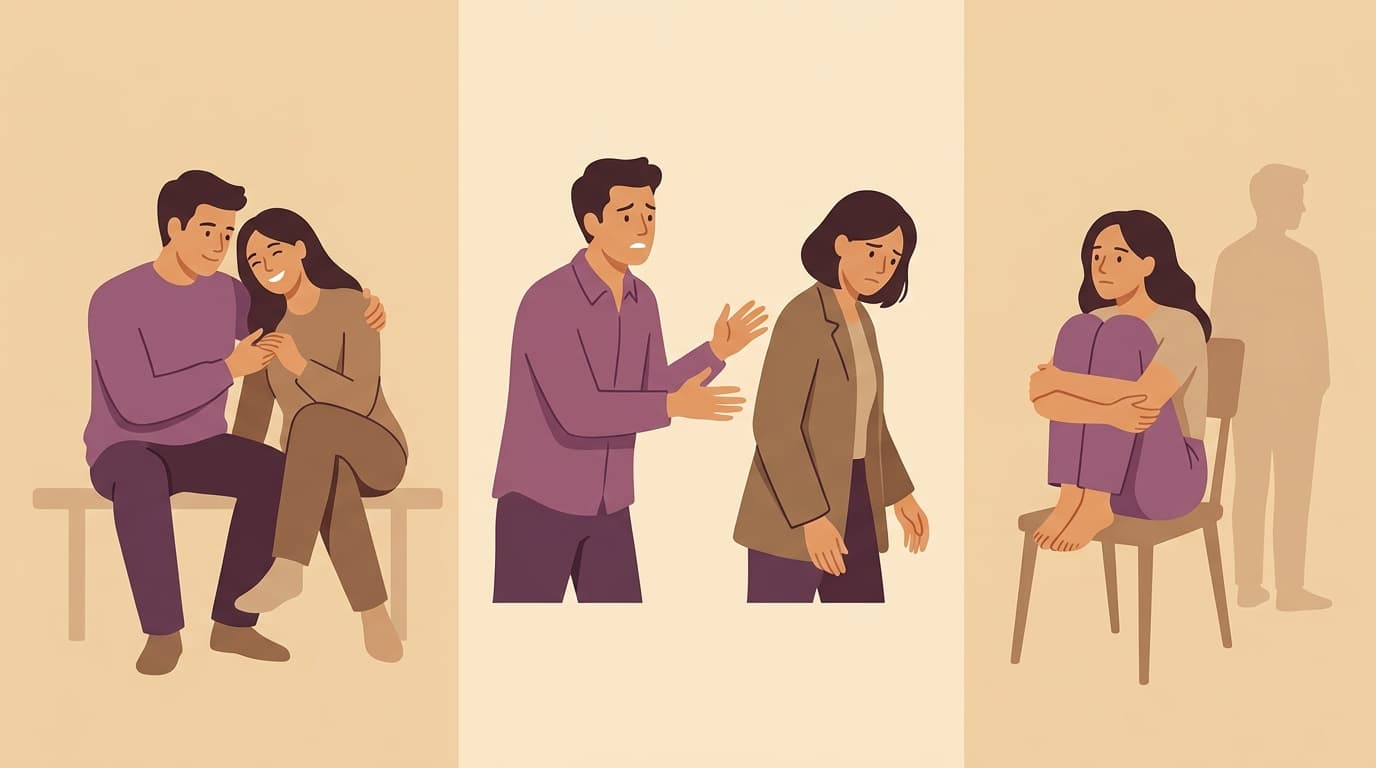
How your attachment style shapes every conversation with your partner
How your attachment style shapes every conversation with your partner, and what to do about it. Covers secure, anxious, and avoidant.
Why personal growth sometimes threatens your relationship
When one partner grows, the relationship system gets disrupted. Why that happens and how to handle it.
The difference between needing and wanting your partner
Is it better to need or want your partner? The real answer is more complicated than Instagram quotes suggest.
Building self-worth that doesn't depend on your partner
When your self-worth depends on your partner's approval, every interaction becomes high-stakes. Here's how to build an internal foundation.