Key Takeaways
The myth of 'grieving together' hides a harder truth: partners rarely grieve the same way or at the same pace. Research on the Dual Process Model and instrumental vs. intuitive grieving styles explains why, and what couples can do to stay connected through loss instead of drifting apart.
When a couple faces a significant loss, there's an expectation that grief will bring them closer. Shared pain, shared tears, a deepened bond forged through suffering. It's a comforting idea.
It's also frequently wrong.
Research consistently shows that grief is one of the most difficult experiences for couples to go through together. Not because they don't care about each other, but because grief is deeply individual, maddeningly inconsistent, and almost never synchronized between two people, even when they've lost the same thing.
Margaret Stroebe and Henk Schut's Dual Process Model of Coping with Bereavement, published in 1999, provides one of the most useful frameworks for understanding why. Their model describes two orientations in grief: loss-orientation (confronting the pain of the loss, processing emotions, longing for what's gone) and restoration-orientation (attending to the practical changes the loss has caused, building a new identity, re-engaging with life). Healthy grieving involves oscillating between the two: sometimes focused on the pain, sometimes focused on moving forward.
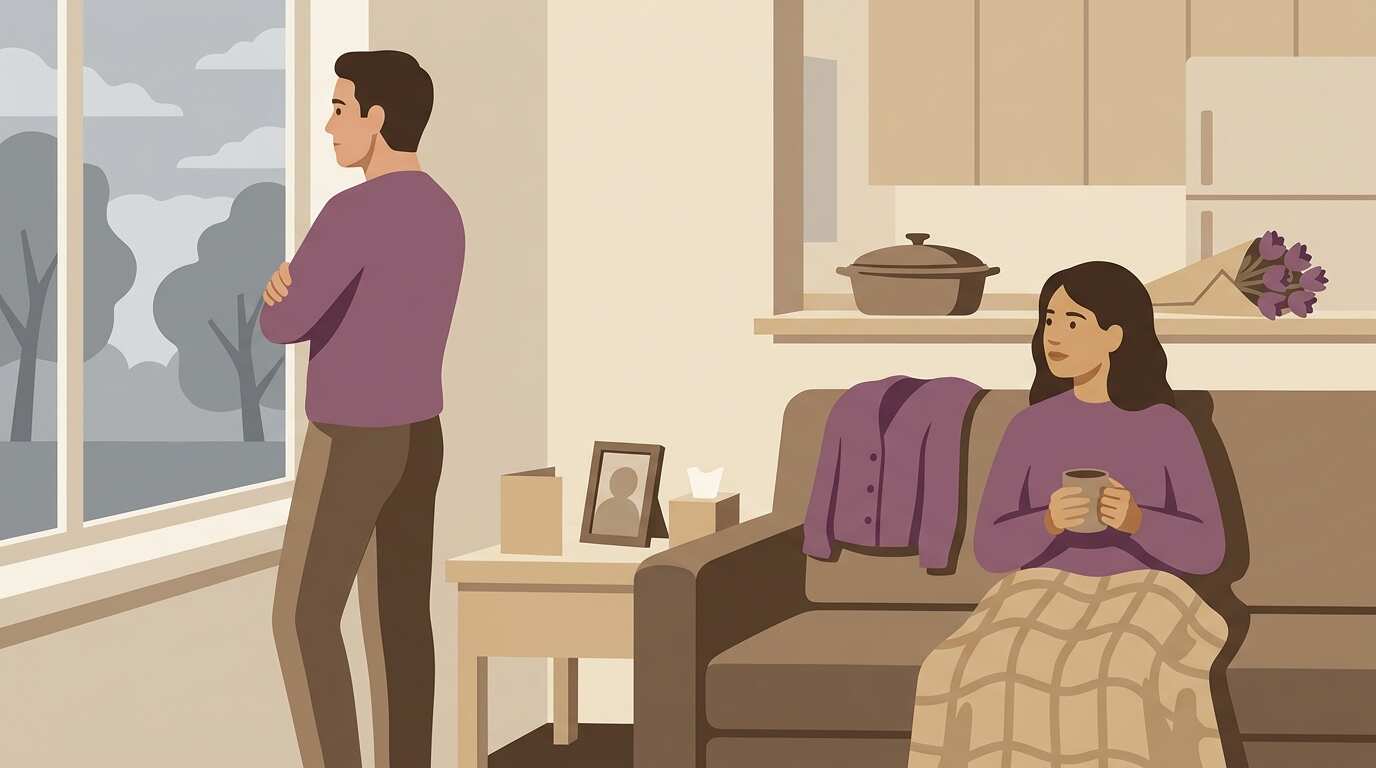
The problem for couples is that partners rarely oscillate in sync. One person might be deep in loss-orientation (crying, remembering, needing to talk about what happened) while the other is in restoration-orientation (handling logistics, returning to routines, appearing "fine"). From the outside, this looks like one person is grieving and the other has moved on. From the inside, both are grieving. They're just doing it at different times and in different ways.
That mismatch, if it's not understood, pulls couples apart.
Why do partners grieve so differently?
Beyond the oscillation patterns Stroebe and Schut described, there are fundamental differences in how people approach grief itself.
Terry Martin and Kenneth Doka, in their 2000 book Grieving Beyond Gender, identified two primary grieving styles: intuitive and instrumental. Intuitive grievers experience and express grief primarily through emotions. They cry, they talk, they feel the pain acutely and openly. Instrumental grievers experience grief primarily through thinking and doing. They problem-solve, they take action, they channel the pain into activity rather than emotional expression.
These styles don't map perfectly onto gender, though cultural conditioning means women are more likely to grieve intuitively and men are more likely to grieve instrumentally. But what matters for couples isn't the demographic pattern. It's what happens when an intuitive griever and an instrumental griever lose the same thing.
The intuitive griever wants to talk about the loss. They want to cry together, share memories, sit in the pain. The instrumental griever wants to handle the will, clean out the closet, make plans. The intuitive griever sees their partner's activity as avoidance. The instrumental griever sees their partner's emotion as wallowing. Both are wrong. Both are grieving. But the translation gap between their styles can feel like evidence that their partner doesn't care, or doesn't care enough.
What makes losing a child different from other losses?
Every loss is significant. But the research on child loss deserves specific attention because its impact on couples is uniquely severe.
The death of a child is consistently rated as the most stressful life event a person can experience. And the statistics on couples after child loss are grim. A frequently cited (and sometimes overstated) claim is that 80% of couples who lose a child divorce. The actual numbers are less dramatic but still sobering. A 2006 study by Dijkstra and Stroebe found that bereaved parents had higher rates of relationship dissolution than comparison groups, though the rates varied significantly based on the age of the child at death, the cause of death, and the quality of the relationship before the loss.
What makes child loss particularly dangerous for relationships is that both partners are grieving the same loss with maximum intensity. There's no asymmetry of attachment; both parents lost their child. But they may be grieving completely different things. One parent might be consumed by the loss of the child's future: the milestones that won't happen, the adult their child won't become. The other might be stuck in the physical absence: the empty room, the missing sounds, the routines that no longer have a purpose.
And because the pain is so intense, the normal capacity for empathy gets overwhelmed. A person drowning in their own grief has very little bandwidth to support someone else who is also drowning. This is why couples who lose a child need external support (grief counseling, support groups, community) rather than expecting each other to be everything.
Is miscarriage grief taken seriously enough in relationships?
No. And the gap between how miscarriage affects people and how it's treated socially creates specific relational problems.
Miscarriage is common. Estimates suggest 10-20% of known pregnancies end in miscarriage. Despite this prevalence, there's a persistent cultural minimization of the loss. "At least it was early." "You can try again." "It wasn't really a baby yet." These statements, however well-intentioned, communicate that the grief isn't proportional or justified.
Within the couple, miscarriage grief often creates an asymmetry. The person who was carrying the pregnancy has had a physical and hormonal experience the other partner hasn't. They may have already bonded with the pregnancy in ways their partner hadn't yet. The non-carrying partner may feel grief too, but it might be less intense or differently shaped, which can make the carrying partner feel alone in their pain.
Research by Kersting and Wagner (2012) found that about 10-15% of women who miscarry develop clinical depression or anxiety, and that lack of partner support was a significant risk factor. The most helpful thing partners can do is validate the loss as real: not minimized, not rationalized, not compared. "This is a loss. I'm sad about it too. What do you need?" is worth more than any attempt to find a silver lining.
How do you support a grieving partner without trying to fix it?
The instinct to fix is strong, especially when you love someone and they're in pain. You want to make it better. You want to say something that helps. You want the pain to stop, partly for their sake and partly because their pain is hard for you to witness.
But grief can't be fixed. It can only be carried. And the difference between a partner who helps you carry grief and one who tries to fix it is enormous.
Fixing sounds like: "Maybe you should try to get back to your normal routine." "Have you thought about talking to someone?" "At least we still have each other." "They wouldn't want you to be this sad."
Carrying sounds like: "I'm here. I don't know what to say, but I'm here." "Tell me about what you're feeling." "What do you need today, company or space?" "I miss them too."
The distinction is between trying to change your partner's emotional state and being willing to sit in it with them. Researcher and therapist Dr. Pauline Boss, who coined the term "ambiguous loss," emphasizes that in many grief situations, there is no resolution to offer. The most therapeutic thing another person can do is tolerate the pain alongside the griever without rushing to resolve it.
This is hard. Watching someone you love suffer without being able to help triggers helplessness, and helplessness is deeply uncomfortable. Many partners who become impatient with a griever aren't actually impatient with the grief; they're struggling with their own inability to make it better. Understanding this dynamic can prevent the secondary injury of feeling abandoned by your partner during the worst moments of your life.
When does grief pull couples apart versus push them together?
The research points to a few factors that differentiate couples who are strengthened by shared grief from those who are damaged by it.
Communication quality before the loss matters most. Couples who already had the skill of talking about difficult emotions were better equipped to talk about grief. Couples who avoided hard topics before the loss didn't suddenly develop that skill when they needed it most. The foundation for grieving well together is built long before the loss happens.
Tolerance for different grieving styles. Couples who could accept that their partner's way of grieving was valid, even when it looked nothing like their own, maintained connection. Couples who interpreted different styles as evidence of not caring enough lost each other in the translation gap.
Willingness to seek outside support. Grief is not a burden a relationship should carry alone. Couples who engaged with grief counseling, support groups, religious communities, or close friends had more resources and less relational strain than couples who tried to contain the grief within the relationship.
The ability to grieve separately and together. This is the hardest one. It means allowing your partner to have their own grief process (their own timeline, their own rituals, their own way of remembering) while also creating shared moments of grief. A couple might visit the grave separately during the week and together on weekends. One partner might write in a journal; the other might want to talk at dinner. Both are valid. The couple finds connection not by merging their grief processes but by respecting them.
What kinds of loss count as grief?
People sometimes feel they need permission to grieve losses that aren't death. They don't. Grief is the response to any significant loss, and relationships can be strained by any of them.
Job loss. The end of a friendship. A health diagnosis that changes your life trajectory. Infertility. The loss of a dream: a career path that didn't work out, a move that had to be abandoned, a vision of the future that's no longer possible. A pet's death (which is often minimized but can be genuinely devastating). Even a career change can trigger grief for the identity that's being left behind.
Each of these losses affects the relationship, because each one changes the person experiencing it. And the partner's response, whether they validate the grief or dismiss it, shapes how the griever processes the loss and whether they feel supported or alone within the relationship.
When should you seek grief counseling as a couple?
Individual grief counseling is warranted whenever grief is significantly disrupting someone's ability to function. But couples grief counseling addresses a specific set of problems that individual work can't.
Seek couples grief counseling when:
- You're having repeated conflicts about how the other person is (or isn't) grieving
- One partner feels unsupported and the other feels criticized for their grieving style
- You've stopped talking about the loss because it always leads to a fight
- Intimacy, emotional or physical, has disappeared since the loss and isn't returning
- You're grieving different aspects of the same loss and can't bridge the gap
- One partner seems stuck (not oscillating between loss and restoration) and the other doesn't know how to help
A grief-specialized therapist can do something partners can't do for each other: translate. They can help each person understand what the other's grief looks like from the inside, not just how it appears from the outside. That translation is often the thing that reconnects couples who've been drifting apart since the loss.
The long game of grieving together
Grief doesn't end. It changes shape, becomes less acute, integrates into life rather than dominating it. But it doesn't end. And for couples, this means learning to live alongside grief, theirs and their partner's, as a permanent, if diminishing, presence.
The couples who do this well tend to develop rituals. An annual acknowledgment of the loss. A shared moment of remembrance. Not a performance of sadness, but a recognition that the loss is part of their story. These rituals give grief a place to live so it doesn't leak out unpredictably into daily life.
Staying curious about your partner's inner life matters more during and after grief than at any other time. A single question, "how are you doing with it today?", can keep the door open between two people who might otherwise retreat into private, parallel grief. That's not a small thing. It's the difference between grieving together and grieving in the same house.
Frequently asked questions
How long does grief affect a relationship?
There's no standard timeline, and anyone who gives you one is guessing. Acute grief, the intense, disruptive early phase, typically lasts weeks to months. But grief's effects on a relationship can persist for years, particularly after major losses like the death of a child or a parent. The relevant question isn't "when will this be over?" but "how are we adapting to this being part of our lives?" Couples who frame grief as something to integrate rather than something to overcome tend to fare better.
What if my partner thinks I should be "over it" by now?
This is one of the most common and painful dynamics in couples dealing with grief. Your partner may not be dismissing your pain intentionally. They may be uncomfortable with it, scared by it, or genuinely confused about why it's lasting so long. A direct conversation helps: "I know my grief is lasting longer than you expected. It's lasting longer than I expected too. I need you to let me have this process without a deadline." If that conversation doesn't land, couples therapy can mediate.
Can grief bring a couple closer?
Yes, but not automatically. Shared grief can deepen intimacy when both partners feel seen, supported, and free to grieve in their own way. The key word is "can." Grief that's navigated with empathy and communication often strengthens emotional safety. Grief that's navigated with judgment, impatience, or avoidance does the opposite. The loss itself doesn't determine the outcome. How you treat each other during it does.
Should we grieve separately or together?
Both. This isn't a contradiction. Healthy grieving involves private processing and shared processing, and the balance shifts over time. Early in grief, you might need more shared time. Later, individual processing might dominate. The important thing is that neither partner feels excluded from the other's grief or imprisoned by it. Check in regularly about what each of you needs, and expect the answer to change.
Aperi: one question a day
A daily question app that adapts to you and your partner, and goes deeper the more you use it.


Free to start. Available on iPhone and Android.
Explore question packs
Related articles
Building self-worth that doesn't depend on your partner
When your self-worth depends on your partner's approval, every interaction becomes high-stakes. Here's how to build an internal foundation.
When you project your insecurities onto your partner
Projection makes you fight about things that aren't real. How to catch it, understand where it comes from, and stop.
Why boredom in your relationship isn't always bad
Relationship boredom gets a bad reputation. Sometimes it signals safety. Sometimes it signals stagnation. Here is how to tell the difference.
When you and your partner speak different love languages
You show love your way, not theirs. How to close the gap when you and your partner express affection differently, beyond the quiz.
What research says about age gap relationships
Age gap relationships attract strong opinions. What does the data actually show about satisfaction, power dynamics, and stigma?

Relationship advice for your 20s
Your 20s are when you learn how to be in a relationship. Here's what the research says about building the skills that matter.