Key Takeaways
Gratitude in relationships is a maintenance mechanism, not just good manners. Research shows it strengthens bonds through a find-remind-bind cycle, but it erodes over time unless you actively counteract hedonic adaptation with specific daily practices.
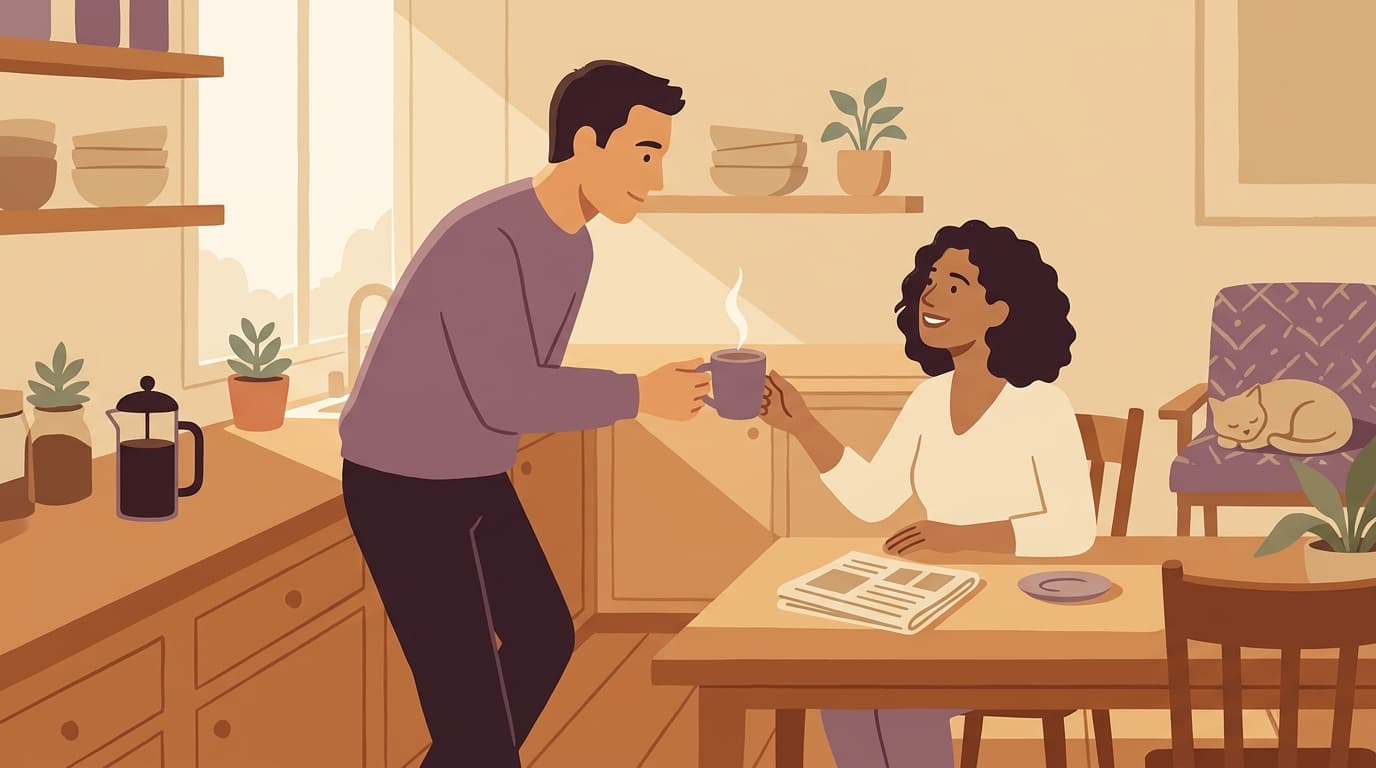
An uncomfortable truth about long-term relationships: the things your partner does for you stop registering. The morning coffee they make. The way they handle the logistics you hate. The fact that they show up, consistently, day after day. At the beginning, you noticed all of it. Two years in, it's wallpaper.
This isn't a character flaw. It's hedonic adaptation: the well-documented psychological tendency to return to a baseline level of satisfaction regardless of positive changes in your life. The same mechanism that makes you stop noticing a new car after six months makes you stop noticing your partner's daily acts of care. And when gratitude erodes, the relationship slowly shifts from "we're lucky to have each other" to "this is just how things are."
The research on gratitude in romantic relationships shows that this erosion is both predictable and preventable. But preventing it requires understanding what gratitude actually does in a relationship, which is more than you might think.
What does gratitude actually do in a relationship?
Sara Algoe, a psychologist at the University of North Carolina, has spent over a decade studying how gratitude functions in romantic partnerships. Her central finding: gratitude isn't just an emotion you feel. It's a relationship maintenance mechanism that operates through what she calls the find-remind-bind theory.
Find: Gratitude helps you identify a partner who is responsive to your needs. When someone does something thoughtful and you feel genuinely grateful, that emotional response is your brain flagging: this person pays attention to what matters to me. Early in a relationship, gratitude functions as a signal detector for partner quality.
Remind: Over time, gratitude keeps the evidence of your partner's responsiveness visible. Without it, the daily proof that your partner cares fades into the background. Gratitude pulls it back into focus.
Bind: Most importantly, gratitude strengthens the bond between partners. Algoe's research, published in Personal Relationships and replicated across multiple studies, found that on days when one partner felt more grateful toward the other, both partners reported feeling more connected and satisfied with the relationship. Gratitude isn't just good for the person feeling it; it's good for the person receiving it too.
This is different from how we usually think about gratitude. It's not about being polite or having good manners. It's a behavioral mechanism that keeps relationships healthy by continuously reinforcing the perception that this person is good for me, and I'm going to invest in this bond.
What's the difference between feeling grateful and expressing it?
This distinction matters more than it seems. Amie Gordon, a psychologist at the University of Michigan, found that feeling grateful internally and expressing it externally have different effects on relationships.
Feeling grateful without expressing it benefits you. It improves your own mood and your personal perception of the relationship. But it doesn't do much for your partner. They can't read your mind. The warm feelings you have about them making dinner don't reach them unless you say something.
Expressing gratitude, actually telling your partner what you appreciate and why, benefits both people. Gordon's research showed that on days when people expressed gratitude to their partner, both the expresser and the receiver reported feeling more satisfied with the relationship and more connected to each other. The expression is what creates the relational benefit.
But here's where it gets specific. Not all expressions of gratitude are equal. Saying "thanks" as you walk past the kitchen doesn't carry the same weight as "I really appreciate that you cooked tonight. I know you were tired, and the fact that you still did it means a lot to me." The second version works better because it includes three elements: what they did, the cost they paid, and what it meant to you. It communicates that you noticed, which is the whole point.
This connects to what Gottman's research describes as turning toward bids for connection. When your partner does something thoughtful, that's a bid. Expressing specific gratitude is turning toward it. A generic "thanks" is a minimal turn. A specific, personal expression of gratitude is a full turn, and the research shows the difference matters.
Why does gratitude erode in long-term relationships?
Hedonic adaptation is the primary culprit. Philip Brickman's classic 1978 study found that lottery winners returned to their baseline happiness levels within months. The same process operates in relationships, but more slowly and less obviously.
When your partner first started doing the things they do (remembering your coffee order, handling the bills, being patient when you're stressed) it felt notable. You noticed because it was new. Over time, these behaviors become the baseline. They shift from "something my partner does for me" to "just how things are." The behavior hasn't changed. Your perception of it has.
Nathaniel Lambert and colleagues at Brigham Young University studied this dynamic directly and found that couples who had been together longer were less likely to express gratitude for routine positive behaviors, even though those behaviors were just as effortful and just as valuable as they'd always been. The longer the relationship, the more invisible the daily care becomes.
This creates a vicious cycle. Partner A stops expressing gratitude because Partner B's efforts feel routine. Partner B, no longer feeling appreciated, starts to reduce their effort or feel resentful. Partner A doesn't notice the reduction because they weren't noticing the effort in the first place. Both people end up feeling undervalued without understanding why.
The antidote isn't trying harder to feel grateful (you can't force an emotion). It's building practices that counteract the adaptation by deliberately drawing your attention back to what your partner contributes.
How is gratitude different from indebtedness?
This is a distinction that matters clinically and practically. Gratitude and indebtedness can look similar from the outside but they feel completely different from the inside, and they produce opposite relational outcomes.
Gratitude says: "You did something wonderful, and I appreciate you for it." It's focused on the giver's positive qualities. It draws you closer.
Indebtedness says: "You did something for me, and now I owe you." It's focused on obligation. It creates distance.
Martin Seligman's work on positive psychology draws this line clearly: gratitude is a freely felt positive emotion. Indebtedness is a negatively valenced obligation. In healthy relationships, a partner cooking dinner triggers gratitude ("That was kind of you"). In unhealthy dynamics, it triggers indebtedness ("Now I have to do something equivalent or they'll hold it over me").
Watkins and colleagues (2006) found that gratitude was associated with higher relationship satisfaction while indebtedness was associated with lower satisfaction. They can coexist (you can feel both grateful and somewhat obligated) but the ratio matters. If most of what you feel when your partner does something nice is obligation rather than appreciation, that's worth examining.
The practical test: after your partner does something thoughtful, do you feel warm toward them or pressured to reciprocate? Gratitude makes you want to do something nice because you want to. Indebtedness makes you feel like you have to.
What are the best daily gratitude practices for couples?
The research supports several specific practices that counteract hedonic adaptation and maintain active gratitude in long-term relationships:
The "three good things about us" exercise
Seligman's "three good things" exercise, originally designed for individual well-being, has been adapted for couples. Each day, both partners write down or share three things they appreciated about the other person or the relationship that day. They can be small: "You made me laugh during dinner." "You listened when I vented about work." "You remembered to get the thing I mentioned needing."
The power of this exercise isn't in any single item. It's in the attention shift. When you know you're going to identify three specific things at the end of the day, you start noticing them as they happen. You train your brain to scan for your partner's positive contributions rather than letting them disappear into the background.
Gratitude journaling as a couple
Gordon and colleagues found that individuals who kept a gratitude journal focused on their partner showed increased relationship satisfaction over time, and so did their partners, even when the partners didn't know about the journal. The mechanism: people who intentionally focus on what they appreciate about their partner treat that partner better, and the partner responds to the improved treatment.
Some couples do this together, sharing entries at the end of each week. Others keep individual journals. Both approaches work; the shared version adds a layer of expressed gratitude on top of the felt gratitude.
Specific, timely expressions
Research consistently shows that specific and timely gratitude is more effective than general and delayed. "Thank you for driving the kids today. I know rush hour traffic is miserable and you chose to handle it so I could rest" works better than "Thanks for everything you do." Specificity signals that you're actually paying attention, which is what the recipient needs to feel.
The Gratitude Deck is designed around this principle: structured prompts that help couples move past generic appreciation into specific, meaningful expressions that actually register.
Gratitude during conflict
This one sounds counterintuitive, but Algoe's research found that couples who maintained a habit of expressing gratitude during non-conflict times were better at handling conflict when it arose. The mechanism: regular gratitude keeps the Emotional Bank Account (Gottman's term) in surplus, so when a withdrawal happens during an argument, the relationship can absorb it.
More practically, some couples have found that beginning a difficult conversation with a genuine statement of appreciation ("I know you've been working hard on this, and I appreciate it. I want to talk about something that's bothering me") sets a different tone than launching directly into the complaint. It's not a trick. It's a framing that acknowledges the full picture rather than reducing your partner to the thing that's currently frustrating you.
Why does gratitude have to be intentional?
Because the default direction is erosion. Left to its own devices, the brain stops flagging familiar positive stimuli. This isn't pessimism; it's neuroscience. The brain is an efficiency machine that prioritizes novel information over repeated information. Your partner's consistent reliability is, neurologically speaking, boring to your brain. It's the definition of something that doesn't need attention.
Intentional gratitude practice is a deliberate override of that default. It's choosing to notice what your brain has automated away. And the research shows it works, not as a one-time intervention but as an ongoing practice, similar to physical exercise. You don't work out once and stay fit forever. You don't practice gratitude once and stay appreciative forever.
This is why daily structure helps. A weekly relationship check-in that includes a gratitude component, or a daily practice of naming one specific thing you appreciated, creates the recurring prompt that your brain needs to keep noticing what it would otherwise filter out.
The couples who stay grateful after years together aren't more naturally appreciative. They've built systems that prevent the natural fade.
How gratitude connects to relationship depth
There's a less obvious connection between gratitude and the kind of deep, substantive relationship that most people want. Gratitude keeps the surface warm: the daily appreciation, the noticed efforts, the expressed thanks. But it also creates the safety that deeper conversations require.
When you feel consistently appreciated by your partner, you're more willing to be vulnerable. You're more willing to share the harder stuff (fears, insecurities, unfinished thoughts) because you trust that your partner sees you positively. Gratitude builds the emotional safety that allows depth.
Conversely, when gratitude is absent, when both partners feel like their efforts go unnoticed, vulnerability feels risky. Why share something difficult if you don't even feel appreciated for the easy stuff? The surface dries up first, and the depth follows.
This is why gratitude isn't just a nice-to-have. It's foundational. It prevents the slow drift into the roommate rut, that state where couples coexist efficiently but stop connecting meaningfully.
Aperi's daily question practice embeds gratitude into the rhythm of a relationship. When both partners answer a question about what they value in each other, what they've noticed, or what they're thankful for, it creates the intentional moment of attention that prevents hedonic adaptation from doing its quiet damage. Not a grand gesture. Just a daily redirect of focus back to what matters.
Frequently asked questions
How often should couples express gratitude to each other?
The research doesn't prescribe a specific frequency, but the pattern across studies is clear: daily is better than weekly, and specific is better than general. Algoe's find-remind-bind model suggests that gratitude works best as a consistent practice rather than an occasional burst. Aiming for at least one specific expression of appreciation per day, something more substantial than a passing "thanks", is a reasonable target that most studies support.
Can you express too much gratitude?
In theory, excessive or inauthentic gratitude could feel performative. But in practice, research hasn't found a ceiling where genuine gratitude starts to backfire. The more common problem, by far, is too little gratitude rather than too much. If your expressions are specific and genuine, it's extremely unlikely you'll overdo it. The risk is all on the side of under-expression.
What if my partner doesn't express gratitude back?
One-sided gratitude is better than no gratitude. Gordon's research found that individuals who practiced gratitude toward their partner experienced personal benefits (better mood, higher satisfaction) regardless of whether the partner reciprocated. That said, sustained one-sided expression without reciprocation can feel draining. If you've been intentionally expressing appreciation and your partner hasn't matched it, a direct conversation about what you need may be warranted, not as a demand, but as a bid for responsiveness.
Is gratitude different from appreciation?
They overlap significantly but aren't identical. Appreciation is recognizing the value of something or someone. Gratitude adds an element of benefit: it's appreciation plus the recognition that the other person's action benefited you specifically. In practice, both are valuable in relationships, and the distinction matters less than the act of expressing either one consistently.
Can gratitude practices help if the relationship is already struggling?
Yes, with caveats. Gratitude practices work best as maintenance: they're most effective at preventing erosion rather than reversing significant damage. If a relationship has serious issues (contempt, chronic conflict, trust violations), gratitude alone isn't sufficient. But even in struggling relationships, reintroducing specific, genuine expressions of appreciation can shift the emotional tone enough to create space for addressing the deeper problems. It's often a useful starting point for repair, not a complete solution.
Aperi: one question a day
A daily question app that adapts to you and your partner, and goes deeper the more you use it.


Free to start. Available on iPhone and Android.
Explore question packs
Related articles
Creating a shared calendar that works for your relationship
A shared calendar isn't just logistics. It's the difference between 'I told you about that' and actually being on the same page.
Social media rules for couples
Social media creates real relationship problems. Research-backed rules for handling posts, exes, and phone time together.
Different sleep schedules and how to share a bed
One of you is asleep by 10. The other is up until 1 AM. How to stop the sleep mismatch from wrecking your relationship.
Why personal growth sometimes threatens your relationship
When one partner grows, the relationship system gets disrupted. Why that happens and how to handle it.
The difference between needing and wanting your partner
Is it better to need or want your partner? The real answer is more complicated than Instagram quotes suggest.

Building self-worth that doesn't depend on your partner
When your self-worth depends on your partner's approval, every interaction becomes high-stakes. Here's how to build an internal foundation.