
Key Takeaways
Resentment builds from unspoken needs and perceived unfairness. Once it takes hold, it rewires how you interpret your partner's behavior, and even neutral actions look hostile. The way out isn't a single hard conversation. It's a pattern of smaller ones.
Resentment doesn't announce itself. It doesn't slam doors or raise its voice. It moves in slowly, like mold behind drywall. You don't notice it until the structure is already compromised.
By the time most people realize they're resentful, the feeling has been accumulating for months or years. It started as a specific frustration: they didn't help with bedtime. They forgot your birthday. They promised to change and didn't. Each individual incident was small enough to swallow. But you weren't digesting them. You were storing them.
Resentment is what happens when legitimate anger goes unexpressed over time. It's anger that has fermented into something heavier and more diffuse: a background hum of "you owe me" that colors everything.
And it's quietly destroying more relationships than dramatic betrayal ever will.
Why does resentment build?
Resentment rarely comes from a single cause. It accumulates through several overlapping channels, and most people have more than one source running simultaneously.
Unspoken needs. You need something from your partner (more help, more affection, more respect for your time) but you don't say it directly. Maybe you hint. Maybe you expect them to notice. Maybe you told them once, three years ago, and figured that should be enough. The need stays unmet, and each day it goes unmet adds a small deposit to the resentment account.
Unequal labor. This is the most common source in couples with shared responsibilities. One partner is carrying more: more housework, more childcare, more mental load, more emotional labor. And the imbalance feels both invisible and unfair. Allison Daminger's 2019 research at Harvard identified "cognitive labor" as a distinct category of household work that's disproportionately carried by women: anticipating needs, identifying options, monitoring outcomes. This labor is real work, but it's invisible to the partner who isn't doing it, which makes the resentment especially hard to articulate.
Repeated boundary violations. You've said no, and your boundary wasn't respected. You've asked for something to change, and it didn't. Each violation adds evidence to a growing case: "My needs don't matter to this person." Whether or not that's true, the pattern creates the experience of being disregarded.
Score-keeping. Once resentment starts, the brain begins tracking inputs and outputs with the precision of a forensic accountant. You start noticing every time you do something and they don't reciprocate. Every sacrifice gets logged. Every perceived slight gets filed. This isn't pettiness. It's the brain's attempt to build a case that justifies the anger you're feeling but haven't expressed. (More on this in how to stop keeping score.)
Unrealistic expectations. Sometimes resentment builds not because your partner is failing but because your expectations were never communicated or were never reasonable. If you resent your partner for not reading your mind, the problem isn't their obtuseness. It's the assumption that love means automatic understanding.
Most real-world resentment involves a mix of these. There's some legitimate grievance, some unexpressed need, and some unfair expectation all tangled together. Sorting them out is part of the work.
What does Gottman mean by "negative sentiment override"?
John Gottman observed something remarkable in his research: once resentment reaches a certain threshold, it changes how couples process information.
In a healthy relationship, ambiguous actions get the benefit of the doubt. Your partner forgets to text you back, and you think, "They're probably busy." They buy the wrong kind of milk, and you think, "Honest mistake."
In a resentful relationship, the same actions get interpreted through a hostile filter. They forgot to text because they don't care. They bought the wrong milk because they never listen.
Gottman calls this "negative sentiment override." It's the relationship equivalent of putting on glasses that make everything look slightly sinister. Your partner's actual behavior hasn't necessarily changed. Your interpretation of it has.
This is what makes resentment so insidious. Once negative sentiment override takes hold, positive actions get discounted ("They're only being nice because they want something") while negative actions get amplified ("See? This is what they're always like"). The evidence the brain collects is filtered to confirm the resentment, not challenge it.
Couples in negative sentiment override can't compliment their way out of it. "I appreciate you" from a resentful partner lands with a thud, and "I appreciate you" from the resented partner sounds suspicious. The filter distorts everything in both directions.
The only way out is to address the underlying resentment directly. Surface-level behavioral changes bounce off the filter. You have to go underneath.
What does resentment do to your body?
Janice Kiecolt-Glaser, a researcher at Ohio State University, has spent decades studying the biological effects of marital conflict. Her findings are uncomfortable.
In one study, she brought married couples into a lab, had them discuss a disagreement, and then measured their physiological responses for 24 hours afterward. Couples who displayed hostile conflict behavior (criticism, contempt, defensiveness, withdrawal) showed elevated cortisol levels, higher blood pressure, and impaired immune function compared to couples who handled conflict constructively.
In another study, she gave married couples small blister wounds and measured healing rates. Couples who interacted with hostility healed 60% slower than couples who interacted supportively. The mechanism is straightforward: chronic stress suppresses immune function, and unresolved resentment is a form of chronic stress.
This isn't abstract. If you're carrying resentment toward your partner, your body is processing that as an ongoing threat. Your cortisol stays elevated. Your sleep suffers. Your inflammatory markers increase. Over years, this translates into measurable health risks: cardiovascular disease, weakened immune response, chronic fatigue.
Resentment is a health problem, not just a relationship problem.
How do you know if you're resentful?
Most people don't label it as resentment. They describe it differently:
- "I'm just tired of everything."
- "I don't feel anything when they walk in the room."
- "Everything they do annoys me."
- "I keep a running list in my head of all the things they've done wrong."
- "I've given up bringing things up because nothing changes."
If any of these sound familiar, you're probably carrying resentment. Other signs: fantasizing about being single, telling friends things you haven't told your partner, feeling allergic to your partner's touch, or noticing that their happiness actually irritates you.
That last one is a telling signal. When your partner's good mood makes you angry, because they seem unaware of how much you're carrying, resentment has moved from background noise to foreground reality.
How do you surface resentment safely?
This is where most couples get stuck. The resentment needs to come out, but dumping it all at once, a full accounting of every stored grievance, will overwhelm your partner and trigger a defensive response. That leads to a fight, which confirms the resentful partner's belief that bringing things up is pointless, which drives the resentment further underground.
The alternative is structured disclosure. A framework that works:
Start with one thing, not everything. Pick the most pressing resentment, not the entire catalog. "I want to talk about how we handle bedtime routine" is manageable. "I want to talk about the last three years of imbalance in this relationship" is not.
Own the accumulation. Part of why resentment exists is that you didn't speak up sooner. That's not entirely your fault, and there were probably good reasons you stayed quiet, but acknowledging your role in the buildup prevents the conversation from being a pure indictment. "I should have said something about this months ago. I let it build, and that's on me."
Describe the pattern, not the person. "When I'm the one who always handles X, I start feeling like my time isn't valued" is different from "You never help with anything." The first describes an experience. The second assigns character.
Say what you need going forward, not just what went wrong. Resentment-driven conversations tend to focus exclusively on the past. That's useful for understanding, but it doesn't give either person a path forward. "Here's what I need from you" is more actionable than "Here's what you did to me."
Expect multiple conversations. Deep resentment doesn't resolve in one sitting. The first conversation opens the door. Subsequent conversations work through the details. If both people know it's a multi-session process, the pressure to resolve everything immediately drops.
When does resentment signal a real problem versus a communication gap?
Not all resentment is created equal. Sometimes resentment is telling you something true and important about your relationship. Other times, it's telling you something true and important about your communication patterns.
Resentment signals a communication gap when: the underlying needs are reasonable, the partner would be willing to change if they understood the problem, and the main barrier is that the conversation hasn't happened yet. In these cases, having the conversation usually releases the pressure. The partner responds, adjustments are made, and the resentment fades.
Resentment signals a real problem when: the underlying needs have been communicated clearly and repeatedly, the partner has been unwilling or unable to change, and the resentment reflects a genuine, ongoing imbalance. In these cases, conversation alone won't fix it. Something structural has to change: the division of labor, the relationship dynamic, the partner's willingness to engage with therapy, or, in some cases, the relationship itself.
The distinction matters because the prescription is different. For a communication gap, you need courage and a conversation. For a real problem, you need change and possibly professional help.
How do you actually let resentment go?
Letting go of resentment isn't a single act of will. It's a process that typically involves several components.
Name it honestly. Resentment thrives in vagueness. "I'm fine" and "It's nothing" are resentment's favorite hiding places. Getting specific ("I resent that I manage our entire social calendar without help") takes the feeling out of the shadows.
Grieve what you lost. This sounds dramatic, but resentment often contains grief. Grief for the relationship you expected to have. Grief for the version of your partner you thought you were getting. Grief for the time and energy you spent on something that wasn't reciprocated. Allowing yourself to feel sad about it, not just angry, often loosens the grip.
Decide what you can influence. Some of the things you resent are changeable. Others aren't. Sorting them into categories helps. For the changeable things: have the conversation, make the request, set the boundary. For the unchangeable things: the work shifts from trying to fix the situation to deciding whether you can accept it.
Rebuild the positive. Resentment erodes the positive memory bank. When you've been resentful for a long time, you lose access to the good memories and the good interpretations of your partner's behavior. Intentionally rebuilding positive experiences, not as a way to paper over the resentment but as a way to give the relationship data that counters the negative filter, helps restore balance.
Sara Algoe's research on gratitude in relationships (her "find-remind-bind" theory) suggests that expressing specific appreciation for your partner can counteract negative sentiment over time. Not generic compliments, but noticing and naming specific things your partner does that matter to you. It sounds too simple, but the research support is strong.
Frequently Asked Questions
Can a relationship recover from years of resentment?
Yes, but it requires both people to participate. One person can't forgive themselves out of resentment if the conditions that created it haven't changed. Both partners need to be willing to hear what went wrong, take responsibility for their part, and make concrete changes going forward. It's slow work, and it often benefits from a therapist who can hold the space while old grievances surface.
Is resentment the same as contempt?
They're related but distinct. Resentment is anger about perceived unfairness. Contempt is moral superiority, the belief that you're fundamentally better than your partner. Gottman identifies contempt as the single strongest predictor of divorce. Resentment can become contempt over time if it goes unaddressed: "You never help" (resentment) becomes "You're incapable of helping" (contempt). Catching resentment early prevents the slide into contempt.
What if I'm the one my partner resents?
Listen without defending. Your partner's resentment contains information about what they need and what they've been missing. That doesn't mean every grievance is fair or accurate, but the feeling is real regardless. Ask: "What do you need from me that you haven't been getting?" Then actually do it. Consistency over time, not a dramatic one-time gesture, is what dissolves resentment from the other side.
How do I tell the difference between resentment and falling out of love?
They feel similar (emotional distance, irritation, loss of interest) but they have different origins. Resentment has specific sources: identifiable grievances, unmet needs, accumulated hurts. Falling out of love tends to be more diffuse, a gradual loss of connection without a clear cause. If you can point to specific things you resent, there's usually something to work with. If the feeling is more general and harder to pin down, the issues may be deeper.
Can individual therapy help with resentment toward a partner?
It can help you understand your own patterns: why you suppress anger, what needs you struggle to voice, where your expectations come from. Individual therapy won't fix the relational dynamic, though. If the resentment is about something between the two of you, it eventually needs to be addressed between the two of you. Individual work is good preparation for that conversation, not a substitute for it.
Resentment dissolves through honest conversation, not willpower. Aperi gives couples a daily prompt that opens the door to the kind of check-ins that keep small frustrations from becoming permanent fixtures. It won't replace a hard conversation about accumulated grievances, but it builds the habit of talking before things pile up.
Aperi: one question a day
A daily question app that adapts to you and your partner, and goes deeper the more you use it.


Free to start. Available on iPhone and Android.
Explore question packs
Related articles

High-conflict vs. low-conflict couples: which are you?
Gottman identified three stable couple styles: volatile, avoiding, and validating. The key isn't which style you are, it's the 5:1 ratio.

When compromise isn't the answer
Not every disagreement has a middle ground. Here's how to tell the difference between flexibility and self-abandonment.

Forgiving your partner when it feels impossible
What forgiveness actually is, why "just let it go" never works, and the research-backed process for forgiving your partner.
Why you always fight about the same things
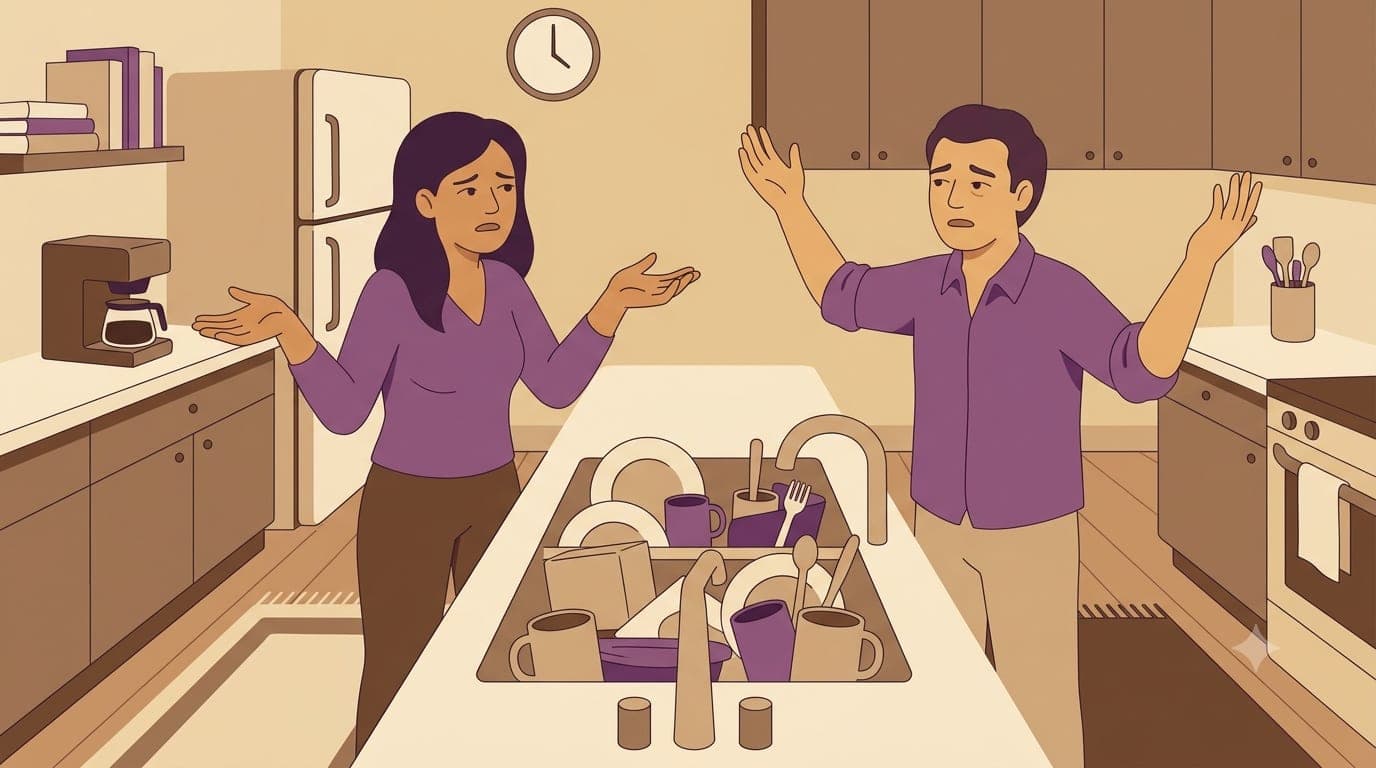
69% of couple conflicts are perpetual. Here's why the dishes fight is never about the dishes, and how to stop the loop.

The pursuer-withdrawer pattern: why you fight the same fight every time
The pursuer-withdrawer cycle explains why 60% of couples fight the same way every time. Learn how to break the pattern.

Why personal growth sometimes threatens your relationship
When one partner grows, the relationship system gets disrupted. Why that happens and how to handle it.