Key Takeaways
Mundane tasks like grocery shopping expose the real dynamics of your relationship: how you plan, compromise, negotiate, and handle stress under fluorescent lights.
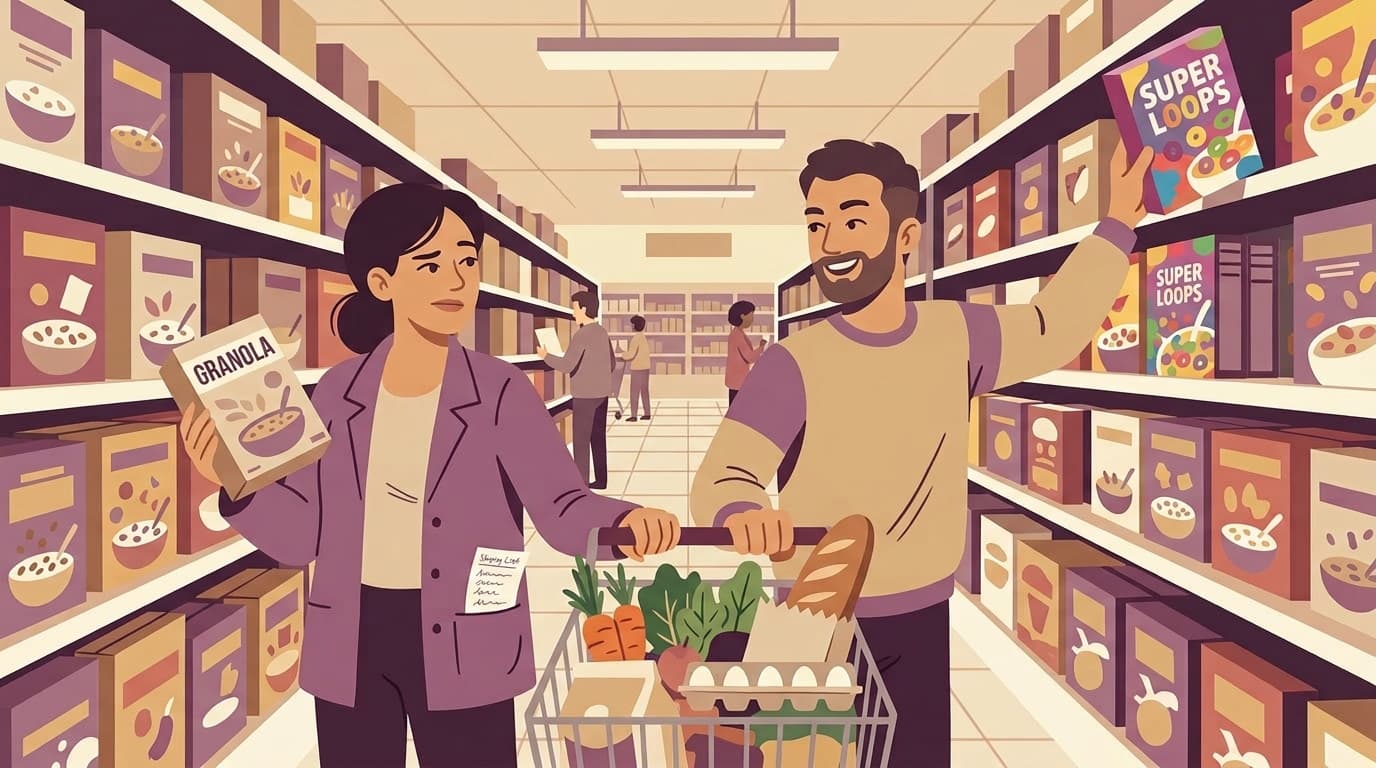
You're standing in the cereal aisle. One of you is holding organic steel-cut oats. The other is reaching for Cinnamon Toast Crunch. Nobody says anything for a moment. Then: "We still have oatmeal at home." Then: "That's been in the pantry since October." Then something about how one person always vetoes the other's choices, and suddenly you're not talking about cereal anymore.
Grocery shopping is one of the few activities couples do together that requires real-time decision-making under mild pressure: a budget, a time constraint, hunger, other people's carts blocking the aisle. It's low stakes enough that your defenses are down, but complex enough that your actual relationship patterns show up. The way you navigate a shared grocery run says more about your partnership than most date nights ever could.
Why the mundane stuff matters more than you think
Dr. John Gottman spent decades studying couples at the University of Washington, and one of his most counterintuitive findings was this: relationships don't fail because of big fights. They erode through what he calls "sliding door moments," the small, unremarkable interactions that happen dozens of times a day. How you respond when your partner suggests a different brand of pasta sauce. Whether you acknowledge their preference or steamroll it. Whether you split up to save time or walk the aisles together.
These micro-moments accumulate. A 2012 study published in the Journal of Social and Personal Relationships found that relationship satisfaction correlated more strongly with the quality of everyday interactions than with the frequency of "special" experiences like vacations or elaborate dates. The researchers, led by Harry Reis at the University of Rochester, concluded that ordinary moments provide more opportunities for responsiveness, the feeling that your partner sees, understands, and cares about your needs.
Grocery shopping is dense with these moments. In a typical 40-minute trip, you'll make somewhere between 20 and 50 joint decisions. That's more collaborative decision-making than most couples do in an entire week of evenings together.
What your grocery style reveals
Watch any couple navigate a supermarket for ten minutes and you'll see their relationship dynamics play out in miniature. A few common patterns:
The planner and the improviser
One person arrives with a list organized by aisle. The other wants to wander, see what looks good, and figure out meals based on what's on sale. This pairing is more common than you'd think. Research on personality complementarity in couples suggests that people often partner with someone whose organizational style differs from their own.
The friction here is really about how you each manage uncertainty. The planner finds comfort in structure. The improviser finds it constricting. Neither approach is wrong, but if the planner dismisses the improviser as chaotic, or the improviser dismisses the planner as rigid, you've stopped negotiating groceries and started undermining each other's way of being in the world.
The budget hawk and the quality seeker
One person compares unit prices. The other grabs the high-end olive oil without checking the tag. According to a 2023 survey by the Financial Health Network, differing spending priorities are a top-three source of conflict for cohabitating couples, and groceries are where those priorities collide weekly.
This dynamic often maps onto deeper beliefs about scarcity and abundance. The budget-conscious partner may have grown up in a household where money was tight. The quality-focused partner may view food as one of the few daily pleasures worth investing in. Both are valid. The problem arises when one person's spending feels like a judgment on the other's values.
The efficiency optimizer and the browser
One person treats the grocery store like a timed obstacle course. Get in, execute the list, get out. The other lingers at the cheese counter, reads the back of every jar of salsa, and wanders into the international aisle "just to look."
This one often escalates because it touches on a fundamental difference in how partners experience time together. The optimizer sees shopping as a task to complete. The browser sees it as a shared activity, a chance to slow down and exist in the same space. When the optimizer starts sighing and checking their phone, the browser feels rushed and dismissed. When the browser picks up a sixth item not on the list, the optimizer feels their time is being disrespected.
The health monitor and the comfort seeker
One person is reading nutrition labels and putting back anything with more than 8 grams of sugar. The other is loading up on frozen pizza and chips for the weekend. This tension can carry real emotional weight because food choices are tangled up with body image, health anxiety, and childhood comfort.
Dr. Brian Wansink's research at the Cornell Food and Brand Lab (before his later methodological controversies) found that people's comfort food preferences are strongly tied to emotional memories. Mac and cheese isn't just calories; it's safety. When one partner polices the other's food choices, even with good intentions, it can feel like having your emotional needs vetoed.
The solo mission splitter and the side-by-side shopper
Some couples divide the list and reunite at checkout. Others walk every aisle together. Neither is inherently better, but the choice often reflects something about how you balance independence and togetherness more broadly. Couples who always split may be efficient but miss out on the small moments of connection. Couples who always stick together may be avoiding a conversation about wanting more autonomy.
The conflict zones
Certain aisles and moments are more combustible than others. If you recognize any of these, you're not alone.
Brand loyalty battles. One person has been buying the same peanut butter since college. The other found a better option and can't understand why their partner won't even try it. This is identity masquerading as preference. The pushback often isn't about the product but about feeling like your choices are being corrected.
The "we already have that at home" standoff. This phrase has probably caused more grocery store tension than any other. It's often technically true and emotionally tone-deaf. The subtext from the person saying it: "You're being wasteful." The subtext heard by the other: "My wants don't matter."
Impulse buy judgment. One person puts something fun in the cart: fancy cheese, a bakery cookie, sparkling water in a flavor that doesn't need to exist. The other takes it out, or gives a look, or says nothing but radiates disapproval. Research by Dr. Scott Rick at the University of Michigan has shown that "tightwad-spendthrift" couples, where partners differ significantly in their emotional pain of paying, experience more conflict over purchases, even small ones.
The healthy eating power struggle. When one partner is on a diet or health kick, grocery shopping becomes a minefield. The non-dieting partner may feel judged for their choices, controlled by proxy ("If you don't buy it, I can't eat it"), or resentful about the household menu being dictated by someone else's goals.
Cart management. This sounds trivial. It is not. Who pushes the cart determines who sets the pace, who decides which aisle comes next, who has to do the reaching and loading. Some couples trade off naturally. Others have a silent, years-long power struggle over cart custody that neither has ever named.
Turning the grocery run into connection time
The point here isn't that grocery shopping should be stressful or that disagreements over yogurt brands are symptoms of deep dysfunction. Most of these tensions are minor. But they're also opportunities. Specifically, opportunities to practice the skills that matter in every other area of your relationship.
Plan the meals together before you go. This is the single highest-leverage change. Sitting down for 15 minutes to plan the week's meals eliminates most in-store conflict because the decisions have already been negotiated in a calmer setting. Research on implementation intentions, the work of psychologist Peter Gollwitzer at NYU, shows that pre-deciding reduces decision fatigue and conflict at the point of action.
It also becomes a small ritual. Couples who build shared rituals, even simple ones, report higher relationship satisfaction according to a 2019 study in the Journal of Family Psychology. Your weekly meal-planning session counts.
Give each person a discretionary pick. Each trip, both partners get to add one item to the cart that the other person doesn't question. No justification needed. A $7 block of aged cheddar. A bag of spicy chips. A magazine from the checkout rack. This small practice acknowledges that not every purchase needs to be a joint decision and gives both people a sense of autonomy within the shared task.
Use the drive or walk to the store. The ten minutes getting there and back are dead time for most couples. Use them. Not for logistics (you already have the list) but for an actual question. Something like "What's one thing you're looking forward to this week?" or "What's been on your mind lately?" Tools like Aperi can help here if you want a prompt that's more specific than "how was your day" but less intense than a therapy session.
Alternate who leads. If one person always drives the cart, always checks the list, always makes the final call on substitutions, try switching. It's a small shift that redistributes the mental load and often surfaces assumptions neither person realized they held.
Debrief the friction. If something bugged you during the trip, name it afterward. Not in an accusatory way. More like, "I noticed I got annoyed when you put back the crackers. I think it's because I felt like my choice got overruled. Can we figure out a better way to handle that?" This is exactly the kind of micro-repair that Gottman's research identifies as critical to long-term relationship health.
Frequently asked questions
We always fight at the grocery store. Does that mean something is wrong with our relationship?
Not necessarily. It means you have different preferences and haven't built a shared system for navigating them under time pressure. Grocery stores combine decision fatigue, hunger, crowds, and money. It's a stressful environment. The fact that friction surfaces there doesn't mean your relationship is in trouble. It means you're human. What matters is whether you can talk about the friction afterward without it escalating.
Should we just shop separately to avoid the conflict?
You can, and plenty of happy couples do. But shopping together isn't the problem; unresolved differences in how you make decisions together is. If you shop separately to avoid all conflict, those same patterns will show up somewhere else. It's worth trying the shared meal-planning approach first. If you genuinely prefer shopping solo because it's faster or more enjoyable, that's a different story.
My partner controls every food decision. How do I bring that up without starting a fight?
Frame it around how you feel, not what they do. "I've noticed I feel like I don't have much say in what we eat, and I'd like us to share that more" lands differently than "You always control the grocery list." If food control is part of a broader pattern, if one partner dominates most household decisions, that's worth exploring with a couples therapist or even through structured conversation tools like Aperi that help surface these dynamics in a low-pressure way.
Is it normal to have strong opinions about grocery shopping?
Completely. Food is one of the most emotionally loaded categories of daily life. It connects to health, identity, culture, childhood, money, and pleasure. Having strong opinions about what you eat and how you shop is not petty. It's a reflection of your values. The goal isn't to stop caring. It's to care about your partner's preferences as much as your own.
The real test
The grocery store test isn't really about groceries. It's about whether you can share a mundane, slightly annoying task with another person and come out the other side still liking each other. Whether you can compromise on the small stuff without keeping score. Whether you can let your partner put something weird in the cart and just go with it.
The couples who do this well aren't the ones who agree on everything. They're the ones who've figured out how to disagree in aisle seven without it following them home.
Related reading
Aperi: one question a day
A daily question app that adapts to you and your partner, and goes deeper the more you use it.


Free to start. Available on iPhone and Android.
Explore question packs
Related articles
The couple's budget: managing money without resentment
Money is the #1 predictor of divorce, ahead of sex and in-laws. How to talk about it without someone sleeping on the couch.
Supporting your partner's dreams without losing yours
Great relationships help both people become their ideal selves. Here's how to support your partner without losing yourself.
Communication in marriage: how the years change the conversation
Communication in marriage erodes through efficiency, not conflict. What the years change, which patterns predict real trouble, and what daily practice looks like.
Lack of communication in a relationship is rarely a skills problem
Lack of communication in a relationship: what the breakdown looks like in practice, what causes it (rarely skills), and the scripts that rebuild it.
50 couples therapy questions, in the order a therapist would ask them
50 couples therapy questions sequenced like a real session: history, patterns, needs, repair, future. Plus an honest look at when a list is not enough.
When you and your partner speak different love languages
You show love your way, not theirs. How to close the gap when you and your partner express affection differently, beyond the quiz.