Key Takeaways
The first three minutes of a conversation predict 96% of its outcome. Learning to express needs with soft startups, specific language, and good timing is a skill that transforms how couples handle conflict.
There's a reason you don't say what you need. It's not laziness. It's not passive-aggression (usually). It's that the last time you tried, it went badly. You said something about needing more help around the house, and suddenly you were in a 45-minute fight about who does what, who keeps score, and that one time three Thanksgivings ago when you didn't take out the trash.
So you stopped trying. You swallowed it, or dropped hints, or let resentment build until it came out sideways: sarcasm, withdrawal, or an explosion over something small. None of which actually gets your need met.
This is the cycle for most couples. Unexpressed needs don't disappear. They ferment. And when they finally come out, they come out contaminated with weeks or months of accumulated frustration, which guarantees that your partner hears an attack instead of a request.
Breaking this cycle requires specific skills. Not vague advice about "being open," but actual techniques for saying what you need in a way that your partner can hear without feeling threatened.
Why does expressing needs feel so dangerous?
Attachment theory gives us the clearest explanation. John Bowlby, the British psychiatrist who developed attachment theory in the 1960s and 1970s, observed that humans are wired to seek proximity and responsiveness from their primary attachment figures. When we express a need to a partner, we're doing something fundamentally vulnerable: we're revealing a dependency. We're saying, "I need something from you that I can't get on my own."
For people with secure attachment histories, this feels manageable. They've internalized the expectation that expressing needs leads to those needs being met. For people with insecure attachment, whether anxious or avoidant, expressing needs triggers a threat response. Anxiously attached people fear their needs will drive the partner away. Avoidantly attached people have learned that expressing needs is pointless, so they suppress them.
Sue Johnson, the developer of Emotionally Focused Therapy, describes this as the core dynamic in most couple conflicts. The surface fight is about dishes, or sex, or money. The attachment question underneath is: "Are you there for me? Can I count on you?" When that deeper question feels at risk, people either escalate (protest) or shut down (withdraw). Neither one actually communicates the need.
Understanding this doesn't magically fix it, but it changes the approach. You're not trying to win a debate. You're trying to reveal something vulnerable in a way that's safe for both of you.
What happens in the first three minutes?
John Gottman's research at the University of Washington produced one of the most specific and useful findings in relationship science: the first three minutes of a conflict conversation predict its outcome 96% of the time.
If a conversation starts with what Gottman calls a "harsh startup" (criticism, blame, contempt, or global accusations), it will almost certainly end badly. The other person's defenses go up immediately, and from there, the conversation is about self-protection, not understanding.
If it starts with a "soft startup," the conversation has a dramatically better chance of being productive. Gottman's data on this is extensive: across thousands of observed conversations, the startup pattern was the single most reliable predictor of how the conversation would resolve.
A harsh startup sounds like: "You never help with anything. I'm doing everything around here while you sit on the couch."
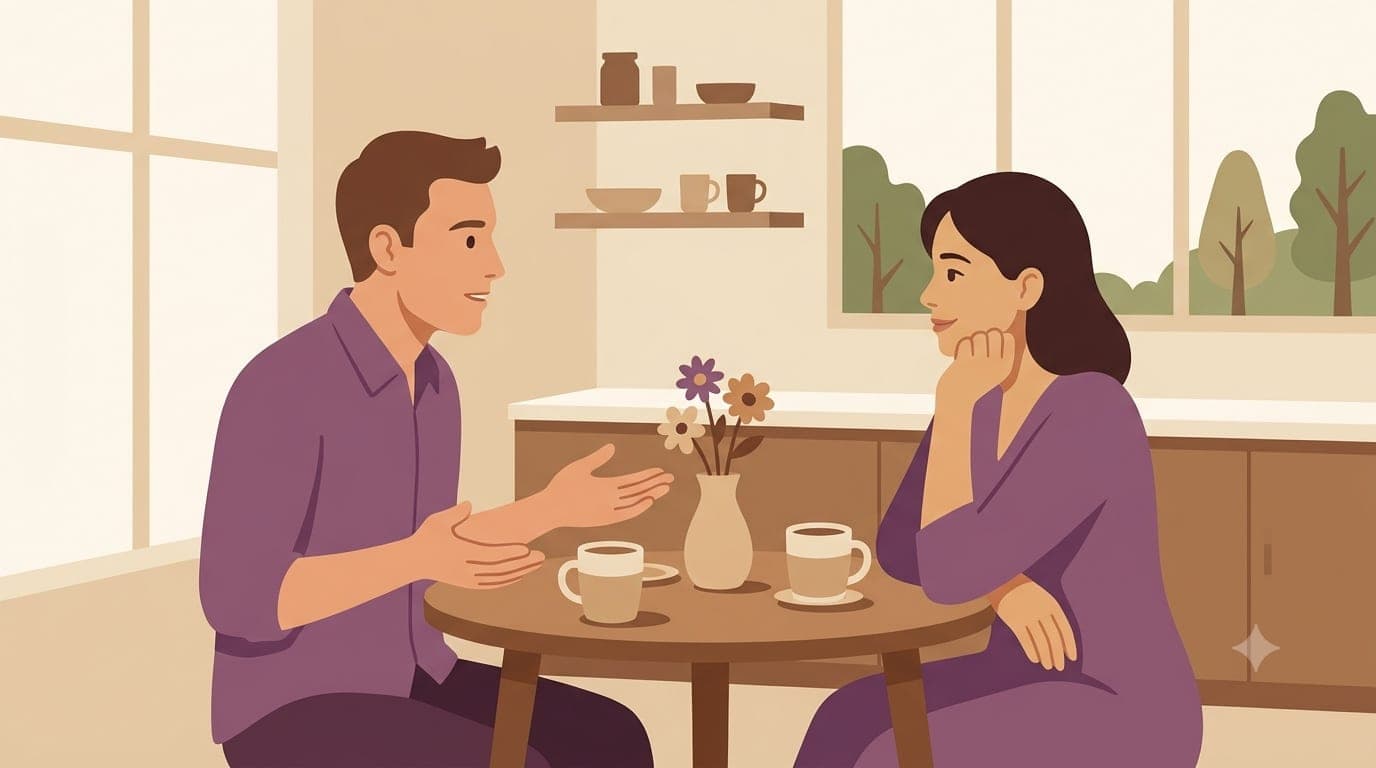
A soft startup sounds like: "I've been feeling overwhelmed with the household stuff lately. Can we figure out a way to split things differently?"
Same underlying need. Completely different framing. The first one puts your partner on trial. The second one invites them into a problem-solving conversation. The difference isn't about being "nicer." It's about being strategic. You're more likely to get your need met with the second approach because your partner can hear it without feeling attacked.
How does the XYZ formula work?
Therapists and communication researchers have converged on a simple framework for expressing needs that avoids the most common pitfalls. It's sometimes called the XYZ formula:
"When X happens, I feel Y, and I need Z."
X is the specific situation or behavior. Not a character judgment. Not a pattern accusation. A concrete, observable thing that happened. "When you check your phone during dinner" is specific. "When you're always distracted" is a character accusation masquerading as a situation.
Y is your emotional response. This is where I-feel statements come in. "I feel disconnected" or "I feel unimportant," not "I feel like you don't care about me," which is a thought dressed up as a feeling. The difference matters because genuine feelings are hard to argue with. Your partner can dispute whether they care about you, but they can't dispute that you feel disconnected. Your internal experience is yours.
Z is what you need. A specific, actionable request. "I need us to put phones away during dinner" is clear. "I need you to be more present" is vague enough to be useless. The more specific the request, the more likely it is to be met, because your partner knows exactly what success looks like.
The formula applied: "When we go a whole weekend without any real conversation (X), I start feeling lonely even though we're in the same house (Y). I'd love it if we could have one meal this weekend where we really talk, phones away, just us (Z)."
Compare that to: "You never talk to me anymore. We're basically roommates." Same underlying need. The first version is hearable. The second one is a grenade.
Why do "you always" and "you never" destroy conversations?
These two phrases, "you always" and "you never," are relationship poison, and there's a psychological reason they're so damaging that goes beyond just "sounding mean."
The fundamental attribution error, identified by social psychologist Lee Ross in 1977, describes a persistent human tendency: when other people do something wrong, we attribute it to their character ("they're lazy," "they don't care"). When we do something wrong, we attribute it to circumstances ("I was tired," "I forgot"). We judge others by their traits and ourselves by our situations.
In relationships, this error gets weaponized through global language. "You always leave your dishes in the sink" isn't really about dishes. It's an attribution: you are the kind of person who leaves dishes in the sink. You're careless. You're inconsiderate. It defines them rather than describing a behavior.
Your partner's brain registers this as a threat to their identity, not feedback about their behavior. And when identity is threatened, people don't listen; they defend. Gottman calls this "criticism" (one of his Four Horsemen), and it's distinct from a "complaint." A complaint addresses a specific behavior: "The dishes are still in the sink and I'd like help with them." Criticism addresses the person: "You never do the dishes. I can't count on you for anything."
The shift from complaint to criticism is often just a few words. But those words determine whether your partner hears "here's a problem we can solve together" or "here's what's wrong with you as a person."
When should you not have the conversation?
Timing is half the battle, and most people get it wrong. They bring up needs when emotions are already high: right after an incident, during another argument, or when one or both partners are stressed, hungry, or tired.
Gottman identified a physiological state he calls "flooding": when heart rate exceeds roughly 100 beats per minute during conflict, cognitive function deteriorates. You literally cannot process complex emotional information when you're flooded. The prefrontal cortex (rational thinking, empathy, perspective-taking) goes offline and the amygdala (threat detection, fight-or-flight) takes over.
Signs of flooding: rapid heartbeat, muscle tension, desire to flee or fight, repeating the same point louder. When you're flooded, the conversation needs to stop. Gottman recommends a minimum 20-minute break with an agreement to return.
Bad times to express a need: right when your partner walks in the door, during an existing argument, via text, when either of you has been drinking, late at night, or in front of other people.
Good times: when you're both calm, have time, and are face-to-face. Weekend mornings. During a walk, where parallel movement and lack of direct eye contact can make vulnerable conversations easier. During a planned check-in (a weekly relationship check-in works well for this).
What does good need-expression look like in practice?
Theory is useful. Examples are more useful. Here are three common needs expressed both poorly and well.
Need: More physical affection.
Poor: "You never touch me anymore. Do you even find me attractive?" Better: "I've been missing physical closeness with you. When you reach for my hand or put your arm around me, it makes me feel connected. Can we make more room for that?"
Need: More involvement in household decisions.
Poor: "You always just decide things without asking me. It's like I don't even live here." Better: "When the plumber got scheduled without us talking about it first, I felt sidelined. For bigger household decisions, I'd like us to check in with each other before committing."
Need: More quality time together.
Poor: "All you do is work. You clearly care more about your job than us." Better: "I know work has been intense. I'm not asking you to work less. I just miss spending time together. Could we protect Saturday evenings as our time?"
Notice the pattern: the better versions are longer. Expressing needs well takes more words, because you're doing more work: specifying behavior, naming emotion, making a clear request, avoiding the traps.
What's the difference between a need and a demand?
This distinction trips couples up constantly. A need expressed as a demand isn't really communication. It's coercion.
The difference is in the space left for the other person to respond. A need says: "This is what I'm experiencing and what would help." A demand says: "Do this or else." The "or else" might be explicit ("If you don't start helping more, I'm done") or implicit (tone, body language, or the unspoken threat of withdrawal or punishment).
Harriet Lerner, the psychologist and author of The Dance of Anger, draws a useful line here. You're responsible for clearly expressing what you need. You're not entitled to dictate how your partner responds. They might say yes. They might need a middle ground. They might need time. All legitimate responses. If the only acceptable response is immediate compliance, you've crossed from need into demand.
This also means accepting that some needs won't be met the way you imagined. The goal isn't to get everything you want. It's to be known well enough that you can find solutions that work for both of you.
How do you respond when your partner expresses a need?
This is the other half of the equation, and it's just as important. If expressing needs is vulnerable, receiving them graciously is what makes the vulnerability worth it.
When your partner says "I need more quality time," your brain might hear: "You're not enough. You're failing. You're being criticized." That's the fundamental attribution error in reverse: you're interpreting their need as your inadequacy.
Try hearing it differently: "My partner trusts me enough to tell me what they need. That's an act of intimacy, not an attack." Then respond to the need, not to your defensive interpretation of it.
Practical steps: reflect back what you heard. Ask clarifying questions. And then follow through. Nothing kills future need-expression faster than a partner who listens beautifully and then changes nothing.
If you can't meet the need, say so: "I hear that you need more quality time. This week is brutal with the deadline, but can we plan something for the weekend?" That's collaborative. It honors the need even when it can't be immediately fulfilled.
Learning to listen well when your partner is expressing a need is what makes the whole system work.
If you're looking for ways to start having hard conversations more regularly, or you want a structured way to practice this, Aperi gives couples a daily question designed to open up exactly these kinds of exchanges, starting lighter and going deeper as you build comfort with vulnerability.
FAQ
What if I express a need and my partner gets defensive anyway?
It happens, even with perfect technique. If your partner gets defensive, resist the urge to escalate or say "see, this is why I never tell you anything." Instead, try: "I think this came across differently than I intended. I'm not blaming you. I'm trying to tell you something I need. Can we try this again?" If they're too activated to hear you, take a break and come back to it. Gottman's research shows that taking a 20-minute break when conversations get heated leads to significantly better outcomes than pushing through.
How do I know the difference between a reasonable need and being too demanding?
A useful filter: does meeting this need require your partner to fundamentally change who they are, or to adjust a specific behavior? "I need you to be a different person" is unreasonable. "I need you to text me when you'll be late" is reasonable. If you're unsure, ask yourself whether you'd consider the same request reasonable if your partner made it of you. And pay attention to volume: if every conversation is about an unmet need, there may be a deeper compatibility question worth examining.
My partner says I'm "too needy." How do I handle that?
First, examine whether there's a pattern of expressing needs at high frequency or intensity that might overwhelm your partner. If so, prioritizing your top 1-2 needs and spacing out the conversations can help. But also consider that "too needy" is sometimes what avoidantly attached people say when any need feels like too much. In that case, the issue isn't your needs, it's your partner's discomfort with dependency. This dynamic often benefits from professional help, because the pursuer-withdrawer cycle it creates is hard to break alone.
Can I express needs over text?
For small, logistical needs, sure. "Can you pick up milk?" is fine over text. For emotional needs, anything involving vulnerability, disappointment, or relationship dynamics, no. Sarah Coyne at Brigham Young University found that using texting to manage conflict or express difficult emotions was associated with lower relationship quality. Text strips out tone, facial expression, and all the nonverbal information that helps your partner receive your message accurately. Have the important conversations face to face.
What if my partner and I have conflicting needs?
Most couples do, about most things, most of the time. Gottman found that 69% of relationship conflicts are perpetual, rooted in fundamental personality differences that won't resolve. The goal isn't to eliminate the conflict but to move from gridlock to dialogue. This means understanding what your partner's need means to them at a deeper level, finding areas of flexibility within your own position, and accepting that compromise doesn't mean someone loses. A therapist trained in Gottman Method or EFT can be extremely helpful for couples stuck in gridlocked conflicts.
Aperi: one question a day
A daily question app that adapts to you and your partner, and goes deeper the more you use it.


Free to start. Available on iPhone and Android.
Explore question packs
Related articles
Lack of communication in a relationship is rarely a skills problem
Lack of communication in a relationship: what the breakdown looks like in practice, what causes it (rarely skills), and the scripts that rebuild it.
Passive-aggressive behavior in relationships
Passive-aggression isn't about dishes left in the sink. It's anger that learned to hide. How to spot it, respond to it, and stop doing it yourself.

The repair conversation: what to say after a big fight
The conversation after a fight matters more than the fight itself. Here is exactly how to have it.

Why most apologies don't work
Most apologies make things worse. What the research says about real repair attempts and why 'I'm sorry you feel that way' always fails.
12 rules for fighting fair
Conflict isn't the problem; how you fight is. Twelve research-backed rules for fighting fair, from soft startups to repair attempts.
How to have hard conversations without fighting
Soft startups, the speaker-listener format, repair attempts: tested techniques for hard conversations that don't turn into fights.