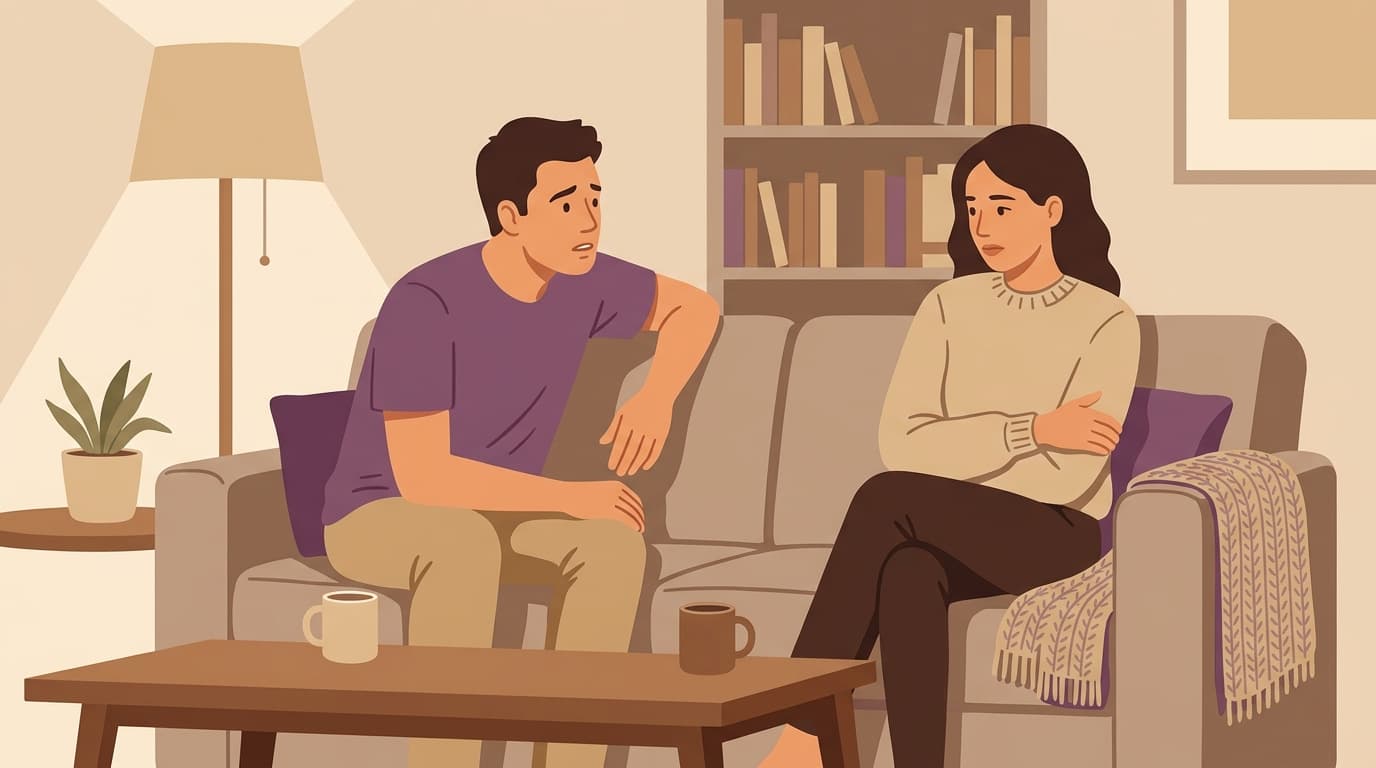
Key Takeaways
Effective apologies have three non-negotiable components: specific acknowledgment of what you did, understanding of its impact on your partner, and a concrete plan to prevent recurrence. 'I'm sorry you feel that way' contains none of them.
"I'm sorry."
Two words. Everyone knows them. Most couples say they don't actually help. The hurt person doesn't feel better. The one apologizing feels frustrated that their effort didn't land. Both walk away still carrying it.
The problem isn't that people don't apologize. Most apologies are just broken. They address the wrong thing, or come at the wrong time, or dodge the part that matters. And a bad apology doesn't just fail to fix things. It often makes them worse, because now the hurt person feels misunderstood on top of being hurt.
Gottman's research found that "repair attempts" during conflict are the single strongest predictor of whether a relationship survives — not how often you fight or what you fight about, but whether you can repair afterward.
Why most apologies fail
The non-apology
"I'm sorry you feel that way." "I'm sorry if I hurt you." "I'm sorry, but..."
These aren't apologies. They're apology-shaped sentences that avoid taking responsibility for anything. "I'm sorry you feel that way" puts the problem on the other person's reaction. "I'm sorry if I hurt you" introduces doubt about whether harm even happened. "I'm sorry, but" is a counterattack wearing an apology costume.
Most people using these phrases don't realize they're doing it. They feel genuinely sorry and think they're expressing it. But there's a gap between feeling remorse and communicating accountability, and the hurt partner can tell the difference instantly.
The premature apology
"Okay, I'm sorry. Can we move on?"
This one prioritizes the apologizer's discomfort over the other person's processing. It usually happens when whoever caused the hurt can't sit in their partner's pain. The apology becomes a tool for ending the conversation, not repairing it.
Premature apologies skip understanding. If you apologize before you really get what you did and why it hurt, your partner knows. They can tell you're sorry in the abstract (sorry there's conflict, sorry things are tense) but not sorry for the specific thing that got them. The specificity is what heals.
The explaining apology
"I'm sorry I snapped at you. I was stressed about the deadline and I hadn't eaten and my mom called this morning with that whole thing about the house and..."
The intention is context. The effect is minimization. Every reason you offer for your behavior works as a partial excuse, whether you mean it that way or not. Your partner hears: "I did this because of these other things, so it's not really about you, so maybe you shouldn't be so hurt."
Context can come later, after you've fully owned the impact without qualifiers. Accountability first. Explanations second, and only if your partner wants them.
The repeated apology
"I know I keep doing this. I'm so sorry. I'll do better."
When you've apologized for the same thing three times, the words have lost their weight. Your partner doesn't need more words. They need different behavior. Apologizing again without a concrete plan actually erodes trust further, because now your apologies are clearly disconnected from what you do.
What a real apology looks like
Psychologists Roy Lewicki and Beth Polin studied what makes apologies work. They found six components; three are non-negotiable:
1. Name what you did (be specific)
Not "I'm sorry about last night" but "I'm sorry I dismissed what you were saying about your sister and changed the subject."
Specificity proves you understand what happened. When you name the exact behavior, your partner knows you're not just apologizing for the mood in the room. You actually see what you did. This is the hardest part, honestly, because it means sitting with your own behavior clearly enough to describe it out loud.
2. Show you understand the impact (from their side)
Not "I know that wasn't great" but "I can see that made you feel like your relationship with your sister doesn't matter to me, and that you couldn't trust me with something you were already struggling with."
This takes real empathy. Not the general "I feel bad" variety, but the specific kind where you articulate your partner's experience from inside their perspective. When someone does this well, it's the part of the apology that heals the most. The injured person finally feels seen.
Gottman calls this "turning toward your partner's negative affect." It means moving toward the pain you caused instead of away from it. Most people instinctively move away. They minimize, deflect, explain, rush to resolution. Moving toward means staying with the uncomfortable fact that you hurt someone you love.
3. Say what you'll do differently
Not "It won't happen again" (it might) but "Next time you're telling me about something important, I'm going to put my phone down and actually listen. And if I catch myself drifting, I'll say so instead of just changing the subject."
This is what separates a one-time apology from actual repair. The plan doesn't have to be perfect. It has to be specific and honest. It should acknowledge that changing behavior takes time. It's not a switch.
The timing problem
When you apologize matters almost as much as how.
Too fast and your partner hasn't finished processing what happened. They can't receive an apology for something they haven't finished feeling yet. Your apology feels like pressure to wrap up their emotions on your schedule.
Too slow and the window closes. The longer you wait, the more your silence says. Your partner starts building a story about what that silence means: you don't care, you don't think you did anything wrong, you're waiting for them to get over it. Once that story takes hold, an apology has to work much harder.
The right timing is usually when your partner is ready to hear it, not when you're ready to say it. If you're unsure, ask: "I want to talk about what happened. Is now a good time, or do you need more space?" That question itself is a kind of care. It puts their needs first.
If you're the type who needs time before you can genuinely engage instead of reflexively defending, say that. "I need some time to think about what happened. Can we talk about it tonight?" is better than shutting down or delivering a half-meant apology. For more on this dynamic, see what to do when your partner shuts down.
After the apology: rebuilding trust
An apology opens a door. It doesn't walk through it.
Follow through on your plan. If you said you'd put your phone down during important conversations, do it. Every time. Not just for the next week until things feel normal again. Your partner is watching, not because they're keeping score, but because their nervous system needs repeated evidence that the old pattern is actually changing.
Don't say "I already apologized for that." Few sentences corrode a relationship faster. If your partner brings something up again, the repair isn't finished. Sometimes an injury needs to be processed more than once, particularly if it hit something old (an attachment wound, a childhood pattern, a core fear).
Let your partner be angry as long as they need. You don't get to set the timeline for someone else's healing. If you've apologized sincerely and you're backing it up with changed behavior, trust will come back. But demanding forgiveness on your schedule is just another way of prioritizing your own comfort.
Receiving an apology
Apologies go both ways. If your partner gives you a genuine one (specific, empathetic, with a plan), how you receive it matters too.
Acknowledge it. "Thank you for saying that. I can tell you thought about it" isn't weakness. It reinforces the thing you want more of.
Be honest about whether it landed. If they apologized for the wrong part, or the understanding wasn't quite there, say so. Not to punish, but to help. "I appreciate that. The part that really hurt was [this other thing]." Give them a chance to get it right.
Don't perform forgiveness you don't feel. "Fine, I forgive you" in a flat voice with crossed arms isn't forgiveness. If you're not there yet, say "I hear you and I need more time." That's more honest and more useful.
Building a repair culture
The couples who do this well don't just have good apology technique. They've built a relationship where admitting fault is normal, not dramatic. Saying "I messed up" isn't a crisis. It's a Tuesday.
Both people understand they're going to hurt each other sometimes. Not because they're bad partners, but because closeness means exposure, and exposure means someone's going to get scratched.
Regular check-ins about how the relationship is going help here. When you're in the habit of talking about what's working and what isn't, small repairs happen before things build up. You catch the missed bid, the careless comment, the evening where you were there but not really there, and you deal with it before it calcifies into resentment.
The couples who last aren't the ones who never hurt each other. They're the ones who got good at the repair.
Frequently asked questions
What if I don't think I did anything wrong?
Two things can be true at the same time: you didn't intend harm, and your partner was hurt. Impact and intent are separate things. You can acknowledge impact without conceding that your behavior was wrong: "I didn't mean to dismiss what you were saying, and I can see that's how it landed. I'm sorry for that." That's not caving. It's recognizing that your partner's experience is real regardless of what you intended.
How many times do I have to apologize for the same thing?
If you keep getting asked, one of two things is going on: the repair didn't fully land and your partner needs to process it more, or the behavior hasn't actually changed. If it's the first, be patient. Deep injuries take more than one conversation. If it's the second, stop apologizing and start doing something different.
My partner never apologizes. What do I do?
Model it. Apologize well yourself, consistently, and talk about what it feels like when repair happens versus when it doesn't. Some people grew up in families where apologizing meant losing, or where mistakes got punished instead of addressed. They may need to see that vulnerability isn't dangerous before they can try it themselves.
Is there a point where too many apologies signal a bigger problem?
Yes. If one person keeps apologizing for the same kind of thing (losing their temper, breaking promises, being emotionally checked out), the apologies are acting as a pressure release that prevents real change. At that point, you need to stop talking about individual incidents and start talking about the pattern. A therapist can help both of you see the cycle from above.
Aperi: one question a day
A daily question app that adapts to you and your partner, and goes deeper the more you use it.


Free to start. Available on iPhone and Android.
Explore question packs
Related articles
Lack of communication in a relationship is rarely a skills problem
Lack of communication in a relationship: what the breakdown looks like in practice, what causes it (rarely skills), and the scripts that rebuild it.
Passive-aggressive behavior in relationships
Passive-aggression isn't about dishes left in the sink. It's anger that learned to hide. How to spot it, respond to it, and stop doing it yourself.
The repair conversation: what to say after a big fight
The conversation after a fight matters more than the fight itself. Here is exactly how to have it.
Expressing your needs without starting a fight
Research-backed techniques for telling your partner what you need without triggering defensiveness or escalation.
12 rules for fighting fair
Conflict isn't the problem; how you fight is. Twelve research-backed rules for fighting fair, from soft startups to repair attempts.
How to have hard conversations without fighting
Soft startups, the speaker-listener format, repair attempts: tested techniques for hard conversations that don't turn into fights.