
Key Takeaways
Happy couples don't avoid conflict. They fight differently. Gottman's research shows that 69% of problems never get resolved, and that's fine. What matters is whether you fight with contempt or curiosity, whether you take breaks when flooded, and whether your repair attempts land.
One number should change how you think about relationship conflict: 69% of the problems couples argue about are perpetual. They never get resolved. Not because the couple is dysfunctional, but because the problems are rooted in fundamental differences in personality, values, or preferences that don't go away.
That finding comes from Dr. John Gottman's longitudinal research at the University of Washington, where his team tracked couples over decades and found that the majority of disagreements couples have at year one are essentially the same disagreements they have at year fifteen. The tidy partner and the messy partner. The spender and the saver. The introvert who needs alone time and the extrovert who feels abandoned by it.
The implication is uncomfortable but liberating: most of your fights aren't problems to solve. They're ongoing conversations to manage. And the difference between couples who thrive and couples who implode isn't whether they fight. It's how they fight.
The couples in Gottman's research who stayed together and stayed happy had just as many disagreements as the couples who divorced. But their conflicts had a different quality. Less contempt. More humor. More willingness to accept influence from each other. More repair attempts, those small gestures mid-fight that say "I know this is getting heated, but I still like you."
Fighting fair means keeping the fight about the actual issue instead of letting it become about whether you respect each other.
The Four Horsemen (and why they matter more than the topic)
Before the rules, the framework. Gottman identified four communication patterns that predict divorce with over 93% accuracy. He called them the Four Horsemen:
Criticism: attacking your partner's character instead of addressing a specific behavior. "You never think about anyone but yourself" versus "I felt hurt when you made plans without checking with me."
Contempt: expressing superiority or disgust. Eye-rolling, sarcasm, mockery, name-calling. This is the single most destructive pattern, more predictive of divorce than the other three combined. Contempt communicates: "You are beneath me."
Defensiveness: responding to a complaint with counter-complaints or excuses rather than taking any responsibility. "It's not my fault; you're the one who..." This feels protective but it tells your partner their feelings don't matter.
Stonewalling: withdrawing from the interaction entirely. Going blank, shutting down, walking out without a word. Usually a response to physiological flooding, not deliberate cruelty, but devastating to the other partner nonetheless.
Every rule below is essentially an antidote to one or more of these horsemen.
The 12 rules
1. Start soft or don't start at all
Gottman's research produced one of the most replicated findings in relationship science: 96% of the time, a conversation ends on the same emotional tone it began. If the first sentence is an accusation, the fight ends in a fight. If the first sentence is a vulnerable statement about how you feel, the conversation ends in understanding.
Harsh startup: "You forgot to call the school again. You're so irresponsible." Soft startup: "I noticed the school still hasn't been called. I'm feeling stressed about it. Can we figure out who's handling it?"
The formula: describe the situation without blame, state how you feel using "I" language, and make a specific request.
2. Fight about the real thing
Most couples think they're fighting about dishes, or screen time, or whose turn it is to deal with the plumber. They're usually fighting about something underneath: respect, fairness, feeling valued, feeling controlled, feeling invisible.
If you notice the emotional intensity of the fight doesn't match the topic, if you're furious about a dirty countertop, pause and ask yourself what this is really about. The dishes might represent "I feel like I carry the entire domestic load and you don't notice." That's a different conversation, and a more productive one.
3. No contempt. Period.
This is the non-negotiable. You can raise your voice. You can be frustrated. You can be wrong. But the moment you communicate that your partner is stupid, pathetic, or beneath you, you've crossed a line that causes real damage.
Contempt erodes the positive sentiment override, the baseline of goodwill that allows partners to give each other the benefit of the doubt. Once that's gone, every neutral action gets interpreted negatively. "They didn't text me back" goes from "they're probably busy" to "they don't care about me."
If you feel contempt rising, stop the conversation. Take a break. Come back when you can see your partner as a flawed human you care about, not an opponent you want to defeat.
4. Take the 20-minute break
When your heart rate exceeds 100 beats per minute, your prefrontal cortex, the part of the brain responsible for empathy, reasoning, and impulse control, goes offline. Gottman calls this "diffuse physiological arousal," or flooding. You can't listen. You can't problem-solve. You definitely can't de-escalate.
The rule: when either person notices signs of flooding (racing heart, clenched jaw, desire to flee or yell), call a break. Minimum 20 minutes, because that's how long it takes for the body to return to baseline. Say when you'll come back. Actually come back.
During the break: walk, read, breathe, pet the dog. Do not mentally rehearse your arguments. That keeps your arousal elevated and you'll walk back in just as flooded as when you left.
5. Ban "always" and "never"
"You always leave your stuff everywhere." "You never listen to me." These words feel true in the moment. They are almost never accurate. And they guarantee defensiveness because they erase every positive thing your partner has ever done.
Replace with specifics: "The last three times I've asked you to move your bag, it was still there the next morning. That's frustrating for me." Specifics can be discussed. Absolutes can only be defended against.
6. Accept influence
Gottman found that men who accept influence from their wives have an 81% chance of having a stable, happy marriage. Men who refuse their partner's influence, who insist on getting their way and dismiss suggestions or concerns, have a much higher rate of relationship failure.
This isn't gendered advice wrapped in research. It's about power dynamics. Whoever holds more structural power in the relationship (which is culturally often men, but not always) needs to actively practice yielding, compromising, and treating their partner's perspective as having equal weight to their own.
Accepting influence doesn't mean agreeing with everything. It means genuinely considering your partner's position and being willing to adjust yours.
7. Make repair attempts (and receive them)
A repair attempt is any gesture (words, humor, touch, tone shift) that tries to de-escalate during a conflict. "Can we start over?" "I'm sorry, that came out wrong." "I know we're both upset, but I love you." Even a well-timed joke can function as a repair attempt.
Gottman's research found that the success or failure of repair attempts is one of the primary factors in whether a couple's conflict is productive or destructive. Happy couples don't have better repair attempts; they have partners who are better at receiving them. They notice the attempt and let it work instead of batting it away.
If your partner tries to lighten the moment or extend an olive branch during a fight, take it. Even if you're still hurt. The repair attempt is not them minimizing the issue. It's them saying "The relationship is more important than winning this argument."
8. Stay on topic
One issue per fight. The moment you bring in last Tuesday, and that thing from Thanksgiving, and what their mother said, and the time three years ago when they were late, the original issue is lost. Now you're defending against an archive of grievances, and nobody wins that fight.
If other issues come up, acknowledge them: "That's a separate thing and I want to talk about it, but right now I need to stay on [the current topic]."
9. No character assassination
There's a critical difference between "You were careless with the budget this month" (behavior feedback) and "You're financially irresponsible" (character attack). The first describes something that happened. The second defines who your partner is.
People can change behavior. They can't un-be who you've told them they are. When you attack character, your partner stops listening to the feedback and starts defending their identity. The conversation is over; the defensive wall is up.
Stick to behaviors, impacts, and requests. "When you [specific behavior], I felt [emotion]. What I need is [specific request]."
10. Don't threaten the relationship
"Maybe we should just break up." "I don't know if I can do this anymore." These sentences weaponize the relationship itself. They're usually said in the heat of the moment without genuine intent, but they do cumulative damage. Every time the relationship's existence is put on the table as a negotiating tactic, your partner's sense of safety erodes.
If you genuinely are considering leaving, that's a conversation for a calm moment, ideally with professional support. If you're saying it because you're angry and want your partner to take you seriously, find a different way to communicate the severity of your feelings: "This issue is really important to me and I need us to figure it out."
11. Own your part
Every conflict has two contributors. Even when you're 90% right and 10% wrong, acknowledging your 10% changes the entire dynamic. It shifts the conversation from prosecution to collaboration.
"You're right that I should have told you about the expense before making it. I was wrong not to check in."
This isn't weakness. It's modeling the accountability you want from your partner. And research on effective apology shows that partial ownership by one partner makes the other partner dramatically more likely to take responsibility for their part.
12. End with understanding, not agreement
Not every conflict ends in agreement. Remember, 69% are perpetual. The goal is for both partners to feel heard and understood, even if you still disagree. "I hear that you need more alone time, and I hear that it's not about pulling away from me. I still struggle with it, but I understand where you're coming from."
That's a successful conflict. No resolution. Full understanding. The issue will come up again, and next time it'll be a little easier because you've both had the experience of being heard on it.
What fighting fair looks like in practice
Reading rules is easy. Applying them when your chest is tight and your jaw is clenched and your partner just said the one thing that makes you see red? That's the actual work.
The couples who fight well don't follow every rule every time. They slip up. They say the harsh thing. They bring up last Thanksgiving. But they also catch themselves. They apologize mid-sentence. They call the break when they feel the flooding. They circle back the next day and say "I'm sorry about how I said that. Can we try again?"
What distinguishes them isn't perfection. It's the ratio. Gottman's research found that stable, happy couples have a 5:1 ratio of positive to negative interactions during conflict. Five positive moments (humor, affection, agreement, empathy, interest) for every one negative moment. The negative moments don't disappear. They're just outweighed.
That ratio doesn't happen by accident. It happens because the couple has invested in their emotional bank account: through daily affection, through regular conversations about things that matter, through turning toward each other in small moments throughout the day. When the account is full, conflict is a withdrawal you can afford. When it's empty, every fight feels existential.
Building that reserve of goodwill starts with small, consistent practices: a daily question, a genuine "how are you," a moment of curiosity about your partner's inner world. The Conflict to Connection pack was designed specifically for couples who want to get better at this: questions that help you understand each other's conflict styles, triggers, and needs before you're in the heat of the moment.
Frequently asked questions
Is it normal to fight every week?
Frequency alone doesn't determine relationship health. Some couples argue weekly and are perfectly happy; others rarely argue but are deeply disconnected. What matters is the quality of the conflict: whether both partners feel heard, whether repair attempts land, and whether the fights are about specific issues or have devolved into character attacks. If your weekly arguments follow a predictable, destructive pattern (same escalation, same stonewalling, same unresolved ending), that's worth addressing, but not because of the frequency.
What if I follow these rules but my partner doesn't?
You can't control your partner's behavior, but your behavior changes the dynamic. Research consistently shows that when one partner shifts their conflict style (softer startups, fewer absolutes, more repair attempts) the other partner's behavior changes in response, often without conscious effort. It's not instant, and it's not guaranteed, but conflict patterns are bidirectional. Changing one side changes both sides. If your partner consistently fights with contempt, defensiveness, or cruelty despite your sustained efforts, that's a signal that professional help is needed.
How do you fight fair over text?
You don't. Text removes tone, facial expression, pacing, and all the nonverbal signals that humans rely on to interpret meaning. Research on digital communication shows that negative messages are interpreted as more hostile in text than in person. If a conflict starts over text, pause it: "This is important and I want to talk about it properly. Can we discuss tonight in person?" If you absolutely must address something in writing, read your message out loud in the most uncharitable tone you can imagine. If it sounds aggressive, rewrite it.
What if we fight about the same thing over and over?
That's probably one of Gottman's perpetual problems, and it's completely normal. The fix isn't resolution; it's developing a way to talk about it that honors both perspectives without contempt. Try sharing the dream within the conflict: "When I push for us to save more, it's because growing up we never had financial security and I'm terrified of that happening again." When your partner understands the deeper meaning behind your position, the disagreement becomes more tender and less combative, even if the positions don't change.
Are there things you should never say in a fight?
Yes. Contemptuous language (name-calling, mockery), threats to leave as a weapon, bringing up vulnerabilities your partner shared in confidence, and comparisons to exes or family members meant to wound. These cause damage that outlasts the argument. You can be angry, frustrated, and hurt without being cruel. The line between "expressing hard feelings" and "trying to hurt" is usually clear if you're honest with yourself about which side you're on.
Aperi: one question a day
A daily question app that adapts to you and your partner, and goes deeper the more you use it.


Free to start. Available on iPhone and Android.
Explore question packs
Related articles

Lack of communication in a relationship is rarely a skills problem
Lack of communication in a relationship: what the breakdown looks like in practice, what causes it (rarely skills), and the scripts that rebuild it.
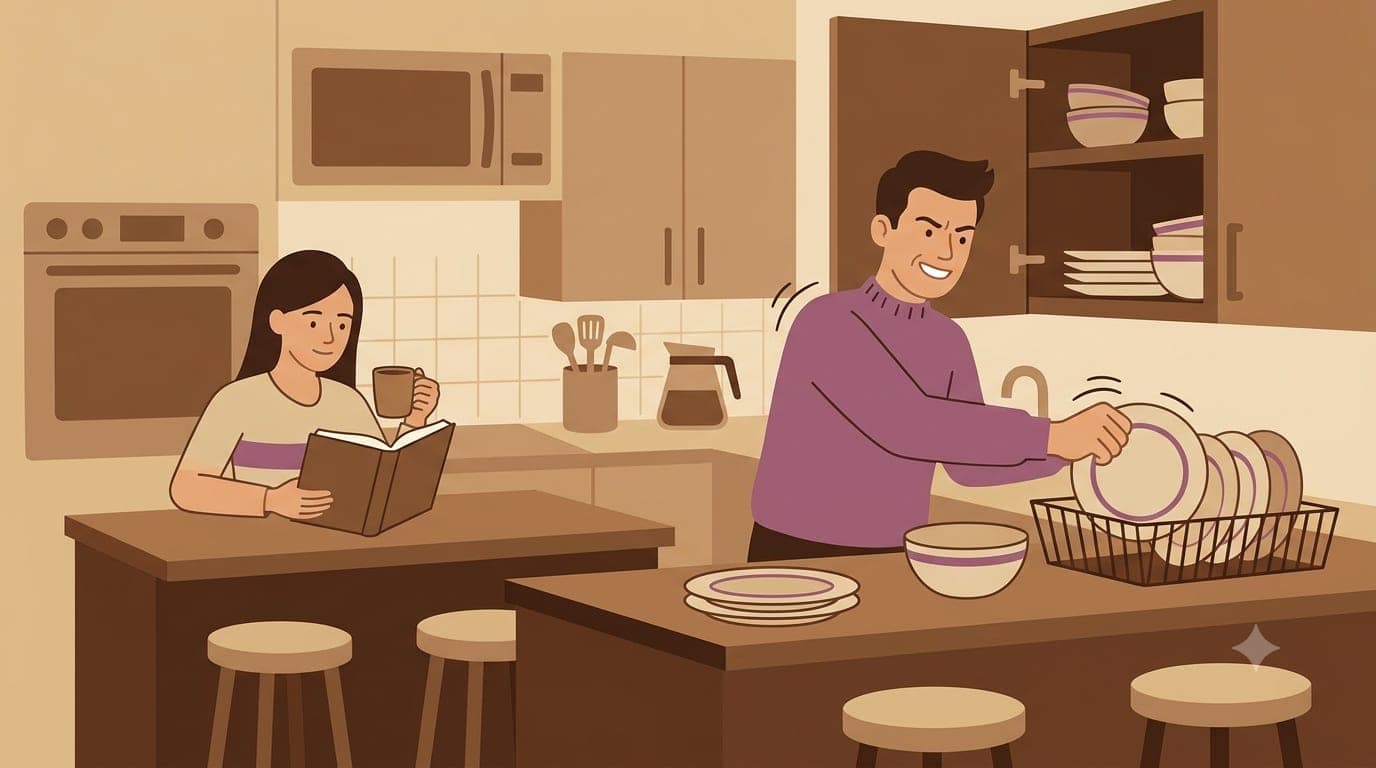
Passive-aggressive behavior in relationships
Passive-aggression isn't about dishes left in the sink. It's anger that learned to hide. How to spot it, respond to it, and stop doing it yourself.

The repair conversation: what to say after a big fight
The conversation after a fight matters more than the fight itself. Here is exactly how to have it.

Why most apologies don't work
Most apologies make things worse. What the research says about real repair attempts and why 'I'm sorry you feel that way' always fails.

Expressing your needs without starting a fight
Research-backed techniques for telling your partner what you need without triggering defensiveness or escalation.

How to have hard conversations without fighting
Soft startups, the speaker-listener format, repair attempts: tested techniques for hard conversations that don't turn into fights.