Key Takeaways
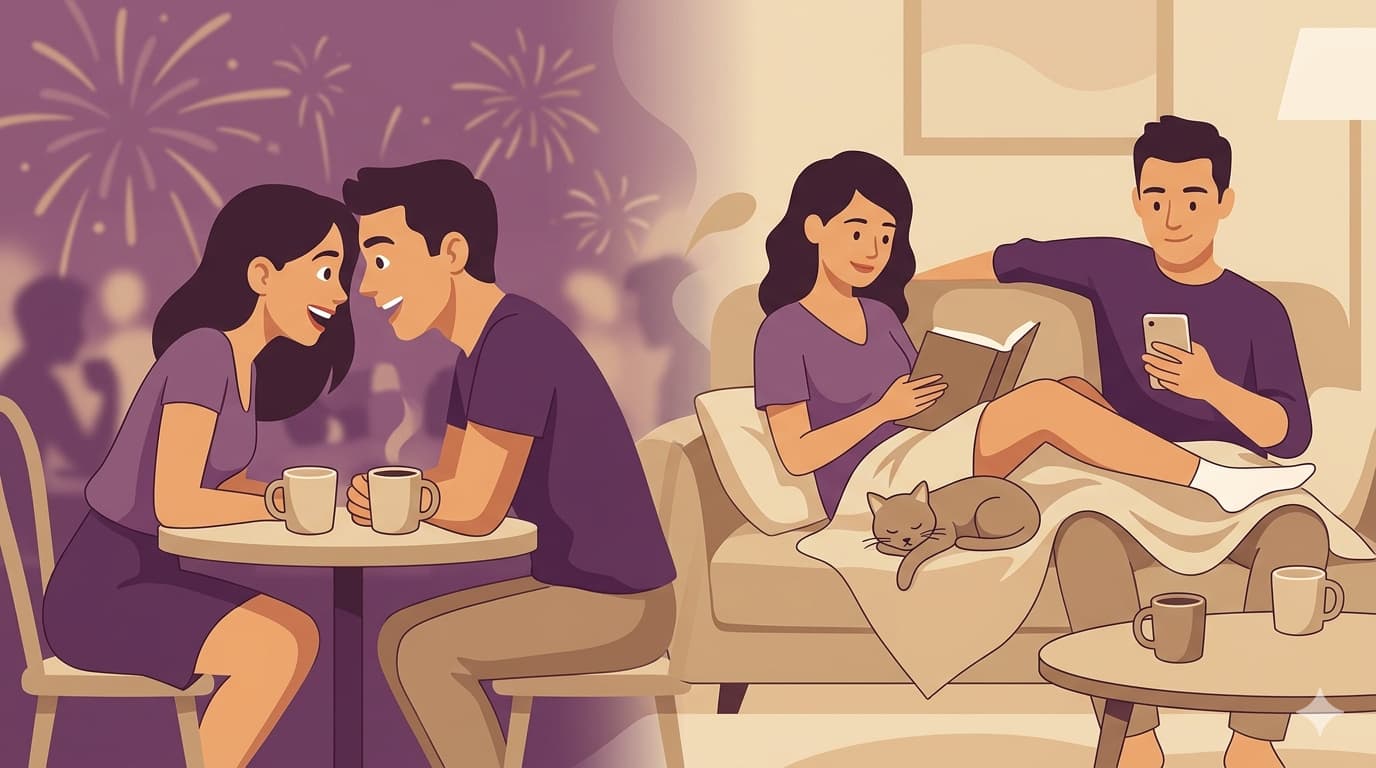
Being 'in love' is a dopamine-driven state of limerence that lasts 18 months to 3 years. Loving someone is an oxytocin-based attachment bond built on choice and knowledge. The transition between them feels like loss but is actually maturation. Research by Acevedo and Aron (2011) shows passion can persist in long-term love, just without the anxiety and obsession of the early phase.
At some point in most long-term relationships, someone thinks the sentence that starts the slow unraveling: I love them, but I'm not in love with them anymore.
It's said in therapists' offices, whispered to friends over drinks, typed into search bars at 1 AM. And it's usually treated as a verdict. As if the absence of that specific feeling means the relationship has expired and there's nothing left to do but figure out the logistics of leaving.
But what if the premise is wrong? What if "in love" and "loving someone" aren't the same thing at different intensities but two entirely different processes running on different neurochemistry, different timelines, and different rules? And what if the shift from one to the other isn't a loss at all, but a transition that every lasting relationship has to make?
What happens in the brain when you're "in love"?
Helen Fisher, a biological anthropologist at Rutgers, put people in fMRI machines and watched their brains respond to photographs of their romantic partners. Her studies, published beginning in 2005, revealed a specific neural signature for early romantic love.
The ventral tegmental area (VTA) lit up. This is a primitive brain region that produces dopamine and sends it surging into the caudate nucleus, part of the brain's reward system. The same circuitry activates when you take cocaine or win a bet. The brain of a person newly in love is, in a measurable sense, addicted.
Fisher also found elevated norepinephrine, which accounts for the racing heart, the sweaty palms, the inability to eat or sleep. And she found suppressed serotonin levels, which is the same pattern observed in people with obsessive-compulsive disorder. That explains the intrusive thinking, the constant mental loop of the other person's face, words, and imagined scenarios.
This cocktail produces what most people call "the spark." It's real. It's measurable. And it's temporary.
What is limerence and why does it end?
Dorothy Tennov, a psychologist at the University of Bridgeport, spent years interviewing people about their romantic experiences. In 1979 she published Love and Limerence, in which she coined the term limerence to describe the involuntary state of obsessive longing for another person.
Limerence has specific features. Intrusive thinking about the "limerent object." Acute sensitivity to their behavior, reading meaning into every text, every glance, every pause. Desperate need for reciprocation. Idealization of the beloved. Fear of rejection that borders on physical pain.
Tennov's research found that limerence typically lasts between 18 months and 3 years. In rare cases it persists longer, usually when the relationship involves uncertainty or intermittent reinforcement (which, not coincidentally, is the most potent schedule for maintaining addictive behavior). But in stable relationships where both partners are available and responsive, limerence fades.
Why? Because limerence is a bonding mechanism, not a permanent state. Fisher argues that it evolved to keep two people focused on each other long enough to conceive and begin raising offspring. Once the bond is established, the brain shifts resources. The dopamine surge tapers. The obsessive circuits quiet. Something else takes its place.
What does the brain do when limerence ends?
The replacement system is quieter. Oxytocin and vasopressin, neurochemicals associated with attachment, bonding, and trust, become the dominant players. These chemicals don't produce the high-voltage excitement of dopamine. They produce something different: a sense of calm when your partner is near. A stress response when they're gone. A deep, pre-verbal feeling of safety.
This is the biological basis of what Elaine Hatfield at the University of Hawaii calls companionate love: the affection and intimacy felt for someone with whom your life is deeply intertwined. Her research, conducted with Richard Rapson across multiple cultures, found that companionate love was a far stronger predictor of long-term relationship satisfaction than passionate love. Couples high in companionate love at the 10-year mark reported greater happiness, better health, and more frequent sex than couples who scored high on passionate love but low on companionate love.
More frequent sex. The couples who had deep friendship and steady attachment had more physical intimacy than the couples running on passion alone. The "boring" love outperformed the "exciting" love on the very metric people think it lacks.
Does the shift from "in love" to "loving" mean something is wrong?
No. It means something is right. Or at least, something is normal.
The problem is that our cultural narratives treat the limerent phase as the real love and everything after as a diminished version. Rom-coms end at the point where love gets interesting. Breakup stories begin at the point where limerence fades. We've built a collective story that says the transition from dopamine to oxytocin is a kind of death, when the research says it's closer to a metamorphosis.
Robert Sternberg's Triangular Theory of Love provides a useful frame here. Early love is typically high on passion and fast-growing intimacy, with commitment developing later. As the relationship matures, passion naturally declines while intimacy deepens and commitment solidifies. The combination of intimacy and commitment without passion is what Sternberg calls companionate love. The combination of all three is what he calls consummate love, the complete form. For a full breakdown of all seven types in Sternberg's model, see the guide to seven types of love.
The couples who reach consummate love don't do it by clinging to the early passion. They do it by building the intimacy and commitment layers so solidly that passion has a foundation to rest on when it returns in a different form.
Can passion actually persist in long-term relationships?
One finding complicates the simple narrative.
In 2011, Bianca Acevedo and Arthur Aron at Stony Brook University published a study that scanned the brains of people in long-term relationships (average duration: 21 years) who reported still being intensely in love with their partners. The scans showed activity in the VTA, the same dopamine-producing region that lights up in early romantic love.
But there was a difference. The regions associated with anxiety, obsession, and mania, the ones that make early love feel like a fever, were quiet. These long-term lovers had intensity without instability. Passion without the panic.
Acevedo and Aron proposed that this represents a distinct form of romantic love: one that retains the reward-system activation of early passion but sheds the insecurity and obsessiveness. They called it "romantic love without obsession," which is a less catchy name for what might be the best feeling humans are capable of having.
Their finding suggests that the common assumption, passion must fade, is incomplete. What fades is limerence. What can persist, given the right conditions, is a mature passion grounded in deep knowledge of the other person. The difference is that early passion is fueled by novelty and uncertainty, while long-term passion is fueled by intimacy and choice.
When does the shift feel like grief?
For many people, the transition from limerence to attachment feels genuinely like a loss. And honestly, it is a loss. The high is gone. The obsessive thinking stops. The world that was saturated with color returns to normal contrast. Your partner, who once occupied every corner of your mind, becomes one element among many in your daily life.
This is the moment when people most often think: I've fallen out of love. Something is missing. I need to find that feeling again, maybe with someone else.
The grief is real and worth honoring. But acting on it as if it were evidence that the relationship has failed is like leaving a movie 30 minutes in because the opening credits were more exciting than the second act. The second act is where the actual story lives.
Esther Perel, a couples therapist and researcher, writes about this transition with unusual honesty. She argues that the loss of limerence confronts us with a choice most people don't realize they're making: will you grieve the fantasy and engage with the real person in front of you, or will you keep chasing the fantasy with someone new?
The couples who choose engagement describe something that sounds like the opposite of limerence but feels, in its own way, deeper. Instead of "I can't stop thinking about you" it's "I choose to pay attention to you." Instead of "I can't live without you" it's "I want to build a life with you." The verbs change from involuntary to voluntary. From happening to you, to something you do.
What does choosing love look like daily?
It looks boring. That's the honest answer.
Choosing love looks like asking how their day was and listening to the answer even when you're tired. It looks like turning toward a bid for connection instead of staying on your phone. It looks like saying "I'm sorry" after a fight even when you still think you were right about the underlying issue. It looks like noticing that they seem off and asking about it rather than waiting for them to bring it up.
Gottman's research quantifies this. The "masters" of relationships, those who stayed together and reported high satisfaction, turned toward their partner's bids for connection 86% of the time. The "disasters" turned toward 33% of the time. The gap wasn't about grand romantic gestures. It was about the thousands of micro-decisions that accumulate into a felt sense of: this person cares about me. This person sees me. I'm not alone in this.
There's a paradox embedded in the research. The couples who work hardest at love often describe it as feeling effortless. Not because no effort is involved, but because the effort has become habitual enough that it doesn't feel like work. Like how a skilled musician doesn't experience playing their instrument as "effort" even though it took years of practice to get there.
How do you tell the difference between a natural transition and a real problem?
This is the question that matters most, and it deserves a careful answer.
The transition from limerence to attachment is: the excitement dims but the respect and warmth remain. You're less obsessed but still engaged. You don't think about them constantly, but when you do think about them, it's with fondness. You'd still choose them. You just don't feel the compulsive need anymore.
A real problem is: the warmth is gone. You feel indifferent or actively irritated by their presence. You've stopped turning toward bids. Contempt has replaced affection. You avoid them. You don't think about them with fondness. You think about them as an obligation, an annoyance, or not at all.
The first scenario is the normal shift from dopamine to oxytocin. It's manageable, and many couples find that actively investing in novelty and curiosity can reintroduce elements of passion. Aron's research on shared novel activities supports this.
The second scenario requires attention. It might be the result of accumulated unrepaired hurts, unaddressed resentment, or the erosion that comes from years of neglect. These issues are repairable with work, as Gottman's method and Emotionally Focused Therapy both demonstrate. But they require honest acknowledgment first.
If you're in the first scenario and worrying you're in the second, the best thing you can do is start engaging again. Ask a real question. Plan something new. Turn toward instead of away. See what happens. The response will tell you what you're dealing with.
Aperi's daily questions are built around this exact insight: that a single genuine question, asked with curiosity, can be the smallest unit of choosing love. Not the whole solution, but a starting point that you can practice every day while you figure out what the larger picture looks like. The relationship between relationship stages and the type of questions that matter is something the app calibrates for.
Frequently Asked Questions
Is it possible to fall back "in love" with your long-term partner?
The limerent phase, with its obsessive thinking and dopamine highs, doesn't typically return in its original form. But Acevedo and Aron's 2011 brain imaging study showed that intense romantic feelings, including VTA activation, can persist or reappear in long-term relationships. Aron's self-expansion research suggests that engaging in new, challenging activities together can reactivate some of the neurochemical patterns associated with early passion. It won't feel identical to month three. It can feel equally intense in a different way.
How long does the "in love" feeling typically last?
Dorothy Tennov's research puts limerence at 18 months to 3 years in most cases. Helen Fisher's neurochemical data is consistent with this timeline. The transition is gradual rather than sudden. Most people don't wake up one morning no longer in love. They slowly realize that the obsessive thinking has quieted and the emotional intensity has settled into something calmer.
My partner says they love me but aren't "in love" with me. Is the relationship over?
Not necessarily. This statement usually describes the transition from limerence to companionate love, which is biologically normal. The question is whether warmth, respect, and willingness to engage remain. If yes, the relationship has a strong foundation, and active investment in novelty and curiosity can often restore elements of passion. If the statement is accompanied by contempt, withdrawal, or indifference, the issue is deeper than a normal neurochemical transition and may require professional support.
Does loving someone mean you should stay with them?
Not automatically. Love is a necessary but insufficient condition for a healthy relationship. You can love someone and still have incompatible values, harmful dynamics, or unresolvable differences. The roommate rut describes one common pattern where love persists but the relationship has become functionally empty. Respecting both the love and the reality of the relationship is part of making an honest decision about whether to stay or go.
What's the difference between companionate love and just being comfortable?
Companionate love involves active warmth, genuine interest in the other person, and continued emotional investment. Comfort without companionate love is more like cohabitation. The test: do you still feel genuine fondness when you look at your partner? Are you curious about their inner life? Do you care about their happiness as much as your own? If yes, that's companionate love. If you feel neutral or indifferent, the comfort might be masking a deeper disconnection.
Aperi: one question a day
A daily question app that adapts to you and your partner, and goes deeper the more you use it.


Free to start. Available on iPhone and Android.
Explore question packs
Related articles
Building self-worth that doesn't depend on your partner
When your self-worth depends on your partner's approval, every interaction becomes high-stakes. Here's how to build an internal foundation.
When you project your insecurities onto your partner
Projection makes you fight about things that aren't real. How to catch it, understand where it comes from, and stop.
Why boredom in your relationship isn't always bad
Relationship boredom gets a bad reputation. Sometimes it signals safety. Sometimes it signals stagnation. Here is how to tell the difference.
When you and your partner speak different love languages
You show love your way, not theirs. How to close the gap when you and your partner express affection differently, beyond the quiz.
What research says about age gap relationships
Age gap relationships attract strong opinions. What does the data actually show about satisfaction, power dynamics, and stigma?
Grieving together without growing apart
Partners often grieve differently and asynchronously. How to support each other through loss without losing your connection.