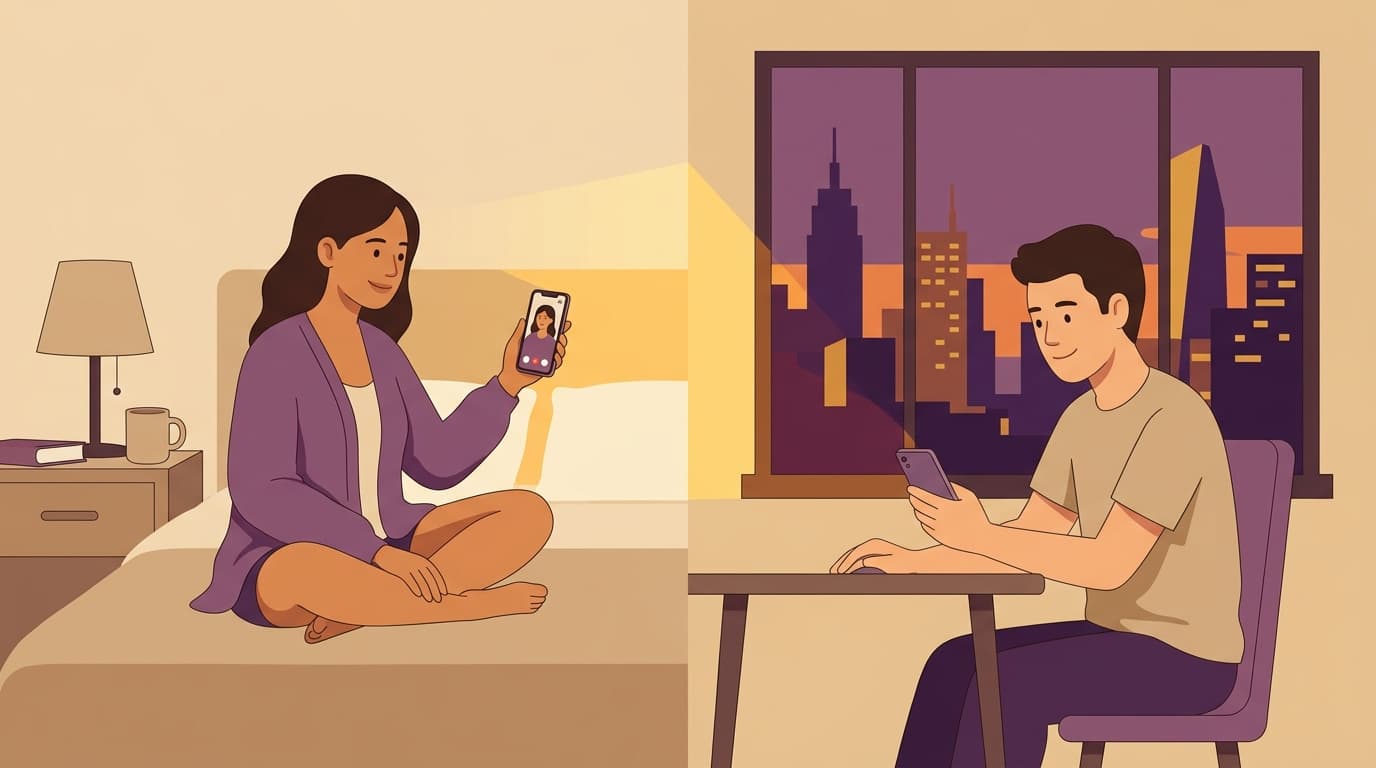
Key Takeaways
Long-distance couples who thrive share three traits: they prioritize quality of communication over quantity, they maintain independent lives instead of merging identities over video, and they have a concrete plan for eventually closing the distance.
You've heard the warnings. Everyone has an opinion about long-distance relationships, and most of those opinions are negative. "Out of sight, out of mind." "It never works." "You're just delaying the inevitable."
The data tells a different story: long-distance relationships are about as likely to succeed as geographically close ones. A 2013 study in the Journal of Communication found that long-distance couples reported equal or higher levels of relationship satisfaction and communication quality compared to proximal couples. A meta-analysis by Crystal Jiang and Jeffrey Hancock at Cornell confirmed that distance itself doesn't reliably predict breakup.
That doesn't mean distance is easy. It means the things that make relationships work (communication quality, trust, emotional responsiveness) are the same regardless of geography. Distance just strips away the passive stuff, so you have to be deliberate about the rest.
Why long-distance relationships get a bad reputation
Survivorship bias. The long-distance relationships people remember are the ones that failed, usually with a dramatic story attached. The ones that worked just... became regular relationships eventually. Nobody writes a cautionary tale about the couple who did long-distance for two years, closed the gap, and now argues about whose turn it is to unload the dishwasher.
There's also a selection effect. Some long-distance relationships weren't strong to begin with. They started as short flings that tried to stretch across distance, or they were already struggling when one partner moved. These relationships would have ended regardless of geography, but distance gets the blame.
The relationships that do work at a distance tend to share specific traits. Worth understanding whether you're currently long-distance or not.
What the research says works
Quality over quantity of communication
Dr. Crystal Jiang's research found that long-distance couples don't actually communicate more than proximal couples in total time. The difference is quality. Long-distance couples have more substantive conversations, about feelings, about the relationship, about their actual lives, because they can't coast on passive togetherness.
When you live together, a lot of your "communication" is logistical or ambient. You're in the same room, you exchange a few words about dinner, you watch something, you go to bed. It counts as time together but it doesn't build much. Long-distance couples don't have that ambient layer, so when they do talk, they tend to go deeper.
This transfers to other situations too. The roommate rut that many cohabiting couples fall into is the long-distance advantage in reverse: too much ambient contact, not enough real conversation.
So don't try to simulate living together over video. You can't, and the attempt creates exhausting marathon calls that neither person enjoys. One meaningful 30-minute call beats a three-hour video session where you're both half-doing other things.
Maintain separate lives
A counterintuitive finding: couples who maintain active independent lives during the separation (friendships, hobbies, personal goals) report higher satisfaction than couples who organize everything around the next call.
This makes sense through the lens of self-expansion theory, Arthur Aron's framework (the same researcher behind the 36 questions study). Relationships do better when both people are growing individually and bringing new experiences back. If your entire life outside of work is waiting for your partner to get online, you have nothing new to share. The relationship starts to feel like a holding pattern.
It also heads off a dynamic where one partner becomes the other's entire social world. That kind of dependency puts impossible pressure on every interaction.
Have a concrete plan for closing the distance
This is the single biggest predictor of long-distance success in the research. Couples who have a specific, agreed-upon plan for eventually being in the same place, even if it's 18 months away, handle the daily grind of distance much better than couples with no endpoint.
The plan doesn't need to be perfectly detailed. "You'll move here after you finish your degree in June 2027" is enough. What matters is that you both agree on it, it's realistic, and you can point to it during hard moments.
Open-ended distance ("we'll figure it out eventually") is where most relationships erode. Without an endpoint, the sacrifices feel purposeless. Resentment builds because neither person can answer "how long do I have to do this?" Each time the topic gets avoided, it gets heavier.
If you don't know when or how you'll close the distance, that's a conversation worth having out loud rather than leaving it unspoken. The uncertainty itself isn't fatal. Pretending it doesn't exist is.
The specific challenges (and what to do about them)
Jealousy and trust
Distance amplifies jealousy because you can't verify through observation. Your partner mentions a new coworker, and your imagination fills in details that wouldn't occur to you if you'd met the person at a party.
The fix isn't constant check-ins or location sharing, which just create surveillance dynamics. It's transparent, voluntary sharing about your daily life. Not because you owe an account of your movements, but because including your partner in the texture of your day shrinks the gap that jealousy fills.
If jealousy is a recurring issue, it's worth examining whether it's about the current relationship or about attachment patterns that predate it. Anxious attachment in particular can make distance feel existentially threatening, not because your partner is untrustworthy, but because separation triggers the same alarm system that fired in childhood.
Mismatched communication needs
One partner wants to text throughout the day. The other finds constant messaging draining. This mismatch exists in all relationships but distance makes it acute because texting and calls are basically your only connection channel.
The solution is saying what you need out loud, not adapting through silent frustration. "I love hearing from you but I can't text during work hours. Can we do a morning message and an evening call?" is more sustainable than either person suppressing what they actually want.
Some couples find that asking each other a daily question gives them a reliable touchpoint. One thoughtful question and two honest answers can maintain closeness with minimal time commitment, without the pressure of sustaining a full conversation.
Physical intimacy gaps
This is the most honest challenge and the one least discussed in polite advice columns. Physical proximity matters. Touch, sex, casual physical closeness: these are real needs, and distance means they go unmet for weeks or months at a time.
There's no clean fix. What helps: plan visits frequently enough that the gap never feels infinite (every 4-6 weeks seems to be a common sustainable rhythm for most couples). Be honest about what you miss without using it as a weapon. And know that the first few hours of a visit are often awkward. You're readjusting to each other's physical presence. That's normal.
Time zone differences
Time zones add a logistical layer that starts to feel personal. When your best evening hours overlap with your partner's work day, somebody has to sacrifice. Over months, this breeds resentment if it's always the same person making the adjustment.
Rotate who adjusts. Share the inconvenience. And build in asynchronous communication that doesn't require real-time overlap: voice messages, short videos of your day, a shared photo album. These keep you present in each other's lives without demanding you both be awake at the same time.
When distance reveals something important
Sometimes what distance shows you is uncomfortable. You might discover that you don't miss your partner as much as you expected, or that the relationship worked better when it was limited to intense reunion weekends. Maybe the version of your partner you carry in your head doesn't quite match the person on the other end of the call. That's a weird thing to sit with.
None of this means you failed. It means you learned something you couldn't see from up close. A relationship that can't survive distance was probably held together by proximity more than either person realized, whether that looked like codependency, conflict avoidance, or just comfortable routine.
If distance reveals that your communication is shallow, that's worth addressing whether or not you close the gap. If it reveals that you've been avoiding difficult conversations, distance didn't create that problem. It just removed the background noise that let you ignore it.
Making visits count
The pressure to make every visit perfect often ruins them. You plan every hour, you stack expectations, and then you're both exhausted and vaguely disappointed by Sunday afternoon.
Protect unstructured time instead. Some of the visit should have no plans at all. Just existing together the way you can't when separated. Grocery shopping, cooking a meal, lying on the couch doing nothing. These mundane moments are what you actually miss, and they're what your relationship needs practice at.
Also: have at least one real conversation during each visit. Not catching up, not logistics, not just fun. Talk about how the relationship is going, what you need more or less of, how you're each handling the distance. This is harder in person than you'd think, because the visit feels precious and nobody wants to "waste" it on heavy topics. But avoiding these conversations in person, where you have tone and body language and touch available, and trying to have them over text instead? You'll regret that every time.
Frequently asked questions
How often should we visit?
No universal answer, but every 4-6 weeks seems sustainable for most couples. More often is better if you can swing it financially. The real question is whether the time between visits feels manageable. If you're both falling apart by week three, the gap is too long.
Should we have a "no phones" rule when we're together?
Not as a strict rule, but maybe as a default. The pull to document the visit or catch up on everything you've been handling alone is real. Try agreeing on some screen-free windows (meals, first and last hour together) and let the rest be natural.
Is it okay to not talk every day?
Yes. Plenty of successful long-distance couples skip days. What matters is consistency and reliability, not daily check marks. If you talk most days and miss one, that's fine. If skipping days starts to worry one of you, talk about it directly rather than letting anxiety fill the silence.
We don't have a plan for closing the distance. Is that a dealbreaker?
Not right away, but it needs to become a real conversation soon. Couples can handle uncertainty for a while, but open-ended ambiguity slowly drains the motivation to keep investing. You don't need a move-in date. You need both people agreeing that closing the distance is the goal, and a rough sense of what needs to happen to get there.
My partner seems fine with the distance but I'm struggling. Does that mean they care less?
Probably not. People handle distance differently depending on attachment style, introversion, and how much their daily life already fills their social needs. Someone who's busy and socially engaged might be okay with less contact, not because they care less, but because their baseline need for connection is different from yours. The conversation is about finding a rhythm that works for both of you, even when your defaults don't match.
Aperi: one question a day
A daily question app that adapts to you and your partner, and goes deeper the more you use it.


Free to start. Available on iPhone and Android.
Explore question packs
Related articles
When your partner travels for work
Work travel creates an asymmetry that regular long-distance advice ignores. What actually helps couples stay connected when one partner is always away.
Military couples: staying connected across distance and deployment
Military relationships face unique stressors from deployment to reintegration. What research says about staying connected.
Communication in marriage: how the years change the conversation
Communication in marriage erodes through efficiency, not conflict. What the years change, which patterns predict real trouble, and what daily practice looks like.
Lack of communication in a relationship is rarely a skills problem
Lack of communication in a relationship: what the breakdown looks like in practice, what causes it (rarely skills), and the scripts that rebuild it.
50 couples therapy questions, in the order a therapist would ask them
50 couples therapy questions sequenced like a real session: history, patterns, needs, repair, future. Plus an honest look at when a list is not enough.
When you and your partner speak different love languages
You show love your way, not theirs. How to close the gap when you and your partner express affection differently, beyond the quiz.