Key Takeaways
One partner pushes for connection, the other retreats to self-protect, and the cycle feeds itself. Breaking it requires the withdrawer to re-engage before the pursuer softens, and both people have to see the pattern as the enemy, not each other.
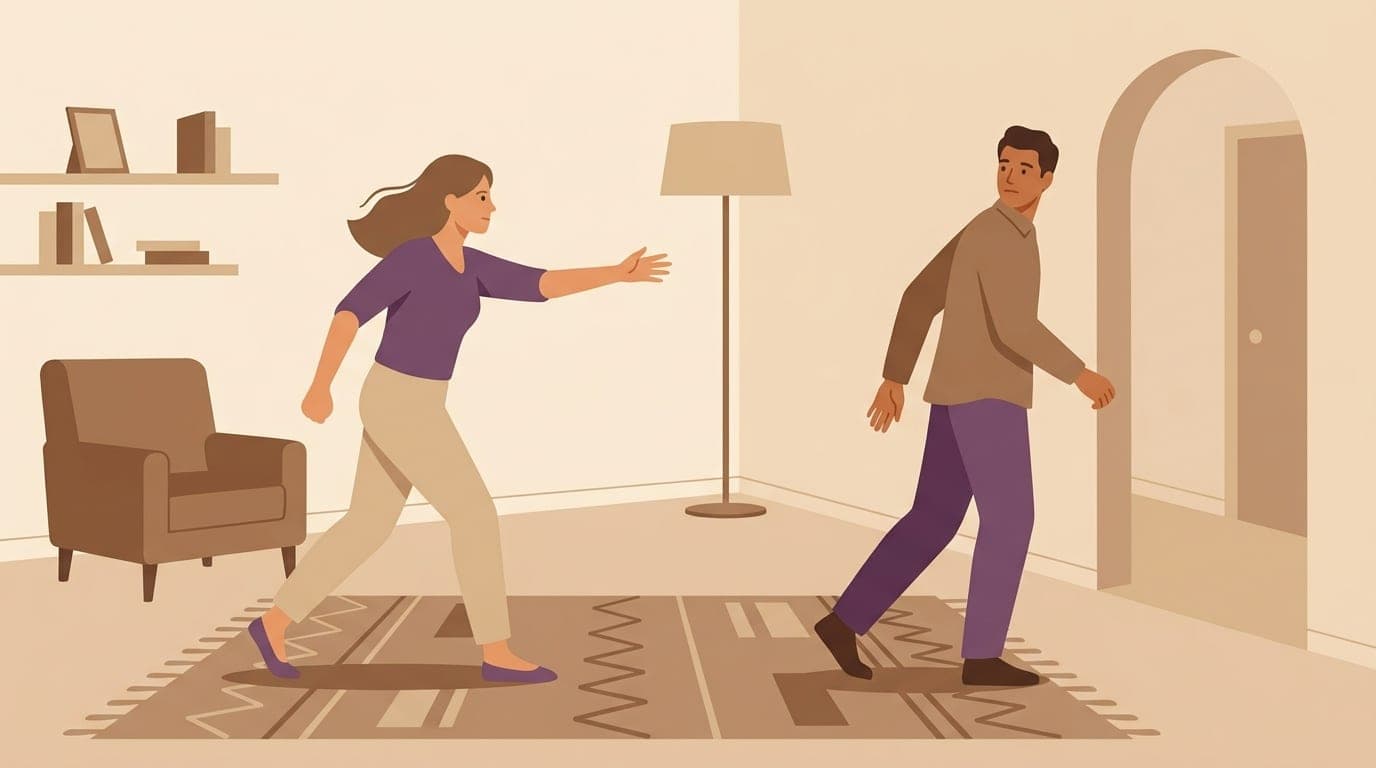
You've had this fight before. Maybe hundreds of times. The topic changes (dishes, money, sex, in-laws) but the choreography stays the same. One of you leans in, voice rising, wanting to talk about it right now. The other goes quiet, leaves the room, or offers a flat "fine" that means anything but.
You're not imagining the repetition. Researchers Andrew Christensen and Neil Heavey documented this pattern in 1990 and found it in roughly 60% of the couples they studied. They called it the demand-withdraw pattern. Therapists now more commonly call it the pursuer-withdrawer cycle. Whatever the name, it's the single most common conflict dynamic in romantic relationships.
And it's remarkably hard to break. Not because people are stubborn, but because both sides are doing something that makes complete sense from their own perspective.
What does the pursuer-withdrawer cycle actually look like?
The basic mechanics are simple. One partner (the pursuer) tries to engage: they bring up a concern, ask questions, push for a resolution. The other partner (the withdrawer) disengages: they go quiet, change the subject, leave, or shut down emotionally.
The pursuer reads the withdrawal as abandonment. So they pursue harder. The withdrawer reads the escalation as attack. So they withdraw further. Each person's coping strategy triggers the other person's worst fear, and the cycle tightens.
A typical sequence:
Partner A notices something is off. They say, "Can we talk about what happened last night?" Partner B tenses up. They say, "There's nothing to talk about." Partner A feels dismissed. They press: "You always say that. I need you to actually engage with me." Partner B feels cornered. They go quiet or walk away. Partner A follows, frustrated. Partner B shuts down completely.
The topic barely matters. What's actually happening is a feedback loop about connection and safety. The pursuer is trying to reestablish connection. The withdrawer is trying to reestablish safety. Both needs are legitimate. But the strategies are mutually exclusive.
Is there a gender pattern?
Yes, but it's not absolute. Christensen and Heavey's original research found that women are more likely to be the pursuer and men the withdrawer. Later work confirmed this holds in heterosexual couples, with women pursuing about two-thirds of the time.
There are a few reasons for this. Women are socialized to be relationship caretakers and are often more attuned to relational problems. Men are socialized to avoid emotional vulnerability and may have fewer tools for handling intense relational conversations. Physiologically, men tend to experience "flooding," the overwhelm of the autonomic nervous system during conflict, more quickly and intensely than women, according to Gottman's lab research. Withdrawal is a self-protective response to flooding.
But gender doesn't determine the role. In same-sex couples, the pattern still appears at similar rates; it just distributes differently. And in many heterosexual couples, the man pursues and the woman withdraws, particularly around topics like physical intimacy or shared activities. The pattern often flips depending on who cares more about the issue at hand.
What matters isn't who fills which role. What matters is recognizing that you have roles at all.
Why does both sides feel completely justified?
This is what makes the pattern so sticky. Neither person is being irrational.
The pursuer's logic: "If I don't bring this up, it'll never get addressed. You'll just pretend everything is fine. I'm the one doing the emotional work here, and you won't even show up for a conversation."
The withdrawer's logic: "Every time I try to talk, it turns into a fight. Nothing I say is good enough. The safest thing I can do is not engage, because engaging just makes it worse."
Both are correct about their own experience. The pursuer is often carrying more of the emotional labor. The withdrawer does often face criticism no matter what they say. The problem is that each person can only see their own side of the trap.
Paul Watzlawick, the communication theorist, called this "punctuation." Where you think the cycle starts determines who you think is at fault. The pursuer punctuates the sequence as: "I pursue because you withdraw." The withdrawer punctuates it as: "I withdraw because you pursue." They're describing the same cycle from different entry points, and both believe the other person started it.
What's the attachment system doing underneath?
Sue Johnson, the creator of Emotionally Focused Therapy (EFT), sees the pursuer-withdrawer pattern as an attachment drama. The pursuer is typically operating from anxious attachment: they need confirmation that the bond is intact, and silence reads as threat. The withdrawer is typically operating from avoidant attachment: they need space to regulate, and intensity reads as overwhelm.
Johnson describes the dynamic as a "protest polka." The anxious partner protests the disconnection (by pursuing). The avoidant partner manages the threat (by withdrawing). Both are trying to survive what feels, at an attachment level, like danger.
This framing changes the conversation. The pursuer isn't "nagging" or "controlling." They're scared the relationship is in trouble and trying to fix it the only way they know how. The withdrawer isn't "cold" or "checked out." They're overwhelmed and trying to prevent an explosion.
When couples can see the cycle through this lens, as two scared people using different strategies, something shifts. The enemy becomes the pattern, not the partner.
How do you actually break the cycle?
Breaking the pursuer-withdrawer pattern requires both people to do something that feels counterintuitive.
The withdrawer has to move first.
This is the part that surprises people. Conventional advice often targets the pursuer: "Stop pushing so hard. Give them space." And there's truth to that. But research from EFT consistently shows that the cycle breaks more reliably when the withdrawer re-engages before the pursuer backs off.
Why? Because the pursuer's entire strategy is driven by the withdrawer's absence. When the withdrawer shows up, genuinely, not performatively, the pursuer's alarm system calms down. The pursuing behavior decreases because the reason for it has been addressed.
Withdrawer re-engagement looks like this in practice:
Name what's happening internally. "I'm shutting down right now. I can feel myself wanting to leave this conversation." This alone is a form of engagement. It tells the pursuer: I see what's happening. I'm not disappearing on purpose.
Ask for a pause, not an exit. "I need 20 minutes to calm down, and then I want to come back to this." The key is the return commitment. Stonewalling, leaving without a return plan, is what activates the pursuer's panic. A timed pause with a clear plan to reconnect is different.
Offer something before you need space. A brief acknowledgment works: "I hear that this matters to you, and I don't want to blow it off. I just need a minute before I can talk about it well." This gives the pursuer enough connection to tolerate the pause.
And what about the pursuer?
The pursuer's work is what Johnson calls "softening." Instead of leading with criticism or urgency, they lead with vulnerability.
Compare these two openings:
- "You never want to talk about anything. I'm sick of being the only one who cares about this relationship."
- "When you go quiet, I get scared that we're disconnecting. I don't want to push you away, but I don't know how to handle the silence."
The first one guarantees withdrawal. The second one invites engagement. The content is the same ("I need more from you") but the emotional tone is completely different. The first is an accusation. The second is an admission.
Softening requires the pursuer to risk vulnerability instead of defaulting to criticism. That's genuinely hard, especially when you're angry. But criticism is anger's bodyguard. It protects the softer feeling underneath. The work is to skip the bodyguard and go straight to the feeling.
What happens when the roles flip?
In many couples, the pursuer-withdrawer roles aren't fixed. They shift depending on the topic.
A common version: she pursues about emotional connection, he withdraws. He pursues about physical intimacy, she withdraws. Same pattern, different subjects. Both people get to experience both sides of the trap.
When roles flip, it can actually be useful. It builds empathy. The partner who usually withdraws gets to feel what pursuit is like: the anxiety of wanting something and watching the other person pull away. The partner who usually pursues gets to feel what withdrawal is like: the overwhelm of being pressed when you don't have words for what you're feeling.
If you notice the flip, name it out loud. "I think I'm doing to you right now what you usually do to me. I'm pushing, and you're pulling back. That helps me understand what it feels like for you." That kind of statement can break the cycle faster than any technique because it shows you see the whole picture.
Can this pattern actually damage a relationship long-term?
Yes. Christensen and Heavey's longitudinal research found that demand-withdraw predicts declining relationship satisfaction over time, for both partners. John Gottman identified withdrawal (which he calls stonewalling) as one of the "Four Horsemen," communication patterns that predict divorce with over 90% accuracy.
The damage isn't just emotional. Janice Kiecolt-Glaser's research at Ohio State found that hostile conflict patterns, including the pursuer-withdrawer cycle, produce measurable changes in stress hormones, blood pressure, and immune function. Couples stuck in chronic demand-withdraw showed slower wound healing and higher inflammatory markers. The body keeps score even when the mind decides to "just let it go."
But the pattern is breakable. EFT has some of the strongest outcome data in couples therapy research. Johnson and colleagues have shown that 70-75% of couples move from distressed to recovered, and about 90% show significant improvement. The pursuer-withdrawer cycle is the primary target of EFT because it's so common and so responsive to intervention.
You don't necessarily need therapy to start, though. The first step is just recognizing the pattern in real time: catching yourself mid-cycle and saying, "We're doing it again."
What's one thing you can try tonight?
Pick a low-stakes moment. Not during a fight. Sit down and map out your pattern together. Who tends to pursue? Who tends to withdraw? What does it feel like from each side?
The goal isn't to assign blame. It's to build a shared vocabulary for what happens between you. When you can both say "we're in the cycle" instead of "you're doing that thing again," you've already changed the dynamic. The same fights start looking different when you can see the machinery underneath.
Daily questions, the kind Aperi sends to both partners, can work as a low-pressure entry point for this kind of conversation. They create a structured moment of connection that doesn't depend on someone bringing up a problem. For withdrawers, the structure makes engagement feel safer. For pursuers, the daily rhythm reduces the anxiety that drives escalation.
Frequently Asked Questions
Can a couple be stuck in pursuer-withdrawer forever?
The pattern tends to worsen over time if nothing changes. Pursuers get louder, withdrawers get more distant, and both accumulate resentment. But it's not irreversible. Couples who've been in the cycle for decades have successfully broken it, particularly through Emotionally Focused Therapy. The length of time matters less than the willingness of both people to see the pattern and try something different.
What if my partner won't admit they withdraw?
Withdrawal doesn't always look like leaving the room. It can be emotional withdrawal: staying physically present but going blank, changing the subject, agreeing to everything just to end the conversation. If your partner doesn't recognize their withdrawal, try describing the observable behavior without labeling it: "When I bring up something difficult, I notice you get very quiet and your answers get shorter" rather than "You always stonewall me."
Is the pursuer always the more emotionally healthy one?
No. Pursuit and withdrawal are strategies, not character traits. Pursuit can be healthy (seeking connection) or unhealthy (controlling, aggressive, contemptuous). Withdrawal can be unhealthy (avoidance, abandonment) or healthy (self-regulation, preventing escalation). The healthiness depends on the intent and the execution, not the role itself.
Should the pursuer just stop pursuing?
Telling a pursuer to simply stop pursuing is like telling someone who's hungry to stop wanting food. The pursuit is driven by a real need for connection. Suppressing it without addressing the underlying need just creates a different problem. The pursuer becomes resentful and emotionally detached. The better approach is to change how they pursue, moving from criticism to vulnerability, while the withdrawer works on re-engaging.
Does couples therapy always address this pattern?
Not all therapy modalities focus on it equally. Emotionally Focused Therapy (EFT) was specifically designed around attachment patterns like pursuer-withdrawer. Gottman Method Therapy addresses it through their conflict management framework. Cognitive-behavioral couple therapy approaches it differently, focusing on changing specific behaviors. If this pattern is your primary issue, look for a therapist trained in EFT. It has the strongest evidence base for this specific dynamic.
The pursuer-withdrawer pattern runs on autopilot until you interrupt it. Aperi gives couples a daily question that creates a structured moment of connection, one that doesn't require either person to be the one who "brings it up." It's a small way to practice turning toward each other, even when your instincts say otherwise.
Aperi: one question a day
A daily question app that adapts to you and your partner, and goes deeper the more you use it.


Free to start. Available on iPhone and Android.
Explore question packs
Related articles

High-conflict vs. low-conflict couples: which are you?
Gottman identified three stable couple styles: volatile, avoiding, and validating. The key isn't which style you are, it's the 5:1 ratio.

When compromise isn't the answer
Not every disagreement has a middle ground. Here's how to tell the difference between flexibility and self-abandonment.

Forgiving your partner when it feels impossible
What forgiveness actually is, why "just let it go" never works, and the research-backed process for forgiving your partner.
Why you always fight about the same things
69% of couple conflicts are perpetual. Here's why the dishes fight is never about the dishes, and how to stop the loop.

Resentment: where it comes from and how to let it go
Resentment is unexpressed anger plus time. Here is where it comes from, what it does to your body, and how to release it.

Why personal growth sometimes threatens your relationship
When one partner grows, the relationship system gets disrupted. Why that happens and how to handle it.