Key Takeaways
Most recurring fights aren't solvable because they're not really about what they appear to be about. Gottman's research shows 69% of couple conflicts are perpetual, rooted in personality differences or core values. The goal isn't to resolve them. It's to move from gridlock to dialogue by understanding the hidden dreams and attachment needs beneath the surface.
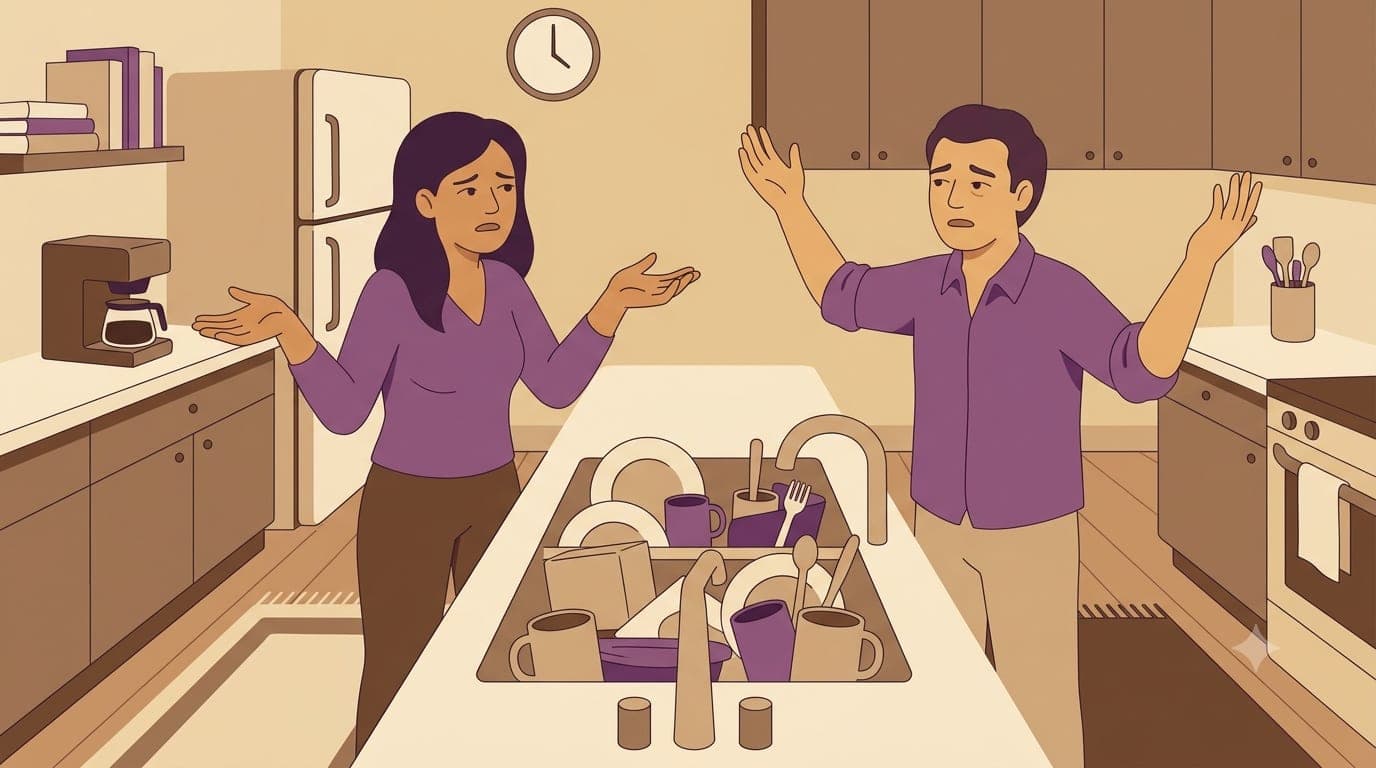
You've had this fight before. You know exactly how it goes. One of you says the thing. The other responds with the other thing. Voices rise, defenses go up, and twenty minutes later you're standing in the kitchen wondering how a conversation about dishes turned into a referendum on the entire relationship.
And the worst part: you'll have this fight again. Next week, next month, maybe tomorrow. Different trigger, same shape. Same feelings, same stalemate, same exhaustion afterward.
If this sounds familiar, you're not broken. You're normal. And the reason you can't seem to fix it is that you're trying to solve a problem that isn't designed to be solved.
What if most couple fights can't actually be resolved?
The finding that changed relationship science: John Gottman and Robert Levenson, working out of the University of Washington's "Love Lab," followed 130 newlywed couples over 14 years. They videotaped their conflicts, measured their physiology, and tracked who stayed together and who didn't. When they brought couples back years later, they found something nobody expected.
Sixty-nine percent of couple conflicts are perpetual. Not solvable. Not temporary. Perpetual. The same basic disagreements showed up in conversations four, eight, and fourteen years later.
The couples who lasted weren't the ones who resolved their perpetual problems. They were the ones who learned to talk about them without destroying each other.
This is a radical departure from how most people think about conflict. We assume that healthy couples agree on the important stuff and that recurring fights mean something is wrong. Gottman's data says the opposite: disagreement on the important stuff is the default, and the measure of a healthy relationship is how you handle the disagreement, not whether it exists.
Why does the same argument keep coming back?
Perpetual problems persist because they're rooted in fundamental differences between two people. Not surface-level preferences. Deep stuff: personality, values, identity, how you were raised, what you need to feel safe.
Gottman distinguishes between two types of perpetual problems. The first is the dialogue-able perpetual problem. These are ongoing disagreements where both partners can talk about it with some humor, some affection, and a general acceptance that they see this differently. Think of the couple where one person is always early and the other is always late. They joke about it. It's annoying but not threatening. They've found a way to coexist with the difference.
The second type is the gridlocked perpetual problem. Same underlying difference, completely different experience. The conversation feels stuck. There's no humor, no flexibility, no movement. Both people feel unheard. Both dig in harder each time. The emotional temperature rises every time the topic comes up. You start to feel like your partner is the enemy on this issue.
The difference between dialogue-able and gridlocked isn't the severity of the problem. It's whether the underlying meaning has been surfaced or not.
What's actually underneath the dishes fight?
What makes gridlocked problems so frustrating: they look like practical disagreements. Who does the housework. How much time to spend with in-laws. Whether to save or spend. How to raise the kids. The content seems straightforward, like there should be a compromise available if both people would just be reasonable.
But the content is a decoy. Underneath every gridlocked position is what Gottman calls a "dream within the conflict." A dream, in this context, is a core need or value that the person connects to their position. And it's almost never about the literal thing being argued about.
The partner who's rigid about housework might be carrying a dream about being seen and valued for invisible labor. The partner who resists might have a dream about autonomy and not being controlled the way a parent controlled them. Neither dream is unreasonable. But neither person has actually talked about the dream. They've only talked about the dishes.
Sue Johnson, the founder of Emotionally Focused Therapy, describes the same dynamic through attachment theory. She argues that underneath most recurring fights is an attachment question: "Are you there for me? Do I matter to you? Can I count on you?" The fight about spending habits is really asking: do you care about our future together? The fight about in-laws is really asking: am I your priority?
When those attachment questions go unaddressed, the surface argument becomes a proxy war for something much bigger. And proxy wars can't be resolved at the proxy level.
How do you identify the hidden dream?
This is the hardest part, and it's the part most couples skip. It requires temporarily suspending your position and getting curious about what your partner's position means to them. Not whether their position is right. What it represents.
Gottman's clinical approach involves each partner taking turns as speaker and listener. The speaker explores what their position connects to: childhood experiences, hopes, values, identity. The listener's only job is to understand, not to rebut.
Some questions that help surface the dream:
- What does this issue mean to you? Not practically. Emotionally.
- Is there a story from your past that connects to how you feel about this?
- What would it mean about you if you completely gave in on this?
- What need does your position protect?
Consider a couple who argues about weekends. One wants planned activities, the other wants unstructured time. They go around on this for months. When they actually dig underneath, one position connects to a fear of wasting time that traces back to growing up in a household where productivity was equated with worth. The other connects to a need for space after a childhood where every minute was scheduled by someone else.
Neither is wrong. They aren't even really disagreeing. They're each protecting something that feels existential and not realizing the other person is doing the same thing.
Why does gridlock feel so personal?
When you've been fighting about the same thing for years, it stops feeling like a disagreement and starts feeling like a character indictment. You begin to believe your partner could see it your way if they cared enough. Their refusal to change starts to look like evidence that they don't value what you value.
This is where the damage happens. Not from the disagreement itself, but from the story you build around it. "He knows this matters to me and he still won't change." "She doesn't respect what I need." These narratives harden over time, and each new instance of the fight gets filtered through them. You stop seeing your partner's actual behavior and start seeing confirmation of the narrative.
Gottman's research on "Negative Sentiment Override" describes this process. Once a negative narrative takes hold, even neutral or positive behavior gets interpreted negatively. Your partner does the dishes and you think "finally" instead of "thanks." They bring up the topic in a calm way and you're already defensive because you know where this goes.
Breaking out of gridlock requires breaking the narrative. And that only happens when both people hear the dream underneath the other person's position.
How do you move from gridlock to dialogue?
The shift from gridlock to dialogue is about changing the emotional quality of the conversation so that the topic can be discussed without feeling like a threat, not about finding a solution.
Step one: accept that the problem may never be fully resolved. This sounds defeatist but it's actually liberating. When you stop trying to win or fix, you create space for something more useful: understanding. The pressure to reach a conclusion is often what makes these conversations so tense.
Step two: take turns sharing the dream. Each partner gets uninterrupted time to talk about what their position means to them at a deeper level. The listener asks questions to understand, not to argue. "Tell me more about that" is the most useful sentence in this conversation.
Step three: identify the non-negotiable core vs. the flexible periphery. Within every gridlocked position, there's usually a core that can't move (the underlying need) and a periphery that can (the specific way that need gets met). The partner who needs to feel valued for their domestic contribution might have flexibility about how that acknowledgment happens. The partner who needs autonomy might be flexible about which areas of life that applies to.
Step four: create a temporary, revisable agreement. Not a permanent solution. A "let's try this for two months and see" approach. This lowers the stakes and makes both people more willing to experiment.
Step five: revisit without resentment. Fighting fair means checking back in on these agreements with curiosity rather than score-keeping.
The pursuer-withdrawer dynamic often shows up in gridlocked conflicts. One partner pushes for resolution while the other shuts down, making the conversation feel even more stuck. Recognizing this pattern is sometimes the first step toward changing it.
What if your partner won't engage with this process?
This is common. One person reads the article, gets excited about the framework, and the other person isn't interested. Or says they'll try but then falls back into the same defensive posture when the topic comes up.
You can't force someone into dialogue. But you can change your own approach, and that often shifts the dynamic. Instead of leading with your position ("We need to talk about how you never..."), lead with curiosity about theirs ("I want to understand why this matters so much to you"). Instead of pushing for resolution, explicitly remove it from the table: "I'm not trying to solve this right now. I just want to understand your side better."
When one person consistently shows up with curiosity rather than defensiveness, it often makes it safer for the other person to do the same. Not always. But often enough that it's worth trying.
If hard conversations keep turning into fights, that's a signal that the emotional temperature needs to come down before the content can be addressed.
When does a perpetual problem become a dealbreaker?
Not all perpetual problems are created equal. Some are genuinely livable. Others erode the relationship over time.
A perpetual problem becomes dangerous when it turns contemptuous. When you no longer see your partner as a reasonable person with a different perspective and instead see them as flawed, selfish, or stupid for holding their position. Contempt, in Gottman's research, is the single strongest predictor of divorce.
It also becomes dangerous when the gridlock spreads. When you stop talking about the thing entirely because it always goes badly. When you start avoiding each other around the topic. When the resentment from this one issue starts coloring everything else.
And sometimes a perpetual problem reveals a genuine incompatibility that no amount of dialogue can bridge. If one person wants children and the other doesn't, that's not a gridlocked dream that can be dialogued. That's a fundamental difference that requires an honest, painful conversation about whether the relationship can work. The Gottman Method has specific frameworks for distinguishing between gridlock and genuine incompatibility.
The real goal
The most freeing thing about Gottman's perpetual problems research is this: you don't have to agree. You don't have to find the perfect compromise. You don't have to change your partner and they don't have to change you.
You have to understand each other. Really understand, not just intellectually acknowledge. Understand the childhood story, the fear, the hope, the identity that lives underneath the position. When both people feel understood at that level, the problem doesn't go away, but it changes shape. It becomes something you carry together instead of something you throw at each other.
Aperi's daily questions are designed to surface these deeper layers gradually. You don't jump straight to "what are we really fighting about." You build the habit of honest exchange over time, and that habit gives you the safety to go to the hard places when you need to.
Frequently asked questions
Is it normal to fight about the same things for years?
Yes. Gottman's longitudinal research found that the majority of couple conflicts are perpetual, meaning they recur throughout the relationship. This isn't a sign of failure. It's a sign that two different people with different personalities, histories, and values are trying to build a life together. The question isn't whether you have recurring conflicts but whether you can discuss them without contempt, defensiveness, or emotional shutdown.
How do I tell the difference between a perpetual problem and a solvable one?
Solvable problems tend to be situational and specific: who's picking up the kids on Thursday, how to handle the in-laws visiting next week. Perpetual problems keep showing up across different situations because they're tied to personality or values. If you've been having some version of the same argument for more than a year and neither of you has budged, it's probably perpetual. That's not bad news. It just means the approach needs to shift from problem-solving to understanding.
What if understanding my partner's dream doesn't change how I feel?
Understanding doesn't automatically produce acceptance. Sometimes you hear the dream and think "I get it, but I still feel the same way." That's okay. The goal of the dreams conversation isn't instant resolution. It's softening. When you understand why your partner holds their position, you may still disagree, but you're less likely to interpret their stance as a personal attack. Over time, that reduced defensiveness creates space for creative solutions that pure stubbornness blocks.
Can a couples therapist help with gridlocked conflicts?
Yes, and this is one of the areas where therapy is most effective. A trained therapist can create the safety needed for both partners to share the vulnerable, often unspoken material underneath their positions. Many couples can't do this on their own because the emotional charge is too high. A therapist acts as a regulator, slowing the conversation down, redirecting defensiveness, and helping each person actually hear what the other is saying. Gottman Method and Emotionally Focused Therapy are both specifically designed for this kind of work.
Should we just avoid the topics we always fight about?
Temporary avoidance can be strategic. If you're both flooded (heart rate above 100, adrenaline pumping, can't think straight), stepping away is smart. But chronic avoidance makes gridlocked problems worse, not better. Unaddressed perpetual problems don't fade. They accumulate resentment. The issue grows in the silence because each person builds a story about what the other's silence means. Scheduled, calm, time-limited conversations about the topic are more effective than either fighting about it or pretending it doesn't exist.
Aperi: one question a day
A daily question app that adapts to you and your partner, and goes deeper the more you use it.


Free to start. Available on iPhone and Android.
Explore question packs
Related articles

High-conflict vs. low-conflict couples: which are you?
Gottman identified three stable couple styles: volatile, avoiding, and validating. The key isn't which style you are, it's the 5:1 ratio.

When compromise isn't the answer
Not every disagreement has a middle ground. Here's how to tell the difference between flexibility and self-abandonment.

Forgiving your partner when it feels impossible
What forgiveness actually is, why "just let it go" never works, and the research-backed process for forgiving your partner.

The pursuer-withdrawer pattern: why you fight the same fight every time
The pursuer-withdrawer cycle explains why 60% of couples fight the same way every time. Learn how to break the pattern.

Resentment: where it comes from and how to let it go
Resentment is unexpressed anger plus time. Here is where it comes from, what it does to your body, and how to release it.

Why personal growth sometimes threatens your relationship
When one partner grows, the relationship system gets disrupted. Why that happens and how to handle it.