
Key Takeaways
Communication is about talking better, not talking more. This guide covers the full picture: why listening matters more than speaking, how the first three minutes of a conversation predict its outcome, what the research says about repair attempts, and specific practices that actually improve how couples connect.
Ask any couples therapist what brings people through their door, and the answer is almost always the same: "We can't communicate." It's the number one complaint in relationship counseling. In surveys, communication problems consistently rank as the primary factor in relationship dissatisfaction and the most commonly cited reason for divorce.
But communication problems are almost never actually about communication. They're about what's underneath: unmet needs, mismatched expectations, accumulated resentment, fear of vulnerability. The "communication problem" is usually a symptom, not the disease.
That said, the symptom matters. Because even when you understand the deeper issue, you still need to be able to talk about it without making things worse. And most couples are remarkably bad at that, not because they're bad people, but because nobody teaches relationship communication as a skill. You're expected to figure it out by watching your parents (who probably couldn't do it either) and by trial and error (which mostly produces error).
This guide covers what four decades of relationship research actually says about how couples communicate, what goes wrong, and what to do about it.
Why communication matters (and what it actually means)
When researchers say communication predicts relationship outcomes, they don't mean the amount of talking. They mean the quality of interaction: how partners listen, how they raise difficult topics, how they respond to each other's bids for connection, and how they repair after conflict.
The distinction matters. Some of the worst-communicating couples talk constantly. They're always discussing, debating, processing, and rehashing. But the communication is circular, defensive, and unproductive. Meanwhile, some of the best-communicating couples are relatively quiet. They just make the conversations they do have count.
Quality means several things simultaneously:
- Each partner feels heard (not just tolerated while talking)
- Difficult topics can be raised without the conversation becoming a fight
- Both people can express needs without the other person hearing it as criticism
- Conflict leads to understanding rather than entrenchment
- Repair happens after disconnection
If those things are present, you can have a great relationship with relatively few words. If they're absent, no amount of talking will fix it.
The myth: communication isn't about talking more
The biggest misconception about relationship communication is that the problem is insufficient talking and the solution is more of it. This leads couples into marathon processing sessions, three-hour conversations that leave both people exhausted and further apart than when they started.
John Gottman's research at the University of Washington is unambiguous on this point: the length of a conflict conversation has almost no relationship to its outcome. What matters is how the conversation starts, whether repair attempts are made and received, and whether both partners feel physiologically calm enough to actually process information.
Some of the most effective communication in relationships is nonverbal. A touch on the arm. A look across the room. Sitting closer. These micro-moments of connection are what Gottman calls "bids," and they happen dozens of times per day. Couples who respond to each other's bids 86% of the time tend to stay together. Those who respond only 33% of the time tend to divorce.
A bid for connection isn't always verbal, and responding to it doesn't require a conversation. Sometimes it just requires noticing.
Listening: the undervalued half
Most communication advice focuses on how to express yourself better. Say "I feel" instead of "you always." Use a soft startup. Name your needs clearly. All useful. But it addresses only half the equation. The other half, listening, gets far less attention, and it's arguably more important.
What listening actually requires
Real listening is not waiting for your turn to talk. It's not formulating your response while your partner is mid-sentence. It's not hearing the words while mentally categorizing them as right or wrong.
Real listening requires what psychologist Carl Rogers called "unconditional positive regard": a temporary suspension of your own agenda, your own defensiveness, and your own need to be right, in service of genuinely understanding what the other person is trying to say.
This is hard. It's especially hard when your partner is saying something that triggers you, something that sounds like blame, or touches a wound, or contradicts your version of events. The instinct to defend, correct, or counter-argue is powerful. Overriding it is a skill that takes practice.
Active listening vs. reflective listening
Active listening means giving verbal and nonverbal signals that you're tracking: eye contact, nodding, brief affirmations ("yeah," "I hear you," "go on"). It keeps the speaker going and signals that you're present.
Reflective listening goes further. You paraphrase what your partner said back to them: "So what I'm hearing is that you felt dismissed when I made that decision without asking you. Is that right?" This does two things. It confirms you actually understood (not just heard), and it gives your partner the chance to correct any misunderstanding before it calcifies.
The speaker-listener technique, developed by Howard Markman and Scott Stanley in the PREP program, formalizes this. One partner speaks. The other reflects back what they heard. The speaker confirms or clarifies. Only then does the listener respond with their own perspective. It's structured and feels awkward at first, but it prevents the cross-talking, interrupting, and assumption-making that derail most difficult conversations.
For more depth on becoming a better listener in your relationship, see our guide to communicating better.
The Gottman 5:1 ratio
One of Gottman's most cited findings: stable, happy relationships maintain a ratio of at least five positive interactions for every one negative interaction during conflict conversations. Not overall, during conflict. When things are going well, the ratio is more like 20:1.
This doesn't mean you paper over problems with compliments. It means that even during disagreements, effective couples maintain a foundation of warmth. They make jokes. They show affection. They find points of agreement. They express understanding even while disagreeing. The negative interaction happens inside a context of positivity, which makes it survivable.
When the ratio drops below 5:1, the relationship enters what Gottman calls "negative sentiment override," a state where even neutral or positive actions get interpreted negatively. Your partner brings you coffee and you think, "They probably want something." Your partner compliments you and you hear sarcasm. The filter has flipped, and everything passes through it.
Rebuilding the ratio is about the steady accumulation of small positive interactions, not grand gestures: a smile, a thank-you, a moment of physical affection, a question about their day, a laugh at their joke. The deposits are small. They just need to outnumber the withdrawals.
The Four Horsemen (and their antidotes)
Gottman identified four communication patterns that predict relationship failure with over 90% accuracy. He called them the Four Horsemen of the Apocalypse. They're worth knowing because they're so common that most couples engage in at least one regularly without recognizing it.
Criticism: attacking your partner's character rather than addressing a specific behavior. "You never help around the house" is criticism. "I need more help with the dishes this week" is a complaint. Complaints are healthy. Criticism is corrosive. The antidote: use a gentle startup. Start with "I" instead of "you," describe the situation factually, and state what you need.
Contempt: communicating from a position of superiority. Eye-rolling, sarcasm, name-calling, mockery. Contempt is the single strongest predictor of divorce in Gottman's research. The antidote: build a culture of appreciation. Contempt grows in the absence of expressed respect. Regular gratitude, specific, genuine, spoken aloud, makes contempt harder to sustain.
Defensiveness: responding to a complaint with counter-complaints or excuses. "You forgot to pick up the groceries." "Well, you forgot to tell me which store!" Defensiveness blocks accountability and tells your partner their concern doesn't matter. The antidote: accept responsibility, even partial. "You're right, I should have double-checked. Sorry."
Stonewalling: withdrawing from the conversation entirely. Shutting down, going silent, walking away, becoming a wall. Stonewalling usually happens when someone is physiologically flooded, their heart rate has exceeded 100 BPM and their nervous system has shifted into fight-or-flight. The antidote: take a break. Not storming off, but a structured, agreed-upon pause. "I'm flooded and I can't think clearly. Can we come back to this in 20 minutes?"
For a deeper look at each of these patterns and specific strategies for addressing them, see our guide to the Gottman method. For stonewalling specifically, we have a dedicated guide.
Five types of conversations every couple needs
Not all couple conversations serve the same purpose, and treating them as interchangeable is a common mistake. Research and clinical practice point to five distinct conversation types that healthy relationships need.
1. Logistics
Who's picking up the kids. What's for dinner. The plumber is coming Thursday. This is the most common conversation type and the least interesting. It's necessary but it should be contained, ideally to specific times, so it doesn't crowd out everything else.
2. Emotional check-ins
"How are you, really?" conversations. These are about each partner's internal state: not events, but feelings. How are you holding up? What's weighing on you? What do you need? Regular emotional check-ins prevent the slow drift into parallel living where you know each other's schedules but not each other's inner worlds. A weekly check-in structures this.
3. Dream conversations
What do you want? Where are you headed? What's the life you're building? These conversations tend to happen early in relationships and then fade as the shared dream becomes shared routine. Gottman considers "honoring each other's dreams" one of the seven principles of lasting marriage. You can't honor dreams you don't know about. Our guide to questions that replace "how was your day" includes prompts for this.
4. Conflict conversations
Disagreements about real issues: values, money, parenting, sex, in-laws. These are inevitable and necessary. The goal isn't to eliminate conflict but to have it productively. See our guides on fighting fair and having hard conversations without fighting.
5. Fun conversations
Inside jokes. Stupid hypotheticals. Shared laughter. "Did you see that thing?" This category gets dismissed as trivial, but Gottman's research found that shared humor and playfulness are strong predictors of relationship stability. Fun is connective tissue.
The soft startup
How a conversation begins determines how it ends. This is one of Gottman's most replicated findings. In 96% of cases, the trajectory of a 15-minute conversation can be predicted from the first three minutes. Start harsh, end harsh. Start soft, end productively.
A soft startup means raising an issue without blame, contempt, or global character assassination. It has three components:
- Describe the situation factually. "The kitchen was still dirty when I got home."
- State how you feel using "I." "I felt frustrated because I'd asked for help this morning."
- State what you need. "Can we figure out a system so the kitchen gets cleaned before I'm home?"
Compare that to a harsh startup: "You never clean up. I'm always the one who has to deal with everything. You don't even care."
Same issue. Completely different conversation trajectory. The soft version opens a problem-solving dialogue. The harsh version triggers defensiveness and escalation.
The soft startup is a skill. It requires pausing between feeling the frustration and expressing it, long enough to strip out the blame and find the need underneath.
Repair attempts
Every couple fights. Every couple says things they wish they hadn't. Every couple has moments of disconnection. What separates couples who make it from couples who don't is not the absence of these moments; it's the presence of repair.
A repair attempt is any action, verbal or nonverbal, that de-escalates conflict and reconnects partners during or after a disagreement. It can be as simple as a touch on the arm, a joke, saying "I'm sorry, let me start over," or even "This is getting too heated. Can we pause?"
Gottman found that the success of repair attempts, whether the other partner receives them, is the single most important factor in whether conflicts get resolved. In happy relationships, repair attempts work. In unhappy relationships, the same repair attempt gets ignored or rejected.
This means two things. First, make repair attempts. Don't wait until the fight is over. Try to de-escalate in real time. Second, receive repair attempts. When your partner reaches out during a fight, even clumsily, meet them. The content of the repair matters less than the willingness to accept it.
Non-verbal communication
Studies consistently estimate that 60-70% of meaning in face-to-face communication comes from non-verbal cues: tone, facial expressions, posture, touch, eye contact, proximity. You can say "I'm fine" in a way that communicates "I'm absolutely not fine," and your partner will (usually) read the non-verbal signal, not the words.
This is why texting about emotional topics is risky: you lose the majority of the signal. It's also why how you say something matters more than what you say. Saying "we need to talk" with warm eye contact and an open posture produces a different response than saying it while sighing and crossing your arms, even though the words are identical.
For couples, non-verbal communication shows up most importantly in:
- Eye contact during conversation: the presence or absence of it signals engagement or withdrawal
- Physical orientation: facing toward your partner signals openness; turning away signals disconnection
- Touch: a hand on the knee during a difficult conversation says "I'm with you" more efficiently than any sentence
- Tone: the same words said with warmth, sarcasm, impatience, or care produce entirely different conversations
When communication breaks down
Sometimes communication doesn't just struggle. It stops. Understanding why helps you respond differently.
Stonewalling and flooding
Stonewalling isn't stubbornness. In most cases, it's a physiological response. When heart rate exceeds roughly 100 BPM, the prefrontal cortex, the part of the brain responsible for reasoning, empathy, and perspective-taking, goes partially offline. You literally cannot think clearly. Your body has decided this is a threat and is routing resources to survival, not communication.
Gottman calls this state "diffuse physiological arousal" (DPA), or more commonly, flooding. When someone is flooded, continuing the conversation is pointless. They can't hear you. They can't process nuance. They're in survival mode.
The only effective response to flooding is a break: at least 20 minutes, ideally with self-soothing (walking, breathing, something calming). Trying to push through flooding produces the worst communication of the entire relationship. If your partner shuts down, read our guide to stonewalling and our piece on when your partner won't open up.
The pursuer-withdrawer dynamic
The most common destructive communication pattern isn't two people yelling. It's one person pursuing (pressing for connection, discussion, resolution) and the other withdrawing (pulling back, going quiet, deflecting). The pursuer pushes harder because the withdrawal feels like rejection. The withdrawer pulls back further because the pursuit feels like pressure. It's a feedback loop that gets worse with each cycle.
Research by Andrew Christensen and Neil Jacobson found that the pursuer-withdrawer pattern predicts relationship dissatisfaction more reliably than the severity of the issues being discussed. The pattern is the problem, not the topic.
Breaking it requires both sides adjusting. The pursuer needs to approach with less intensity and more patience. The withdrawer needs to engage sooner, even minimally. "I need 20 minutes, but I will come back to this" is engaging. Walking away without a word is not.
Communication across attachment styles
Your attachment style shapes how you communicate, especially under stress. Understanding your pattern, and your partner's, helps you stop taking their communication style personally.
Secure attachment: comfortable with closeness and autonomy. Communicates needs directly, can hear criticism without crumbling, repairs naturally after conflict.
Anxious attachment: fears abandonment, seeks reassurance. Tends to pursue, over-communicate, interpret silence as rejection, and escalate in an attempt to get a response. The communication isn't the problem; the underlying fear of being left is.
Avoidant attachment: uncomfortable with too much closeness. Tends to withdraw under pressure, minimize emotional topics, and stonewall when overwhelmed. The withdrawal isn't indifference; it's self-protection.
When an anxious partner pairs with an avoidant partner (which happens frequently), you get the pursuer-withdrawer pattern on steroids. The anxious partner's need for reassurance triggers the avoidant partner's need for space, which triggers more anxiety, which triggers more avoidance.
The way out: the anxious partner practices self-soothing before pursuing ("I'm feeling anxious, but I can sit with it for 20 minutes before bringing it up"). The avoidant partner practices approaching before being asked ("I know we need to talk about last night. Can we do that after dinner?"). Both moves go against instinct. Both are necessary.
For a deeper dive, see our guide to attachment styles in relationships.
Tools and practices that build better communication
Knowing about communication doesn't improve communication. Practice does. Here are specific, research-backed tools.
The weekly check-in. A structured 15-minute conversation, same time each week, covering appreciation, temperature-checking, and looking forward. See our complete guide with 15 questions.
Daily questions. One meaningful question per day, answered by both partners. Not logistics, but something about your inner worlds. Consistent low-dose self-disclosure keeps the communication channel open without requiring marathon conversations. This is exactly what Aperi does: one question daily, calibrated to your relationship.
The speaker-listener technique. For specific conflicts. One person speaks, the other reflects back what they heard, speaker confirms or clarifies, then roles switch. Prevents cross-talking and assumption-making.
The soft startup practice. Before raising an issue, write down: the factual situation, how you feel, and what you need. Then say those three things in order. This takes 30 seconds of preparation and prevents the harsh startup that derails 96% of conversations.
The 6-second kiss. Gottman's recommendation. A kiss that lasts long enough that you actually have to be present for it. It functions as a non-verbal reconnection point, a daily physical reminder that you're partners, not roommates.
Scheduled difficult conversations. Don't ambush your partner with hard topics. Say: "I want to talk about our finances. Can we do that Saturday morning?" This gives both people time to prepare emotionally and prevents the defensive reaction that comes from being caught off guard.
The repair checklist. Gottman created a literal list of repair phrases that couples can use during conflict: "Can I take that back?" "I'm sorry, I didn't mean that." "Tell me what you need right now." "I'm getting flooded. Can we take a break?" Having these phrases pre-loaded means you don't have to think of them in the heat of the moment. You can read about how to apologize effectively for more on repair language.
FAQ
What if we communicate differently, where one of us is a talker and the other isn't?
This is normal and doesn't mean you're incompatible. The talker needs to create space without filling it: ask a question and then wait, even through silence. The quieter partner needs to signal that they're engaged even when they're not speaking, whether that's a nod, a "let me think about that," or writing their thoughts down. The goal isn't matching styles. It's making sure both people feel heard in the style that works for them. See our guide on partner gives one-word answers for specific strategies.
How do I bring up something that's been bothering me without starting a fight?
Use the soft startup. State the facts, say how you feel, say what you need. Time it well: not when your partner just walked in the door, not right before bed, not during another conflict. And start by expressing your intention: "I want to bring something up because it matters to me, not because I want to fight about it." If the conversation still escalates, see our guide on having hard conversations without fighting.
Is couples therapy necessary, or can we fix communication on our own?
Most communication patterns can improve with deliberate practice between partners. Therapy becomes valuable when you've tried and keep getting stuck in the same loops, when there's a significant power imbalance, when trust has been broken, or when one or both partners are dealing with individual mental health issues that affect the relationship. Therapy isn't a last resort; it's a tool. But it's not the only tool. Consistent daily practices often produce more change than weekly therapy sessions alone. See our couples therapy guide for more.
We only talk about logistics and the kids. How do we break out of that?
Contain the logistics. Set a specific time for coordination (five minutes after dinner, a Sunday planning session) and protect the remaining time for other conversation types. Then introduce one non-logistical question per day. It can be as simple as "What's something you're looking forward to this week?" or using a prompt from Aperi or the Conflict to Connection pack. The shift feels forced at first. That's normal. After a few weeks, non-logistical conversation starts happening naturally again.
How long does it take to change communication patterns?
Gottman's research suggests that couples who commit to practicing new communication skills show measurable improvement within 3-6 months. Individual skills (like the soft startup) can improve within weeks. Deeper patterns (like the pursuer-withdrawer dynamic) take longer because they're tied to attachment styles that formed in childhood. The honest answer: it depends on what you're changing, how entrenched the pattern is, and whether both partners are committed. But any sustained effort produces some improvement, and small improvements compound.
Communication in relationships isn't one skill. It's a collection of skills: listening, speaking, repairing, timing, reading non-verbal cues, managing your own physiology, and understanding your partner's inner world well enough to meet them where they are. Nobody masters all of them. The goal is steady improvement, not perfection.
The simplest place to start: one question per day, answered honestly by both partners. That single practice addresses listening, self-disclosure, emotional check-ins, and bid-responding all at once. It's why Aperi exists: to make that daily question effortless, adaptive, and consistent. Not because an app replaces real communication, but because it gives you a reason to practice it.
For related reading, explore our guides on feeling disconnected from your partner, emotional safety in relationships, and the Check-In pack for structured conversation starters.
Aperi: one question a day
A daily question app that adapts to you and your partner, and goes deeper the more you use it.


Free to start. Available on iPhone and Android.
Explore question packs
Related articles

When you and your partner speak different love languages
You show love your way, not theirs. How to close the gap when you and your partner express affection differently, beyond the quiz.

The Zeigarnik effect: why unfinished conversations haunt your relationship
Why unresolved conflicts keep looping in your head, and how to close the open loops that create resentment.

ADHD and relationships: what both partners need to know
ADHD doesn't just affect focus. It reshapes relationship dynamics in ways both partners need to understand to stop the blame cycle.
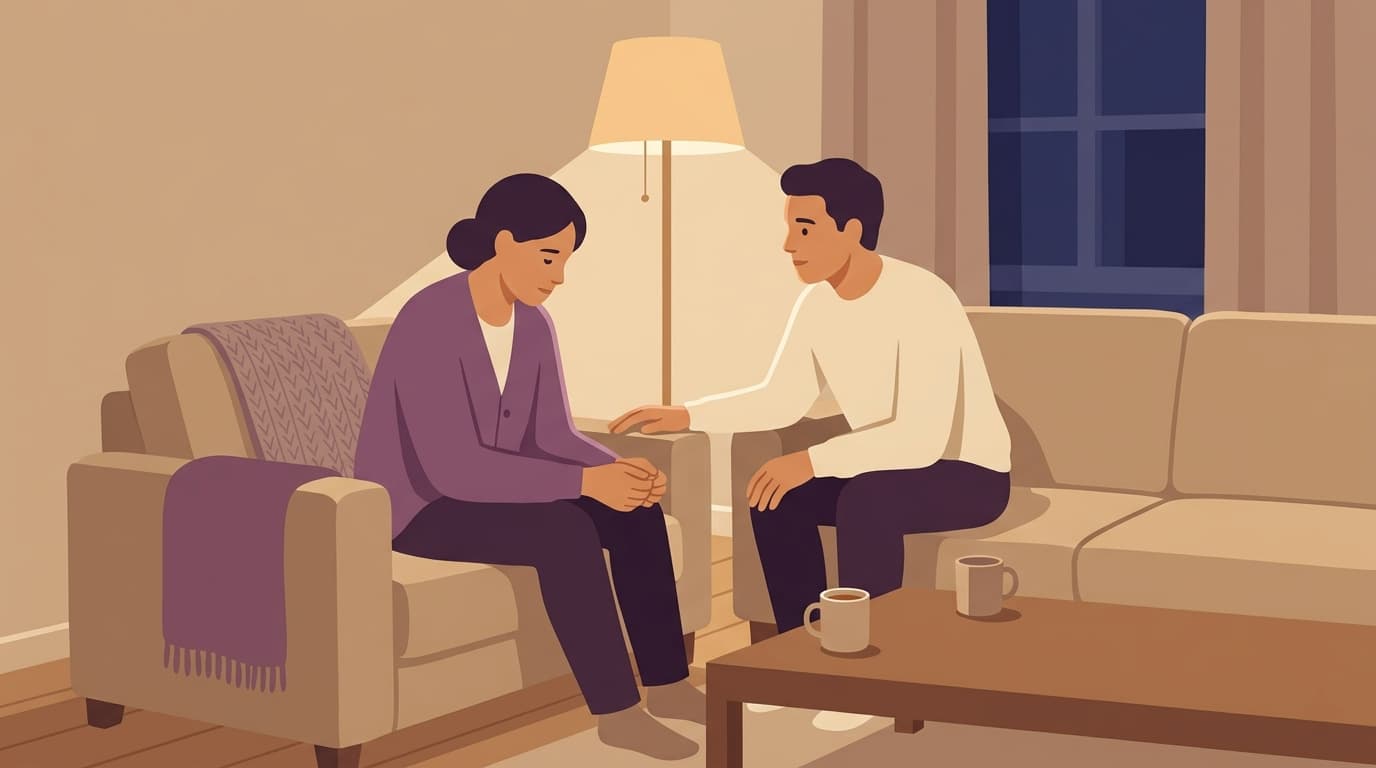
The mental health conversation every couple needs to have
Why mental health is a relationship topic, how to bring it up, and how to build a mental health plan as a couple.

Active listening: the most underrated relationship skill
What active listening really means, why most people get it wrong, and specific techniques backed by decades of research.

Rebuilding trust after it's been broken
Trust isn't rebuilt by promises. It's rebuilt by changed behavior over time. Here's what the research says about the process.