Key Takeaways
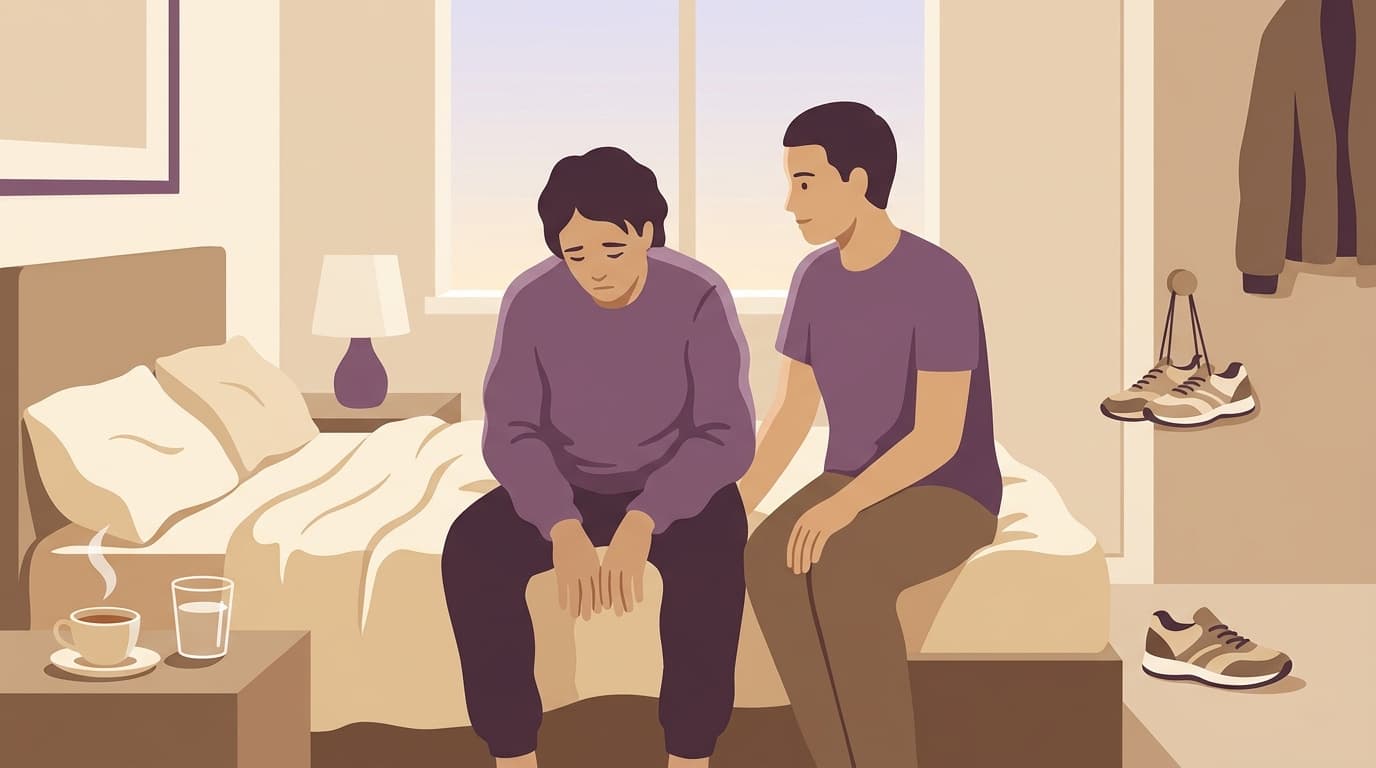
You can't therapy your partner into wellness, and trying will exhaust you both. The research says the most helpful thing is consistent validation, clear boundaries, and knowing when to step back so professionals can step in. Taking care of yourself isn't selfish; it's required.
When you love someone with anxiety or depression, your first instinct is to fix it. To say the right thing. To solve the problem. To absorb their pain so they don't have to carry it alone.
That instinct comes from a good place. It will also burn you out, damage the relationship, and probably not help your partner much either.
This is the central tension of loving someone who's struggling mentally: the difference between supporting and fixing is enormous, and most people have never been taught where one ends and the other begins.
What anxiety and depression actually look like in a relationship
The public image of depression is someone crying in bed all day. The public image of anxiety is someone having a visible panic attack. These things happen, but they're not the everyday reality for most people. The day-to-day manifestation is subtler and, for the partner, more confusing.
Depression in a relationship often looks like:
- Withdrawal. Not dramatic isolation, just gradually doing less together, being present but checked out, declining invitations with a shrug rather than a reason.
- Irritability. Research published in the Journal of Abnormal Psychology shows that irritability is one of the most common, and most overlooked, symptoms of depression. Your partner isn't angry at you. They're depleted, and depletion makes everything abrasive.
- Loss of interest. Not just in hobbies, but in the relationship itself. Sex drops off. Conversations become perfunctory. They stop initiating plans or affection. This isn't about you. But it feels like it is.
- Difficulty with basic tasks. Dishes pile up. Emails go unanswered. Appointments get missed. This isn't laziness. Executive function, the brain's ability to plan, prioritize, and initiate action, is one of the first casualties of depression.
- Guilt and shame about all of the above. Your partner likely knows they're pulling away. They feel terrible about it. That shame makes them pull away more, because engaging means confronting how much they've already withdrawn.
Anxiety in a relationship often looks like:
- Excessive reassurance-seeking. "Are we okay?" "You're not mad at me, right?" "Do you still love me?", sometimes multiple times a day. This isn't insecurity in the relationship. It's the anxiety latching onto whatever feels most vulnerable.
- Avoidance. Canceling plans, dodging conversations, refusing to make decisions. Anxiety makes future-oriented thinking feel threatening, so the brain avoids anything that requires committing to an outcome.
- Control. Wanting things a specific way, getting disproportionately upset about small changes, needing to plan everything in advance. This looks like rigidity. It's actually an attempt to manage an internal world that feels chaotic.
- Physical symptoms. Headaches, stomach problems, insomnia, muscle tension. These are real, not performative. Anxiety lives in the body as much as the mind.
- Catastrophizing. A small disagreement becomes "You're going to leave me." A minor work setback becomes "I'm going to lose my job and we'll lose the house." The anxious brain connects worst-case dots that don't actually connect.
For the partner witnessing all this, the emotional experience is often: confusion, helplessness, loneliness, frustration, and guilt about feeling frustrated. "I know they're struggling, so I shouldn't be upset that our relationship is suffering." Except you absolutely can feel both things simultaneously, and pretending otherwise helps no one.
Why fixing doesn't work
The urge to fix is strong. You see your partner in pain, you want to make it stop. But depression and anxiety aren't problems with solutions you can provide. They're medical conditions that require professional treatment. You wouldn't try to set your partner's broken leg at home. Mental health is the same category.
When you try to fix your partner's mental health, several things happen:
You become their therapist, and that kills the partnership. Research by Dr. Guy Bodenmann on dyadic coping, which studies how couples handle stress together, shows that when one partner takes on a caretaking role, the relationship's balance of power shifts. You're no longer equals. You're the stable one and the struggling one, the helper and the helped. Over time, this dynamic breeds resentment on both sides.
Your solutions don't work, and you both feel worse. "Have you tried exercising?" "Maybe you should meditate." "What if you just worried less?" Your partner has heard all of this. They've tried most of it. Offering solutions to someone who's clinically depressed is like offering a map to someone whose car has broken down. Technically relevant, practically useless until the engine is running again.
You take their symptoms personally. When your suggested hike doesn't fix their depression, or your reassurance doesn't stop their anxiety, it's easy to feel rejected. "I'm not enough for them." You aren't enough, not because you're inadequate, but because this isn't a problem that a partner can solve. And that's okay.
What does helpful support actually look like?
Research on what helps partners of people with mental health conditions points to a few consistent strategies.
Validation without agreement
Validation means acknowledging that your partner's feelings make sense given their experience. It does not mean agreeing that their fears are accurate.
"I can see that you're really overwhelmed right now. That sounds exhausting." This is validation.
"You're right, everything probably is going to fall apart." This isn't validation. It's reinforcing the distortion.
"There's nothing to worry about, you're being irrational." This isn't helpful either. It dismisses their experience and they already know it's irrational. That's the whole problem.
Dr. Marsha Linehan's research on validation (developed in the context of Dialectical Behavior Therapy) identifies six levels, from paying attention to the person's experience all the way to treating their response as understandable given their context. You don't need to memorize the levels. The core principle: "Your feelings are real, and I'm here with you in them."
Holding space without taking over
Holding space means being present with your partner's pain without trying to manage, redirect, or eliminate it. It's sitting next to them while they're having a hard time and not filling the silence with advice. It's asking "What do you need right now?" instead of assuming you know.
Sometimes what they need is practical: "Can you handle dinner tonight? I can't." Sometimes it's emotional: "Can you just sit with me for a while?" Sometimes it's nothing: "I don't need anything, I just need to get through this." All of these are valid answers. Your job is to ask, listen, and respond, not to pre-empt.
Being specific about what you can offer
Vague offers of support ("Let me know if you need anything") are well-intentioned but rarely acted on. A person in the grip of depression or anxiety has reduced executive function. Asking for help requires energy they may not have.
Specific offers work better: "I'm going to make dinner tonight." "I'll call the plumber, you don't need to worry about it." "I've cleared Saturday afternoon. Do you want company, or would you rather have the house to yourself?"
The specificity matters because it removes the cognitive load of figuring out what to ask for. It also demonstrates that you're paying attention to what they actually need, rather than offering a blank check you hope they'll never cash.
Maintaining your own life
This isn't a nice-to-have. It's essential. Research on compassion fatigue, originally studied in healthcare workers and later extended to family members of people with chronic conditions, shows a clear pattern: caregivers who abandon their own needs eventually burn out, and burned-out caregivers become resentful, withdrawn, or emotionally volatile. At that point, you're not supporting anyone. You're just two people drowning.
Keep seeing your friends. Keep doing your hobbies. Keep going to the gym, or the park, or wherever you recharge. Your partner may feel guilty about this ("You shouldn't have to go have fun without me"). That guilt is the depression talking. A partner who maintains their own wellbeing is a partner who can sustain support long-term. A partner who sacrifices everything eventually has nothing left to give.
Setting boundaries: kindly, clearly, non-negotiably
Boundaries are not punishments. They're the structure that allows you to keep showing up. Without them, you'll either break or leave, and neither of those helps your partner.
Examples of healthy boundaries:
- "I want to support you, and I'm not equipped to be your therapist. I need you to talk to a professional about this."
- "I can handle one check-in conversation per day about how you're feeling. Beyond that, I start to feel overwhelmed, and I need you to write in your journal or call your therapist."
- "When you lash out at me because you're anxious, I understand the anxiety is driving it, and it's still not okay. I need you to take a break and come back when you can talk to me without directing your frustration at me."
- "I'm going out with friends tonight. I know you'd rather I stay. I need this for my own mental health, and I'll be back by 10."
The key: state the boundary with compassion, not anger. Enforce it consistently. Don't apologize for having needs. A relationship where one person's mental health means the other person has no needs is not sustainable, and pretending otherwise is a faster path to the relationship ending than the boundary itself.
When is your support not enough?
Always. Your support is never enough, in the sense that it's never a replacement for professional treatment. It's an important part of the picture, but it's not the whole picture.
Signs that your partner needs more than you can provide:
- Symptoms are worsening or have lasted more than a few weeks without improvement
- They're self-medicating with alcohol, drugs, or other compulsive behaviors
- They've expressed feelings of hopelessness or worthlessness that don't lift
- They've mentioned self-harm or suicidal thoughts (take this seriously every time; ask directly, don't tiptoe around it)
- Daily functioning is significantly impaired: they can't work, can't maintain hygiene, can't leave the house
- Your support isn't making any difference despite sustained effort
Bringing up professional help requires sensitivity. "You need to see a therapist" can feel like "I can't deal with you anymore." Try: "I love you and I can see how much you're struggling. I think you deserve support from someone who's trained to help with this. Would you be open to talking to someone?"
If they resist, don't push in a single conversation. Come back to it. Offer to help with the logistics: research therapists, make the call, drive them to the appointment. Reduce the friction between them and help. If they won't engage with the idea at all, that's a harder conversation about whether you can sustain the current dynamic indefinitely.
Taking care of yourself is not optional
This section isn't a footnote. It's the load-bearing wall.
If you're in a relationship with someone who has chronic anxiety or depression, you are in a demanding situation. That demands rest, support, and your own emotional processing.
- Get your own therapy. Not couples therapy (though that can help too). Individual therapy, for you, to process the specific grief and frustration of loving someone who's struggling. A space where you can say "I'm angry that this is so hard" without guilt.
- Talk to people who understand. Not everyone will. Some friends will say "Just be supportive" as if that's simple. Find the ones who get the complexity, ideally people who've been in similar positions.
- Monitor your own mental health. Depression is not contagious, but living under chronic stress can trigger your own anxiety, depression, or burnout. Your partner's condition doesn't exempt you from needing care.
- Accept that you'll feel conflicting things. Love and resentment. Compassion and frustration. Loyalty and the desire to escape. These contradictions don't make you a bad partner. They make you a human in a hard situation.
When emotional disconnection starts building, when the illness has taken up so much space that you've stopped connecting as people, small daily practices can help keep the relationship alive underneath the difficulty. A daily question, a brief check-in that isn't about the illness, a moment of normalcy. These aren't cures. They're maintenance, the relational equivalent of keeping the lights on while you wait for the storm to pass.
Through Aperi's daily questions, couples dealing with mental health challenges have found that having one structured, positive interaction each day keeps the connection from disappearing entirely under the weight of the struggle. It's not a substitute for professional help. It's the thread that keeps you tied together while the hard work happens.
Frequently asked questions
How do I tell the difference between my partner being depressed and my partner losing interest in me?
Look at the pattern across their whole life, not just the relationship. If they've also pulled back from friends, hobbies, work, and activities they used to enjoy, that's depression affecting everything, not a specific loss of interest in you. If they're engaged and energetic in other areas but consistently withdrawn with you, that's a different conversation. When in doubt, ask directly and without accusation: "I've noticed you've been more distant lately. I'm not blaming you. I just want to understand what's going on."
Should I hide my own stress to avoid adding to their burden?
No. Concealing your own difficulties creates emotional distance and models the idea that one person's feelings matter more than the other's. You can be thoughtful about timing and framing (don't dump your worst day on them during their worst day), but pretending everything is fine when it isn't teaches both of you that honesty is conditional. Your partner wants to support you too, and being denied that opportunity can make them feel even more useless.
What if my partner's anxiety or depression is directed at me: they're suspicious, accusatory, or hostile?
This is one of the hardest situations. Anxiety can produce unfounded jealousy, and depression can produce irritability that gets aimed at the nearest target: you. Set a clear boundary: "I understand you're struggling, and I won't accept being spoken to with hostility. I need you to step away, reset, and come back when you can talk to me with basic respect." If the pattern persists despite boundaries and professional treatment, you need to evaluate honestly whether this dynamic is sustainable for you.
How long should I wait before expecting improvement?
There's no universal timeline. Antidepressants typically take 4-6 weeks to reach full effect. Therapy shows measurable results in 8-16 sessions for many people. But chronic conditions are chronic, and there may be good stretches and setbacks. What you should expect is effort: that your partner is actively engaged in treatment, following through on what their therapist recommends, and taking their own recovery seriously. Effort without linear progress is understandable. No effort at all is a different problem.
Can a relationship survive one partner's long-term mental illness?
Yes, but it requires both people to be active participants. The partner with the condition needs to pursue treatment and take responsibility for managing their illness to the best of their ability. The supporting partner needs to maintain their own health, set boundaries, and resist the pull to become a full-time caregiver. Couples who successfully manage long-term mental health challenges typically describe it as a team effort: not one person carrying the other, but two people facing a shared challenge from their own positions of strength. The Mental Health & Emotional Wellbeing pack can help open these conversations in a structured, non-threatening way.
Aperi: one question a day
A daily question app that adapts to you and your partner, and goes deeper the more you use it.


Free to start. Available on iPhone and Android.
Explore question packs
Related articles
When you and your partner speak different love languages
You show love your way, not theirs. How to close the gap when you and your partner express affection differently, beyond the quiz.
The Zeigarnik effect: why unfinished conversations haunt your relationship
Why unresolved conflicts keep looping in your head, and how to close the open loops that create resentment.

ADHD and relationships: what both partners need to know
ADHD doesn't just affect focus. It reshapes relationship dynamics in ways both partners need to understand to stop the blame cycle.
The mental health conversation every couple needs to have
Why mental health is a relationship topic, how to bring it up, and how to build a mental health plan as a couple.
Active listening: the most underrated relationship skill
What active listening really means, why most people get it wrong, and specific techniques backed by decades of research.

Rebuilding trust after it's been broken
Trust isn't rebuilt by promises. It's rebuilt by changed behavior over time. Here's what the research says about the process.