Key Takeaways
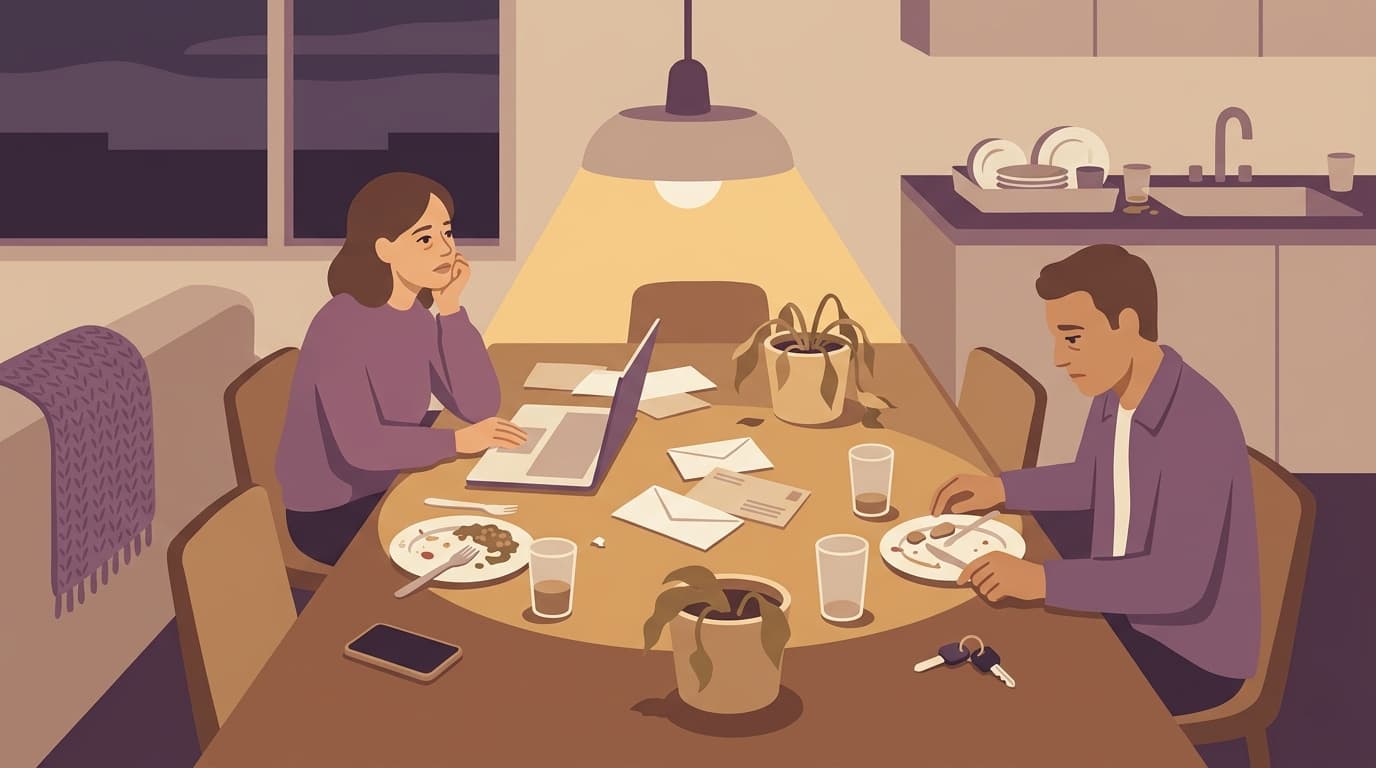
Relationships are hard because of a biological mismatch between pair-bonding systems evolved for survival and modern expectations of emotional fulfillment, hedonic adaptation that erodes the initial high, the transition from limerence to attachment, and the fact that 69% of relationship problems never resolve. Difficulty isn't failure. It's the normal cost of two separate people trying to build a life together.
An uncomfortable truth that no one includes in wedding toasts: your relationship is probably going to be hard, and the difficulty has almost nothing to do with whether you picked the right person.
We've inherited a cultural script that says love should be easy when it's right. That struggle means something is wrong. That the couples who make it are the ones who found their perfect match and the rest of us are just fumbling with the wrong puzzle pieces. This script is not only wrong, it's actively destructive. It makes normal difficulty feel like evidence of failure, which causes people to bail on relationships that were working fine or to stay in toxic ones because "love is supposed to be hard."
The truth sits somewhere less comfortable. Relationships are hard because of what they are. Two separate nervous systems, two separate histories, two separate sets of needs and fears, trying to coordinate a shared life. The miracle isn't that this is difficult. The miracle is that it works at all.
Why does the "spark" fade?
Let's start with biology, because that's where the trouble begins.
Helen Fisher, a biological anthropologist at Rutgers, spent decades studying the brain in love. Her 2004 book Why We Love detailed fMRI scans of people in various stages of romantic relationships. The early stage, what Fisher calls "romantic love," involves massive dopamine and norepinephrine activity in the brain's reward system, particularly the ventral tegmental area and caudate nucleus. These are the same circuits activated by cocaine.
This isn't a metaphor. The brain on new love is the brain on drugs. And like drugs, tolerance develops.
Dorothy Tennov coined the term limerence in 1979 to describe this initial state: the intrusive thinking, the emotional dependency, the desperate need for reciprocation, the idealization of the beloved. Her research, based on hundreds of interviews, found that limerence typically lasts between 18 months and 3 years. Then it fades. Not because something went wrong, but because the neurochemical cocktail that produced it was never meant to be permanent. It exists to get two people bonded. Once the bond is established, the brain shifts to a different system.
The replacement system runs on oxytocin and vasopressin, neurochemicals associated with calm bonding rather than frantic desire. This is the transition from passionate love to what Elaine Hatfield at the University of Hawaii calls companionate love. It feels less exciting. It also predicts long-term relationship satisfaction far more reliably than the dopamine-fueled early phase.
The problem isn't the transition. The problem is that nobody tells you it's coming. So when it arrives, you think love is dying. It's not dying. It's maturing. But the difference between dying and maturing can be very hard to feel from the inside.
Are we asking too much of modern relationships?
Historian Stephanie Coontz traced the evolution of marriage expectations in her 2005 book Marriage, a History. Her argument is worth understanding because it explains a lot of the pressure modern couples feel.
For most of human history, marriage was an economic and social arrangement. You married for land, alliances, labor, survival. Love was considered a nice bonus, sometimes a dangerous distraction. The expectation that your spouse should also be your best friend, your intellectual equal, your sexual ideal, your co-parent, your therapist, and your adventure buddy is historically brand new. It emerged in the West primarily in the last 150 years and accelerated dramatically after World War II.
Eli Finkel, a psychologist at Northwestern, formalized this argument in his 2017 book The All-or-Nothing Marriage. He analyzed data from multiple national surveys and found that the best marriages today are better than the best marriages of any previous era. But the average marriages are worse. The gap widened because expectations skyrocketed while the time and energy people invest in their relationships didn't keep pace.
Finkel's metaphor is a mountain. We used to expect marriage to meet our base-camp needs: survival, shelter, economic security. Now we expect it to get us to the summit: self-actualization, personal growth, existential meaning. Some couples make it to the summit. Many don't have the resources (time, energy, skills) to climb that high, and they end up disappointed at a base camp that would have felt perfectly adequate a century ago.
This isn't an argument against high expectations. It's an argument for understanding what those expectations cost and being willing to invest accordingly. You can't demand a summit-level marriage while investing base-camp-level effort.
Why do couples fight about the same things forever?
John Gottman's research at the University of Washington produced one of the most useful (and most deflating) findings in relationship science: 69% of relationship conflicts are perpetual. They never resolve. They come back, wearing slightly different outfits each time, because they're rooted in fundamental personality differences between partners.
She wants more spontaneity. He wants more structure. She processes emotions by talking them through immediately. He needs time alone first. She's a spender. He's a saver. These aren't problems to solve. They're differences to manage.
Gottman found that the difference between happy and unhappy couples wasn't whether they had perpetual problems. Everyone does. The difference was whether they could discuss those problems with humor, affection, and acceptance rather than contempt and gridlock. Happy couples developed what he called "dialogue" with their perpetual problems. They could talk about the issue, acknowledge both perspectives, make temporary compromises, and circle back to it later without each conversation feeling like a referendum on the relationship.
Unhappy couples got gridlocked. Each discussion felt like a battle where someone had to win. The issue became symbolic of deeper threats: you don't respect me, you don't see me, you want to control me. Once a perpetual problem triggers those attachment fears, it stops being about dishes or spending or punctuality and starts being about survival. For more on this dynamic, understanding the myth of the perfect relationship is a useful frame.
What is hedonic adaptation and how does it affect relationships?
Sonja Lyubomirsky, a psychologist at UC Riverside, has spent her career studying happiness. One of her core findings is hedonic adaptation: the human tendency to return to a baseline level of happiness after positive changes. You get a raise, and within months you're back to your previous happiness level. You move to your dream city, and within a year it's just where you live.
The same thing happens in relationships. A 2012 study by Lyubomirsky and colleagues found that the happiness boost from marriage lasted, on average, about two years before couples returned to their pre-marriage baseline. This doesn't mean marriage doesn't matter. It means the initial euphoria normalizes.
Hedonic adaptation is the engine behind one of the most common complaints in long-term relationships: "We've gotten boring." The restaurant you used to love is just a restaurant now. The person who used to thrill you is just the person next to you on the couch. This is your brain doing exactly what brains do. It adapts. It normalizes. It stops responding to stimuli that aren't new.
Arthur Aron's research at Stony Brook offers a partial antidote. His studies on self-expansion found that couples who regularly engaged in new, challenging, and exciting activities together showed increases in relationship satisfaction compared to couples who did pleasant but familiar activities. The novelty doesn't have to be extreme. It just has to be genuinely new. A different restaurant. A different conversation. A different question than the one you asked yesterday. Keeping curiosity alive goes deeper on practical approaches.
Is a "good enough" relationship actually good?
Donald Winnicott, a British pediatrician and psychoanalyst, coined the term "good enough mother" in the 1950s. His argument was radical for its time: children don't need perfect parents. They need parents who are reliably present and responsive enough that the child develops a secure sense of self. Perfection isn't the goal. Adequacy that allows growth is the goal.
The concept translates to adult relationships with uncomfortable precision. A "good enough" relationship isn't one where you're settling. It's one where both people are consistently responsive to each other's needs, where ruptures get repaired, where fundamental respect exists, and where both people are growing. The imperfection is part of the design. You learn from the friction. You develop resilience from the repair.
The alternative to "good enough" isn't "perfect." It's an endless cycle of starting over, chasing the limerence high with a new partner every two to three years, never getting past the point where real intimacy begins. Or it's staying in a relationship but chronically disappointed because it doesn't match an ideal that no actual relationship can match.
What gets me about the research: The couples who report the highest satisfaction aren't the ones who describe their relationship as perfect. They're the ones who describe it as worth the effort. The difficulty isn't incidental. It's the medium through which depth develops.
What cultural myths make relationships harder?
Several pervasive myths set couples up for disappointment by establishing expectations that no real relationship can meet.
"You complete me" might be the most damaging four words in popular culture. The idea that another person fills a void inside you isn't romantic. It's a setup for codependency and crushing disappointment. Healthy relationships involve two people who are already complete (or at least working on it) choosing to share their lives.
"Love means never having to say you're sorry" is spectacularly wrong. Gottman's research on repair attempts found that the willingness to apologize, take responsibility, and make amends is one of the strongest predictors of relationship survival. Love means having to say you're sorry regularly and meaning it.
"If it's meant to be, it'll be easy." The data says the opposite. Finkel's all-or-nothing marriage model, Gottman's perpetual problems, Lyubomirsky's hedonic adaptation, they all point to the same conclusion: lasting relationships require sustained, intentional effort. Ease can be a sign of avoidance as much as compatibility.
"Your partner should just know." Mind-reading is not a relationship skill. It's an unfair expectation that punishes your partner for being a separate person with a separate brain. Communicating clearly remains the only reliable alternative to resentment.
How do you make peace with the difficulty?
The shift that matters isn't from "this is hard" to "this is easy." It's from "this is hard, something must be wrong" to "this is hard, that's what this is."
Accept perpetual problems. Not with resignation, but with the recognition that your partner's personality isn't going to fundamentally change, and neither is yours. The question isn't "how do we fix this?" It's "how do we live with this gracefully?"
Invest in the friendship. Gottman's single strongest finding across decades is that the quality of the friendship between partners predicts outcomes more than anything else. Friendship means curiosity, humor, fondness, and genuine interest in each other's inner lives. That stuff requires maintenance.
Expect the limerence to end. When it does, don't panic. You're not falling out of love. You're falling into the part of love that actually lasts.
Keep asking questions you don't know the answer to. This is the simplest and most underrated relationship habit in the research. Not "how was your day" on autopilot. Real questions. Ones that update your understanding of who your partner is becoming. Aperi sends one per day, calibrated to your relationship's depth. The whole idea is that the small daily act of genuine curiosity can counteract adaptation and keep closeness alive even when the relationship is, inevitably, hard.
Frequently Asked Questions
Is it normal to question your relationship?
Yes. Doubts are normal, especially during the transition from limerence to companionate love (typically 18 months to 3 years in). Fisher's neurochemistry research shows this is a biological shift, not a red flag. The question to ask is whether the doubts are about the normal difficulty of partnership or about genuine incompatibility, contempt, or lack of respect. Understanding relationship stages can help you calibrate.
How much fighting is too much in a relationship?
Frequency of fighting matters less than how you fight. Gottman's research focused on the presence or absence of his "Four Horsemen" (contempt, criticism, defensiveness, stonewalling) rather than how often couples argued. A couple that fights weekly but repairs well is healthier than a couple that fights rarely but with contempt. Learn more about productive conflict.
Can a relationship recover after getting really hard?
Yes, with conditions. Gottman's research on repair attempts shows that relationships can recover from significant damage if both partners are willing to take responsibility and rebuild trust. The timeline is not quick. Sue Johnson's Emotionally Focused Therapy research shows recovery rates of 70-75% among distressed couples who complete the process, typically 8-20 sessions. What predicts failure is contempt that has become entrenched and a refusal by one or both partners to engage in repair.
Why does my relationship feel harder than everyone else's?
It probably doesn't. Social media creates a systematic distortion: you see curated highlights of other relationships and compare them to your unfiltered reality. Research on social comparison by Mussweiler and colleagues consistently shows that upward comparison (comparing yourself to seemingly better-off others) reduces satisfaction. Most couples experience the same perpetual problems, the same adaptation, the same difficulty. They just don't post about it.
Aperi: one question a day
A daily question app that adapts to you and your partner, and goes deeper the more you use it.


Free to start. Available on iPhone and Android.
Explore question packs
Related articles
Building self-worth that doesn't depend on your partner
When your self-worth depends on your partner's approval, every interaction becomes high-stakes. Here's how to build an internal foundation.
When you project your insecurities onto your partner
Projection makes you fight about things that aren't real. How to catch it, understand where it comes from, and stop.
Why boredom in your relationship isn't always bad
Relationship boredom gets a bad reputation. Sometimes it signals safety. Sometimes it signals stagnation. Here is how to tell the difference.
When you and your partner speak different love languages
You show love your way, not theirs. How to close the gap when you and your partner express affection differently, beyond the quiz.

What research says about age gap relationships
Age gap relationships attract strong opinions. What does the data actually show about satisfaction, power dynamics, and stigma?

Grieving together without growing apart
Partners often grieve differently and asynchronously. How to support each other through loss without losing your connection.