Key Takeaways
ADHD in adult relationships creates predictable friction patterns: the non-ADHD partner feels ignored, the ADHD partner feels criticized, and both feel misunderstood. Breaking the cycle requires understanding ADHD as a neurological difference, building external systems, and communicating about the pattern, not just the symptoms.
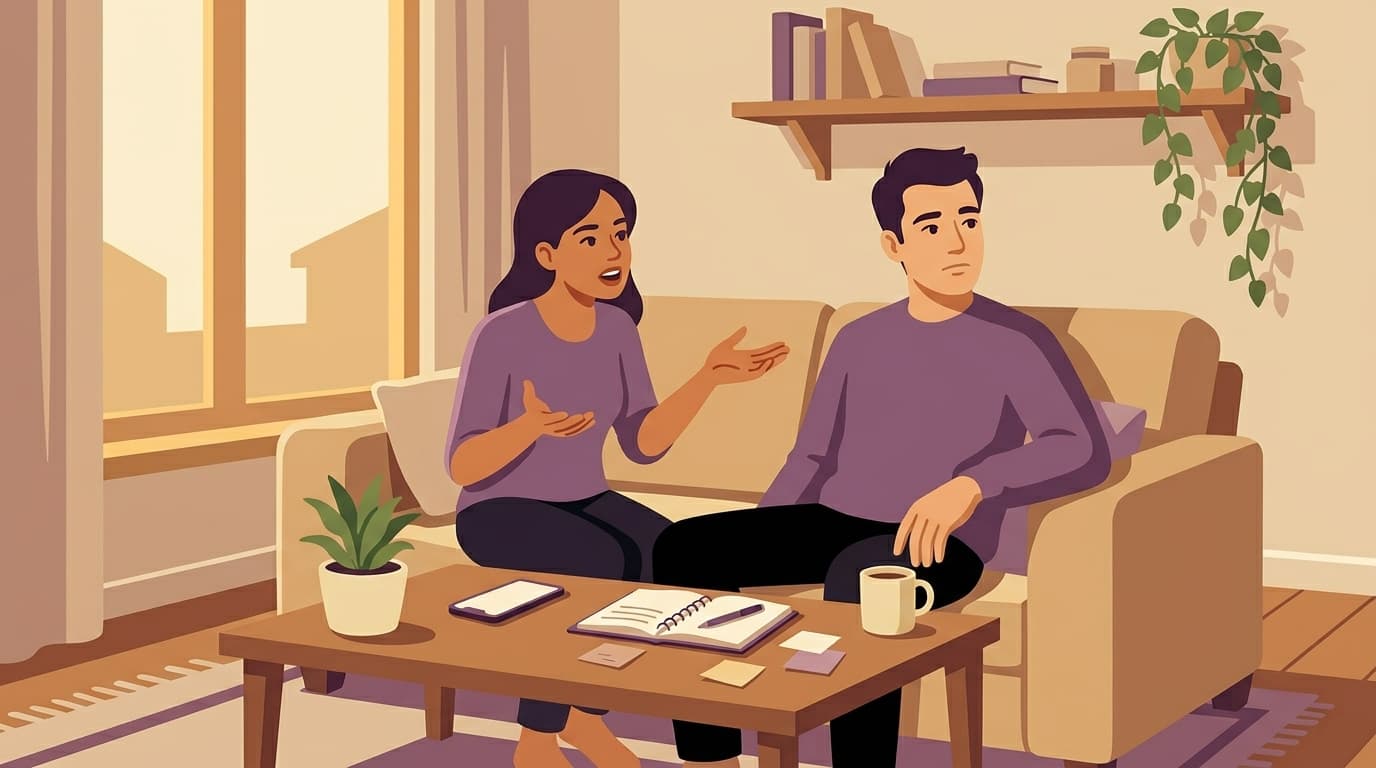
Somewhere around year two or three, the frustration starts to crystallize. One partner can't understand why the other forgot the appointment again, left the cabinet doors open again, started a project and abandoned it again. The other partner can't understand why everything they do is wrong, why their best effort never seems enough, why they keep getting that look, the one that says I'm disappointed in you.
This pattern has a name. Melissa Orlov, who wrote The ADHD Effect on Marriage, calls it the "parent-child dynamic," and it's the most common relationship-destroying pattern in couples where one partner has ADHD. It goes like this: the non-ADHD partner, out of frustration and necessity, takes over more and more of the planning, organizing, and managing. The ADHD partner, now being directed and corrected, feels infantilized. The more the non-ADHD partner manages, the less the ADHD partner initiates. The less they initiate, the more the non-ADHD partner manages. Both hate it. Neither knows how to stop.
If this sounds like your relationship, the first thing to know is that you're not failing. You're caught in a dynamic that's driven by neurology, not character. And it's fixable, but not through willpower alone.
What does ADHD actually look like in adult relationships?
ADHD isn't a kids-only condition. The CDC estimates that about 4.4% of American adults have ADHD, and many weren't diagnosed until adulthood, or still haven't been. The childhood stereotype of a hyperactive boy bouncing off walls misses the majority of how ADHD presents in grown-ups, especially in women, where the hyperactivity is often internalized as mental restlessness rather than physical movement.
In relationships, ADHD shows up as:
Inconsistent attention. The ADHD partner might be intensely focused during a date-night conversation but completely zoned out during a discussion about weekend plans. This isn't selective caring. It's how ADHD brains work: they're driven by interest and novelty, not importance. The non-ADHD partner experiences this as "you pay attention when you want to," which feels like a choice. It isn't.
Forgetfulness about commitments. Missed anniversaries, forgotten errands, overlooked promises. Not because they don't care, but because working memory, the mental system that holds information you need to act on, is impaired in ADHD. The intention was genuine. The follow-through failed.
Emotional dysregulation. ADHD significantly affects emotional regulation. The ADHD partner may react more intensely than the situation seems to warrant: a small criticism triggers a disproportionate response, or a minor frustration becomes a major emotional event. Dr. Russell Barkley's research positions emotional dysregulation as a core feature of ADHD, not a secondary effect.
Hyperfocus courtship, then perceived neglect. During the early relationship, the novelty and intensity of new love often triggers ADHD hyperfocus, and the partner gets all the attention. This sets expectations that can't be maintained once the novelty normalizes. The non-ADHD partner may feel deceived: "You were so attentive at the beginning. What happened?" What happened was the neurochemistry shifted, and the ADHD partner returned to their baseline attention patterns.
Difficulty with daily logistics. Chores pile up. Bills get paid late. The car registration expires. Household management, which requires sustained, non-stimulating executive function, is precisely what ADHD brains struggle with most. The non-ADHD partner often picks up the slack, which leads directly to the mental load imbalance that corrodes partnerships.
Why does the ADHD partner feel criticized?
Because they probably are being criticized, even by partners who don't intend to be critical.
When you live with someone whose ADHD symptoms create daily friction, it's nearly impossible to avoid a pattern of correction. "Did you remember to..." "You left the..." "I already told you about..." Each individual comment may be factual and reasonable. But the cumulative effect is a constant message: you are not doing enough. You are not enough.
The ADHD partner's emotional experience is often one of shame. Many adults with ADHD have spent their entire lives hearing some version of "you're so smart, if you'd just try harder" from teachers, parents, bosses, and now their partner. They are trying. The trying just doesn't produce the same results as it does for a neurotypical brain.
Over time, this shame often manifests as defensiveness, withdrawal, or reactive anger. The ADHD partner stops trying because trying and failing feels worse than not trying at all. They pull away from conversations because every conversation feels like it might become another inventory of their failures.
Why does the non-ADHD partner feel ignored?
Because their lived experience is one of chronic disappointment.
They asked their partner to do something. It didn't get done. They asked again. It got partially done. They brought it up a third time and were told they were nagging. So they did it themselves, and now they're exhausted and resentful.
They planned a meaningful evening. Their partner was distracted throughout, checking their phone, losing the thread of conversation, seeming to be somewhere else entirely. The non-ADHD partner doesn't experience this as "my partner's working memory and sustained attention are impaired." They experience it as "my partner doesn't care about me enough to be present."
Orlov's research found that non-ADHD partners frequently report feelings of loneliness within the relationship. They feel like they have a roommate, not a partner. They feel like a project manager, not a spouse. They love the person but are exhausted by the pattern. Sound familiar? That dynamic overlaps significantly with what happens when partners give one-word answers and gradually disengage.
How do you break the parent-child dynamic?
The pattern won't break on its own, and it won't break through either partner just "trying harder." It requires structural changes and a shared understanding of what's happening.
Name the pattern, not the person
The first step is getting both partners to see the dynamic as the problem, not each other. This reframe matters enormously. "You're irresponsible" is an attack. "We've fallen into a pattern where I manage and you execute, and it's making us both miserable" is an observation. One triggers defensiveness. The other invites collaboration.
Separate ADHD symptoms from character
The ADHD partner is not lazy, selfish, or uncaring. The non-ADHD partner is not a nag, a control freak, or impossible to please. Both are reacting predictably to a neurological difference that's creating friction. When both partners truly understand this, not intellectually but viscerally, the blame starts to dissolve.
This doesn't mean ADHD is an excuse. The ADHD partner is still responsible for managing their condition. But there's a difference between "you forgot because you don't care" and "you forgot because your working memory struggles, and we need a system to catch that." The first is a judgment. The second is a strategy.
Build external scaffolding
ADHD brains need external systems to compensate for internal executive function deficits. The couples who manage ADHD well lean heavily on:
- Shared digital calendars with reminders set at useful intervals (not day-of, but day-before plus one-hour-before)
- Visual cues: a whiteboard in the kitchen, sticky notes on the door, alarms for routine tasks
- Routines over willpower: if laundry always happens on Sunday morning, it becomes automatic rather than requiring a decision each time
- Body doubling: the ADHD partner does boring tasks with the other partner present, which helps with initiation (this is a well-documented ADHD strategy, not a character weakness)
- Written agreements: important conversations and decisions get written down, because verbal agreements are easily lost in the ADHD partner's working memory
The point isn't to treat the ADHD partner like a child who needs checklists. It's to acknowledge that their brain works differently and to build an environment that supports both partners.
Redistribute without scorekeeping
The non-ADHD partner should not do everything. But the distribution might not look 50/50 in the traditional sense. Maybe the ADHD partner handles tasks that are more stimulating or have clear, immediate feedback (cooking, yard work, hands-on projects), while the non-ADHD partner handles the organizational scaffolding (bills, scheduling, logistics). This isn't unfair. It's playing to strengths.
What matters isn't perfect equality in task type. It's that both partners feel the overall effort is balanced and that neither is carrying the whole weight.
What communication strategies actually help?
Keep it short. Long, detailed instructions overwhelm ADHD working memory. "Can you take out the trash and then call the vet and also check if we need dog food" is three separate tasks masquerading as one request. One task at a time.
Write it down. If it's important enough to argue about later, it's important enough to put in writing. Shared notes, texts, whatever works. This eliminates "I never said that" / "you never told me" disputes.
Schedule check-ins, don't ambush. Spontaneous relationship conversations ("we need to talk") trigger ADHD anxiety and often catch the ADHD partner when their focus resources are depleted. Scheduled weekly check-ins give both partners time to prepare. A structured format like a weekly relationship check-in works well here.
Use the 10-second rule. When the ADHD partner says something impulsive or hurtful, pause for 10 seconds before responding. Emotional dysregulation means the comment may not represent their actual feelings. Give the prefrontal cortex time to catch up.
Validate before solving. When the ADHD partner shares frustration, resist the urge to fix it immediately. "That sounds really frustrating" goes further than "well, have you tried..." ADHD partners often need emotional acknowledgment before they can engage with practical solutions.
For deeper techniques on keeping conversations productive, the communication strategies framework applies directly to ADHD-affected conversations.
When should you get professional help?
Honestly? Earlier than most people do. ADHD-affected relationships benefit enormously from:
Individual ADHD treatment. Medication, when appropriate, can significantly improve attention, emotional regulation, and executive function. Therapy (especially CBT adapted for ADHD) helps build coping strategies. The ADHD partner treating their condition is not optional for relationship health. It's foundational.
Couples therapy with an ADHD-informed therapist. Standard couples therapy can actually make things worse if the therapist doesn't understand ADHD. A therapist who treats ADHD relationship patterns as willpower problems will reinforce the shame-blame cycle. Look for therapists who specifically list ADHD or neurodivergent relationships in their specialties.
Psychoeducation for both partners. Understanding ADHD as a neurological condition (reading Orlov's work, watching Dr. Barkley's lectures, joining support communities) transforms how both partners interpret each other's behavior. Knowledge isn't a cure, but it's the necessary foundation for everything else.
If anxiety or depression has developed alongside the ADHD friction (common for both partners), our guide on supporting a partner through mental health challenges covers that dimension.
Frequently Asked Questions
Can ADHD hyperfocus actually help a relationship?
Yes, when channeled intentionally. Hyperfocus is a double-edged sword. The same intensity that makes an ADHD partner neglect boring tasks can make them extraordinarily present and creative when engaged. The key is creating relationship moments that activate hyperfocus: novel date ideas, engaging conversations, shared projects. Routine maintenance won't trigger it, but connection-building activities often can.
What if my partner won't get diagnosed or treated?
You can't force someone to seek diagnosis or treatment. What you can do is share your experience without ultimatum: "Here's what I'm observing. Here's how it's affecting us. I'd like us to explore this together." If they refuse and the relationship continues to deteriorate, you may need to decide what you can and can't live with. That's a legitimate boundary, not an abandonment.
Is the non-ADHD partner ever the problem?
Sometimes, yes. If the non-ADHD partner's response to ADHD symptoms has become controlling, contemptuous, or punitive, they've become part of the problem regardless of what triggered the pattern. Taking on a parental role might have started as necessity, but if it's maintained through superiority or resentment, that's corrosive in its own right. Both partners have work to do.
Does ADHD medication fix relationship problems?
Medication can significantly reduce the symptoms that create friction: inattention, forgetfulness, emotional reactivity. But it doesn't fix entrenched relationship patterns. A couple that has spent years in the parent-child dynamic needs to actively rebuild the dynamic even after medication improves the ADHD symptoms. Medication creates the conditions for change. It isn't the change itself.
How do you date someone with ADHD?
With curiosity rather than frustration. Learn about ADHD so you understand what's neurology and what's choice. Build systems together early rather than waiting for resentment to force it. Communicate directly; ADHD partners often miss hints and subtext. And remember that the same brain that forgets the groceries is often the one that comes up with the spontaneous adventure, the unexpected gift, the creative solution nobody else thought of. ADHD is a package deal.
ADHD in relationships is one of those areas where knowledge genuinely changes outcomes. The couples who struggle most are the ones fighting the same pattern without understanding what's driving it. If you want to build a habit of checking in with your partner regularly (something that matters more, not less, when ADHD is part of the equation), Aperi sends you both a daily question designed to spark exactly that kind of conversation.
Aperi: one question a day
A daily question app that adapts to you and your partner, and goes deeper the more you use it.


Free to start. Available on iPhone and Android.
Explore question packs
Related articles
When you and your partner speak different love languages
You show love your way, not theirs. How to close the gap when you and your partner express affection differently, beyond the quiz.
The Zeigarnik effect: why unfinished conversations haunt your relationship
Why unresolved conflicts keep looping in your head, and how to close the open loops that create resentment.
The mental health conversation every couple needs to have
Why mental health is a relationship topic, how to bring it up, and how to build a mental health plan as a couple.
Active listening: the most underrated relationship skill
What active listening really means, why most people get it wrong, and specific techniques backed by decades of research.

Rebuilding trust after it's been broken
Trust isn't rebuilt by promises. It's rebuilt by changed behavior over time. Here's what the research says about the process.
Emotional regulation: the skill that saves relationships
Emotional regulation is the most underrated relationship skill. How it works, why suppression backfires, and what to do when you're flooded.