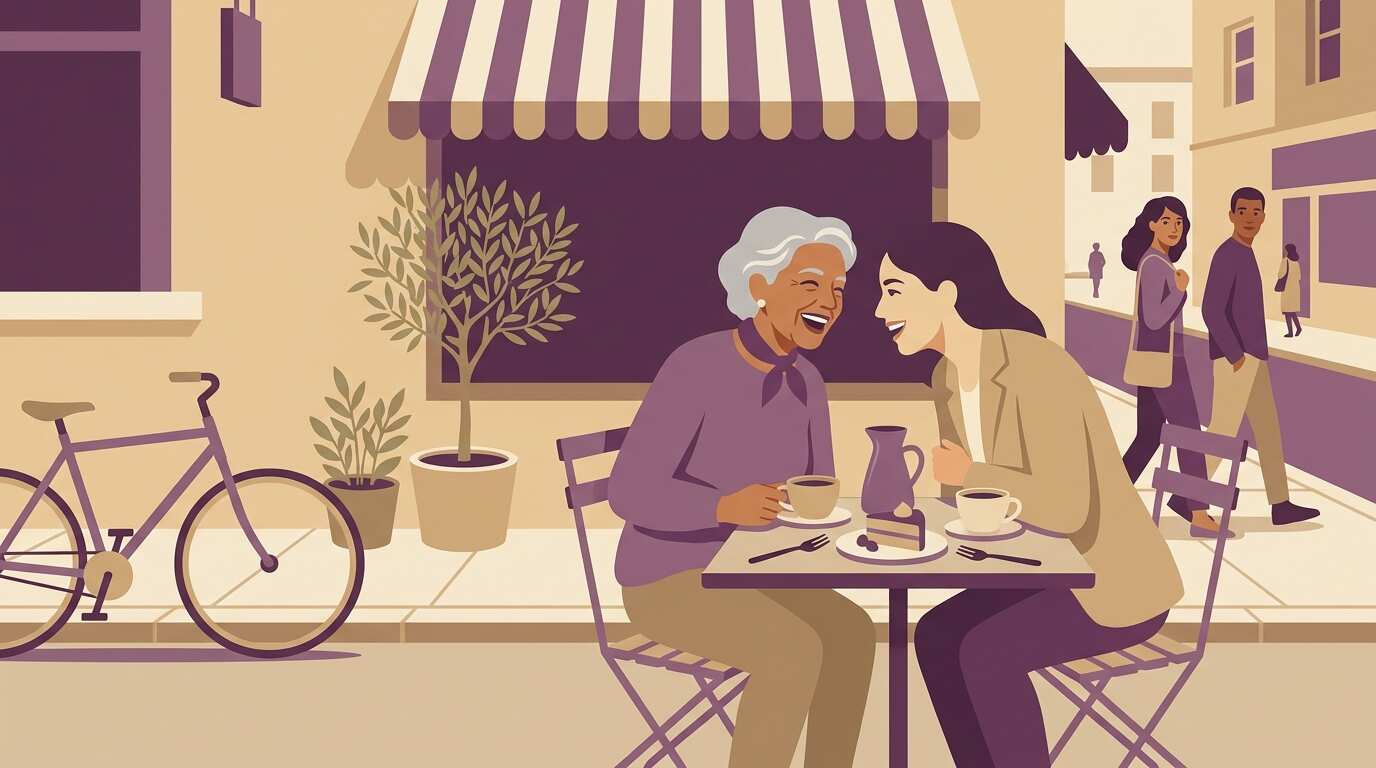
Key Takeaways
Research shows age gaps over 10 years correlate with lower relationship satisfaction, but the reasons are complicated: life stage mismatch and social stigma may matter more than the gap itself. Power dynamics deserve scrutiny but aren't automatic. The double standard around older men vs. older women is real and measurable. Shared values and life vision predict satisfaction better than age similarity.
Few relationship configurations attract as much unsolicited opinion as age gap relationships. Everyone has a take. Online comment sections swing between "love is love" and "that's predatory" with very little in between. What's missing from most of these discussions is data.
So here's the data, the complications around it, and the things that actually matter.
How common are age gap relationships?
More common than the discourse suggests. U.S. Census data consistently shows that in about 8-10% of married heterosexual couples, the age gap is 10 years or more. Smaller gaps of 2-5 years are extremely common, and the average age gap in U.S. marriages is about 2.3 years, with the man older.
Cross-culturally, the patterns vary. In some West African and Middle Eastern societies, gaps of 10-15 years are normative. In Scandinavian countries, gaps tend to be smaller. The point is that what feels "normal" is culturally determined, not biologically fixed.
Same-sex couples show different patterns too. Research by Gotta and colleagues found that same-sex couples are more likely to have significant age gaps than heterosexual couples and report less social stigma around them, possibly because same-sex relationships have already broken one norm and the age-norm violation feels less significant in comparison.
What does the research say about satisfaction?
The most cited study is Sven Drefahl's 2010 analysis of Danish marriage data, which found that the lowest mortality risk (used as a proxy for relationship quality and social support) was in couples with small age gaps. As the gap increased beyond about 7 years, satisfaction indicators declined.
But this study has important limitations. It's observational. It can't tell you whether the age gap caused lower satisfaction or whether the kinds of people who enter large-gap relationships differ in other ways that affect satisfaction. Selection effects are a real problem in this research.
Hugo Mialon's 2014 study, based on 3,000 Americans, found a similar pattern: a 5-year gap made a couple 18% more likely to divorce than a same-age couple. A 10-year gap pushed that to 39%. A 20-year gap: 95%. These numbers are dramatic, but again, they don't isolate the age gap as the causal factor.
What does predict satisfaction in age-gap relationships? The same things that predict it in same-age relationships. Gottman's research doesn't identify age gap as a significant variable when communication quality, respect, and shared meaning are controlled for. In other words: if you communicate well, respect each other, and share a vision for your life, the age gap may not matter much. If you don't, the age gap gives you an additional fault line.
When do power dynamics become a problem?
This is the question that generates the most heat and the least precision.
Age gaps create the potential for power imbalances. The older partner often has more money, more life experience, more professional status, and more confidence in who they are. The younger partner may be financially dependent, still forming their identity, or less practiced at asserting boundaries. None of this is automatic (a 22-year-old can be more self-assured than a 45-year-old), but the structural conditions favor the older partner.
The problem isn't power difference itself. Almost all relationships have some power asymmetry. One person earns more, one is more socially skilled, one is more emotionally intelligent. The problem is when the power difference is used, consciously or not, to control the dynamic.
Warning signs in age-gap relationships specifically:
The older partner dismisses the younger partner's opinions as naive or immature. The older partner uses "I have more experience" to end disagreements rather than engage with them. The younger partner feels unable to make major life decisions without the older partner's approval. The older partner controls finances. The relationship started when the younger partner was very young (late teens or early twenties) and the older partner was well into adulthood.
If you're in an age-gap relationship and wondering whether yours has a power problem, the diagnostic question is: can the younger partner disagree with the older partner on something important and have that disagreement taken seriously? If yes, you're probably fine. If no, or if the answer requires qualification, pay attention. The red flags that apply to all relationships apply here too, with the addition that age-based dismissal is its own category of harm.
What about life stage mismatches?
This is often a bigger practical problem than the age itself.
A 30-year-old and a 45-year-old may be perfectly compatible in values, communication, and daily life. But if the 30-year-old wants children and the 45-year-old already has teenagers and is done, that's a structural conflict that no amount of love will resolve. If one person is in the high-energy phase of building a career and the other is ready to slow down, that creates friction about priorities, schedules, and energy.
Retirement is a particularly stark version of this. When one partner retires 15 years before the other, the asymmetry reshapes the entire relationship. One person has abundant free time and declining structure. The other has full work demands. One is processing the identity shift of no longer working. The other is decades away from that experience. It's hard to empathize with a life stage you haven't reached yet.
Health is another. Bodies age at different rates, but a significant age gap means one partner will likely face serious health challenges while the other is still healthy. Couples in their thirties rarely discuss what it means that one of them will probably be a caregiver 15 years sooner than in a same-age pairing.
These aren't reasons to avoid age-gap relationships. They're reasons to have honest conversations about them before they arrive. The questions you'd ask before marriage apply with extra urgency when your timelines don't naturally align.
What does social stigma actually do to these relationships?
More than most people realize. Lehmiller and Agnew (2006) conducted a study specifically on age-gap relationships and social disapproval. They found that perceived disapproval from friends and family was significantly associated with lower relationship commitment and investment, even after controlling for relationship quality.
The mechanism is straightforward. When the people around you think your relationship is weird, predatory, or doomed, you spend energy defending it instead of enjoying it. Every family gathering requires managing comments. Every new social situation involves a calculation about how to present yourselves. The relationship exists inside a low-grade stress field that same-age couples don't experience.
The stigma is also gendered. Older man with a younger woman: somewhat accepted, somewhat joked about, occasionally admired. Older woman with a younger man: consistently questioned, often mocked, assumed to be temporary. The double standard is documented. A study by Collisson and De Leon found that older women in age-gap relationships were rated as less competent, less warm, and more desperate than older men in equivalent gaps. Both pairings received some negative judgment, but the older woman/younger man combination drew significantly more.
This double standard has real effects. Women in relationships with younger men report more social pressure, more self-doubt about the relationship's viability, and more reluctance to be public about the relationship. The stigma doesn't reflect the reality of these relationships (research doesn't show that older woman/younger man pairings are less satisfying), but it does create an additional burden.
When does the age gap not matter?
Several conditions consistently predict success in age-gap relationships regardless of the gap size.
Shared values and life vision. Do you agree on the big things: where to live, whether to have children, how to spend money, what commitment means? Value alignment predicts satisfaction far more reliably than demographic similarity.
Both partners are in established adulthood. A 40-year-old and a 55-year-old is a very different dynamic than a 20-year-old and a 35-year-old. The younger partner's age matters more than the gap. A person who hasn't finished their psychological development is in a fundamentally different position from someone who has.
Mutual respect for each other's stage. The older partner doesn't treat the younger one as a student or a project. The younger partner doesn't treat the older one as a parent figure. Both bring something to the table and both learn from each other.
External support. Having at least some friends and family who accept the relationship makes a significant difference. Total isolation from social networks is both a red flag and a risk factor.
Strong communication about the gap-specific challenges. Couples who openly discuss the life stage differences, the power dynamics, and the social stigma report higher satisfaction than those who avoid the topic. Pretending the age gap doesn't exist doesn't make it irrelevant; it just makes it impossible to manage.
What do the different relationship stages look like with an age gap?
The stages that all relationships pass through still apply, but the timing can be asymmetric. The older partner may be ready for deeper commitment sooner because they've already done the exploration phase in previous relationships. The younger partner may still be in a phase of identity formation where settling down feels premature.
This asynchrony isn't fatal, but it requires patience from both sides. The older partner needs to let the younger partner's process unfold without rushing it. The younger partner needs to be honest about where they are rather than performing readiness they don't feel.
The biggest long-term risk isn't the beginning. It's the transition to later life stages. The couple who was well-matched at 35 and 50 may face significant challenges at 55 and 70, when health, energy, and social needs diverge more sharply. Planning for this, not just financially but emotionally, is part of the responsibility that comes with choosing a partner at a different life stage.
What should you do if you're in an age-gap relationship?
Stop asking whether the gap is "okay" in the abstract. The gap is a fact about your relationship, like geography or career choice. What matters is how you deal with its specific implications.
Talk about the power dynamics honestly. If you're the older partner, ask your younger partner whether they feel free to disagree with you. If you're the younger partner, notice whether you defer to your older partner's judgment automatically or by choice.
Plan for the life stage challenges. Don't assume you'll figure out the children question, the retirement question, or the caregiving question when you get there. Those conversations need to happen before the decisions become urgent.
Build social support. Find friends, communities, or at minimum a few people who accept your relationship without commentary. The stress of constant social disapproval is corrosive over time.
And be honest with yourself about why you chose this relationship. Not brutally self-critical, just honest. People enter age-gap relationships for all kinds of reasons, including perfectly healthy ones. But if the gap is serving a function (the older partner gets to feel young; the younger partner gets to feel secure and guided), it's worth examining whether that function is sustainable or whether it's a temporary arrangement that won't survive changed circumstances.
FAQ
Is there a "safe" age gap?
Research doesn't identify a clean threshold. Gaps under 5 years show minimal statistical differences from same-age relationships. Gaps of 5-10 years show small increases in divorce risk. Gaps over 10 years show more significant increases. But these are population-level statistics that say nothing about individual couples. A 12-year gap between two people who share values and communicate well is a better bet than a 2-year gap between people who don't.
Do age gap relationships affect children?
The research on children's outcomes in age-gap relationships is limited. What exists suggests that family stability and parenting quality matter far more than parental age difference. Children of age-gap couples may face some social questions from peers, but this is manageable. The more significant concern is the practical one: an older parent may face health limitations while children are still young.
What if my friends and family don't approve?
Their concern may be valid or it may be based on stereotypes. The test is specificity. If they can point to concrete behaviors that worry them (power imbalances, isolation from friends, loss of autonomy), take that seriously. If their objection is essentially "it's weird" or "people will talk," that's stigma, not insight. Regardless, building at least a small support network that accepts your relationship is important for its long-term health.
How can couples with an age gap stay connected as they move through different life stages?
By staying curious about each other's current experience rather than assuming you understand it. The 55-year-old facing retirement is dealing with something the 40-year-old hasn't experienced yet. The 40-year-old's career ambitions are something the 55-year-old may have moved past. Asking each other genuine questions about where you are right now keeps you connected across the stage gap. Aperi's daily questions are built for exactly this: regular check-ins that prevent assumptions from replacing actual understanding.
Aperi: one question a day
A daily question app that adapts to you and your partner, and goes deeper the more you use it.


Free to start. Available on iPhone and Android.
Explore question packs
Related articles

Relationship advice for your 20s
Your 20s are when you learn how to be in a relationship. Here's what the research says about building the skills that matter.
Dating again after divorce
There's no perfect timeline for dating after divorce. But there is a difference between being ready and just being lonely.

Limerence: when new love feels like obsession
What limerence actually is, how it differs from love, why your brain acts like it has OCD, and what happens when it wears off.

Why Gen Z couples are prioritizing emotional intelligence
Gen Z entered dating with a shared vocabulary for emotional dynamics. Some of that is working well. Some is overcorrecting. A breakdown.

Relationship red flags vs. normal growing pains
Not everything uncomfortable is a red flag. Here's how to tell the difference between real warning signs and normal relationship friction.
Why personal growth sometimes threatens your relationship
When one partner grows, the relationship system gets disrupted. Why that happens and how to handle it.