Key Takeaways
Your phone isn't just a distraction. It's competing with your partner for a finite resource: your attention. The couples who manage this well don't rely on willpower. They build specific agreements about when, where, and how devices fit into their shared life.
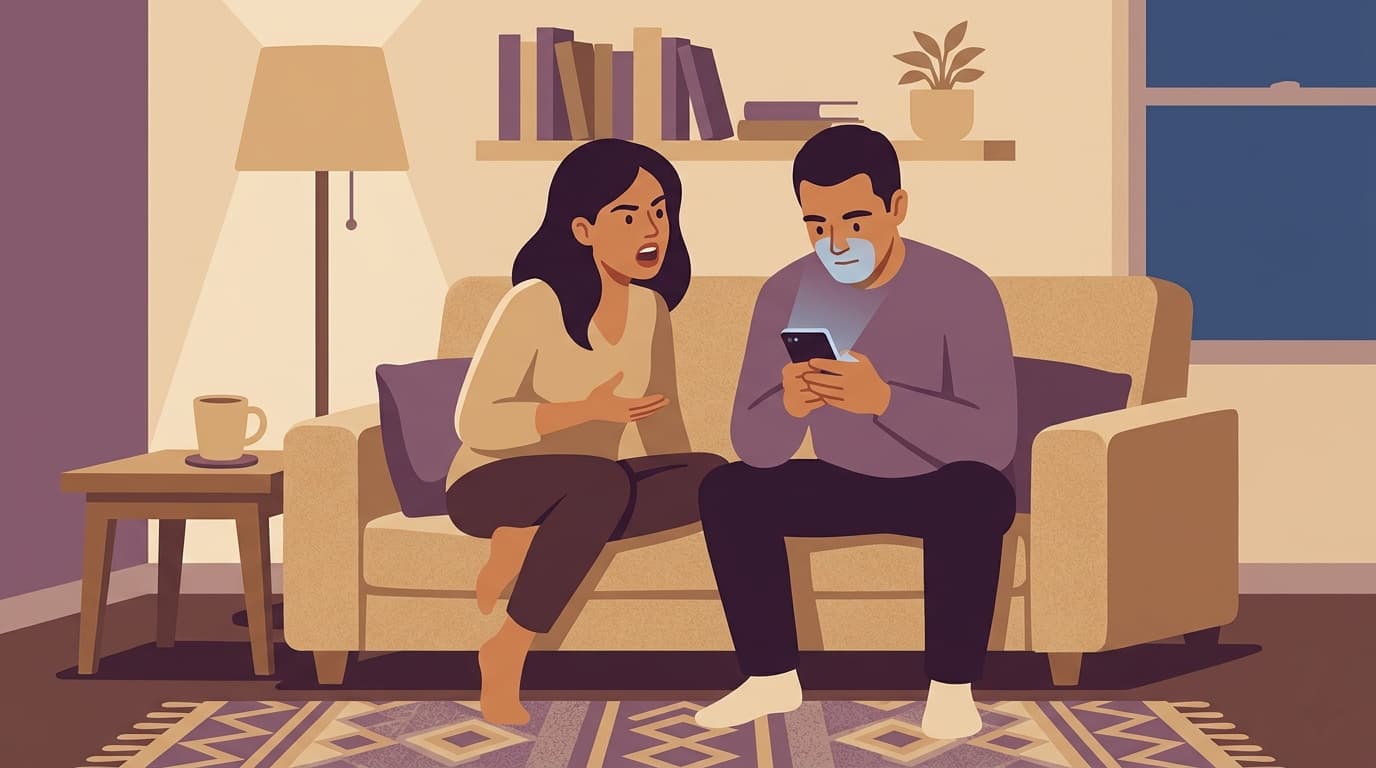
You're telling your partner about your day. Mid-sentence, they glance at their phone. Maybe they pick it up. Maybe they just shift their eyes for a second. Either way, you felt it: the micro-rejection of being less interesting than a notification.
Or maybe you're the one doing it. You're listening, mostly, but your thumb is scrolling reflexively and you don't even realize you checked out until your partner says, "Are you even listening?"
This is the most normalized relationship problem of our era. Phones are everywhere, always on, always demanding something. And because everyone does it, we've collectively agreed it's fine. It isn't.
What does the research say about phones and relationships?
Researchers have a word for the phenomenon of snubbing your partner in favor of your phone: phubbing (phone + snubbing). The term sounds silly. The effects aren't.
A 2016 study by James Roberts and Meredith David at Baylor University found that phubbing was significantly associated with lower relationship satisfaction and higher levels of depression. Not just annoyance, but actual depression. A follow-up study published in Computers in Human Behavior found that phubbing creates a cascade: partner phubbing leads to conflict over phone use, which leads to lower relationship satisfaction, which leads to lower life satisfaction.
Brandon McDaniel at Illinois State University coined the term technoference to describe technology-related interruptions in couple interactions. His research, spanning thousands of couples, found that even minor technoference (a phone buzzing during dinner, pausing a conversation to check a text) was linked to more conflict, lower relationship satisfaction, and in parents, higher rates of depression and behavioral problems in their children.
The mechanism isn't complicated. Attention is the fundamental currency of relationships. When your partner is physically present but mentally elsewhere, your attachment system registers it as unavailability. Over time, repeated small moments of being deprioritized add up to a feeling that you don't matter enough, the same feeling that drives emotional disconnection.
Why doesn't "just put your phone down" work?
If it were that simple, nobody would have this problem. The reason phone habits are so resistant to change is that you're not fighting willpower. You're fighting design.
Every app on your phone was engineered by teams of behavioral psychologists and UX designers whose explicit goal is to maximize the time you spend looking at a screen. Variable reward schedules (the same mechanism that makes slot machines addictive), infinite scroll, push notifications, social validation loops. These aren't accidental features. They're the product.
Tristan Harris, former design ethicist at Google, has described the attention economy as "a race to the bottom of the brainstem." The apps aren't competing with your partner for your higher-order attention. They're hijacking your reflexive, lizard-brain impulse to check for novelty. Your partner can't compete with that through sheer interestingness, and they shouldn't have to.
This means that individual willpower is a losing strategy. You need structural changes: environmental design that makes the default behavior the one you actually want.
What is your relationship's attention budget?
Think of attention as a daily resource with a hard cap. You have a finite number of hours outside work, sleep, and obligations. Of those hours, some portion goes to screens: social media, news, games, YouTube, scrolling. Whatever's left goes to your partner, your kids, your friends, yourself.
Most people have never explicitly calculated this. Try it for a week. Check your screen time reports. Then look at how many waking, non-work hours you actually spent in focused, undistracted interaction with your partner. For many couples, the number is shockingly low, sometimes under 30 minutes per day.
The question isn't whether phones are "bad." It's whether your current allocation reflects your actual priorities. If your relationship is the most important thing in your life, does your attention budget reflect that? Or does Instagram get more of your undivided focus than the person sleeping next to you?
How does social media affect your view of your relationship?
The phone-in-the-room problem is about attention. Social media adds a second dimension: comparison.
Research by Mai-Ly Nguyen Steers and colleagues found that social media use is positively correlated with relationship dissatisfaction, primarily through the mechanism of social comparison. You see curated highlights of other people's relationships (the surprise trips, the anniversary posts, the candid-but-actually-staged couple photos) and your own ordinary Tuesday feels inadequate by contrast.
This isn't just an individual problem. It seeps into the relationship itself. You might find yourself resenting your partner for not being as romantic as the couples you follow. You might feel pressure to perform your own relationship for an audience. You might interpret your partner's lack of public affection as a lack of private affection, even when that's not true at all.
The comparison trap is especially insidious because it's usually unconscious. You don't sit down and think, "I'm going to compare my relationship to strangers' curated content and feel bad." It just happens, drip by drip, scroll by scroll. Before you know it, you're vaguely dissatisfied for reasons you can't quite name. If this feeling sounds familiar, it might be worth reading about the roommate rut, because sometimes the dissatisfaction phones amplify has deeper roots.
What digital boundaries actually work?
Effective digital boundaries share three characteristics: they're specific, mutual, and structural (not willpower-dependent).
Phone-free zones and times
The most impactful single change most couples can make: no phones during meals and in the bedroom.
Meals are one of the few natural connection points in a busy day. Phones on the table, even face-down, reduce the quality of conversation. A 2018 study in the Journal of Experimental Social Psychology found that the mere presence of a phone (not active use, just its physical presence) reduced the quality of face-to-face interaction, empathy, and connection.
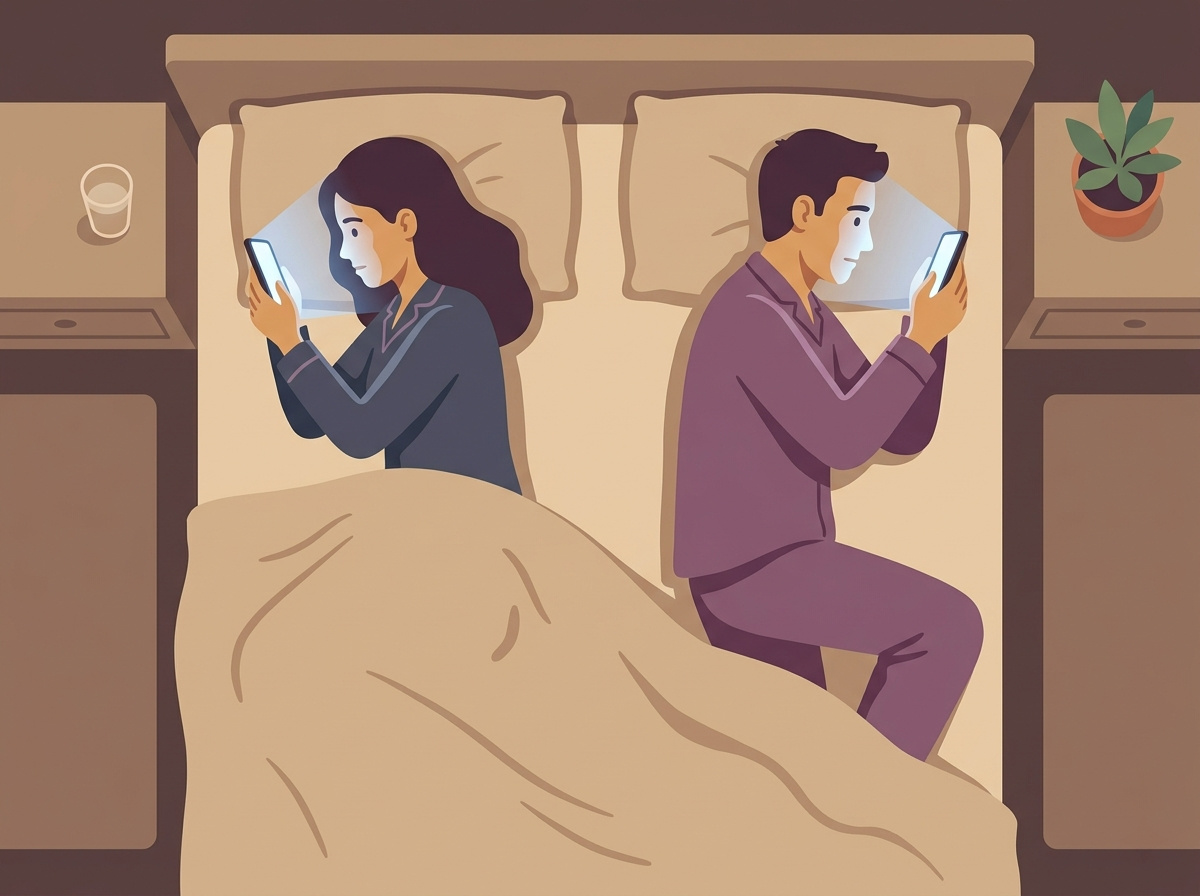
The bedroom is the other critical zone. Phones in bed before sleep replace what used to be the day's last conversation: the debrief, the check-in, the physical closeness that comes from lying in the dark together. Replace that with parallel scrolling and you've eliminated one of the few naturally intimate moments the day offers.
Practical implementation: buy an alarm clock. Charge phones in another room. This removes the "but I need it for my alarm" excuse and eliminates the temptation of a phone on the nightstand.
Notification audit
Go through your notification settings together. Turn off everything that isn't time-sensitive. Most push notifications exist to pull you back into an app, not to inform you of something genuinely urgent. Email can wait. Instagram likes can wait. News alerts can wait (the news will still be there in an hour).
Keep notifications for calls, texts from specific people (kids, elderly parents), and calendar reminders. Disable everything else. This single change dramatically reduces the number of times your phone hijacks your attention during shared time.
The "phone stack" at dinner
When eating out or having a screen-free date night, both partners stack phones face-down in the center of the table. First person to reach for theirs pays the bill (or does the dishes, or whatever stakes you choose). It's playful, but it works because it makes the default behavior visible. You can't mindlessly pick up your phone when there's a social cost attached.
Social media agreements
This one requires a real conversation, not a rule imposed by one partner. Topics to discuss:
- How do you each feel about posting couple content? Some people love it, others find it performative. Neither is wrong, but you need to agree.
- Are there topics that are off-limits for posting? Fights, parenting struggles, financial details, anything that feels private.
- Following exes: where's the line for both of you? This isn't about trust; it's about what makes each person comfortable.
- DMs with people who could be perceived as romantic interests: what's the agreement?
There's no universal right answer to any of these. The right answer is the one you reach together, honestly.
What's the difference between monitoring and transparency?
This is a critical distinction that many couples get wrong.
Monitoring is one partner surveilling the other: checking their phone when they leave the room, demanding to see messages, tracking location without agreement. Monitoring is rooted in anxiety and control, and it erodes trust rather than building it.
Transparency is both partners voluntarily sharing access and information because they've agreed to it. It might mean shared passwords, open phone policies, or location sharing, but the key word is both, and the key emotion is willingness, not compliance.
If you feel the urge to check your partner's phone, that's worth examining. Is it driven by something they've done (a breach of trust, suspicious behavior)? Or is it driven by your own anxiety? The first situation may warrant a direct conversation. The second situation probably needs individual work, possibly with a therapist who specializes in relationship anxiety.
When is phone use a symptom of something bigger?
Sometimes excessive phone use in a relationship isn't the problem. It's the escape valve. If your partner is spending hours on their phone when you're together, ask (gently) whether there's something they're avoiding.
Phone use can be a coping mechanism for:
- Relationship dissatisfaction they don't know how to articulate
- Anxiety or depression that makes scrolling feel easier than engaging
- Conflict avoidance, because it's hard to have a difficult conversation if you're "busy" on your phone
- Boredom, if the relationship has fallen into predictable routines and the phone provides stimulation that the partnership doesn't
In these cases, taking away the phone doesn't fix anything. It just removes the symptom and leaves the underlying issue intact. The real conversation isn't "you're on your phone too much." It's "I feel like we're not really connecting, and I want to understand why."
That's a harder conversation, but it's the one that actually matters.
How do you bring this up without sounding controlling?
Nobody wants to be the partner who polices phone use. "You're always on your phone" sounds nagging. "Put your phone down" sounds parental. Even well-intentioned comments can trigger defensiveness.
A better approach:
Lead with your own experience. "I've been noticing how much time I spend on my phone, and I don't like it. I want more time where we're actually present with each other. Can we figure this out together?"
Make it collaborative, not corrective. This is about how you both want to structure your shared time, not one person's bad habit.
Propose an experiment, not a rule. "What if we tried no phones after 9pm for a week and see how it feels?" An experiment is low-stakes. A rule feels like punishment.
Acknowledge the difficulty. "I know this is hard. Phones are designed to be addictive. I'm not saying we should go off-grid. I just want us to be intentional about it."
Frequently Asked Questions
Is it okay to have a phone password your partner doesn't know?
Yes. Privacy within a relationship is healthy and normal. Having a password your partner doesn't know isn't inherently a sign of deception. Everyone is entitled to some private space: conversations with friends, personal searches, private thoughts. The problem isn't passwords. The problem is secrecy about behavior that affects the relationship. If both partners feel secure and trust each other, separate passwords are fine.
How much screen time together is too much?
There's no universal number. Watching a show together is shared time, even if it involves a screen. The issue is parallel screen use, both people in the same room, each on their own device, not interacting. If the majority of your shared evenings look like that, it's worth recalibrating. Aim for at least 20-30 minutes of genuine, device-free conversation daily.
What if my partner gets defensive when I bring up phone use?
Defensiveness usually means the person already knows it's a problem but feels judged. Back off the accusation angle entirely. Try: "This isn't about blame. I want us to have more focused time together, and I think phones are getting in the way for both of us. What do you think?" Making it mutual ("both of us") reduces the shame factor.
Should couples share social media passwords?
Only if both partners genuinely want to. Shared passwords should be a voluntary expression of openness, not a requirement or a test. If one partner demands it and the other feels coerced, the password sharing isn't building trust. It's masking a trust deficit that needs direct conversation.
Is it okay to text your partner from the same room?
Sometimes, yes. Sending a funny meme or a sweet message when you're both doing your own thing can be a small moment of connection. The problem is when texting replaces talking. If you're texting your partner from the couch because it's easier than starting a real conversation, that's worth noticing.
Your phone isn't going away. Neither is social media. The question isn't how to eliminate them. It's how to make sure they serve your relationship instead of competing with it. If you're looking for a daily practice that pulls you and your partner off your screens and into a real conversation, that's exactly what Aperi's daily questions are designed to do: one meaningful question each day, answered together.
Aperi: one question a day
A daily question app that adapts to you and your partner, and goes deeper the more you use it.


Free to start. Available on iPhone and Android.
Explore question packs
Related articles
Why texting is ruining your relationship communication
How texting strips context from conversations, escalates conflict, and what research says about when to put the phone down.

Communication in marriage: how the years change the conversation
Communication in marriage erodes through efficiency, not conflict. What the years change, which patterns predict real trouble, and what daily practice looks like.
Lack of communication in a relationship is rarely a skills problem
Lack of communication in a relationship: what the breakdown looks like in practice, what causes it (rarely skills), and the scripts that rebuild it.
The quality time myth
Quality time is overrated. Research shows that quantity, small moments, and simple presence matter more than planned events.
50 couples therapy questions, in the order a therapist would ask them
50 couples therapy questions sequenced like a real session: history, patterns, needs, repair, future. Plus an honest look at when a list is not enough.

When you and your partner speak different love languages
You show love your way, not theirs. How to close the gap when you and your partner express affection differently, beyond the quiz.