Key Takeaways
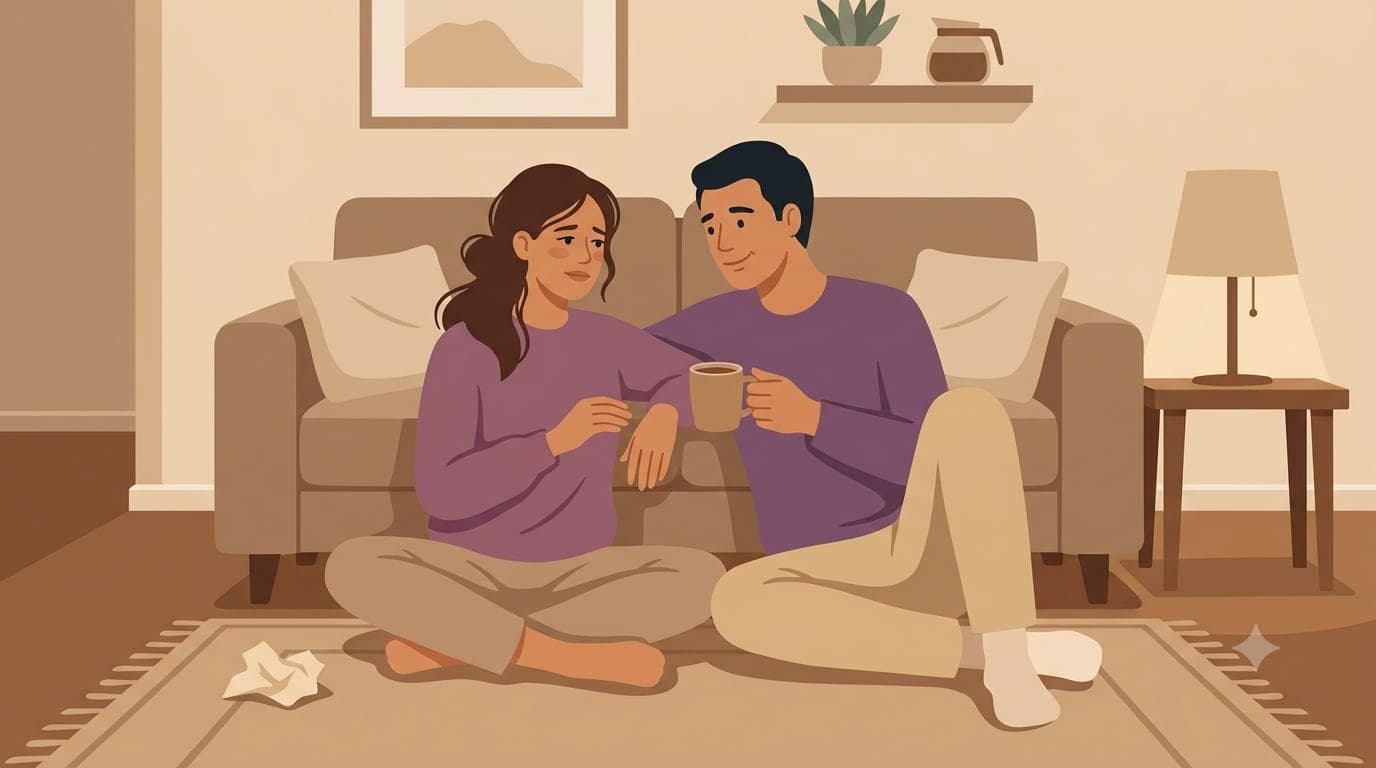
Repair attempts predict relationship survival more than conflict style does. The post-fight conversation isn't a rehash; it's a debrief. Timing, structure, and the willingness to understand before being understood make the difference.
The fight is over. Someone apologized, or you both went to bed angry, or you shifted into that stiff politeness that means nobody's fine but nobody wants to go another round. The immediate crisis has passed.
Now what?
Most couples do one of two things: they pretend it didn't happen, or they have the same fight again at lower volume. Neither works. Pretending buries the issue under a thin layer of "we're fine" that cracks open the next time something goes wrong. Re-fighting covers the same ground without reaching new understanding, because both people are still defending the positions they took in the heat of it.
There's a third option, and it's the one that actually matters. Gottman's research at the University of Washington found that it's not how couples fight that best predicts whether they stay together. It's how they repair after fighting. His term for these moments is "repair attempts." And the success or failure of those attempts is one of the most reliable predictors of relationship stability in the research literature.
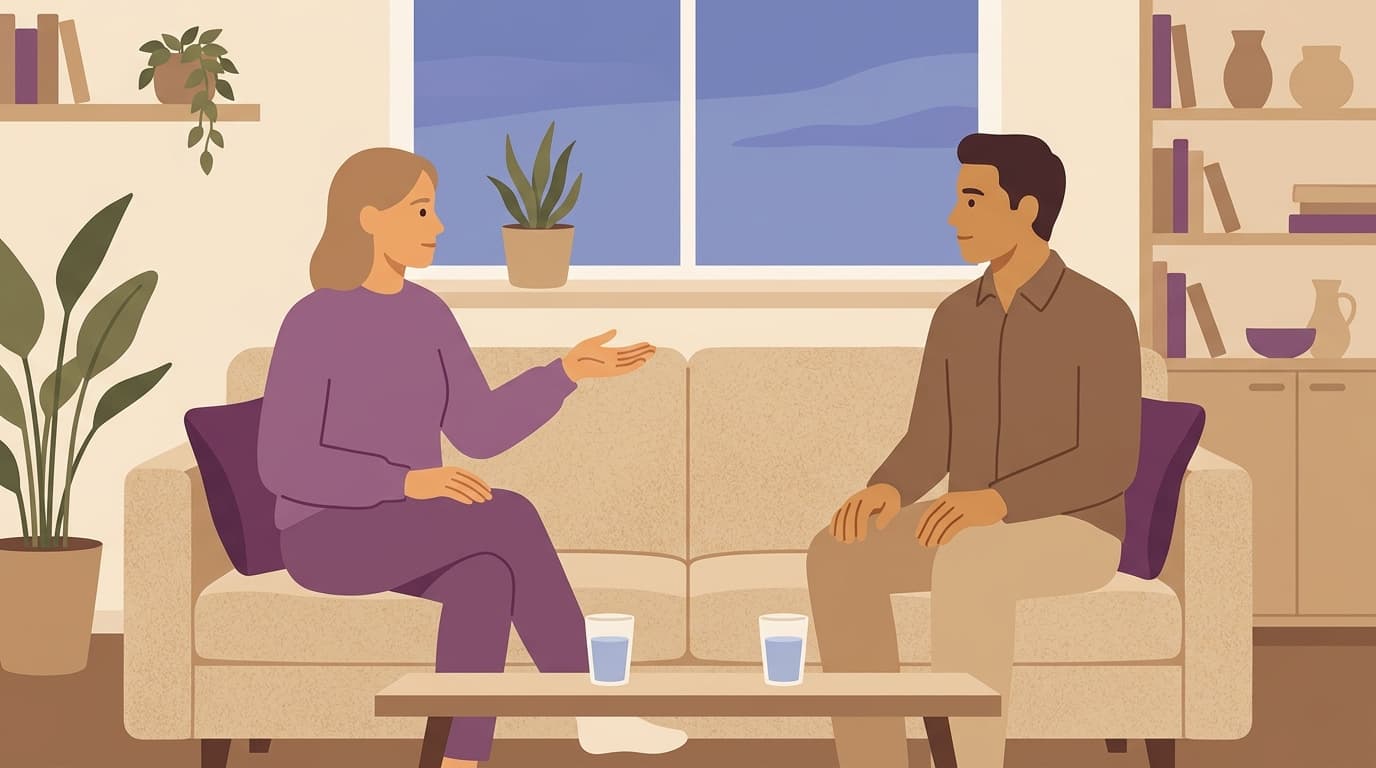
The repair conversation is different from the fight. It's not a continuation. It's a debrief: a structured look back at what happened, with the goal of understanding each other rather than winning. And it requires a specific set of conditions and skills that most couples have never been taught.
Why does the aftermath matter more than the fight?
Every couple fights. The content varies, the frequency varies, the volume varies, but conflict is present in 100% of lasting relationships. Gottman's research found that 69% of couple conflicts are "perpetual," meaning they're about fundamental differences in personality, values, or lifestyle preferences that never fully resolve. You'll be having some version of the same disagreement for the rest of your relationship.
Given that reality, the question isn't "How do we stop fighting?" It's "What do we do after we fight?"
Repair attempts are any action, verbal or nonverbal, that prevents conflict from escalating or helps de-escalate it. A joke during an argument. A touch on the arm. Saying "I see your point" even when you're frustrated. Apologizing for your tone. Asking for a break.
Gottman found that in "master" couples (those who stayed together and stayed happy), repair attempts succeeded 86% of the time. In "disaster" couples, they failed about 67% of the time. The attempts themselves weren't dramatically different between the two groups. The difference was whether the receiving partner accepted the repair or rejected it.
This means the health of a relationship isn't really about the fight. It's about the moment after the fight, when someone reaches across the gap and the other person either takes their hand or doesn't.
When should you have the repair conversation?
Timing matters more than people think. Too soon, and both people are still physiologically activated: heart rates elevated, cortisol flowing, prefrontal cortex offline. The conversation will just restart the fight. Too late, and the moment has passed. The details have faded, the emotions have been buried, and the window for genuine processing has closed.
Gottman's research on physiological flooding suggests a minimum of 20 minutes of self-soothing before re-engaging. That's how long it takes for the autonomic nervous system to return to baseline after a conflict spike. For some people, it takes longer: an hour, a few hours, overnight.
A reasonable guideline: have the conversation within 24 hours, but not within the first hour. The sweet spot for most couples is somewhere between "I've calmed down" and "I still remember exactly what happened."
There's a practical way to handle this. Before the fight fully ends, agree on a return time. "I need to cool off. Can we talk about this after dinner?" or "I'm too upset right now. Can we sit down tomorrow morning?" The key is that both people agree to the timeline. Unilateral departure without a return plan feels like abandonment. A mutually agreed pause feels like maturity.
If your partner asks for time, give it to them. If you ask for time, honor the return commitment. Breaking the return promise, saying you'll come back and then "forgetting" about it, erodes trust in the repair process itself.
What's the structure of a good repair conversation?
Gottman developed a specific framework called the "Aftermath of a Fight" conversation. It has six components, and the order matters:
1. Share your subjective reality.
Each person describes their experience of the fight: what they felt, not what the other person did wrong. This is harder than it sounds. The natural tendency is to explain why you were right and they were wrong. The task here is different: describe your internal experience without analyzing your partner's behavior.
"I felt dismissed when the conversation shifted." Not: "You dismissed me." "I got scared that we weren't going to resolve this." Not: "You kept escalating."
The distinction between describing your feelings and describing your partner's failures is the difference between a repair conversation and round two of the fight.
2. Validate your partner's experience.
Validation doesn't mean agreement. It means acknowledging that your partner's feelings make sense from their perspective, even if you experienced the same events differently.
"I can see why that felt dismissive to you" is validation. It doesn't require you to agree that you were dismissive. It just acknowledges their experience as legitimate.
Most couples skip this step or do it badly. "I understand, but..." isn't validation. It's a setup for a counter-argument. Real validation sounds like: "That makes sense. If I were seeing it the way you described, I'd feel hurt too."
3. Accept responsibility for your part.
Not for the whole fight or for your partner's feelings. For your specific contribution to the escalation. Every fight has two participants, and even if you believe you were 90% right, there's a 10% that belongs to you.
"I raised my voice, and I know that shuts you down." "I brought this up at the worst possible time." "I made assumptions about what you meant instead of asking."
Taking responsibility for your piece, without requiring your partner to reciprocate immediately, breaks the defensive loop. Most couples are stuck in a standoff: neither person will acknowledge fault until the other one goes first. Someone has to break the stalemate. Be the one who does.
4. Identify what triggered you.
Fights often escalate because of emotional triggers that have nothing to do with the current topic. Your partner's tone reminded you of your father's criticism. The feeling of being ignored echoed a childhood experience of being overlooked. The argument about money activated a fear that comes from growing up without financial security.
Sharing the trigger, like "When you walked away, it activated a really old fear that people leave when things get hard," gives your partner information they can't get any other way. It explains why a minor disagreement produced a major reaction.
When you show your partner what's underneath the anger, you give them the chance to respond to the real issue instead of the surface conflict.
5. Own your own triggers.
This is the flip side of step four. Identifying your triggers is useful. But placing the responsibility for managing them on your partner isn't fair. "When you walk away, it triggers my abandonment fear" is useful information. "Therefore you should never walk away from a conversation" is an unreasonable demand.
The ownership sounds like: "I know this is my thing. I'm working on it. What I need from you is [specific, reasonable request], and what I'm going to work on is [my own response to the trigger]."
6. Discuss what you could both do differently next time.
Not as a negotiation or a contract. As a genuine exploration of alternatives. "Next time this comes up, I'd rather you tell me you need a break instead of going silent." "I'll try to bring things up before I'm already angry, so I don't come in hot."
This step matters because it converts the fight from a loss into learning. Something useful comes out of it. You both leave with a clearer picture of each other's needs and a concrete idea of what to try next time.
What should you actually say? Scripts that work.
The framework is great in theory. In practice, people need words. Here are some openers that work better than the defaults:
Instead of: "Let me explain why I said what I said." Try: "Help me understand how that landed for you."
Instead of: "You always do this." Try: "When this happened, I felt [emotion]. I don't think that's what you intended."
Instead of: "I'm sorry you feel that way." Try: "I'm sorry that what I said hurt you. That's not what I was going for."
Instead of: "Can we just move on?" Try: "I want us to be okay. Can we talk about what happened so we can actually move past it?"
Instead of: "I already apologized." Try: "I know I apologized, but I'm not sure I fully understood what hurt you. Can you help me get it?"
The pattern in these alternatives is consistent: they lead with curiosity and openness rather than defense and closure. They ask before they tell. They prioritize understanding over resolution.
What are the most common mistakes in repair conversations?
The pseudo-apology. "I'm sorry, but..." "I'm sorry if you were offended." "I'm sorry you feel that way." These aren't apologies. They're dressed-up defenses. A real apology names the specific thing you did, acknowledges the impact, and doesn't include a justification. "I'm sorry I raised my voice. I know that feels threatening and it wasn't fair." Full stop. No "but."
The history dump. Bringing up old grievances during a repair conversation is one of the fastest ways to derail it. "While we're at it, let me tell you about the thing from six months ago..." The repair conversation is about one specific fight. If you have a backlog of unresolved resentment, those deserve their own conversations. Mixing them in here guarantees that nothing gets resolved.
Rushing to fix. Some people, often the partner who's more uncomfortable with emotional tension, want to jump straight to "so what's the solution?" before the understanding phase is complete. Premature problem-solving feels invalidating to the partner who hasn't finished being heard. The fix comes after the understanding, not instead of it.
Requiring reciprocity. "I apologized, so now it's your turn." Repair doesn't work on a tit-for-tat schedule. Sometimes one person is ready to own their part before the other is. That's fine. The other person may need more time, and pressuring them to reciprocate before they're ready turns the repair into another conflict.
Demanding forgiveness. "I said I'm sorry. Why can't you let it go?" Forgiveness has its own timeline. An apology creates the conditions for forgiveness; it doesn't guarantee it. Expecting immediate emotional resolution after an apology misunderstands how forgiveness works.
What if only one person wants to repair?
This happens. One partner is ready to talk, and the other isn't. Or one partner wants to process, and the other wants to pretend it never happened.
If you're the one who wants to repair and your partner doesn't, you can make the invitation without demanding a response. "I'd like to talk about what happened yesterday. Not to rehash it, but to understand each other better. When you're ready, I'm here."
That framing matters. "We need to talk about the fight" sounds like a summons. "When you're ready, I'm here" sounds like an invitation.
If your partner consistently refuses to have repair conversations, if every fight ends in silence and nothing ever gets processed, that's a pattern worth naming directly. "I've noticed that after we fight, we never talk about it. That's making me feel like we can't get through hard stuff together. I need us to be able to do this." If the pattern persists, consider whether a therapist could create the safety needed for the conversation to happen.
Frequently Asked Questions
How long should a repair conversation take?
Most productive repair conversations run 20 to 45 minutes. Shorter than that, and you probably haven't gotten past the surface. Longer than that, and you're likely going in circles. If you hit the 45-minute mark and you're still not reaching understanding, it's okay to pause and return to it later. Marathon processing sessions rarely produce better outcomes than two or three shorter, focused conversations.
What if the repair conversation turns into another fight?
Stop. Acknowledge what's happening: "I think we've shifted back into fighting mode. Can we take a break and try again later?" The repair conversation requires a fundamentally different emotional stance than the fight itself: curiosity instead of defense, understanding instead of winning. If either person can't hold that stance, the conditions aren't right yet. That's not failure. It's information about timing.
Do you always need to have a repair conversation after every disagreement?
No. Small disagreements that both people genuinely shrug off don't require formal processing. The repair conversation is for fights that left someone feeling hurt, misunderstood, or disconnected. A simple check-in like "Are we good after earlier?" can help you gauge whether a full conversation is needed. If the answer is an easy "Yeah, we're fine," you probably don't need one. If there's hesitation, you probably do.
What if I can't remember what happened during the fight?
Conflict activates the fight-or-flight response, which impairs memory encoding. It's common to have a blurry recollection of what was said during a heated argument. Be honest about this: "Parts of it are a blur for me. Can you tell me what stood out to you?" That's not a dodge. It invites your partner to share their experience without you contesting the details.
Can a relationship survive without repair conversations?
Short-term, yes. Long-term, it's unlikely. Unprocessed fights accumulate as unresolved hurt, and unresolved hurt becomes resentment. Resentment becomes emotional distance. Distance becomes disconnection. The couples who last aren't the ones who never fight; they're the ones who repair reliably. If repair conversations feel too difficult to do on your own, that's one of the strongest reasons to try couples therapy.
Repair starts with turning toward your partner, even when it's uncomfortable. Aperi sends you both a daily question that builds the habit of honest conversation, so when the hard talks come, you already have the muscle for them.
Aperi: one question a day
A daily question app that adapts to you and your partner, and goes deeper the more you use it.


Free to start. Available on iPhone and Android.
Explore question packs
Related articles
Lack of communication in a relationship is rarely a skills problem
Lack of communication in a relationship: what the breakdown looks like in practice, what causes it (rarely skills), and the scripts that rebuild it.
Passive-aggressive behavior in relationships
Passive-aggression isn't about dishes left in the sink. It's anger that learned to hide. How to spot it, respond to it, and stop doing it yourself.

Why most apologies don't work
Most apologies make things worse. What the research says about real repair attempts and why 'I'm sorry you feel that way' always fails.

Expressing your needs without starting a fight
Research-backed techniques for telling your partner what you need without triggering defensiveness or escalation.
12 rules for fighting fair
Conflict isn't the problem; how you fight is. Twelve research-backed rules for fighting fair, from soft startups to repair attempts.
How to have hard conversations without fighting
Soft startups, the speaker-listener format, repair attempts: tested techniques for hard conversations that don't turn into fights.