Key Takeaways
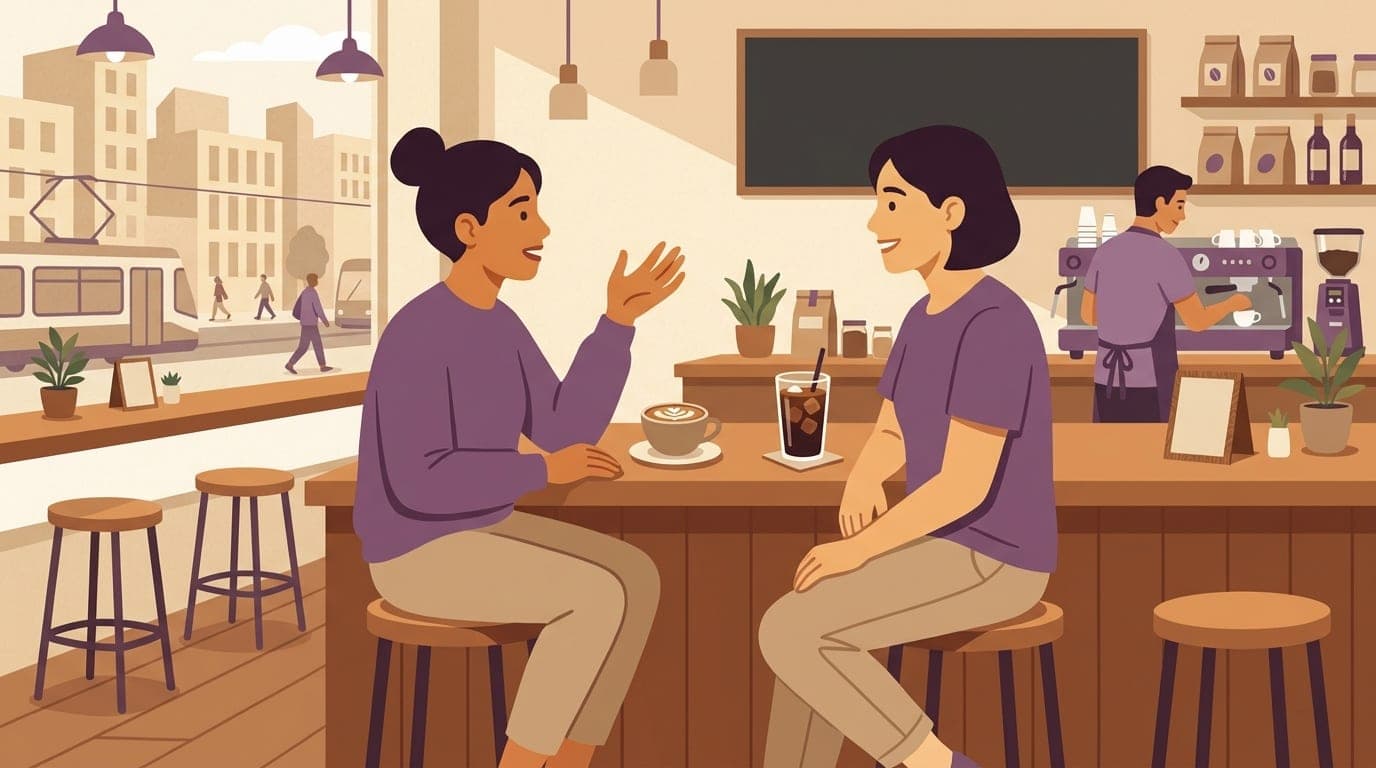
The best first date questions reveal values, humor, and emotional availability without feeling forced. Skip 'what do you do' and ask something that actually matters.
The Resume Exchange
You sit down. You order drinks. And then, like clockwork: "So, what do you do?"
It's not a bad question in theory. But on a first date, it triggers a rehearsed monologue: job title, company name, maybe a self-deprecating joke about work-life balance. The other person nods, waits their turn, delivers their version. You've exchanged LinkedIn profiles over cocktails. Nobody feels anything.
Most first dates follow this pattern. Where are you from, what do you do, how long have you lived here. It's structured like an intake form. And the result is predictable: you leave knowing facts about someone but having no idea whether you actually like them.
The problem isn't nervousness. It's that the default script is designed for safety, not connection.
Why Small Talk Doesn't Work
In 1997, psychologist Arthur Aron published a study that changed how researchers think about intimacy. He paired strangers together and had them ask each other 36 increasingly personal questions over 45 minutes. By the end, many pairs reported feeling closer to their partner than to people they'd known for years. One pair got married.
The study, often called the "fast friends procedure," demonstrated something counterintuitive: depth creates closeness faster than time does. People don't bond over surface-level information. They bond over mutual self-disclosure: the gradual, reciprocal act of letting someone see who you actually are.
This maps to what sociologist Brené Brown has documented across two decades of research: vulnerability is the mechanism of connection, not the byproduct of it. You don't get close and then get vulnerable. You get vulnerable, and that's what makes you close.
Small talk blocks this process. It keeps both people performing the polished version of themselves, which is exactly the version that's hardest to connect with.
None of this means you should open a first date with "tell me about your childhood trauma." There's a sweet spot: questions that feel natural and low-pressure but actually reveal something real.
What Makes a Good First-Date Question
Not all questions are created equal. The ones that work on a first date share a few qualities:
They're open-ended. Yes/no questions kill momentum. "Do you like your job?" ends a conversation. "What would you do if you didn't have to worry about money?" starts one.
They reveal values sideways. Asking "what are your values?" is clinical. Asking "what's the best money you ever spent?" tells you the same thing and is actually fun to answer.
They invite stories, not statements. The goal is to hear how someone thinks, not what they've concluded. "Tell me about a time you changed your mind about something" is more interesting than "are you open-minded?"
They're reciprocal. A good question is one you'd also enjoy answering. If it feels like something a therapist would ask, dial it back.
They don't feel like a test. There's a fine line between curiosity and interrogation. Curiosity says "I'm interested in you." Interrogation says "I'm evaluating you." The difference is usually tone and follow-up: whether you lean in with genuine interest or move mechanically to the next question on your mental list.
The best first-date conversations don't feel like Q&A. They feel like two people discovering that they're both paying attention.
The Questions
The Warm-Up
Low-stakes, interesting, easy to answer. These replace the "where are you from" script with something that actually sparks a conversation.
-
What's the best thing that happened to you this week that had nothing to do with work? This immediately sidesteps the job-title exchange and tells you what they notice and value in daily life.
-
What's something you've gotten really into lately, whether a show, a hobby, or a random Wikipedia hole? Current obsessions reveal more about someone than their resume ever will.
-
If you could live anywhere for a year, no logistics to worry about, where would you go? Not "where have you traveled" (which can turn into a flex). This reveals what they're drawn to.
-
What's the most unexpectedly great meal you've ever had? Everyone has a food story. The specificity matters, and it usually leads somewhere interesting.
-
What's something most people learn about you pretty quickly? This is a softer version of "tell me about yourself" that gives them control over the frame.
-
What would your closest friend say is the most accurate thing about you? Third-person framing makes self-disclosure easier. It also tells you how well they know themselves.
-
Are you a morning person or do you just pretend to be one? Light, relatable, and surprisingly revealing about lifestyle compatibility.
Values Without the Lecture
These surface what someone cares about without making them deliver a TED talk about their principles.
-
What's the best money you ever spent? A $12 used book, a plane ticket, a stupid gadget. The answer tells you what they value without them having to say "I value experiences over things."
-
What's a hill you'll die on that most people think is trivial? Strong opinions about low-stakes topics (the correct way to load a dishwasher, whether a hot dog is a sandwich) are more telling than they seem. You learn how someone argues, not just what they believe.
-
What did you want to be when you were ten? The gap between childhood dreams and adult reality is fertile ground. Their reaction to that gap, whether nostalgia, humor, or wistfulness, tells you a lot.
-
Who's someone you admire that you don't personally know? Not "who's your hero" (too loaded). This reveals what qualities they're drawn to.
-
What's something you changed your mind about in the last few years? Intellectual flexibility is one of the strongest predictors of relationship success, according to John Gottman's research. This question tests for it gently.
-
What's a tradition or routine you'd never give up? Sunday dinners, morning runs, rereading the same book every year. Rituals reveal what people protect, which reveals what matters.
Humor and Play
Silly questions that do serious work. Laughter activates the same neural reward pathways as deep conversation. Research from neuroscientist Sophie Scott at University College London shows that social laughter triggers endorphin release and signals trust to the brain. Games like Never Have I Ever work on the same principle: playful stakes that lower defenses and surface real information.
-
What's the most useless talent you have? Bonus points if they demonstrate it. This question is an invitation to be unpolished.
-
What's the worst advice you've ever received? Usually produces a great story and tells you whether they can laugh at the absurd.
-
If you had to teach a college course on any topic, what would it be? This isn't really about expertise. It's about enthusiasm. The answer is usually something wonderfully specific.
-
What's the most embarrassing song on your playlist right now? Musical guilty pleasures are a low-risk vulnerability exercise. And you'll probably bond over a shared one.
-
What's a conspiracy theory you find weirdly compelling, even though you know better? This question reliably produces the best first-date conversations. It's playful, slightly edgy, and reveals how someone thinks about certainty and doubt.
-
If your life had a theme song that played every time you entered a room, what would it be? Self-awareness meets humor. The overthinking that follows is half the fun.
-
What's the pettiest reason you've ever stopped seeing someone? This one walks a line, but if the vibe is right, it's gold. It also sets a tone of honesty about dating.
The Deeper Cut
For when the date is going well. You've been talking for an hour, the drinks are refilled, nobody's checking the time. These are the questions that make a first date memorable.
-
What does a really good day look like for you, specifically, from morning to night? This is intimate without being heavy. You're asking someone to share their ideal life, and the details (solitude vs. people, structure vs. chaos) tell you about compatibility.
-
What's something you're proud of that most people don't know about? This invites someone to share something they don't usually get to claim credit for. The answer is almost always interesting.
-
When was the last time you felt genuinely out of your comfort zone? How someone handles discomfort, whether they seek it out or avoid it, shapes everything about how they'll show up in a relationship.
-
What's the closest you've come to a totally different life? The almost-moved-to-Berlin story. The nearly-accepted job offer. The fork in the road. These reveal how someone thinks about choice and risk.
-
What's something you're still figuring out? This is a gift of a question because it gives someone permission to be unfinished. Most first dates are performance. This one is presence.
-
What's the kindest thing someone has done for you? Research by Sara Algoe at UNC Chapel Hill shows that gratitude narratives, telling stories about being on the receiving end of kindness, generate more interpersonal warmth than almost any other conversational topic.
Red Flag Detectors
These aren't traps. They're questions that gently surface how someone handles conflict, responsibility, and other people. Pay attention to what's between the lines.
-
What's your relationship like with your family? You're not looking for a specific answer. You're looking at how they talk about complicated things: with nuance, defensiveness, or blame.
-
What's something a past relationship taught you? Self-awareness about relationship patterns is one of the most reliable indicators of emotional maturity. Beware of answers that paint them as the perpetual victim.
-
How do you usually handle disagreements with people you care about? Direct, but revealing. Most people will tell you exactly how they fight if you ask.
-
What's something you're working on about yourself? People who can name a real answer here, not a humblebrag disguised as a flaw, are usually doing the work.
-
What made you want to go on a date tonight? Simple, but the answer reveals intention. Are they looking for connection, distraction, or a story to tell their friends?
What to Do With the Answers
Asking good questions is only half of it. The other half is listening, actually listening, not just waiting to deliver your next question.
The reciprocity of self-disclosure that Aron's research identified works because both people participate. If you ask a revealing question and someone gives a genuine answer, the worst thing you can do is nod and move to the next question. Respond. Share something back. Let the conversation follow its own thread instead of sticking to a script.
A few things that make listening visible:
Follow up on what they actually said. "You mentioned you almost moved to Portland. What stopped you?" is worth more than five new questions.
Share back, don't just extract. If you ask about their proudest moment, offer yours. The research on self-disclosure is clear: it only builds intimacy when it's mutual. One-sided vulnerability feels like an interview.
Notice what lights them up. When someone's eyes change, when they lean forward, when they lose track of the rehearsed version. That's the real person showing up. Go there.
Let silences exist. Not every pause needs to be filled. Comfort with silence on a first date is a surprisingly good compatibility signal.
If you find someone worth seeing again, the habit of asking real questions doesn't stop at date two. Couples who maintain curiosity about each other, who keep asking and keep listening, report higher relationship satisfaction years later, according to longitudinal research by Terri Orbuch at the University of Michigan. Tools like Aperi are built around this idea: that a daily question habit keeps connection from going on autopilot, whether you've been together two months or twenty years.
FAQ
Isn't this too intense for a first date?
No, and this is the most common misconception about deeper questions. Aron's fast friends research specifically showed that people enjoy self-disclosure more than they predict they will. A 2021 study by Michael Kardas and Nicholas Epley at the University of Chicago confirmed this: people consistently overestimate how awkward deep conversations will be and underestimate how much the other person will enjoy them. The key is reading the room and matching energy. You don't have to use all of these. Pick two or three that fit the vibe.
Should I memorize these questions?
Absolutely not. Memorized questions sound memorized. Read through them beforehand, let a few stick, and then forget about the list. The goal is to internalize the principle: ask things that invite real answers, not to perform a script. If you can remember even one question that feels natural to you, that's enough.
What if the other person only gives short answers?
Short answers are data. They might mean the person is nervous (give it time), that the question didn't land (try a different category), or that they're not interested in this kind of conversation (which is itself useful information). If you've tried a few different angles and everything bounces off, that's worth noticing.
What if I ask something and it gets awkward?
Awkwardness is not failure. It usually means someone is being honest, which is the whole point. If a question lands heavier than you intended, you can always name it: "That was a bigger question than I meant it to be" works fine. The ability to navigate a slightly awkward moment with grace is, itself, attractive.
Skip the Script
The best first dates don't follow a formula. They follow curiosity. If you leave knowing what someone does for work but not what makes them laugh, what scares them, or what they care about when nobody's watching, you haven't really met them yet.
Ask something real. Listen to what comes back.
Related Reading
Aperi: one question a day
A daily question app that adapts to you and your partner, and goes deeper the more you use it.


Free to start. Available on iPhone and Android.
Explore question packs
Related articles

50 questions to ask your crush that don't feel like an interview
50 questions to ask your crush, sorted from easy openers to flirty and deep. Warm, natural prompts that keep a conversation going instead of killing it.

100 questions for new couples
100 questions for new couples organized by theme. Skip the generic prompts and ask something worth answering.
74 date night questions for married couples, sorted by the kind of night
Date night questions for married couples who are past small talk: 74 prompts sorted by mood, from a light night out to the big-dreams dinner.
68 questions to reconnect with your partner, from safe to close
Questions to reconnect with your partner when things feel distant: 68 questions sequenced from easy to close, because the way back is small, not dramatic.
50 couples therapy questions, in the order a therapist would ask them
50 couples therapy questions sequenced like a real session: history, patterns, needs, repair, future. Plus an honest look at when a list is not enough.
92 flirty questions to ask your partner, from sweet to bold
92 flirty questions to ask your partner, running from sweet to bold. Flirting inside a long relationship is maintenance, and these make it easy to start.