Key Takeaways
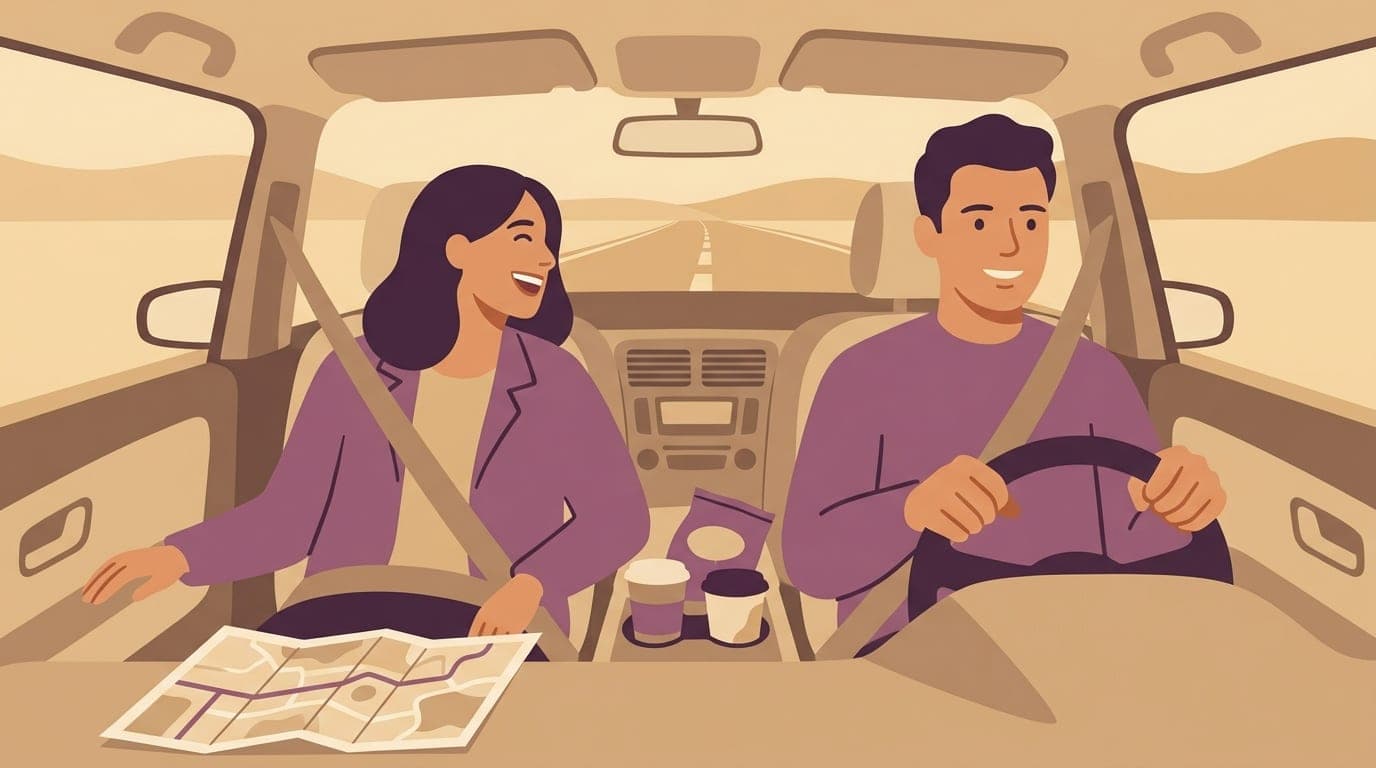
Road trips are one of the best settings for real conversation: no screens, side-by-side positioning, nowhere to be. These 40 questions are organized in 4 phases, from warm-up to wild card, designed to match the rhythm of a long drive.
Why Road Trips Are Secretly Great for Conversation
There's a reason people have their best talks in the car. It's not random. There are a few specific things about the setting that make it work.
First, you're side by side, not face to face. This matters more than most people realize. Psychologists have studied the difference between face-to-face and side-by-side positioning, and the findings are consistent: side-by-side conversations feel less confrontational. There's less eye contact pressure. The social performance demands drop. People share more honestly when they're not being watched directly.
This is why therapists who work with men and boys often suggest walking sessions instead of sitting sessions. It's why teenagers open up in the car but clam up at the dinner table. The architecture of the conversation changes when you remove the face-to-face dynamic.
Second, there are no screens competing for attention (or there shouldn't be; driver's looking at the road, passenger should take the cue). You're both stuck in the same space with limited alternatives. That sounds negative, but the effect is positive: it lowers the bar for conversation. You don't need a reason to start talking. There's nothing else to do.
Third, there's built-in pacing. You can talk for 20 minutes, then stare out the window for a while. Put on some music. Stop for gas. There's no social pressure to maintain continuous dialogue. The conversation can breathe.
All of this adds up to a setting that's surprisingly good for going deeper than you normally would on a Tuesday night.
The Pacing Strategy
Don't open with the heavy stuff. A road trip has a natural arc, and your questions should match it.
First hour: Keep it light. You're both settling in, getting comfortable, finding the right playlist. This is warm-up territory.
Hours two and three: This is the sweet spot. You're relaxed, the initial energy has mellowed, and there's enough road ahead that nobody feels rushed. Go deeper here.
Late in the drive: When you're tired and a little loopy, that's when the wild card questions hit best. The defenses are down. The answers get weird and honest.
Mix questions with music, podcasts, snack stops, and comfortable silence. This isn't a workshop. It's a drive.
Warm Up
Easy, playful, zero stakes. These get the conversation engine running.
- What's the best road trip you've ever taken?
- If this car could teleport us anywhere right now, where would you want to go?
- What's a song that instantly takes you back to a specific moment?
- If you could only eat at one fast food chain for every road trip stop, which one?
- What's the most random thing you've ever bought at a gas station?
- If we had to pick up a hitchhiker from any point in history, who are we picking up?
- What's your unpopular road trip opinion? (Windows down vs. AC, driver picks music, etc.)
- What's the longest you've ever been in a car in one stretch?
- If we could road-trip through any country, which one?
- What's a place we've driven past a hundred times that you've always wanted to stop at?
Memory Lane
Nostalgia-based questions that pull from personal history. The car is good territory for these because people naturally get reflective on long drives.
- What's a smell that teleports you back to childhood?
- What was the first album or artist you were really into?
- What's a friendship from your past that you think about sometimes?
- Where's the first place you ever felt truly independent?
- What's a family vacation you remember vividly?
- Who was the first person outside your family that you really trusted?
- What's a period of your life that shaped you more than people would guess?
- What's a conversation you had years ago that still sticks with you?
- Is there a place from your past you'd want to show me?
- What did you think your life would look like at this age?
Question 20 tends to open up something real. There's almost always a gap between what someone expected and what actually happened, and the feelings about that gap, whether it's gratitude, grief, surprise, or something more complicated, are worth hearing.
Question 13 can go in unexpected directions. The friendships people think about but don't maintain often tell you something about what they value in connection, or what they've lost. Some people mention a childhood best friend. Others mention a college roommate or a coworker from a first job. The specifics aren't the point. It's the quality they miss in that person that reveals something.
Big Picture
Values, priorities, how they see the world. These work best in the middle stretch of the drive when you're both settled in.
- What do you think is the most important thing in a good life?
- If you could change one thing about how the world works, what would it be?
- What's something you believe that most people in your life would disagree with?
- What's the hardest lesson you've had to learn more than once?
- Do you think you'll always live in this part of the country?
- What's a goal you've been thinking about but haven't committed to yet?
- How has your definition of success changed over the years?
- If you could give your 18-year-old self one piece of advice, what would it be?
- What do you think is the hardest part of being alive right now?
- What's something about our relationship that you're proud of?
Some of these might lead to long, winding conversations. Let them. You have the miles. If question 27 turns into a 40-minute discussion about what you both actually want out of the next ten years, that's the whole point.
Question 29 is a good litmus test for where someone is at mentally. "What do you think is the hardest part of being alive right now?" sounds bleak, but the answers are often illuminating rather than depressing. Some people talk about information overload. Others talk about the cost of housing, or the difficulty of maintaining friendships as adults, or the pressure to have an opinion on everything. It's a question that invites your partner to name something they're grappling with in the broader sense, which is different from their personal problems.
Wild Card
Hypothetical, weird, fun. These are best when you're a little tired and a little punchy. The answers get better when people stop filtering.
- You can have any car in the world but you have to drive it every day for five years. What are you picking?
- If you could have been born in any decade, which one?
- You discover you have exactly one year where you won't age, get sick, or need money. What do you do with it?
- If aliens landed and asked you to explain human relationships, what would you say?
- What's the most overrated thing that everyone seems to agree is great?
- If we could only listen to one genre of music for the rest of our lives, what would you vote for?
- You're writing a book about your life. What's the title of the chapter you're in right now?
- If you could have a conversation with any version of yourself, past or future, which age would you pick?
- What's a question you've always wanted someone to ask you?
- If this road trip never ended and we just kept driving, where would you want to end up?
Question 39 is a sleeper. People rarely get asked it, and the answer usually reveals what they wish others were curious about. It's a question about what they want to be known for.
Question 37, "What's the title of the chapter you're in right now?", works because it forces a certain kind of abstraction. Instead of describing what's happening, your partner has to characterize it. "The Learning Curve." "Year of Saying No." "Figuring It Out." The title they pick tells you how they're framing this period of their life, which is often more telling than a straight description.
Making It a Practice
A road trip gives you a concentrated block of time that normal life doesn't. But the kind of conversation you have in the car (unhurried, honest, meandering) doesn't have to be limited to drives.
You can recreate some of this energy with an evening walk, a long dinner without phones, or even just a screen-free date night. The key ingredients are the same: no competing distractions, low performance pressure, and a willingness to let the conversation go where it wants to go.
If you want a daily version of this, Aperi sends you one question a day designed to go past the surface. It's not road trip length, but it keeps the habit of asking real questions alive between trips.
For more conversation starters sorted by mood and energy level, this list of 50 date night prompts covers a wider range of contexts. And if you want to go really deep, the deep questions for couples guide has 250+ questions organized by category and depth level.
FAQ
How do I get my partner to actually engage instead of giving one-word answers?
Start with section one. If the warm-up questions get one-word answers, switch to something more specific. "What's the best road trip you've ever taken?" might get a shrug. "Tell me about the weirdest gas station you've ever been in" might get a story. Specificity invites detail. If short answers are a persistent issue outside of road trips, this post on partners who give one-word answers goes deeper.
Can we use these with friends or family, not just a partner?
Absolutely. The warm-up and wild card sections work with anyone. Memory lane works well with old friends. Big picture works with anyone you're close to. The only section that's specifically romantic is the FAQ you're reading right now.
What about road trips with kids?
Sections one and four work surprisingly well with older kids (roughly 10+). Younger kids might need adapted versions. "If this car could fly, where would we go?" lands better than the teleportation question for a six-year-old. But the principle is the same: good questions beat "are we there yet" every time.
What if the conversation gets heavy and one of us doesn't want to keep going?
Let it go. Put on some music. Stare at the scenery. One of the best things about car conversations is that silence isn't awkward. There's always the road to look at. You can circle back later or not at all. Not every deep moment needs to be fully processed in real time.
Aperi: one question a day
A daily question app that adapts to you and your partner, and goes deeper the more you use it.


Free to start. Available on iPhone and Android.
Explore question packs
Related articles

What your favorite type of question says about your relationship
What your go-to type of couple question says about how you connect and where you have room to grow. Five question personality types.

40 "would you rather" questions for couples
40 Would You Rather questions for couples, from ridiculous hypotheticals to real value trade-offs. The explanations matter more than the answers.

Traveling together without fighting
Travel should bring you closer. Instead, it stress-tests your relationship. Here's how to stop fighting about maps, money, and packing.

68 questions to reconnect with your partner, from safe to close
Questions to reconnect with your partner when things feel distant: 68 questions sequenced from easy to close, because the way back is small, not dramatic.

50 couples therapy questions, in the order a therapist would ask them
50 couples therapy questions sequenced like a real session: history, patterns, needs, repair, future. Plus an honest look at when a list is not enough.

Questions for couples who feel stuck
30 questions for couples who feel stuck, organized by difficulty. Start with safe questions and work toward the things you have been avoiding.