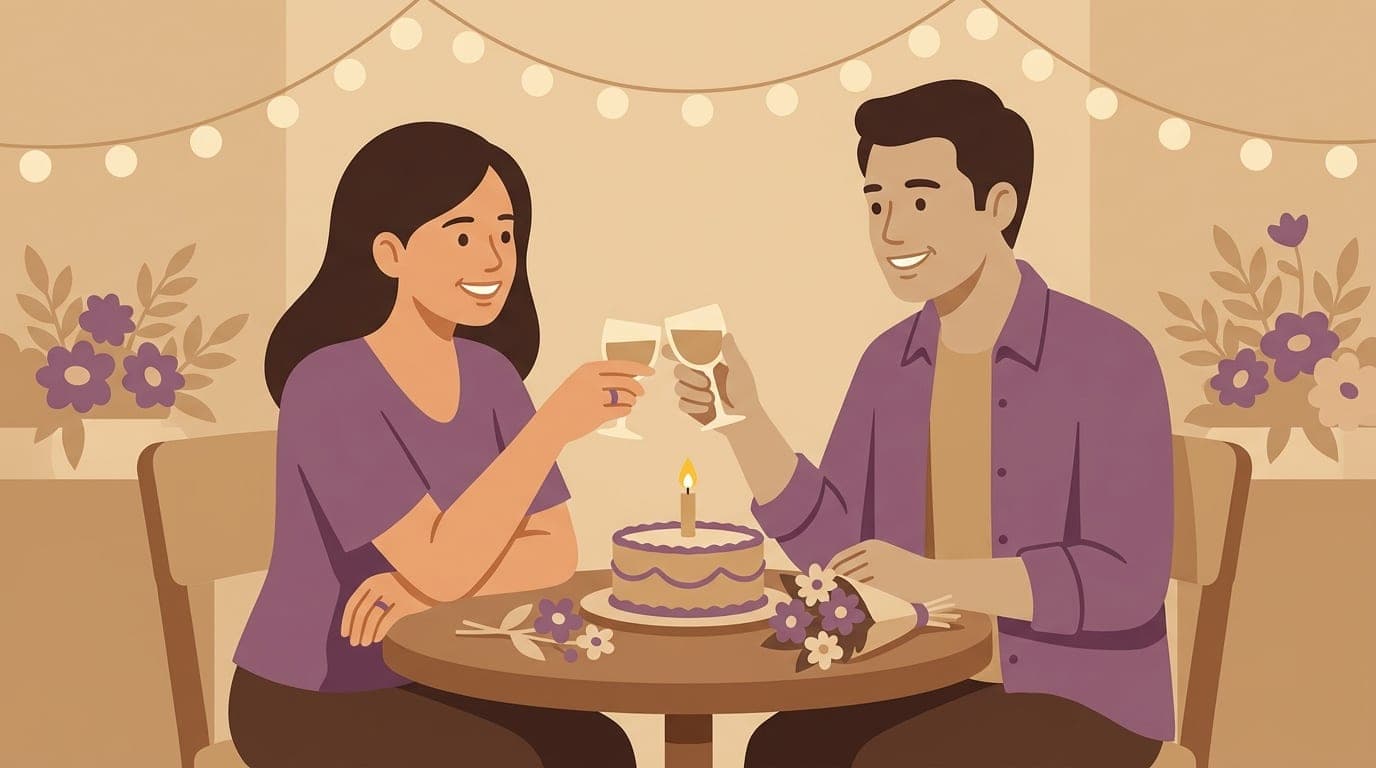
Key Takeaways
Your anniversary is more than dinner. These 20 questions turn it into a meaningful reflection ritual: what happened this year, where you stand now, and what you want from the next one.
Why Reflect on Your Anniversary?
Most couples celebrate their anniversary by going to dinner. Nice dinner, probably. Maybe flowers. Maybe a gift. And then back to the regular rhythm until next year.
There's nothing wrong with celebration. But celebration alone is incomplete. An anniversary marks a full year of shared life, and a year contains too much to capture with a toast and a dessert. The wins you forgot to celebrate. The hard moments you white-knuckled through and never debriefed. The slow shifts in who you are as a couple that neither of you consciously registered.
James Pennebaker's research at the University of Texas has consistently shown that structured reflection produces measurable benefits. Writing or talking about significant experiences helps people create coherent narratives from fragmented events. It moves experiences from "things that happened to us" into "our story." For couples, this narrative-building is how you maintain a shared identity across time. You're not just two people who live together. You're two people with a story, and that story needs tending.
The Gottmans' research points to the same idea from a different angle. Couples with strong "love maps" (their term for detailed knowledge of each other's inner world) handle stress and conflict better. But love maps decay if you don't update them. The person you married three years ago has changed. You've changed. An anniversary is a natural checkpoint to refresh that understanding.
What's the Difference Between a Celebration and a Check-In?
Your anniversary needs both, but they're different activities.
A celebration is about gratitude. You're marking the fact that you chose each other, again, for another year. It should feel warm, appreciative, and affirming.
A check-in is about honesty. You're assessing the health of the relationship, naming what worked and what didn't, and deciding together what the next year should look like. It might include hard truths.
Don't try to combine these into one event. Have your celebration dinner. Enjoy it. Then, separately (the same weekend works, or even the following week), sit down with these questions.
The celebration is the party. The check-in is the meeting. Both are necessary, and they serve different emotional purposes.
How to Set Up Your Anniversary Reflection
This works best as a structured, intentional conversation. The setup:
Block sixty to ninety minutes. Not squeezed between errands. Real, protected time. Phones off or in another room.
Answer independently first. Write your answers down before sharing them. This prevents one person from anchoring the conversation while the other accommodates. You want two honest perspectives, not one perspective and an echo. The double-blind approach gives you better data.
Start with appreciation. Before diving into the questions, each person shares one thing they're genuinely grateful for about their partner and the past year. This sets a tone that makes everything else easier.
Write it down and keep it. In a notebook, a shared doc, wherever. The point isn't just this year's answers. It's next year's comparison. By year three of doing this, you'll have a written record of your relationship's arc that's more revealing than any photo album.
Looking Back: What Happened This Year?
These questions reconstruct the year. Memory is selective and often biased toward the negative. Structured recall gives you the full picture.
1. What was our best moment together this year?
Not the most photogenic. The one where you felt most like yourselves together. Maybe it was a Tuesday night on the couch. Maybe it was the trip you almost didn't take.
2. What was the hardest thing we went through?
Name it honestly. You're not relitigating it. You're acknowledging that it happened and that you came out the other side. Couples who can name their hard moments without getting pulled back into the emotional spiral have done real work.
3. What surprised you about us this year?
Something you didn't expect. A way you handled a crisis. A new thing you discovered about your partner. A capacity you didn't know your relationship had.
4. What grew between us?
Trust? Patience? Humor? Communication? Something shifted over twelve months. Identify it and name it. Growth that goes unrecognized tends to get undervalued.
5. What's something we handled well that we should give ourselves more credit for?
Couples are often harder on themselves than they deserve. This question is a corrective. You handled something. Maybe it was messy, but you got through it.
6. What's a small moment from this year that meant more to you than it probably seemed?
The big moments get remembered. The small ones carry the weight. Maybe it was when your partner brought you coffee without being asked during a stressful week. Maybe it was a look across the room at a party. Name it.
7. Is there something from this year that we never fully processed?
Unresolved experiences accumulate. If there's a conversation you should have had but didn't, this is the moment to flag it. You don't have to resolve it right now. Just name it so it doesn't get carried silently into the next year.
Where We Are: The State of Your Relationship Now
These questions assess the present. They require honesty that might feel uncomfortable. That's the point.
8. On a scale of one to ten, how connected do you feel to me right now?
The number matters less than the conversation it starts. If one person says seven and the other says four, that gap is the most important thing you'll discuss all day.
9. What's one thing I do that makes you feel loved?
Not what the love languages quiz says. What actually works, right now, for the person sitting across from you.
10. What's one thing you need more of from me?
This question requires vulnerability to answer and maturity to hear. If your partner says "I need more physical affection" or "I need you to ask about my day and actually listen," don't get defensive. That's a person telling you how to love them better. That's a gift.
11. What's something we've stopped doing that you miss?
Couples gradually drop rituals and habits without noticing. The morning coffee together. The Sunday walks. The spontaneous weeknight dates. Identifying what got lost is the first step to getting it back.
12. Where do you think we're strongest right now?
Knowing your strengths matters as much as knowing your weaknesses. It tells you what you can rely on when things get hard.
13. Where are we weakest?
This one takes courage. Answer it anyway. Weakness you're aware of is manageable. Weakness you're ignoring grows.
14. Do you feel like I know the current version of you? Or are you changing in ways I haven't noticed?
People change. Continuously. The person you're with now is not the same person you were with a year ago, even if the differences are subtle. This question asks your partner to show you who they're becoming.
What's Next: Vision for the Coming Year
These questions point forward. They turn reflection into intention.
15. What's one thing you want more of in our relationship next year?
Be specific. "More quality time" is a direction. "One phone-free evening per week" is a plan.
16. Is there something you want us to try together that we haven't?
A trip. A hobby. A conversation topic. A way of being together that's new. Novelty isn't just nice to have. The research from Arthur Aron's lab at Stony Brook shows that shared novel experiences directly increase relationship satisfaction. Your brain responds to doing new things with your partner similarly to how it responded during early attraction.
17. What's a conversation we should have before our next anniversary?
Maybe it's about money. Maybe it's about kids. Maybe it's about where you want to live. Flag it now so it doesn't become an emergency later.
18. What kind of couple do you want us to be in the next year?
This isn't about goals like "argue less." It's about identity. "A couple that laughs more." "A couple that travels." "A couple that talks about hard things when they come up instead of six months later." The identity statement shapes behavior more than any specific resolution.
19. What's one thing you want to let go of from this past year?
A grudge. A disappointment. An expectation that kept causing friction. Letting go is sometimes the most productive thing you can do for your relationship's future.
20. What's your hope for us?
End here. Open-ended on purpose. Let your partner say whatever comes to mind. Sometimes the most honest answer is the one they didn't prepare.
Building a Ritual That Compounds
The first year you do this, it's an experiment. It might feel awkward. You might not know how honest to be or how deep to go. That's fine.
The second year, you have last year's answers to compare against. You can see what changed, what didn't, and whether the intentions you set actually materialized. This comparison is where the real value shows up.
By year three, you have a trendline. You can see the arc of your relationship in a way that's impossible to track through memory alone. You'll notice patterns: things that consistently come up, strengths that remain stable, areas that keep needing work.
By year five, this tradition becomes one of the most valuable things you do together. You'll have a document that traces how you grew, what you survived, and how your vision for the future evolved. Some couples have told me their anniversary reflections are more meaningful to them than their wedding photos.
The key is consistency. Do it every year. Same format. Same level of honesty. Keep the written records. Let the ritual compound.
If you already do an annual relationship review, this anniversary version can either replace it or complement it. The annual review works on any date. The anniversary reflection uses the emotional weight of the anniversary itself as fuel for deeper honesty.
FAQ
What if our anniversary brings up more sadness than celebration?
That's information. If looking back at the year fills you with more regret than gratitude, the reflection is doing exactly what it should: showing you reality. Don't skip the hard feelings. Sit with them together. And consider whether the next year needs something different, whether that's a renewed effort from both of you, a change in circumstances, or support from a couples therapist.
What if we haven't been together a full year?
Do it anyway. A six-month reflection is just as valid. Adjust the timeframe in the questions ("What was our best moment in these six months?") and you lose nothing. Starting this practice early is better than waiting for an arbitrary milestone.
Do we have to do both the celebration and the check-in?
You don't have to do anything. But skipping the check-in means your anniversary stays a surface-level event. And skipping the celebration makes the check-in feel clinical. Both serve a purpose. The celebration reminds you why you're here. The check-in helps you stay.
What if we disagree on the answers?
That's expected. You experienced the same year from two different perspectives. If you disagree on what the best moment was, or where you're weakest, that's not a problem. It's a conversation starter. The disagreement itself reveals something about how you each experience the relationship.
Anniversary reflection once a year gives you the big picture. Daily questions give you the daily practice. Aperi sends both of you a question every day, matched to your depth, building the kind of ongoing awareness that makes your annual reflection richer each year.
Related reading: The Annual Relationship Review | How to Start a Weekly Relationship Check-In | Gratitude in Relationships | 50 Couples Journal Prompts
Aperi: one question a day
A daily question app that adapts to you and your partner, and goes deeper the more you use it.


Free to start. Available on iPhone and Android.
Explore question packs
Related articles
30 questions to ask before having kids
30 questions every couple should discuss before having kids, covering motivations, logistics, money, relationship impact, and contingencies.
Questions to ask before moving in together
35 questions to ask before moving in together. Covers money, space, habits, guests, and the relationship itself. The checklist nobody hands you.
50 questions to ask before getting married
50 questions to ask before getting married: values, kids, money, conflict, intimacy, and the ones most couples skip until it's too late.

68 questions to reconnect with your partner, from safe to close
Questions to reconnect with your partner when things feel distant: 68 questions sequenced from easy to close, because the way back is small, not dramatic.
50 couples therapy questions, in the order a therapist would ask them
50 couples therapy questions sequenced like a real session: history, patterns, needs, repair, future. Plus an honest look at when a list is not enough.

76 vulnerable questions to ask your partner, from shallow end to deep water
76 vulnerable questions to ask your partner, arranged from mildly open to deeply personal, built on the graduated self-disclosure behind the 36 questions.