Key Takeaways
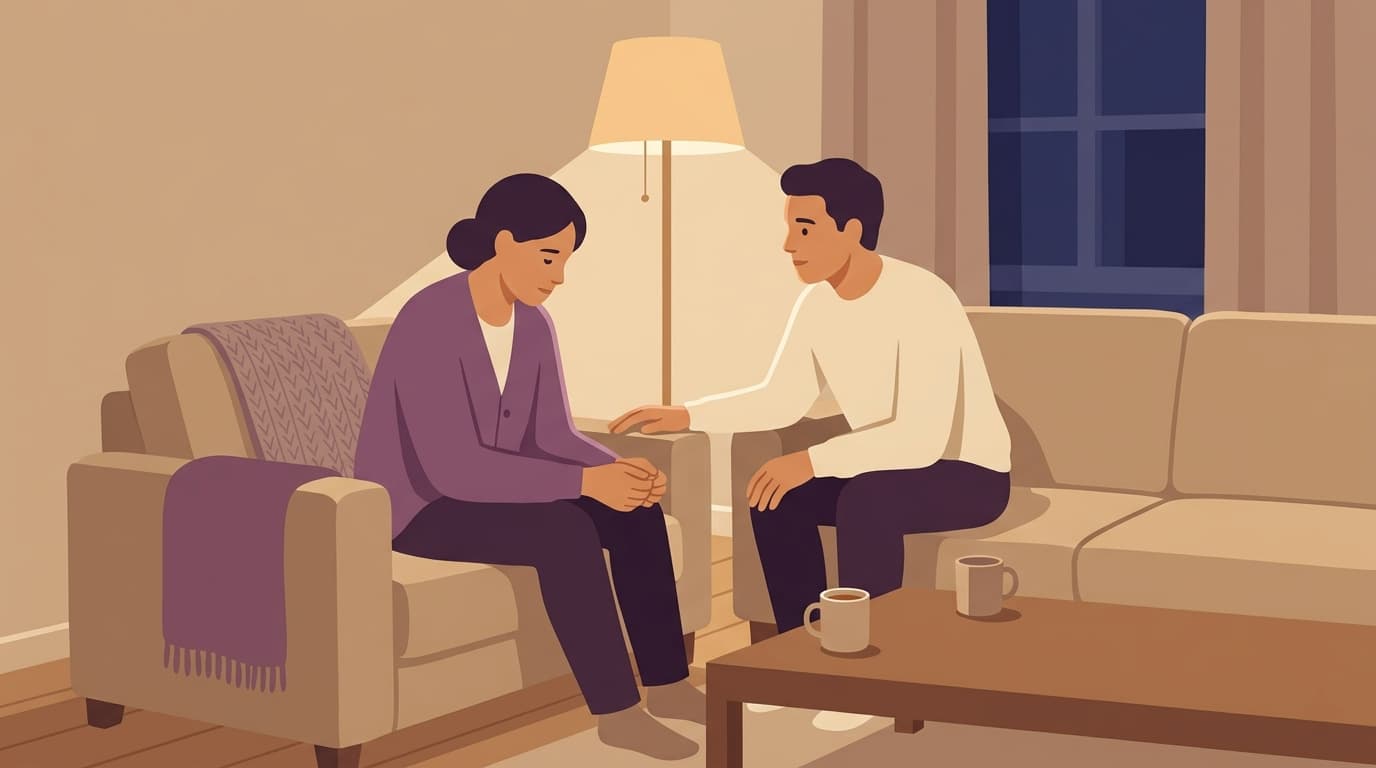
Mental health isn't just an individual issue. Untreated mental health problems are the second strongest predictor of relationship distress after communication breakdown. Couples who can talk openly about their mental health, recognize how it affects the relationship, and build a shared plan for managing it do better on every metric.
There's a conversation most couples avoid for years. Not money, not sex, not in-laws or household chores. Mental health. Yours, your partner's, and how it shapes the space between you.
The avoidance makes sense. Mental health still carries stigma, even between people who love each other. Bringing it up feels like admitting something is wrong, like you're labeling your partner (or yourself), like you might open a door you can't close. So you don't. You tiptoe around the depression that's obviously there. You accommodate the anxiety without naming it. You absorb the impact in silence because talking about it seems harder than enduring it.
It's not. And the research is clear that the enduring-in-silence approach has a cost.
Why mental health is a relationship topic
There's a persistent idea that mental health is individual: your brain, your problem, your therapy appointment. This is true in the sense that each person is responsible for their own well-being. But it's incomplete in the context of a relationship, because mental health doesn't stay contained within one person. It leaks.
Depression changes how someone communicates, how available they are, how much energy they bring to the relationship, and what they're able to give and receive. Anxiety creates patterns of reassurance-seeking, avoidance, and hypervigilance that reshape the relational dynamic. PTSD triggers responses that a partner absorbs without understanding. OCD imposes rituals that affect shared routines and decision-making.
Mark Whisman's research at the University of Colorado is direct: psychological disorders in one partner are the second strongest predictor of relationship distress, after communication problems. Depression in one partner, specifically, is associated with a three-fold increase in relationship dissatisfaction for both partners. Not just the depressed person, but the partner too.
This isn't about blame. Depression doesn't make someone a bad partner. But pretending it doesn't affect the relationship is denial, and denial doesn't protect anyone.
The stigma problem
If mental health affects relationships this directly, why don't couples talk about it? Several reasons, all reinforcing each other.
The strength myth. Many people, men especially though not exclusively, internalize the idea that mental health struggles are a weakness. Admitting to depression or anxiety feels like admitting to failure. In a relationship, this gets amplified: "If I tell my partner I'm depressed, they'll see me differently. They'll lose respect. They'll think I can't handle things."
The burden fear. "I don't want to put this on them. They have their own stuff." This sounds considerate. It's actually isolating. By deciding unilaterally what your partner can and can't handle, you remove their choice to show up for you. And the hidden burden affects the relationship anyway. Your partner just doesn't know why you've been distant, irritable, or withdrawn.
The diagnosis aversion. "If we talk about it, it becomes real." Some couples avoid the conversation because naming a mental health issue feels like making it permanent. This is backwards. The issue is already real. Naming it gives you something to work with.
The fix-it reflex. Some partners avoid bringing up their own mental health because they know their partner will immediately try to solve it: offer solutions, suggest therapy, recommend supplements, fix the schedule. The intention is good. The effect is often dismissive. People need to be heard before they need to be fixed.
How to bring it up
If you need to talk about your own mental health with your partner, or you want to open the conversation about theirs, the language matters. Here are specific approaches for both directions.
Talking about your own mental health
Start with what you've noticed, not with a label.
Works well:
- "I've been feeling off for a few weeks and I wanted to tell you about it instead of pretending everything's fine."
- "I think my anxiety has been affecting us and I want to talk about it."
- "I've been really low lately. I don't need you to fix it. I just need you to know."
Works less well:
- "I think I'm depressed" (dropped without context, which can feel alarming)
- "I'm fine, I just need space" (sends mixed signals and shuts down inquiry)
- Waiting until a fight and then using it as an explanation for everything
The key principles: name what you're experiencing, be honest about what you need (understanding? space? help finding a therapist?), and make it clear that you're sharing because you trust them, not because you're in crisis.
Bringing up your partner's mental health
This is harder. Nobody wants to hear "I think something's wrong with you," no matter how gently you say it.
Works well:
- "I've noticed you haven't been yourself lately. I'm not trying to diagnose anything. I just care about you and I want to know what's going on."
- "I've been worried about you. You seem like you're carrying something heavy. I'm here if you want to talk about it."
- "I've noticed [specific behavior change]. I'm not judging. I'm paying attention because you matter to me."
Works less well:
- "You've been so [negative/irritable/lazy] lately. Are you depressed?"
- "You need to see a therapist."
- "What's wrong with you?"
The frame should be observation + care, not diagnosis + prescription. Your partner is more likely to open up if they feel noticed than if they feel evaluated.
For more on having this kind of conversation without triggering defensiveness, see our guide to hard conversations.
Depression in relationships: what it looks like from each side
Depression in a relationship is a two-person experience. Understanding both perspectives helps couples stop blaming each other for something that isn't either person's fault.
From the depressed partner's side
Depression lies. It tells you that you're a burden. That your partner would be better off without you. That your inability to feel joy or desire or motivation is a personal failing that you should be able to will away. It makes you withdraw, not because you don't care, but because engaging feels impossible. The couch is gravity. The bedroom is a cave. The gap between what you want to give and what you can actually give becomes a source of shame that makes the withdrawal worse.
You might stop initiating sex, conversation, or affection, not because you don't love your partner, but because the energy isn't there. You might become irritable over small things because your emotional buffer is gone. The filter that normally absorbs minor annoyances is offline.
What you need: patience without pity. Acknowledgment without alarm. The freedom to be unwell without it becoming a relationship crisis every time.
From the partner's side
Living with a depressed partner is lonely. You watch someone you love disappear into themselves and you can't follow. You try to help and it doesn't work. You try to give space and wonder if you're enabling. You oscillate between compassion and frustration, then feel guilty about the frustration, which makes you more frustrated.
You might take the withdrawal personally, especially if your partner hasn't explicitly named what's happening. Their low mood seeps into the atmosphere. You start wondering if you're the problem. If they're unhappy with you. The silence feels like rejection even when it's actually illness.
What you need: honesty from your partner about what's going on. Clear communication about what helps and what doesn't. And your own support system, because you can't be your partner's only resource.
For specific strategies, see our guide to supporting a partner with anxiety or depression.
Anxiety in relationships: the reassurance cycle
Anxiety creates a specific relational pattern that's worth understanding because it's so common and so corrosive when it goes unnamed.
The cycle: the anxious partner feels uncertain about the relationship (or about something else that attaches to the relationship). They seek reassurance: "Do you still love me?" "Are you sure you're not mad?" "Is everything okay between us?" The partner reassures. The anxiety drops temporarily. Then it comes back. More reassurance is sought. The partner gets frustrated by the repetition. The frustration reads as confirmation of the anxious person's fear. More anxiety. More seeking. More frustration.
This cycle can run dozens of times per day in severe cases. Both people are exhausted by it. The anxious partner knows, rationally, that the reassurance-seeking is excessive. That awareness doesn't stop it; it just adds shame on top of the anxiety.
Breaking the cycle requires work from both sides. The anxious partner needs to develop distress tolerance, the ability to sit with uncertainty without immediately seeking external validation. This is often where individual therapy (particularly CBT or ACT) is essential. The reassuring partner needs to learn the difference between validating feelings ("I can see you're anxious and that's hard") and feeding the cycle ("No, everything's fine, I promise, you're worrying about nothing"). The first acknowledges the experience. The second just resets the clock on the next reassurance request.
When your mental health histories collide
Every person brings a mental health history into a relationship, whether it's diagnosed conditions, family patterns, attachment wounds, or subclinical tendencies. When two histories interact, the dynamics can get complicated fast.
A partner with depression paired with a partner who has anxious attachment creates a specific storm: the depressed partner withdraws, the anxious partner panics and pursues, the pursuit feels overwhelming to the depressed partner, they withdraw further. Neither person is doing anything wrong. Both are doing what their wiring tells them to do. But without awareness, the pattern escalates.
A partner with anxiety paired with a partner who has avoidant attachment creates another pattern: the anxious partner needs reassurance, the avoidant partner experiences the need as suffocating, they pull back, the anxiety spikes. Again, two perfectly understandable responses that together create a destructive loop.
The antidote is the same in both cases: name the dynamic. When both partners can say "I think we're doing the thing: I'm withdrawing because I'm depressed and you're pursuing because you're anxious," the pattern loses some of its power. You're observing it together instead of being trapped inside it.
This is exactly what Sue Johnson's Emotionally Focused Therapy helps couples do: identify the cycle, understand the attachment needs driving it, and learn to respond to the need rather than reacting to the behavior.
Creating a mental health plan as a couple
Couples make plans for finances, kids, careers, and living situations. They rarely make plans for mental health, even though it affects all of those things. A mental health plan isn't a crisis protocol; it's a proactive agreement about how you'll handle this dimension of your shared life.
What a mental health plan includes
Individual baselines. What does "okay" look like for each of you? How do you each typically manifest stress, anxiety, or low mood? This is useful because early signs are easier to catch when both people know what to watch for.
Signals and permission. Agree on how you'll flag when something's off. "I'm having a hard brain day" or whatever language works for you. Give each other explicit permission to name what they see: "You seem like you're in a dip. Am I reading that right?"
What helps and what doesn't. When you're anxious, do you want to talk about it, or do you want distraction? When you're depressed, do you need someone to pull you out of the house, or do you need someone to sit quietly with you? These preferences are specific and personal. Discuss them when you're not in crisis so the information is available when you are.
Professional resources. Do you each have a therapist? If not, have you identified one you'd see if needed? Is couples therapy something you're open to? Having the name and number of a therapist before you need one reduces the barrier from "I should probably find someone" to "I'll call Dr. X."
Boundaries around support. A partner is not a therapist. You can support each other through mental health challenges, but you can't be each other's primary treatment. The plan should include agreement that professional help is a tool, not a last resort, and that suggesting therapy is an act of care, not a criticism. For help on creating emotional safety around these conversations, see our dedicated guide.
Check-in cadence. Build mental health into your regular check-ins. Not as an interrogation, just a standing question: "How's your head been this week?" Normalizing the check-in means it doesn't carry the weight of a "big conversation" every time.
When to get help
Not every mental health challenge requires professional intervention. But some do. Here are the signals that it's time:
- Symptoms persist for more than two weeks and are worsening or not improving
- The mental health issue is causing significant relationship conflict that you can't resolve together
- One partner is using the other as their sole emotional support system and it's burning both people out
- There's substance use as a coping mechanism
- Daily functioning is impaired: work, self-care, parenting, or basic household tasks are consistently falling off
- Either person has thoughts of self-harm or suicide (this is an immediate help situation; call 988 Suicide and Crisis Lifeline or go to an emergency room)
Types of help:
- Individual therapy for the partner experiencing the mental health challenge. CBT, ACT, psychodynamic, EMDR: the modality matters less than the therapeutic alliance and the match with the specific issue.
- Couples therapy for when the mental health issue has become a relational pattern that you can't break on your own. EFT and Gottman Method both have strong evidence bases for this.
- Psychiatry for medication evaluation. Some conditions (clinical depression, generalized anxiety disorder, bipolar disorder, OCD) respond well to medication, and combining medication with therapy often produces better outcomes than either alone.
- Support groups for both the person with the condition and their partner. NAMI (National Alliance on Mental Illness) offers groups specifically for partners and family members.
The Mental Health & Emotional Wellbeing pack includes questions designed to open this conversation gradually and keep it going over time.
FAQ
How do I bring up my partner's mental health without them getting defensive?
Lead with observation and care, not diagnosis. "I've noticed you've been struggling with sleep and seem really drained" lands differently than "I think you're depressed." Avoid the conversation during conflict or when either of you is stressed. Pick a calm moment. Express it as something you're noticing from a place of love, not something you're accusing them of. And be prepared to hear "I'm fine." It might take more than one conversation.
My partner refuses to get help. What can I do?
You can't force someone into therapy. What you can do: name the impact their mental health is having on the relationship (specific examples, not accusations). Set boundaries about what you can sustain ("I love you and I can't keep being your only support. It's burning me out"). Suggest low-barrier starting points: a single appointment, a book, a screening questionnaire, an app. And get support for yourself regardless. You don't have to wait for your partner to act before you take care of your own well-being.
Is it my responsibility to manage my partner's mental health?
No. It's your responsibility to be a caring, supportive partner. Those are different things. Managing someone's mental health means tracking their medication, monitoring their mood, scheduling their appointments, and becoming their emotional caretaker. That's not partnership; it's parentification, and it breeds resentment on both sides. Supporting someone's mental health means being honest about what you see, creating a safe environment for them to get help, and maintaining your own boundaries and well-being in the process.
Can mental health issues actually break a relationship?
Yes. Not because mental illness makes someone unlovable, but because untreated mental health issues create patterns (withdrawal, reassurance cycles, emotional unavailability, volatility) that erode trust and connection over time. The key word is untreated. Couples where one or both partners actively manage their mental health (through therapy, medication, self-care, and open communication) don't show the same elevated risk. The issue is refusing to address a mental health condition, not having one.
When should we consider couples therapy specifically for mental health issues?
When the mental health dynamic has become a relational pattern you can't break on your own. If you're stuck in the pursuer-withdrawer cycle, if one partner's depression has led to chronic disconnection, if anxiety-driven reassurance-seeking is exhausting both of you, or if you find that every conversation about mental health turns into a fight, a therapist can help you see the pattern from outside and give you tools to change it.
Mental health is the ground your relationship stands on. When the ground shifts (and it will, for everyone, at some point), the couples who have already built the language, the plan, and the permission to talk about it openly are the ones who handle it without falling apart.
Aperi's daily questions include prompts about emotional well-being, stress, and what each partner needs. Not as therapy, but as a practice of noticing and naming what's happening in both people's inner worlds. The conversation gets easier every time you have it.
Aperi: one question a day
A daily question app that adapts to you and your partner, and goes deeper the more you use it.


Free to start. Available on iPhone and Android.
Explore question packs
Related articles
When you and your partner speak different love languages
You show love your way, not theirs. How to close the gap when you and your partner express affection differently, beyond the quiz.
The Zeigarnik effect: why unfinished conversations haunt your relationship
Why unresolved conflicts keep looping in your head, and how to close the open loops that create resentment.
ADHD and relationships: what both partners need to know
ADHD doesn't just affect focus. It reshapes relationship dynamics in ways both partners need to understand to stop the blame cycle.
Active listening: the most underrated relationship skill
What active listening really means, why most people get it wrong, and specific techniques backed by decades of research.

Rebuilding trust after it's been broken
Trust isn't rebuilt by promises. It's rebuilt by changed behavior over time. Here's what the research says about the process.
Love languages are outdated
Love languages dominate relationship advice, but the research doesn't support them. Responsiveness predicts relationship success far better.