Key Takeaways
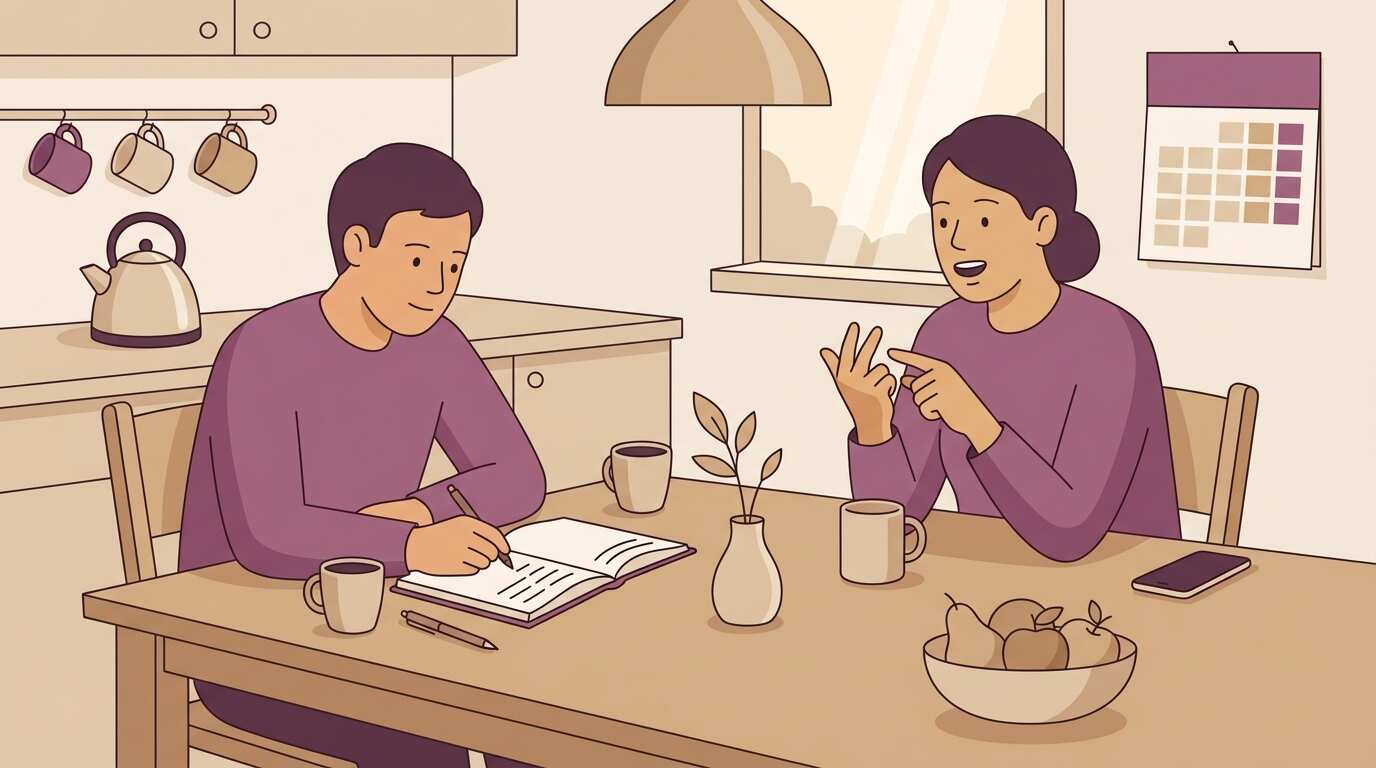
Most couple fights start because small things pile up unaddressed. A 20-minute weekly meeting with a simple structure (logistics, feelings, appreciation) catches problems before they become blowups.
The fight about the dishes is never about the dishes.
It's about the three weeks where one person quietly loaded the dishwasher every night while the other didn't notice. It's about the birthday dinner that got planned without checking the calendar. It's about the moment last Tuesday when you said "I'm fine" and meant "I'm not fine but I don't know how to bring it up without it becoming a thing."
Most couple fights look spontaneous. They erupt over something small: a forgotten errand, a tone of voice, a Saturday plan made without asking. But researcher John Gottman, who has studied over 3,000 couples across four decades at his University of Washington lab, found that these blowups almost always trace back to a slow accumulation of unaddressed emotional bids. Small moments where one partner reached out and the other didn't respond. Not maliciously. Just... didn't notice.
The couples who stay together aren't the ones who never have friction. They're the ones who have a system for catching it early.
Why a scheduled check-in changes everything
Gottman's research on emotional bids, those small moments of connection like "look at that bird" or "I had a rough day," revealed a striking pattern. Couples who eventually divorced responded to each other's bids only 33% of the time. Couples who stayed together and reported being happy? 86%.
The gap is about attention, not love. And attention is a resource that gets depleted by jobs, kids, logistics, screens, and the sheer momentum of daily life.
A weekly check-in works because it creates a guaranteed moment of attention. Psychologist and couples researcher Dan Wile called this "creating a platform": a recurring, low-stakes space where both people know they'll be heard. When that platform exists, the pressure to bring things up in the moment drops. You don't need to interrupt dinner with "we need to talk" because you know Sunday is coming.
There's data behind this. A 2019 study published in Family Process found that couples who engaged in regular structured conversations about their relationship reported 31% fewer escalated conflicts over a six-month period compared to couples who only talked about relationship issues when problems arose. The mechanism is straightforward: scheduled vulnerability prevents spontaneous combustion.
Couples therapist Esther Perel has noted that modern couples carry an unprecedented emotional load. We expect our partners to be lover, best friend, co-parent, financial partner, and intellectual companion. A weekly meeting doesn't reduce that load, but it gives it a container.
The 20-minute format
A concrete template. Twenty minutes, four parts, five minutes each. It's short on purpose. Brevity keeps it sustainable, and sustainability is what matters.
Part 1: Logistics (5 minutes)
Start with the easy stuff. This is a calendar sync, not an emotional conversation.
- What's happening this week? Any travel, late nights, commitments?
- Who's handling what? Groceries, kids' pickup, that plumber appointment.
- Any schedule conflicts to sort out now rather than Wednesday at 9 PM?
This part matters more than it seems. Research from the Sloan Center on Everyday Lives and Families at UCLA found that dual-income couples spend less than 10% of their time at home in the same room, actually talking. Logistical misalignment is a leading source of daily irritation, and it's entirely preventable with five minutes of coordination.
Starting with logistics also serves a psychological purpose: it warms up the conversation. You're talking, you're making eye contact, you're solving small problems together. That primes the brain for the more vulnerable parts ahead.
Part 2: Temperature check (5 minutes)
Now shift from logistics to feelings. The question is simple: How are you feeling about us this week?
Not "how are you feeling about work" or "how's your anxiety." Those matter, but this is specifically about the relationship. Each person gets about two minutes to answer. The other listens without fixing.
Some prompts that help:
- What felt good between us this week?
- Was there a moment that felt off or disconnected?
- On a scale of 1-10, how connected do you feel right now?
The 1-10 scale comes from marriage researcher Terri Orbuch, who ran the longest-running study of married couples in the U.S. (starting in 1986, still ongoing). She found that couples who regularly rated and discussed their satisfaction caught downward trends months before they became crises.
A number also gives you something to track over time. If you're consistently at a 7 or 8, things are working. If you notice three weeks of 5s, that's a signal, and you caught it before it became a 2.
Part 3: One thing (5 minutes)
Each person raises one thing. Not three things, not a list. One.
This could be:
- A request: "Could we eat dinner together without phones at least twice this week?"
- A flag: "I've been feeling like I'm initiating all our plans lately."
- A need: "I need a night to myself this week, no agenda, just space."
- A repair: "I snapped at you Thursday morning and I'm sorry. I was stressed about the presentation."
The one-thing rule is critical. It prevents the meeting from becoming a grievance dump. It forces prioritization: what actually matters most right now? And it ensures both people get equal airtime.
When your partner raises their one thing, the only appropriate first response is some version of "I hear you." Not "well, you also..." Not "that's not what happened." Acknowledge first, discuss second.
Part 4: Appreciation (5 minutes)
End with one specific thing you noticed and appreciated this week.
Not "you're great" or "thanks for everything you do." Those are nice but vague. Specific appreciation sounds like:
- "You got up early Wednesday to make lunches so I could sleep in. I noticed and it meant a lot."
- "When I was stressed about the project, you didn't try to fix it. You just sat with me. That was exactly what I needed."
- "You texted me that article about the thing I'm interested in. It made me feel like you think about me during the day."
Gottman's research found that stable couples maintain a ratio of at least 5 positive interactions to every 1 negative interaction during conflict. But outside of conflict, the ratio in thriving relationships is closer to 20:1. Weekly appreciation doesn't manufacture positivity; it trains you to notice what's already there.
This part also closes the meeting on a warm note. You walked in as roommates comparing calendars. You walk out as partners who see each other.
Making it stick
The first few weeks will feel awkward. That's normal and not a sign it's not working.
Same time, same place. Sunday morning over coffee is the classic, but any recurring slot works. The key is that it's automatic. You don't negotiate when to have it each week. Some couples do Friday evening as a transition into the weekend. Some do Monday morning to align on the week ahead. Pick what fits and protect it.
No phones. Put them in another room. Twenty minutes without a screen is not a hardship, but the temptation to glance at a notification will break the container.
Brief is fine. Some weeks the temperature check is "We're good, I feel connected, nothing to flag." That's a perfectly valid five minutes. Not every meeting needs to be deep. The ones that are routine and uneventful make the hard ones possible. You've built the muscle.
It evolves. After a few months, you'll likely modify the format. Some couples add a "dreams and goals" segment. Others shorten logistics and extend the temperature check. One couple I read about in Orbuch's research added a "what I learned about you this week" closing. The template is a starting point, not a prison.
A daily practice like Aperi, where you're already answering a question together each day, creates a natural foundation for the weekly meeting. The daily questions surface feelings and observations throughout the week. The Sunday meeting gives you space to act on them.
Common pitfalls
Turning it into a grievance session. The one-thing rule exists for a reason. If every meeting becomes "here are all the ways you disappointed me this week," the meeting will die within a month. If you have more than one thing to raise, write the others down and bring them next week, or recognize that you might need a longer, separate conversation (or a therapist's office).
Skipping appreciation. When the meeting feels heavy, when Part 3 surfaces something real, there's a temptation to skip Part 4. Don't. Especially when the conversation was hard, ending with genuine appreciation reminds both of you why you're doing this work. It's the difference between "we have problems" and "we have problems and we're partners who see each other."
Going over time. Twenty minutes is a feature, not a limitation. Longer meetings create resistance, and resistance kills habits. If something in Part 3 needs more than five minutes, acknowledge it and schedule a separate conversation: "This is important. Let's talk about it tonight after dinner, not right now." The meeting's job is to surface things, not resolve everything.
Bad timing. Don't do it when someone is hungry, exhausted, or right after a stressful event. Sunday morning works because most people are rested and the week hasn't started yet. If you try it Sunday night when the Monday dread is setting in, you're working against biology.
Making it optional. The weeks you least want to do it are the weeks you most need it. If you skip it when things are tense, you've just confirmed that this space isn't safe for hard things. Show up especially when it's uncomfortable.
Frequently asked questions
What if my partner thinks this is too structured or "not how relationships should work"?
Suggest trying it for four weeks as an experiment. No commitment beyond that. Most resistance comes from imagining it'll be stiff or clinical, but in practice, a five-minute appreciation segment doesn't feel like a corporate meeting. It feels like being seen. After four weeks, ask: has anything shifted? The answer usually speaks for itself. Couples therapist Julie Schwartz Gottman (John's partner in both life and research) has noted that structure often feels artificial until it becomes ritual, and rituals are the backbone of every lasting relationship.
We already talk all the time. Do we still need this?
Talking all the time and talking about the right things are different. Most daily conversation is logistical or surface-level: what's for dinner, did you see that email, the kid has a thing Thursday. A weekly check-in carves out space for the layer underneath. Couples who "talk all the time" often discover in therapy that they haven't had a real conversation about how they're feeling about the relationship in months.
What if one person dominates the conversation?
Use a timer. Seriously. Each person gets two to three minutes in each section. It feels mechanical for exactly one week, and then it becomes freeing, especially for the quieter partner who now has guaranteed space. If dominance is a persistent pattern, that's worth naming in Part 3 as your one thing.
Can we do this with kids in the house?
Yes, but not with kids in the room. Find twenty minutes when they're asleep, at an activity, or with a grandparent. Some couples wake up twenty minutes early on Sunday for this. The investment is small. The return is not.
The deeper point
A twenty-minute meeting won't save a relationship that has fundamental incompatibilities. But most relationships don't end because of fundamental incompatibilities. They end because of the slow erosion of small, fixable things that never got fixed.
Using a tool like Aperi for daily connection and a weekly meeting for structured reflection creates two complementary habits. One keeps the conversation going, the other makes sure it goes somewhere. The Sunday meeting is where the small stuff gets caught before it becomes the big stuff. It's where appreciation gets spoken instead of just felt. It's where "I'm fine" gets replaced with the truth.
Twenty minutes. Every week. Same time, same place. That's it.
Related reading
Aperi: one question a day
A daily question app that adapts to you and your partner, and goes deeper the more you use it.


Free to start. Available on iPhone and Android.
Explore question packs
Related articles
The couple's budget: managing money without resentment
Money is the #1 predictor of divorce, ahead of sex and in-laws. How to talk about it without someone sleeping on the couch.
Supporting your partner's dreams without losing yours
Great relationships help both people become their ideal selves. Here's how to support your partner without losing yourself.
Communication in marriage: how the years change the conversation
Communication in marriage erodes through efficiency, not conflict. What the years change, which patterns predict real trouble, and what daily practice looks like.
Lack of communication in a relationship is rarely a skills problem
Lack of communication in a relationship: what the breakdown looks like in practice, what causes it (rarely skills), and the scripts that rebuild it.

50 couples therapy questions, in the order a therapist would ask them
50 couples therapy questions sequenced like a real session: history, patterns, needs, repair, future. Plus an honest look at when a list is not enough.
When you and your partner speak different love languages
You show love your way, not theirs. How to close the gap when you and your partner express affection differently, beyond the quiz.