Key Takeaways
Higher social media use correlates with more conflict and lower relationship satisfaction, according to multiple studies. The biggest problems aren't dramatic (cheating via DM) but mundane: comparison, phubbing, and unspoken expectations about what gets posted and who gets followed. Couples who set explicit agreements about social media have fewer fights about it. The rules don't need to be strict. They need to exist.
Nobody's relationship has ever been improved by Instagram. That's an opinion, but it's one the research supports pretty well.
Sarah Coyne and colleagues at Brigham Young University published a study in 2014 looking at social media use and romantic relationship outcomes. The finding: higher social media use was associated with more relationship conflict, more negative interactions, and lower relationship satisfaction. This held even after controlling for the overall amount of time spent online. Something about social media specifically gets under relationships' skin.
The question isn't whether to use social media. That ship sailed. Nearly everyone uses it. The question is whether you and your partner have ever actually talked about how you use it. Most couples haven't. They have unspoken expectations, vague assumptions, and occasional blowups when those assumptions get violated.
Why does social media cause so many relationship problems?
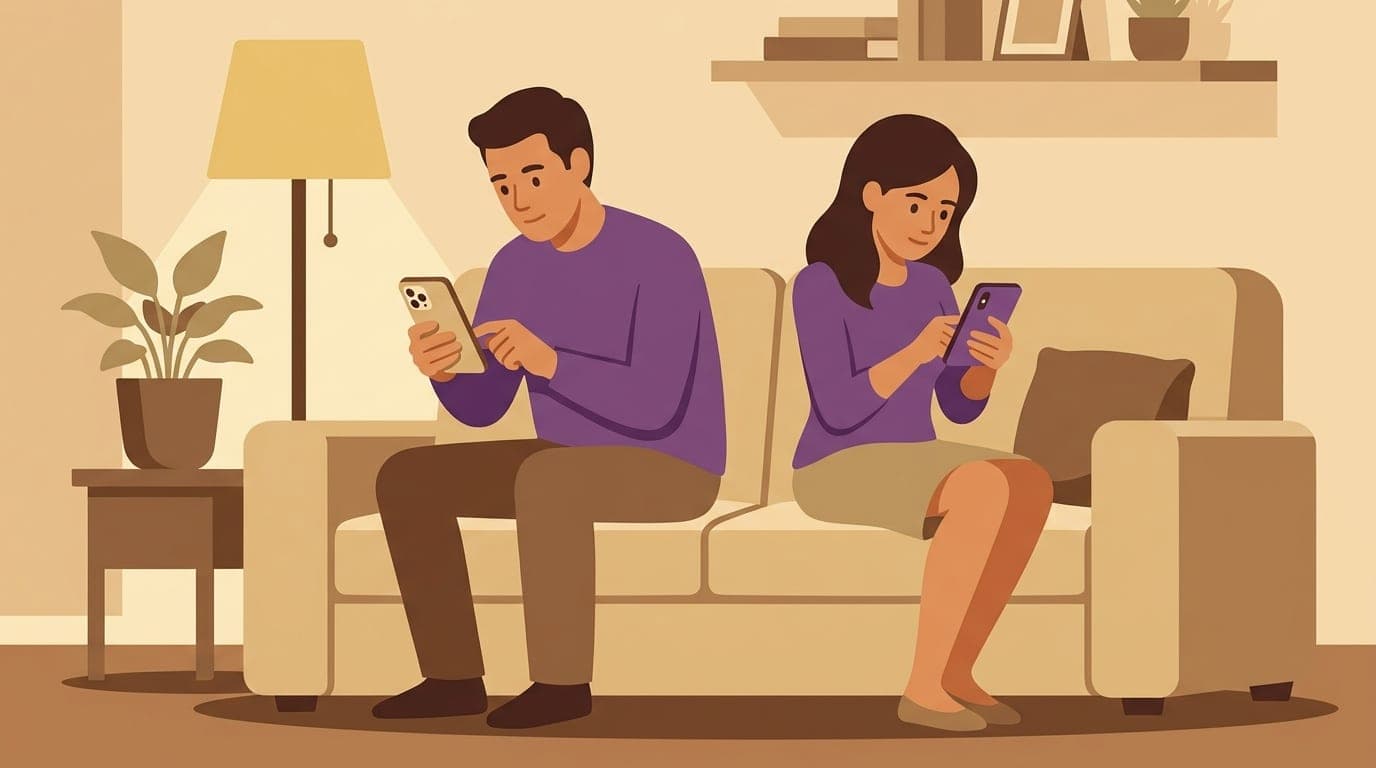
The issues fall into a few categories, and most of them are boring. That's the thing nobody warns you about. Social media relationship problems sound dramatic in theory (secret accounts, emotional affairs, catfishing), but in practice they're mundane: you saw a like on an ex's photo, your partner posted a bad picture of you, you're sitting on the couch next to someone who's been scrolling for 40 minutes without looking up.
The comparison problem is the most documented. Erin Vogel and colleagues published research in 2014 showing that social comparison on social media platforms reduced self-esteem and self-evaluation. When applied to relationships, this means you're not just comparing your body or career to others. You're comparing your relationship. That couple's anniversary post, their vacation photos, the public declaration of love that got 347 likes. Your actual relationship, with its mundane Tuesday dinners and ongoing argument about the dishwasher, looks worse by comparison.
Except you're comparing your full relationship to someone else's highlight reel. You know this intellectually. It doesn't stop the feeling.
Then there's the surveillance dimension. Social media gives you tools to monitor your partner that previous generations didn't have. You can see who they follow, what they like, when they were last active, who comments on their posts. These tools aren't designed for relationship monitoring, but that's how they get used. And monitoring erodes trust, even when it doesn't find anything.
What's the deal with following exes?
This is probably the single most common social media argument in romantic relationships, and there's no universal right answer. But there are useful frameworks.
The key question isn't "is it okay to follow your ex?" but "what does it mean to you, and what does it mean to your partner?" For some people, following an ex is genuinely neutral. The relationship ended years ago, there's no residual feeling, and unfollowing would feel dramatic and unnecessary. For other people, seeing their partner's ex in their feed triggers real anxiety, regardless of whether anything is happening.
Both positions are valid. What's not valid is pretending your partner's discomfort doesn't matter because you think it shouldn't exist. If your partner tells you it bothers them, the fact that you think it's irrational doesn't make it go away.
The research on jealousy in relationships shows that the trigger matters less than the response. Dismissing your partner's concern ("you're being crazy, she's just someone I went to college with") escalates things. Acknowledging it ("I get why that bugs you, let's talk about it") de-escalates. You might decide together that following exes is fine. You might decide it's not. The decision matters less than the fact that it was a decision both people made.
Does posting about your relationship actually help or hurt it?
Posting about your partner feels like a public affirmation. Look how happy we are. Look how much I love this person. Relationship visibility on social media seems like it should strengthen bonds. The data is more mixed.
Lisa Emery and colleagues published research in 2015 examining relationship-contingent self-esteem and social media behavior. They found that people who posted excessively about their relationships on social media tended to have lower relationship security. The posting wasn't a sign of a strong relationship. It was, in many cases, a sign of anxiety about the relationship. Posting became a way to seek external validation for something that felt uncertain internally.
This doesn't mean all relationship posts are bad. Sharing a genuinely happy moment isn't the same as performing happiness for an audience. The distinction is in the motivation. Are you posting because you want to share something real? Or are you posting because you need other people to see your relationship as successful?
A practical test: if nobody liked the post, would you still be glad you shared it? If yes, post away. If the whole point is the response, that's worth examining.
The other dimension is consent. Posting about your relationship involves another person. Your partner has a right to opinions about what gets shared. Some people are private and don't want their arguments, their lazy Sunday face, or their relationship milestones broadcast. Checking before posting isn't controlling. It's basic courtesy.
What is phubbing and why should you care about it?
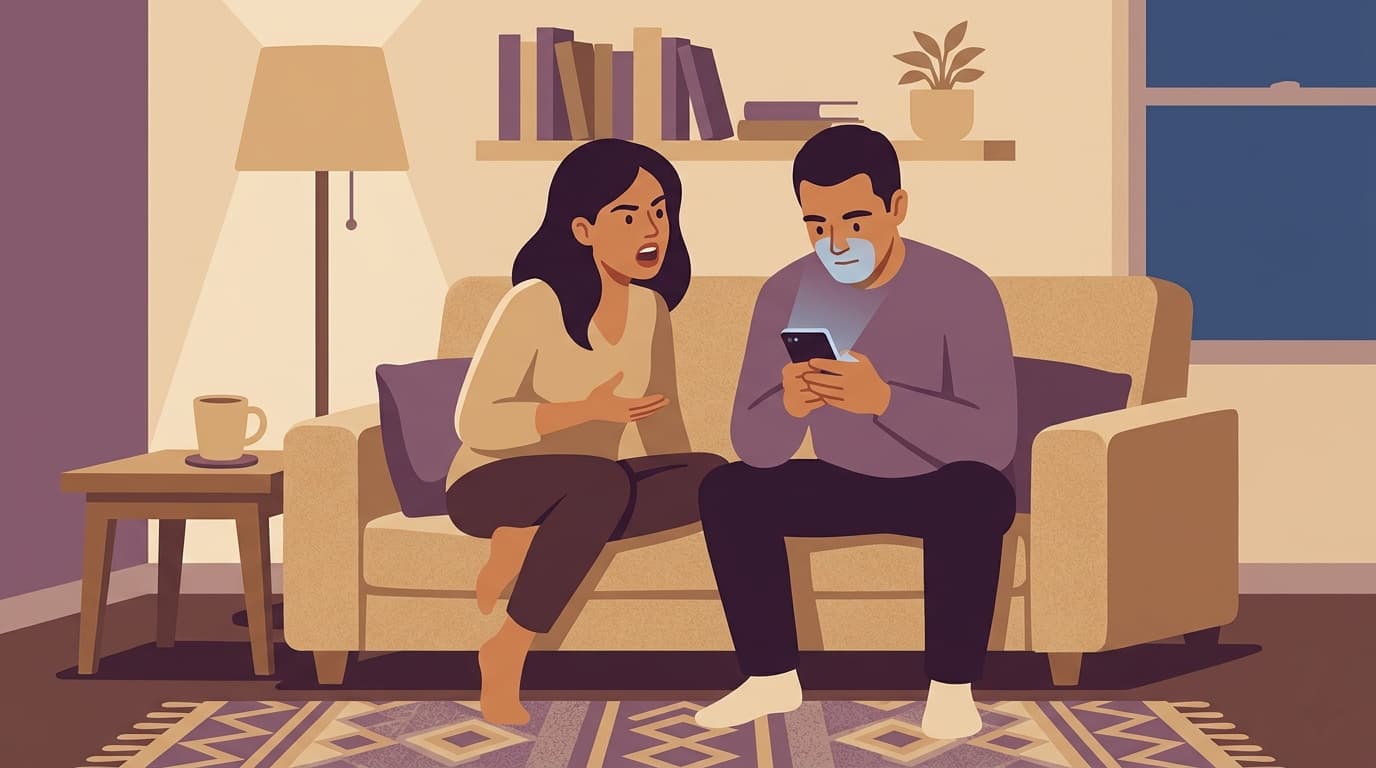
Phubbing. Partner phone snubbing. It's an ugly word for an ugly behavior, and it's probably the most damaging everyday social media habit in relationships.
James Roberts and Meredith David at Baylor University published a study in 2016 that measured the effect of partner phubbing on relationship satisfaction and individual wellbeing. Their findings were stark. Higher levels of phubbing predicted lower relationship satisfaction, which in turn predicted lower life satisfaction and higher rates of depression. The pathway was clear: phone → ignored partner → eroded relationship → diminished wellbeing.
The thing about phubbing is that it doesn't feel like a big deal while you're doing it. You're just checking a notification. You're just looking at one thing for a second. But from your partner's perspective, you just told them that whatever is on your screen is more interesting than what they were saying. Do that enough times and the message sinks in.
Most people phub without realizing it. If you want an honest read on how much you do it, ask your partner. Prepare to be surprised.
What rules actually work for couples on social media?
Rules is a strong word. Agreements is better. These work because they make the implicit explicit. Most social media conflict comes from violated expectations that were never stated. Here are the agreements worth having:
What gets posted. Do you both need to approve photos before they go up? Are there topics that are off-limits (fights, health issues, financial stuff, your kids' faces)? What about stories that disappear versus permanent posts? Having this conversation once prevents dozens of small resentments.
How you handle exes and past connections. Not a unilateral policy. A mutual one. If one of you is uncomfortable, that discomfort gets taken seriously, even if the other person thinks it's unfounded.
Phone-free zones or times. Dinner. Bed. The first 20 minutes after you get home from work. Pick whatever works for your life, but pick something. A screen-free date night once a week is a good baseline.
How to handle DMs from strangers or old friends. Transparency doesn't mean surveillance. It means that neither partner feels the need to hide conversations. If deleting a message before your partner could see it has become a habit, something's wrong.
A response plan for when someone crosses a line. If someone slides into your partner's DMs with something inappropriate, what happens? If a friend posts an embarrassing photo of you as a couple, who handles it? Having a plan prevents reactive blowups.
These don't need to be written down or formalized. They just need to be discussed. One honest 30-minute conversation about social media expectations can prevent years of accumulated irritation. If you need a starting point, the piece on setting boundaries with your partner covers the general framework.
Is a digital detox together actually worth trying?
Yes, but not for the reasons most articles give you.
The standard digital detox pitch focuses on screen time reduction, attention spans, dopamine cycles. Those are fine. But for couples, the main benefit is simpler. When you're not looking at your phone, you're more likely to look at each other. When you're not reading other people's updates, you're more likely to ask your partner about theirs.
A couple's digital detox doesn't need to be extreme. You don't have to go off-grid for a week. Start with one evening. Leave phones in a drawer after dinner. See what happens when neither of you has a screen to retreat to. The first 20 minutes might feel awkward. The conversation that starts at minute 21 might surprise you.
Some couples build this into a regular rhythm. No phones on Sunday mornings. No social media during vacation. Airplane mode after 9 PM. The specific rule matters less than the consistency. You're creating pockets of time where the only content you're consuming is each other.
How do you bring up social media concerns without sounding controlling?
This is the part most people get wrong. "You need to stop liking her photos" sounds controlling because it is. You're dictating someone else's behavior. That triggers defensiveness, and defensively, your partner is going to start hiding things rather than changing them.
The alternative is to talk about your own experience. "When I see you engaging with your ex's posts, I feel anxious. Can we talk about that?" This isn't weaker. It's actually harder because it requires vulnerability instead of authority.
A few ground rules for the conversation:
Pick a calm moment. Not right after you've been scrolling through their followers list at 1 AM. Not during a fight about something else. A regular check-in, maybe as part of a weekly relationship meeting, works well.
Be specific about what bothers you and why. "Social media" is too vague. "When you scroll through TikTok for an hour while we're watching a movie together" is specific enough to act on.
Listen to their perspective. They might not realize they're phubbing. They might have a reason for following someone that makes sense once explained. Or they might get defensive, which is information too.
Come with proposals, not demands. "What if we both agreed to no phones during dinner?" is an invitation. "Put your phone away at dinner" is an order. Same outcome, very different dynamic.
Aperi sends couples a daily question to answer together, which has a useful side effect: it gives you a reason to put your phones down and talk to each other about something that isn't logistics. Sometimes the best digital boundary is simply having something better to do with your attention.
FAQ
Is it a red flag if my partner won't let me see their phone?
Privacy and secrecy are different things. Everyone deserves privacy, including in a relationship. Your partner doesn't owe you access to every conversation they've ever had. But if there's a sudden change in behavior (new password, phone always face-down, leaving the room to text), that pattern shift is worth discussing. The red flag isn't wanting privacy. It's a change in behavior that comes with no explanation and triggers defensiveness when questioned.
How much should couples post about their relationship on social media?
There's no right amount. Some couples post constantly and are genuinely happy. Some never post and are equally happy. The Emery research suggests that the motivation behind posting matters more than the frequency. Post because you want to, not because you're trying to prove something. And always check with your partner first. If one of you is private and the other is broadcasting everything, that mismatch needs a conversation.
My partner gets upset about likes and follows that seem totally innocent. Am I wrong to think they're overreacting?
You might be right that the behavior is innocent. But "overreacting" is a judgment about your partner's emotions, and that judgment rarely goes well. Their anxiety might be rooted in past experiences, attachment patterns, or something else entirely. You don't have to agree that a like is a big deal. You do have to take seriously that it's a big deal to them. Start there and work outward.
Should we have each other's passwords?
Some couples share everything and feel closer for it. Others share nothing and trust each other completely. The research doesn't strongly support either approach. What matters is that you're aligned. If one partner wants shared passwords and the other refuses, that disconnect needs a real conversation about what trust looks like for each of you.
How do I stop comparing my relationship to what I see on social media?
Awareness is the first step, and it's not enough by itself. The comparison happens automatically. What you can control is how you respond to it. When you catch yourself thinking "why don't we do that," pause and ask yourself: "Am I comparing my full relationship to someone's best moment?" You almost always are. Curating your feed helps too. Unfollow or mute accounts that consistently trigger comparison. Fill your feed with things that don't make you feel worse about your life.
Aperi: one question a day
A daily question app that adapts to you and your partner, and goes deeper the more you use it.


Free to start. Available on iPhone and Android.
Explore question packs
Related articles
Why texting is ruining your relationship communication
How texting strips context from conversations, escalates conflict, and what research says about when to put the phone down.
Setting digital boundaries in your relationship
Phubbing, doomscrolling, and Instagram comparisons are eroding your relationship. How to set digital boundaries that actually stick.
Introducing your partner to your family
Introducing your partner to your family is high-stakes. How to prepare, manage expectations, and handle it when things go wrong.
Writing a love letter that doesn't sound cheesy
Most love letters fail because they're too generic. A framework for writing one that actually means something.
Traveling together without fighting
Travel should bring you closer. Instead, it stress-tests your relationship. Here's how to stop fighting about maps, money, and packing.
When you disagree about having kids
When one partner wants kids and the other doesn't, compromise isn't possible. How to have the conversation honestly.