
Key Takeaways
Boredom in relationships isn't the problem. Your response to it is. Secure boredom means comfort. Avoidant boredom means stagnation. The research says novelty, not intensity, is the fix.
You're sitting on the couch next to your partner. You've been together for years. The evening stretches out ahead of you like every other evening, and you feel... nothing. Not unhappy. Not angry. Not disconnected, exactly. Just bored. A low-grade flatness that makes you wonder if this is all there is.
Then the guilt hits. You're not supposed to be bored with the person you love. Boredom means something is wrong. Boredom means the spark is dead. Boredom means you should be doing something about it.
Maybe. Or maybe boredom is exactly what a healthy long-term relationship feels like sometimes, and the real problem is what you do next.
Is boredom actually harmful to relationships?
The research gives a "yes, but" answer.
Cheryl Harasymchuk and Beverley Fehr published a study in 2012 in the Journal of Social and Personal Relationships examining boredom in romantic relationships. They found that relationship boredom correlated with lower satisfaction, less commitment, and more thoughts about alternatives. Bored partners were more likely to fantasize about other relationships and less likely to invest in their current one.
That sounds damning. But here's the critical nuance that most articles about relationship boredom miss: Harasymchuk and Fehr also found that the response to boredom mattered more than boredom itself. Partners who responded to boredom with approach behaviors (trying new things together, having new conversations, seeking shared experiences) maintained their satisfaction. Partners who responded with withdrawal behaviors (pulling away, turning to individual pursuits, checking out mentally) saw their satisfaction decline.
The boredom was the same. The outcomes were opposite. The variable was the response.
This means boredom isn't a diagnosis. It's a signal. And like most signals, what it means depends on context.
When does boredom mean your relationship is safe?
This is the version of boredom that nobody talks about, probably because it doesn't make for dramatic content. But it's the most common type, and it's not a problem at all.
Attachment theory, developed by John Bowlby and expanded by researchers like Sue Johnson, describes secure attachment as the state where you feel confident that your partner is available, responsive, and engaged. When you're securely attached, you don't spend energy monitoring the relationship for threats. You're not anxious about whether your partner still loves you. You're not vigilant about signs of abandonment.
And that security can feel like boredom.
Think about it. The absence of anxiety, the absence of drama, the absence of uncertainty. If you spent the early phase of your relationship (or previous relationships) in a heightened state of emotional activation, worried about whether they'd text back, analyzing every interaction for hidden meanings, riding the dopamine roller coaster of hot-and-cold dynamics, then a secure relationship will feel flat by comparison. Not because it's worse. Because your nervous system calibrated "love" as a high-arousal state, and this isn't that.
Psychologist Stan Tatkin, who developed the PACT approach to couples therapy, talks about this directly. He argues that many people mistake arousal for passion and calm for boredom. A secure relationship produces calm. Calm is not the same as boredom, but it can feel identical if you've never experienced it before.
If you're bored but also feel safe, respected, and confident that your partner has your back, that "boredom" might just be security that you haven't learned to recognize yet.
When does boredom signal real stagnation?
Not all relationship boredom is benign security in disguise. Sometimes boredom is exactly what it seems: a sign that the relationship has stopped growing.

The warning signs are different from secure boredom:
You've stopped learning anything new about your partner. Not because there's nothing left to learn (there always is), but because neither of you is asking. Curiosity has flatlined. You've each built a mental model of the other and stopped updating it. Our piece on keeping curiosity alive addresses this specifically.
You've stopped doing anything new together. Your weekly routine is locked in. Your conversations follow the same patterns. Your activities are the same ones you've been doing for years. There's nothing wrong with any of them individually, but collectively they've created a closed loop with no new inputs.
One or both of you is growing individually but not sharing that growth. You're reading new things, thinking new thoughts, having new experiences at work or with friends, but none of it makes it back to the relationship. You're evolving separately while the relationship stays static.
You avoid difficult conversations. This is the sneakiest form of stagnation. Comfort becomes an excuse to dodge the topics that would create growth but also create temporary discomfort. You don't talk about the thing that's been bothering you. You don't share the dream that might change things. You don't ask the question you're afraid to hear the answer to. The relationship feels stable, but the stability is achieved by avoiding everything that might disturb it.
If several of these describe your situation, the boredom isn't security. It's the relationship telling you something needs to change.
Why is chasing constant excitement a bad strategy?
This is where a lot of relationship advice goes wrong. It identifies boredom as the problem and excitement as the solution, then prescribes a series of increasingly elaborate activities to "keep the spark alive." Skydiving dates. Surprise getaways. Sexual novelty. More, more, more.
This is the hedonic treadmill applied to relationships, and it doesn't work.
The hedonic treadmill (or hedonic adaptation) is the well-documented psychological phenomenon where humans return to a baseline level of happiness regardless of positive or negative events. You get a raise, you're happy for a while, then it's your new normal. You buy a new car, you love it, then it's just your car. The same thing happens with relationship excitement. Any specific novel experience produces a temporary spike in satisfaction, then you adapt.
If your strategy for combating relationship boredom is to keep escalating the intensity of your shared experiences, you'll always need more. Last month's exciting date becomes this month's baseline. You're running faster and faster to stay in the same place.
The research doesn't support intensity as the antidote. It supports something more modest: regular, low-key novelty. Arthur Aron's self-expansion theory proposes that relationships stay satisfying when they continue to be a source of new experiences, perspectives, and growth. But "new" doesn't have to mean "extreme." It can mean walking a different route. Trying a recipe from a cuisine you've never cooked. Asking your partner a question you've never asked. Reading the same book and discussing it.
The bar for novelty is lower than the excitement-industrial complex wants you to believe.
How do you tell the difference between healthy boredom and the dangerous kind?
A simple diagnostic. Ask yourself these questions honestly:
Do I feel safe in this relationship? If yes, your boredom might be security. If you're not sure, or if "safe" sounds like "trapped," that's a different situation.
Am I still curious about my partner? Not "do I know everything about them" (you don't), but "do I want to know more?" Curiosity is the leading indicator. When it's gone, stagnation follows.
Are we growing? Not individually (you probably are). As a couple. Are your conversations evolving? Are you trying anything new? Are you having the hard discussions that lead to deeper understanding? If the relationship itself has been static for months or years, the boredom is signaling stagnation.
How do I respond to the boredom? This is the most telling question. If your instinct is to seek out novelty together (let's try something, let's talk about something new, let's go somewhere), the boredom is just a prompt. If your instinct is to withdraw (more phone time, more solo activities, fantasizing about other people or other lives), the boredom is becoming corrosive.
What does self-expansion theory actually prescribe?
Aron's self-expansion model is the most useful framework for thinking about relationship boredom. The theory says that people are motivated to grow and expand their sense of self, and that relationships are a primary vehicle for this expansion. In early relationships, expansion happens automatically: your partner's interests, knowledge, perspectives, and social network all become part of your expanded self.
As the relationship matures, the rate of expansion slows. You've already absorbed most of what's easily shared. And if you don't find new sources of shared expansion, the relationship starts to feel like it's contracting rather than growing. That contraction is experienced as boredom.
The prescription isn't intensity. It's shared novelty and shared growth. Things that expand both of you:
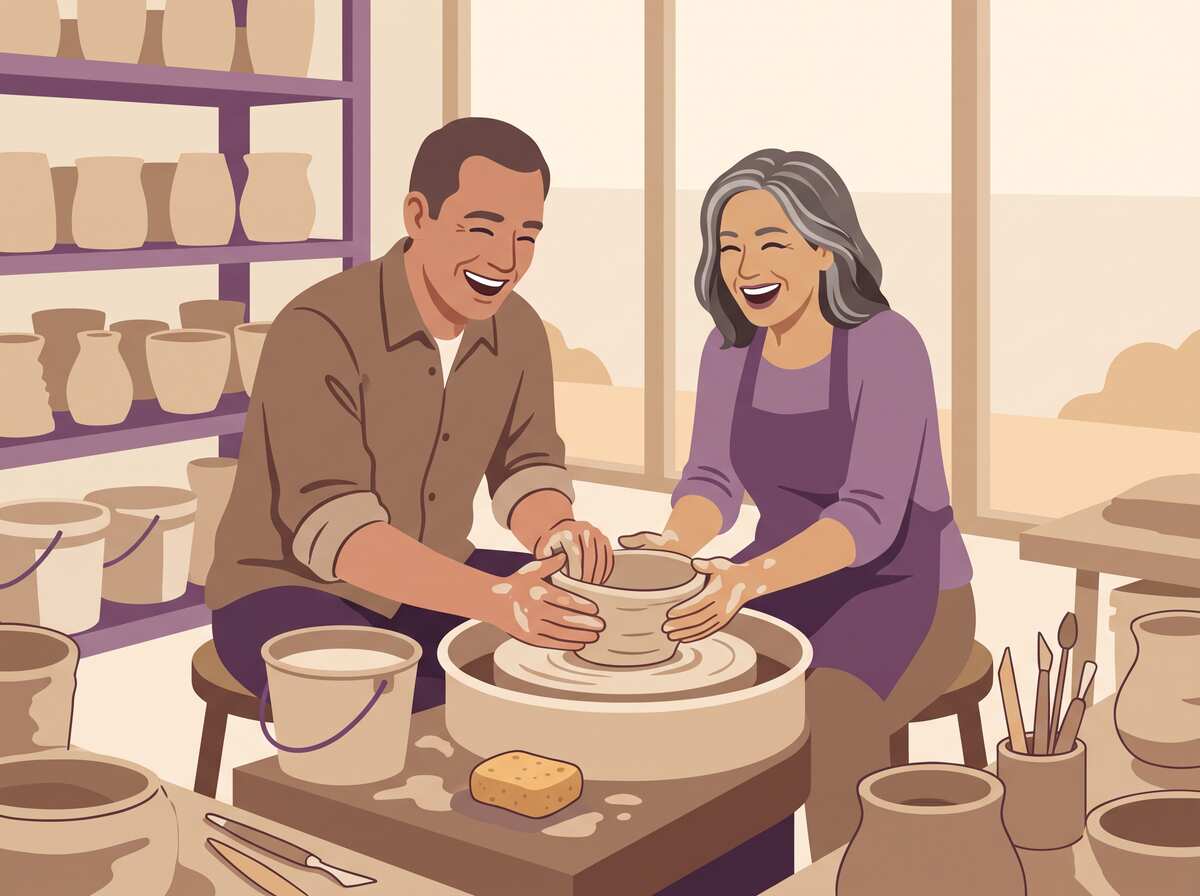
Learn something together. A language. An instrument. A sport. A craft. The specific skill doesn't matter. What matters is that you're both beginners, both vulnerable, both growing.
Have conversations you haven't had. Not the same conversations about the same topics. New ones. Questions you haven't asked. Opinions you haven't shared. The deeper layers of each other that haven't been accessed because there was never a prompt.
Break your patterns. Not all of them. Not permanently. But regularly enough that your brain can't fully predict what's coming next. Take a different route. Switch up the evening routine. Suggest something your partner wouldn't expect from you.
Share your individual growth. If you're learning new things at work or through hobbies, bring them home. Tell your partner about the article that changed how you think about something. Share the new skill you're developing. Let your individual growth become a source of couple-level expansion.
For concrete ideas on reintroducing fun and novelty, see our piece on why couples stop having fun. If you're worried about a deeper rut, our roommate rut guide covers the more serious version.
What should you actually do when boredom shows up?
First, don't panic. Boredom in a long-term relationship is normal. It happens to everyone. The question isn't whether you'll be bored but how you'll respond.
Second, diagnose which type you're dealing with. Is this the calm-that-feels-flat kind (secure boredom)? Or the we've-stopped-growing kind (stagnation boredom)? The response is different for each.
For secure boredom: appreciate it. Seriously. If you feel bored and safe, you have something most people don't. Enjoy the calm. It doesn't mean you can't also seek novelty and growth, but the foundation is good. Build on it rather than undermining it by chasing drama.
For stagnation boredom: start small. You don't need to overhaul your relationship or plan an elaborate adventure. You need one new conversation. One new shared experience. One question you haven't asked. The compound effect of small, regular novelty is more powerful and more sustainable than occasional grand gestures.
For both types: talk about it. Saying "I've been feeling a little bored with our routine lately" is vulnerable but honest. It opens the door to a conversation about what both of you need. The worst thing you can do with relationship boredom is suffer it silently, because silence turns boredom into distance, and distance is much harder to fix.
For a broader look at where your relationship might be in its natural arc, our relationship stages piece can provide useful context.
Frequently asked questions
Is it normal to be bored after only a few years together?
Yes. Hedonic adaptation doesn't wait for decade milestones. Some couples hit their first boredom phase within two years, especially if the early relationship was very intense. The transition from high arousal to stable attachment can feel like a loss even when it's actually a gain.
My partner says they're bored but I'm not. What does that mean?
It means you're experiencing the relationship differently right now, which is normal. Don't take it as an accusation. Ask what they need. Often the bored partner is craving novelty or depth that they're not getting, and the fix is simpler than you'd expect.
Can boredom be a sign I'm with the wrong person?
It can be, but it's unlikely to be a reliable signal on its own. Boredom happens in every long-term relationship. If the boredom is accompanied by a persistent sense that you and your partner want fundamentally different things from life, that's worth examining. If it's accompanied by a general flatness that would probably follow you into any relationship, that's about you, not the partnership.
Is it possible to be too comfortable in a relationship?
Comfort isn't the problem. Comfort without growth is the problem. You can be deeply comfortable and still growing, learning, trying new things, having hard conversations. If comfort means you've stopped stretching, that's stagnation wearing a cozy sweater. If comfort means you have a secure base from which to stretch, that's exactly what attachment theory says a healthy relationship should provide.
Should we seek couples therapy for boredom?
If you've tried introducing novelty and having honest conversations about the boredom and nothing has changed, therapy can help you understand what's underneath it. Sometimes boredom is the surface symptom of a deeper issue (unspoken resentment, mismatched needs, individual depression). A therapist can help you figure out which it is.
Aperi: one question a day
A daily question app that adapts to you and your partner, and goes deeper the more you use it.


Free to start. Available on iPhone and Android.
Explore question packs
Related articles
Why personal growth sometimes threatens your relationship
When one partner grows, the relationship system gets disrupted. Why that happens and how to handle it.

The difference between needing and wanting your partner
Is it better to need or want your partner? The real answer is more complicated than Instagram quotes suggest.

Building self-worth that doesn't depend on your partner
When your self-worth depends on your partner's approval, every interaction becomes high-stakes. Here's how to build an internal foundation.

When you project your insecurities onto your partner
Projection makes you fight about things that aren't real. How to catch it, understand where it comes from, and stop.
When you and your partner speak different love languages
You show love your way, not theirs. How to close the gap when you and your partner express affection differently, beyond the quiz.

What research says about age gap relationships
Age gap relationships attract strong opinions. What does the data actually show about satisfaction, power dynamics, and stigma?