Key Takeaways
The Love Languages framework has real problems as a scientific model, but the underlying observation is valid: people differ in how they prefer to give and receive affection. The fix isn't matching 'languages.' It's building perceived partner responsiveness through asking, observing, and adjusting in real time.
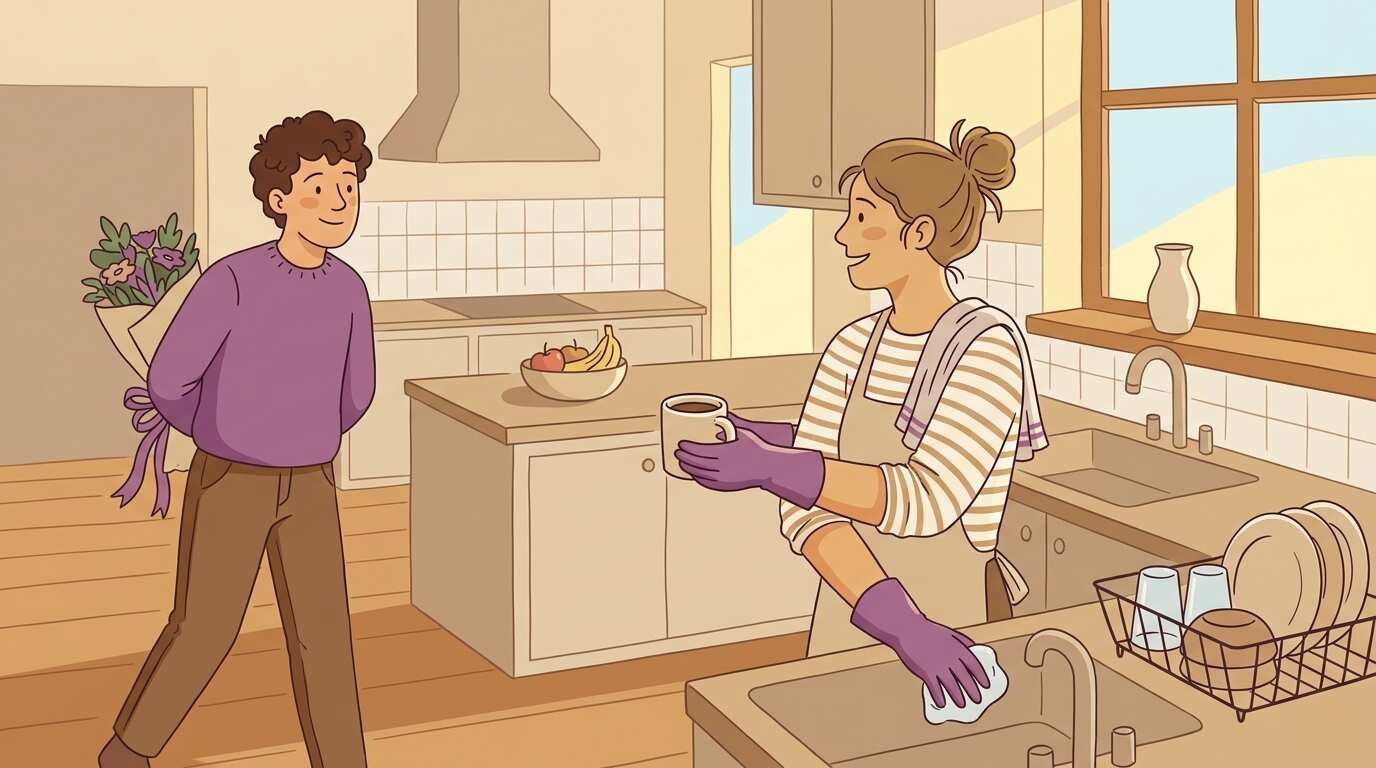
You've probably had this experience. You spend an hour making dinner for your partner, a real effort, not reheated leftovers, and they barely acknowledge it. Meanwhile, they're hurt that you haven't said "I love you" in three days. You showed love. They didn't feel it. Not because either of you is wrong, but because you expressed affection in a way that doesn't register for them.
Gary Chapman's Love Languages framework gave this problem a name, and for that, it deserves credit. The five categories (words of affirmation, acts of service, receiving gifts, quality time, physical touch) gave millions of couples a vocabulary for something they'd been feeling but couldn't articulate. But as we've covered in the piece on why love languages are outdated, the framework has significant scientific problems. The categories don't hold up under rigorous testing. People don't have a single dominant language. And matching languages doesn't predict relationship satisfaction.
So where does that leave you if you and your partner genuinely show love differently?
It leaves you with a better question: instead of asking "what's my love language?", ask "what does my specific partner actually need from me right now?"
Is there a real problem behind the love languages idea?
Yes. Strip away the five-category framework and the quiz, and you're left with something that's obviously true: people have different preferences for how they receive care, and those preferences don't always align between partners.
One person grew up in a family where affection was physical: hugs, hand-holding, sitting close. Their partner grew up in a family where love was demonstrated through action: fixing things, cooking meals, handling logistics. Neither person learned the wrong way to love. They learned different ways. And when they try to show love to each other using their own default, it sometimes lands and sometimes doesn't.
The mismatch isn't the problem. The problem is when you interpret your partner's different style as not caring. "If they really loved me, they'd say it." "If they really loved me, they'd notice I cleaned the entire house." Both partners are giving. Neither partner is receiving. And both feel unloved despite the other's genuine effort.
Harry Reis at the University of Rochester calls the mechanism behind this "perceived partner responsiveness," the degree to which you feel understood, validated, and cared for by your partner. His research, spanning decades, shows this is the single strongest predictor of relationship satisfaction. Not whether your partner does the right category of loving behavior, but whether what they do makes you feel seen.
Why do we default to showing love our own way?
It's not selfishness. It's cognitive efficiency. Your brain defaults to what feels natural, what you learned growing up, what you'd want if you were on the receiving end. Psychologists call this "egocentric bias," the tendency to assume others experience the world the way you do.
So when you want comfort, you want a hug, and you assume your partner does too. When you feel appreciated, it's because someone told you specifically what they valued, so you assume words are what your partner needs. You're not ignoring their preferences. You're projecting your own.
This is why the love languages quiz, despite its scientific shortcomings, became so popular. It named a real phenomenon and gave people permission to say: "Actually, what I need is different from what you've been giving me." That conversation has value even if the five categories are arbitrary.
The problem comes when the quiz replaces ongoing attention. You take the test, learn your partner is "quality time," and then you schedule date nights while ignoring the fact that this week, what they actually need is for you to handle the dishes without being asked. The quiz gives you a static answer to a dynamic question.
How do you learn what your partner actually needs?
Three methods, in order of reliability.
Ask them. Not "what's your love language?" but more specific questions. "When do you feel most loved by me?" "What did I do recently that made you feel appreciated?" "What's something I used to do that you miss?" "When you're having a bad day, what helps the most: talking about it, being left alone, physical comfort, or someone just handling things so you don't have to?"
These questions work better than a quiz because they're grounded in your actual relationship, not a generic framework. The answers will be specific and actionable. "I feel most loved when you put your phone down and actually look at me when I'm talking" is more useful than "my love language is quality time."
Observe them. Pay attention to how your partner shows love to you. People tend to give what they want to receive. If your partner is always touching you (a hand on your back, fixing your collar, sitting pressed against you on the couch) there's a good chance physical closeness is what makes them feel connected. If they're constantly doing things for you (filling your water bottle, handling an errand you mentioned) they probably feel loved when you do the same.
This isn't foolproof. Some people give in the way they were taught to give, not in the way they want to receive. But it's a useful starting signal.
Experiment and pay attention. Try different things and watch the response. Write a note and leave it in their bag. Come home and take over bedtime without being asked. Plan an evening with no phones and no agenda. The approaches that light them up, the ones where you can see the effect in their face, their posture, the way they move toward you, those are your data points. Do more of those.
The common thread across all three approaches: paying attention. Not to a category. To the person in front of you.
What does it take to "translate" your love into their preferences?
Effort. Deliberate, sustained effort that doesn't feel natural at first.
If your instinct is to show love through doing things, and your partner needs to hear it, you're going to feel awkward saying "I love you" or "I'm really proud of you." It'll feel forced. You'll worry it sounds scripted. Do it anyway. The first fifty times you tell your partner something affirming, it might feel stilted. By the hundredth time, it won't. And every single time, regardless of how it feels to you, it means something to them.
This is where the communication guide is relevant. Learning to express what you feel, out loud, in words, to the person who needs to hear it, is a skill. It gets easier with practice. But it requires the initial discomfort of doing something that doesn't come naturally.
The reverse is also true. If your partner shows love through action and you need words, you can learn to read their behavior as a love statement. When they fill up your car with gas or fix the thing you mentioned once three weeks ago, that is their "I love you." Recognizing it as such doesn't come automatically if you're wired for verbal expression, but it's a learnable perspective shift.
The ideal isn't that both people perfectly perform each other's preferred style. It's that both people make visible effort to move toward the other, and both people make visible effort to recognize what's being offered.
When is the difference about preferences and when is it about something bigger?
This is the part most love languages content skips. Sometimes the mismatch is about depth, not style.
If your partner says they need quality time and you're giving them an hour of shared TV watching, you might technically be meeting the category while missing the need entirely. They might mean: "I need to feel like you're interested in me as a person, like you're curious about my inner world, like spending time with me is something you choose rather than default to." That's not a love language issue. That's a responsiveness issue.
There's also a scenario where different love preferences mask incompatible needs. If one partner needs constant verbal reassurance and the other finds that smothering, the gap may not be bridgeable through effort alone. If one partner needs physical touch to feel connected and the other is genuinely averse to frequent physical contact, that's not a translation problem. It's a compatibility question.
The distinction matters. Translation problems are solvable with effort and willingness. Compatibility problems require a harder conversation about whether both people can genuinely get enough of what they need from this relationship. Not every difference in how you express love is just a communication gap. Sometimes it's information about whether you're well-matched.
Eli Finkel's work at Northwestern is useful here. He argues that modern relationships succeed when both partners are willing to invest, to put in the work of understanding and meeting each other's needs. But he's also honest that some gaps are too wide. If meeting your partner's needs requires you to become a fundamentally different person, that's not growth. That's self-erasure.
How do you talk about this without it becoming a fight?
The conversation about differing love preferences is inherently vulnerable. You're essentially saying: "The way you've been showing me love hasn't been working." That's hard to hear.
Frame it as information about yourself, not criticism of them. "I've been thinking about what makes me feel closest to you" is a different entry point than "you never show me affection the right way." The first invites curiosity. The second triggers defense.
It also helps to lead with what they do well. "When you planned that surprise evening last month, I felt so connected to you. I want more of that." Starting with a positive specific example gives your partner a concrete win to build on, rather than a vague deficit to fix.
The piece on expressing needs without fighting covers the mechanics of this conversation in more detail. The short version: be specific about what you want, generous about what you're getting, and honest about what you're missing.
And ask the same question back. "What makes you feel most loved by me?" If you're going to ask your partner to adjust, offer the same willingness. The conversation should feel like two people trying to understand each other better, not one person issuing instructions and the other taking notes.
Aperi sends couples a daily question that often touches on exactly these dynamics: how you give and receive love, what you need more of, what you appreciate but haven't said. The questions work because they make these conversations a habit rather than a crisis-driven event.
FAQ
Should we take the Love Languages quiz together?
It won't hurt, and it might give you a starting point for conversation. Just don't treat the results as scientific truth. Use it the way you'd use a personality quiz: as a prompt for discussion, not a diagnosis. If the quiz says you're "words of affirmation" and that sparks a conversation about what kinds of verbal appreciation you value, great. If it becomes a label you hide behind ("I'm acts of service, so don't expect me to say nice things"), that's a problem. The quiz is a conversation starter, not a conclusion.
What if my partner refuses to adjust how they show love?
First, check whether they actually refused or whether they tried and you didn't notice. If your partner is making visible effort to show love in a way that doesn't come naturally to them, acknowledge it even if it's imperfect. If they're genuinely unwilling to adjust at all, if they say "this is how I am, take it or leave it," that's a different problem. It suggests they're not interested in meeting your needs, which is a relationship issue that goes beyond love styles. A good relationship requires both people to stretch toward each other, even when it's uncomfortable.
Can your love preferences change over time?
Absolutely. What you needed at 25 might be different from what you need at 40. Major life events (having children, losing a parent, a health crisis, a career shift) can change what makes you feel loved. This is one of the biggest problems with the static quiz model: it implies your preferences are fixed. They're not. Check in regularly. What your partner needed from you five years ago might not be what they need now. The only way to know is to keep asking.
Is it possible to have the same love preferences and still feel disconnected?
Yes. Two people who both want quality time can still feel disconnected if the time they spend together is low-quality: parallel phone-scrolling on the couch, logistics-heavy conversations, going through the motions. Shared preferences don't guarantee shared satisfaction. The quality of attention within those preferences is what determines whether both people feel loved. Ten minutes of genuine, focused connection does more than two hours of being in the same room while checked out.
What if I don't know what I need?
That's more common than people admit. Some people grew up in environments where their emotional needs weren't acknowledged, so they never learned to identify them. Start by paying attention to moments when you feel particularly close to or distant from your partner. What was happening? What did they do or not do? Track those moments for a few weeks and patterns will emerge. You might also find that therapy helps here, not because something is wrong, but because having someone ask the right questions can surface preferences you couldn't access on your own.
Aperi: one question a day
A daily question app that adapts to you and your partner, and goes deeper the more you use it.


Free to start. Available on iPhone and Android.
Explore question packs
Related articles
The Zeigarnik effect: why unfinished conversations haunt your relationship
Why unresolved conflicts keep looping in your head, and how to close the open loops that create resentment.
ADHD and relationships: what both partners need to know
ADHD doesn't just affect focus. It reshapes relationship dynamics in ways both partners need to understand to stop the blame cycle.
The mental health conversation every couple needs to have
Why mental health is a relationship topic, how to bring it up, and how to build a mental health plan as a couple.

Active listening: the most underrated relationship skill
What active listening really means, why most people get it wrong, and specific techniques backed by decades of research.

Rebuilding trust after it's been broken
Trust isn't rebuilt by promises. It's rebuilt by changed behavior over time. Here's what the research says about the process.
Emotional regulation: the skill that saves relationships
Emotional regulation is the most underrated relationship skill. How it works, why suppression backfires, and what to do when you're flooded.