Key Takeaways
Your early attachment experiences created internal working models, unconscious templates for how relationships work. These templates drive your adult behavior in ways you often can't see. Parentification becomes caretaking, emotional neglect becomes difficulty naming needs, criticism becomes perfectionism. The patterns aren't destiny. Earned secure attachment is real and documented.
You're in the middle of an argument. Your partner says something mildly critical, maybe about how you loaded the dishwasher, or how you forgot to call the plumber. The words are benign. The reaction is not. Something in your chest tightens. Your jaw clenches. You're suddenly furious, or you want to cry, or you go blank and can't think of a single thing to say.
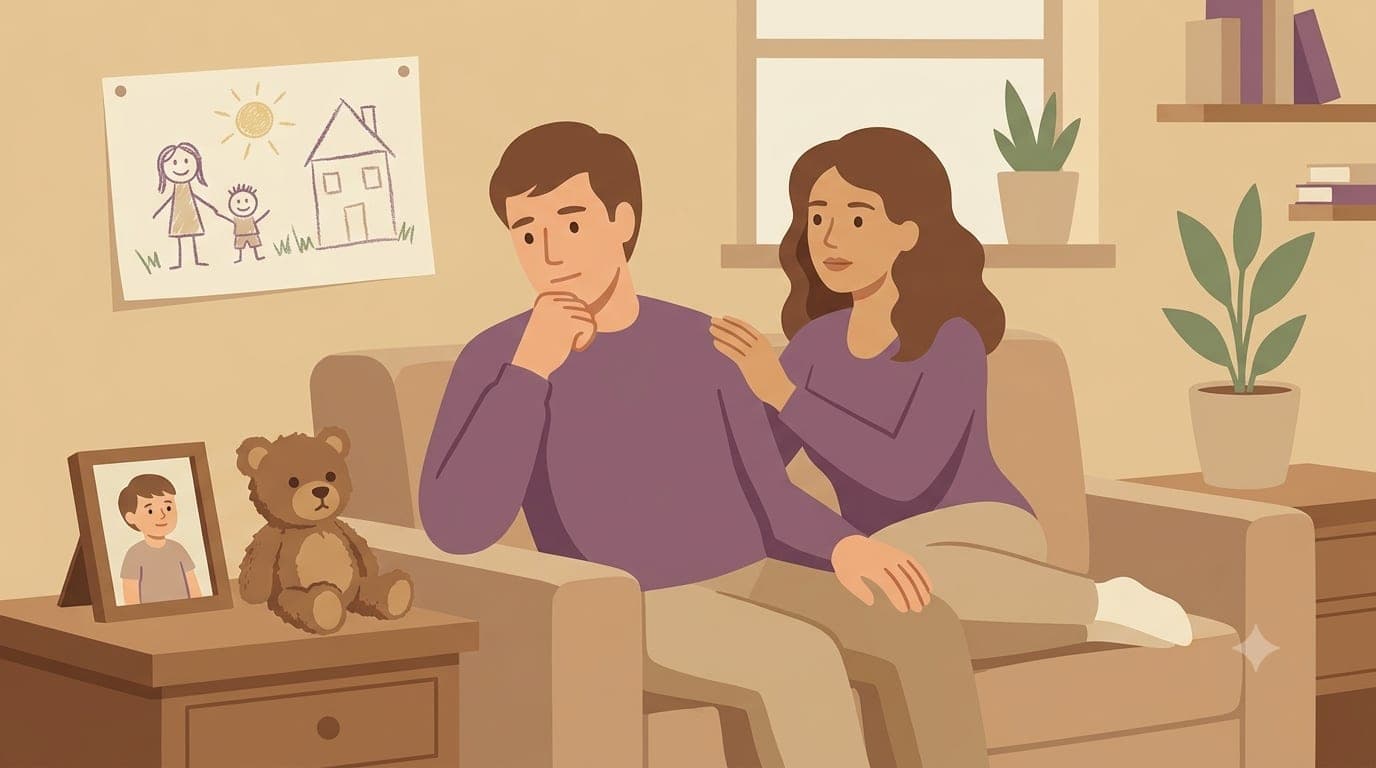
The intensity of your response has nothing to do with the dishwasher. It has everything to do with a six-year-old who learned that criticism meant something was fundamentally wrong with them.
Most adults carry patterns from childhood into their romantic relationships without recognizing the connection. It's not that we don't know our childhoods affected us. It's that the specific mechanisms, the precise ways that early experiences shape adult behavior, are often invisible without deliberate examination.
What are internal working models?
John Bowlby, the British psychiatrist who developed attachment theory in the 1950s and 1960s, introduced the concept of internal working models in 1969. These are mental representations, unconscious templates, that form based on your earliest relationship experiences.
As an infant and young child, you learned basic lessons about how relationships work. Are other people reliable? If I express a need, will it be met? Is it safe to be vulnerable? Do I have to perform to receive love? Are emotions acceptable or dangerous?
These lessons weren't taught through words. They were absorbed through thousands of micro-interactions: how quickly your crying was responded to, whether your emotions were validated or dismissed, how your caregiver's face looked when you reached for them, what happened when you made a mistake.
Bowlby's central argument was that these early experiences create a kind of blueprint that persists into adulthood. The child who learned "if I cry, someone comes" develops a different relational template than the child who learned "if I cry, I'm ignored" or "if I cry, I'm punished." And these templates don't stay in childhood. They travel forward, shaping expectations, interpretations, and behaviors in adult romantic relationships.
The tricky part is that internal working models operate below conscious awareness. You don't think "my mother was emotionally unavailable, therefore I'm anxious about closeness." You just feel a lurch of panic when your partner doesn't text back for an hour. The model runs in the background like software you didn't install and can't easily see.
What did the ACE study find about childhood and adult relationships?
The Adverse Childhood Experiences (ACE) study, conducted by Vincent Felitti and Robert Anda from 1995 to 1997 in collaboration with the CDC and Kaiser Permanente, remains one of the largest investigations of the link between childhood adversity and adult outcomes. Over 17,000 participants reported on ten categories of childhood adversity: physical, emotional, and sexual abuse; physical and emotional neglect; and household dysfunction (domestic violence, substance abuse, mental illness, incarceration, parental separation).
The findings were stark. Higher ACE scores correlated with higher rates of depression, anxiety, substance abuse, and relationship difficulties in adulthood. People with four or more ACEs were significantly more likely to report relationship dissatisfaction, domestic violence, and multiple divorces. The dose-response relationship was clear: more adversity, worse outcomes, in a linear pattern.
But the ACE study also revealed something more subtle. It wasn't just the extreme experiences (abuse, violence, addiction) that created lasting effects. Emotional neglect, which many people don't even identify as adverse because "nothing happened," was one of the most impactful categories. The absence of something (responsiveness, warmth, validation) shaped adult functioning as powerfully as the presence of something harmful.
Jonice Webb, a psychologist who has written extensively about childhood emotional neglect, calls it "the invisible wound" because there's nothing to point to. No bruises, no dramatic incidents. Just a persistent experience of not being seen, not being known, and not learning that your emotional life matters to the people around you.
What patterns follow people from childhood into romance?
The connections are specific. Different childhood experiences produce different adult relationship patterns.
Parentification produces caretaking. If you grew up taking care of a parent, managing their emotions, mediating their conflicts, being the responsible one while they were absent, addicted, or depressed, you learned that love means being useful. In adult relationships, this shows up as compulsive helping. You're drawn to partners who need fixing. You feel most secure when you're needed, and most anxious when you're not. Your own needs feel foreign or unimportant. This overlaps significantly with codependent patterns, and it's not a coincidence.
Emotional neglect produces difficulty identifying needs. If no one asked how you felt as a child, you may not have developed the vocabulary or the internal permission to identify your emotional states. In relationships, this manifests as "I don't know what I need" or "I'm fine" when you clearly aren't. Your partner asks what's wrong and you genuinely can't answer, not because you're withholding, but because the signal from your emotional system is too faint to read. You learned early that your feelings weren't relevant data, so you stopped collecting the data.
Criticism produces perfectionism or people-pleasing. If love in your family was conditional on performance (grades, behavior, appearance, temperament), you internalized a transactional model of love. The adult version: you try to earn your partner's affection through perfection, and any sign that you've fallen short triggers disproportionate shame. Or you become a people-pleaser, constantly scanning your partner's reactions and adjusting your behavior to avoid disapproval.
Unpredictable caregiving produces hypervigilance. If your parent's behavior was inconsistent, warm one moment, explosive the next, you developed a finely tuned threat-detection system. You learned to read facial micro-expressions, tone shifts, and body language with remarkable accuracy, because that skill was survival-relevant. In adult relationships, this becomes hypervigilance: you're constantly monitoring your partner's mood, interpreting neutral expressions as negative, and bracing for the other shoe to drop. Your nervous system is set to "scan" all the time.
Enmeshment produces boundary confusion. If a parent treated you as an extension of themselves, living through your accomplishments, confiding adult problems in you, making you responsible for their emotional wellbeing, you may struggle with boundaries in romance. You don't know where you end and your partner begins. Their problems become yours. Their emotions feel like yours. Separateness triggers guilt.
What is repetition compulsion, and why do we recreate painful dynamics?
Freud observed this pattern over a century ago, but contemporary trauma research has given it a neurobiological basis. Bessel van der Kolk, in his 2014 book The Body Keeps the Score, describes how traumatic or formative early experiences create neural pathways that the brain defaults to in times of stress.
The result: people often unconsciously recreate the dynamics of their childhood in adult relationships. Not because they enjoy pain, but because the nervous system gravitates toward the familiar. Familiar feels safe, even when it isn't.
A person who grew up with a critical parent may be drawn to critical partners. A person who grew up with an emotionally unavailable parent may consistently choose partners who are distant or withholding. The conscious mind says "I want something different." The unconscious relational template says "this feels like home."
Van der Kolk's work, and the work of other trauma researchers like Peter Levine and Pat Ogden, emphasizes that these patterns aren't stored as conscious memories. They're stored in the body, in muscle tension patterns, in autonomic nervous system calibration, in the way you breathe and hold yourself. This is why talk therapy alone sometimes isn't enough. The body has its own memory, and it needs to be addressed on its own terms.
The repetition isn't always obvious. Sometimes it's not the same type of partner but the same type of dynamic. You might date someone who seems completely different from your parent but discover that six months in, you're playing the same role you played at age eight: the caretaker, the peacekeeper, the one who makes themselves small.
Can you actually change your attachment style?
Yes. This is one of the most important findings in attachment research, and it doesn't get enough attention.
The concept is called earned secure attachment. Research by Mary Main and others using the Adult Attachment Interview (AAI) found that some adults who had difficult childhoods, with insecure early attachment and adverse experiences, had developed a secure attachment style by adulthood. Their childhood histories would have predicted insecurity, but their current relational patterns were securely attached.
What distinguished the earned-secure individuals wasn't that they'd had a perfect life. It was that they'd processed their experiences. They could tell a coherent story about their childhood, acknowledging the pain without being overwhelmed by it, understanding their parents' limitations without excusing or minimizing them. They'd integrated the experience rather than being run by it.
This processing can happen through multiple pathways. Therapy is the most studied one, particularly therapies that directly address attachment: Emotionally Focused Therapy (EFT), Internal Family Systems (IFS), psychodynamic therapy, and EMDR for trauma processing. But it also happens through relationships. A consistently responsive partner, a close friendship, a mentor: any relationship that provides the safety and attunement that was missing in childhood can gradually update the internal working model.
The research is clear that attachment style is not fixed at birth or cemented in childhood. It's more like a default setting that can be changed through sustained, corrective relational experiences. The default is stubborn (it took years to form and it doesn't change overnight) but it's changeable.
How do you start working with childhood patterns in your relationship?
Name the pattern, not just the feeling. "I'm angry" is surface-level. "I'm angry because criticism triggers a shame response that started when I was seven" is the beginning of change. You don't need to narrate your entire history to your partner, but being able to say "this is an old reaction, it's bigger than this moment" is a profound act of self-awareness.
Differentiate past from present. When you have a disproportionate reaction, that's a signal. The intensity is coming from somewhere older than this conversation. Pausing to ask "is this about right now or about then?" doesn't mean dismissing your current feelings. It means understanding them accurately enough to respond rather than react.
Tell your partner what you need, not what they did wrong. Childhood wounds often surface as accusations: "you never listen to me" (translation: I learned early that my voice doesn't matter and your behavior just confirmed that belief). Reframing as a need, like "I need to feel heard right now, can you reflect back what I said?", gives your partner something actionable rather than something to defend against.
Be curious about your partner's patterns too. They have their own childhood templates running in the background. When they shut down during conflict, they might not be stonewalling you. They might be a ten-year-old in a house where expressing emotions meant getting screamed at. Curiosity about what's underneath the behavior transforms conflict from adversarial to collaborative.
Build corrective experiences. Every time you express a need and it's met with warmth, the internal working model updates a little. Every time you're vulnerable and your partner responds with care rather than judgment, the old template loses a little power. This is the mechanism of earned secure attachment in real time. It happens through accumulated micro-moments, not through a single breakthrough conversation.
Aperi's daily questions are designed to create these moments: repeated, low-stakes opportunities for vulnerability and response. Each day's question is a tiny experiment. Can I share something honest, and will it be received? Over weeks and months, these experiments accumulate into evidence that contradicts the old template.
When should you work with a therapist?
Self-awareness and a good partner can do a lot. But some childhood patterns are deeply enough wired that they need professional support to change. A few indicators:
You recognize the pattern but can't stop it. You see yourself reacting from the old place, you know it's disproportionate, and you do it anyway. The gap between insight and behavior change is where therapy works.
Your reactions are affecting your relationship in ways your partner can't absorb. If your childhood patterns are causing repeated harm (explosive anger, prolonged withdrawal, inability to trust despite consistent evidence of trustworthiness), a therapist can help you work with the patterns at their root rather than managing them at the surface.
You can't tell a coherent story about your childhood. If early memories are fragmented, blank, or overwhelmingly emotional, that's a sign of unprocessed material. The AAI research shows that narrative coherence, the ability to talk about your past without being flooded or avoidant, is one of the strongest predictors of earned security.
You want to break the cycle for your own kids (current or future). Intergenerational pattern interruption is one of the most powerful reasons to do this work, and it's hard to do alone.
FAQ
Does everyone with a difficult childhood have relationship problems?
No. The ACE study found a correlation, not a deterministic relationship. Many people with difficult childhoods form healthy, secure adult relationships. Protective factors matter: a single responsive caregiver (even if it wasn't a parent), a stable friendship, a mentor, later therapeutic experiences. The research on resilience shows that what matters most isn't the absence of adversity but the presence of at least one relationship where you felt consistently safe and seen. That one relationship can be enough to form a secure template.
Can I work on childhood patterns without my partner knowing?
You can, and individual therapy is often where this work starts. But at some point, bringing your partner into the picture, even in general terms, usually helps. "I'm realizing that my reaction to criticism has roots in my childhood, and I'm working on it" gives your partner context they need. It doesn't require detailed disclosure. It does require enough transparency that your partner can understand disproportionate reactions as historical rather than personal.
Is it fair to blame my childhood for my behavior in relationships?
Understanding is different from excusing. Your childhood explains why you default to certain patterns. It doesn't exempt you from responsibility for the impact those patterns have on your partner. Both things are true simultaneously: you developed these patterns because they were survival strategies in an environment you didn't choose, and you're the only person who can change them now. The most productive stance is compassion for where the patterns came from paired with accountability for where they show up.
How do I know if something was "bad enough" to affect me?
People with childhood emotional neglect ask this question constantly, because there's nothing dramatic to point to. The answer: if it's affecting your relationships now, it was significant enough. You don't need to meet some threshold of suffering for your experiences to have shaped you. A child who was consistently dismissed doesn't have bruises to show, but they carry the internal working model of "my feelings don't matter" just as surely as someone with more visible wounds. Stop measuring the input and look at the output.
Aperi gives couples a daily shared question that gradually increases in depth as trust builds. If you're working on understanding each other's attachment patterns or building the emotional safety that makes old wounds less reactive, a small daily practice of honest conversation creates the corrective experiences that actually change relational templates over time.
Aperi: one question a day
A daily question app that adapts to you and your partner, and goes deeper the more you use it.


Free to start. Available on iPhone and Android.
Explore question packs
Related articles
How your attachment style shapes every conversation with your partner
How your attachment style shapes every conversation with your partner, and what to do about it. Covers secure, anxious, and avoidant.
Why personal growth sometimes threatens your relationship
When one partner grows, the relationship system gets disrupted. Why that happens and how to handle it.
The difference between needing and wanting your partner
Is it better to need or want your partner? The real answer is more complicated than Instagram quotes suggest.
Building self-worth that doesn't depend on your partner
When your self-worth depends on your partner's approval, every interaction becomes high-stakes. Here's how to build an internal foundation.
When you project your insecurities onto your partner
Projection makes you fight about things that aren't real. How to catch it, understand where it comes from, and stop.
Why boredom in your relationship isn't always bad
Relationship boredom gets a bad reputation. Sometimes it signals safety. Sometimes it signals stagnation. Here is how to tell the difference.