Key Takeaways
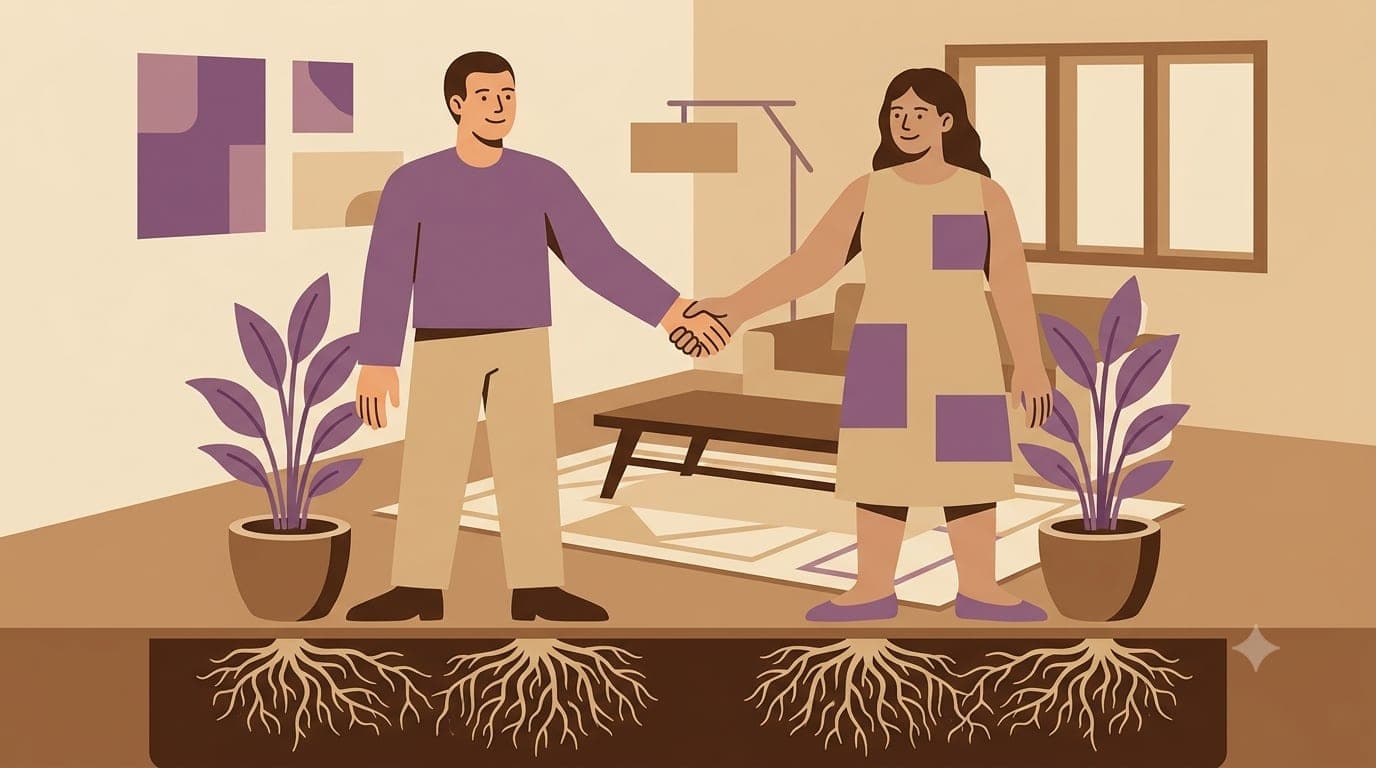
Codependency is when your sense of self depends on your partner's state. Interdependence is when two whole people choose to rely on each other while maintaining their own identity. The difference isn't how much you care, it's whether you still exist as a separate person when you do.
There's a version of closeness that looks like love but functions like a trap.
Two people who finish each other's sentences, who know what the other is thinking, who can't imagine life apart. From the outside, it reads as devotion. From the inside, it sometimes feels like drowning. One person's bad mood becomes the other's emergency. One person's needs consistently disappear beneath the other's. The boundaries between "you" and "me" have dissolved so completely that neither person can locate themselves without reference to the other.
This isn't intimacy. It's codependency. And the difference between codependency and genuine interdependence matters more than almost any other distinction in relationship health.
Where did the concept of codependency come from?
The term originated in addiction treatment circles in the 1970s and 1980s. Clinicians working with alcoholics noticed that the partners and family members of addicts developed their own dysfunctional patterns: enabling behaviors, obsessive monitoring, emotional volatility that tracked the addict's behavior cycle. The partner's entire emotional life became organized around the addict's substance use.
Melody Beattie's 1986 book Codependent No More brought the concept to a mainstream audience. Beattie described codependency as a pattern of painful dependency on compulsive behaviors and on approval from others to find safety, self-worth, and identity. The book sold millions of copies because the pattern Beattie described resonated far beyond addiction contexts.
Since then, the concept has expanded. You don't need an addicted partner to develop codependent patterns. Any relationship dynamic where one person chronically sacrifices their own needs, identity, or boundaries in service of the other person's emotional state can qualify. The common thread is that one or both partners have lost the ability to function as separate selves within the relationship.
It's worth noting that "codependency" isn't a formal diagnosis in the DSM-5. It's a clinical and popular concept rather than a psychiatric one. Some researchers have proposed it as a personality disorder, others see it as a relational pattern. But the behaviors it describes are real and measurable.
What does codependency actually look like?
It's subtler than most people think. Codependency doesn't always look like a doormat and a tyrant. Often it looks like two people who genuinely love each other but have confused enmeshment with closeness.
Self-abandonment. You consistently set aside your own feelings, preferences, and needs to accommodate your partner. Not as a generous choice in the moment, but as a default operating mode. You're not sure what you want for dinner because you automatically think about what they want. You don't voice disagreement because their comfort matters more to you than your own honesty.
Caretaking as identity. Your sense of purpose and worth comes from being needed. When your partner is struggling, you feel important. When they're fine and don't need you, you feel anxious or purposeless. The relationship role of "the one who fixes things" or "the one who holds it all together" has become so central that you don't know who you are without it.
Boundary collapse. You feel responsible for your partner's emotions. If they're sad, you need to fix it. If they're angry, it must be your fault. Their mood becomes your mood. You can't tolerate them being upset without trying to intervene, not because it's helpful but because their distress is physically unbearable to you.
Control disguised as care. You monitor, manage, and direct your partner's choices (what they eat, who they see, how they spend their time) framing it as concern. "I'm just worried about you" becomes a mechanism for managing your own anxiety by controlling their behavior.
Difficulty with separation. Time apart feels threatening rather than healthy. Your partner going out with friends, having interests you don't share, or simply wanting alone time triggers anxiety or abandonment fears. Maintaining your own identity feels like disloyalty.
What is interdependence, and how is it different?
Harold Kelley and John Thibaut developed interdependence theory in the 1950s and 1960s as a framework for understanding how people in relationships influence each other's outcomes. Their core insight: healthy relationships involve mutual influence. Partners shape each other's experiences, decisions, and emotions. That's not pathological. It's the nature of close bonds.
Interdependence means two people who are connected, who rely on each other, and who are affected by each other's choices, but who also maintain a clear sense of self. The "inter" prefix matters: it implies a connection between two distinct entities. If the entities have merged into one, that's not inter-dependence. That's fusion.
The functional difference shows up in how you answer a simple question: "Who am I when my partner isn't around?"
In interdependence, you have an answer. You have your own interests, friendships, opinions, and emotional life. Your partner enriches your world, but they don't constitute it. You miss them when they're gone, but you don't fall apart.
In codependency, the question is disorienting. You're not sure who you are without them. Your identity is so intertwined with the relationship that separateness feels like loss.
Is there a spectrum between independence and codependence?
Yes, and interdependence sits in the middle. Think of it as a continuum:
Counter-dependence / hyper-independence: "I don't need anyone." This is the avoidant end. Relationships are kept at arm's length. Vulnerability is avoided. Self-sufficiency is a point of pride, but it's often a defense against the fear of depending on someone and being let down. It looks like strength but functions as isolation.
Interdependence: "I'm whole on my own, and I choose to share my life with you." Two separate selves who voluntarily intertwine. Each person can set boundaries, voice needs, disagree, and spend time apart without the relationship feeling threatened. Closeness and autonomy coexist.
Codependence: "I can't function without you, and I've lost track of where I end and you begin." Enmeshment. The relationship has become the primary (sometimes only) source of identity, worth, and emotional regulation. Separateness triggers anxiety. Conflict feels existential.
Most people aren't fixed at one point. You might be interdependent in some areas of your relationship and codependent in others. Stress, major life changes, and unresolved attachment wounds can push you along the spectrum temporarily or permanently.
What does differentiation of self have to do with this?
Murray Bowen, the psychiatrist who developed Bowen Family Systems Theory in the 1960s and 1970s, introduced the concept of differentiation of self as a key variable in relational health. Differentiation refers to your ability to maintain your own thoughts, feelings, and identity while remaining emotionally connected to others.
A well-differentiated person can be in a close relationship without losing themselves. They can tolerate their partner's distress without immediately absorbing it or trying to fix it. They can hold an unpopular opinion without crumbling under their partner's disapproval. They can say "I love you and I disagree with you" without experiencing that as a contradiction.
A poorly differentiated person has a harder time separating their emotional experience from their partner's. When their partner is anxious, they become anxious. When their partner disapproves, they fold. Their sense of self is reactive, constantly adjusting based on the relational environment.
Bowen argued that differentiation is largely shaped by family of origin experiences. If you grew up in a family where emotional boundaries were clear and each person was allowed to have their own experience, you likely developed reasonable differentiation. If you grew up in a family where one person's emotions dominated the household, where you learned to monitor and manage a parent's mood to keep the peace, your differentiation may be lower.
This maps directly onto the codependency pattern. Codependent behaviors are, in many cases, the coping strategies of someone who grew up in a low-differentiation family system and carried those strategies into adult romance.
How do you know if you've crossed from close to codependent?
Closeness and codependency share surface features. In both, you care deeply about your partner. You think about them often. You want to help when they're struggling. You're affected by their mood. The difference isn't in the intensity of connection. It's in whether you still have a self that exists independently of the relationship.
Some diagnostic questions:
Do you know what you want? Not what your partner wants, not what would make them happy, not what would avoid conflict. What do you actually want? Codependent patterns erode access to your own desires because those desires have been subordinated for so long that you've lost the signal.
Can you tolerate your partner being unhappy without trying to fix it? In interdependence, you can witness your partner's pain with compassion without making it your project. In codependency, their unhappiness is intolerable because it feels like your failure or because their distress destabilizes your own emotional state.
What happens when you say no? In interdependence, a "no" is a boundary, and both people understand that. In codependency, saying no triggers guilt, anxiety, or fear of abandonment. You might avoid it entirely, or you might say no and then immediately backtrack.
Do you have relationships and interests outside this one? Codependency tends to narrow your world. Friendships fade, hobbies shrink, your social orbit contracts until the partner becomes your entire relational universe. Interdependence allows for a rich life beyond the relationship.
Does your partner's mood determine your day? If your partner wakes up grumpy and your entire morning is derailed, that's data. In interdependence, you notice their mood, maybe check in, and continue with your day. In codependency, you absorb it, react to it, and organize your behavior around it.
How do you shift from codependency toward interdependence?
The shift isn't quick, and it's often uncomfortable. Codependent patterns usually developed for good reasons. They were survival strategies in early environments where monitoring and managing someone else's emotional state was genuinely necessary. Letting go of them feels dangerous because, at one point, they were the thing keeping you safe.
Start with self-awareness. Track your patterns for a week. When you make a decision, notice whether you checked with yourself or with your partner's likely reaction first. When conflict arises, notice whether you automatically capitulate. When your partner is upset, notice whether you can sit with that discomfort without intervening.
Practice small acts of separateness. Have an opinion your partner doesn't share and hold it. Spend an evening doing something that's only for you. Make a decision without consulting them first. These feel trivial but they're exercises in differentiation. Each one strengthens the muscle of independent selfhood.
Tolerate the guilt. This is the hard part. When you start setting boundaries or prioritizing your own needs, the codependent part of you will generate guilt. That guilt isn't evidence that you're doing something wrong. It's the emotional residue of the old system resisting change.
Rebuild your identity outside the relationship. Maintaining your own identity isn't selfish. It's a prerequisite for healthy partnership. Reconnect with friends. Restart hobbies. Pursue something that has nothing to do with your partner.
Work on your own emotional regulation. If you can't tolerate your own distress, you'll keep trying to manage your partner's. Practices that build distress tolerance (mindfulness, therapy, even physical exercise) make it possible to stay present with uncomfortable emotions without acting on them compulsively.
Consider therapy. Codependent patterns are often rooted in family of origin dynamics that are hard to see clearly from the inside. A therapist trained in Bowen Family Systems, Internal Family Systems (IFS), or attachment-based approaches can help you understand where the patterns originated and build new ones.
Can a couple work on this together?
Absolutely. The shift from codependence to interdependence works best when both partners understand what's happening and why. A few practices that help:
Name the pattern without blame. "I notice I tend to lose track of what I want when you're upset" is different from "you make me lose myself." Codependency is a system, not one person's fault.
Check in regularly about needs and wants. Daily questions, even simple ones, create a practice of self-reflection that counteracts the codependent tendency to skip over your own experience. Aperi's daily question model works here because it asks each person to reflect independently before sharing, which builds the habit of knowing your own answer before you hear your partner's.
Support each other's separateness. Encourage your partner's friendships and interests. Celebrate their independence rather than experiencing it as rejection. This can feel counterintuitive when closeness has been defined by togetherness, but the paradox is real: two people who have their own lives bring more to the relationship than two people who have only each other.
FAQ
Is codependency the same as being a caring partner?
No. Caring about your partner is healthy. Organizing your entire identity around their needs is not. The difference is sustainability and reciprocity. A caring partner helps when needed, speaks up when something's wrong, and maintains their own life alongside the relationship. A codependent partner helps compulsively, can't tolerate being unhelpful, and has difficulty locating their own needs beneath the constant focus on the other person. If "caring" always comes at the expense of your own wellbeing, that's codependency wearing the costume of love.
Can both partners be codependent?
Yes, and it's common. Mutual codependency creates a system where both people have outsourced their sense of self to the relationship. This can feel intensely close and even euphoric at first: two people who are completely focused on each other, who need nothing else. Over time, it tends to become suffocating, because neither person has the independent selfhood required to sustain a healthy dynamic. Any threat to the relationship (a separate friendship, a disagreement, time apart) feels existential to both people.
Is codependency related to attachment style?
Strongly. Anxious attachment and codependency overlap significantly. Both involve hypervigilance about the relationship, difficulty tolerating separation, and a tendency to prioritize the partner's needs over one's own. Some researchers argue that codependency is essentially anxious attachment expressed as a behavioral pattern. Avoidant attachment can also play a role: avoidant partners often pair with codependent ones, creating a pursuer-withdrawer dynamic where the codependent partner's chasing reinforces the avoidant partner's distance.
How long does it take to move from codependency to interdependence?
There's no fixed timeline. If the patterns are mild and both partners are motivated, meaningful shifts can happen within months of intentional work. If the patterns are deeply rooted in childhood experiences and reinforced over years, the process takes longer and usually benefits from professional support. The key marker isn't time but behavioral change: are you making decisions based on your own values rather than your partner's anticipated reaction? Can you tolerate disagreement without panic? Do you have a life outside the relationship? These are the milestones that matter.
Aperi's daily questions ask each partner to reflect on their own answer before seeing what the other person said, a small practice that builds the self-awareness and independent thinking at the core of interdependence. If you're working on maintaining your identity while staying connected, a daily habit of honest self-reflection is a good place to start.
Aperi: one question a day
A daily question app that adapts to you and your partner, and goes deeper the more you use it.


Free to start. Available on iPhone and Android.
Explore question packs
Related articles
Why personal growth sometimes threatens your relationship
When one partner grows, the relationship system gets disrupted. Why that happens and how to handle it.
The difference between needing and wanting your partner
Is it better to need or want your partner? The real answer is more complicated than Instagram quotes suggest.
Building self-worth that doesn't depend on your partner
When your self-worth depends on your partner's approval, every interaction becomes high-stakes. Here's how to build an internal foundation.
When you project your insecurities onto your partner
Projection makes you fight about things that aren't real. How to catch it, understand where it comes from, and stop.
Why boredom in your relationship isn't always bad
Relationship boredom gets a bad reputation. Sometimes it signals safety. Sometimes it signals stagnation. Here is how to tell the difference.
When you and your partner speak different love languages
You show love your way, not theirs. How to close the gap when you and your partner express affection differently, beyond the quiz.