Key Takeaways
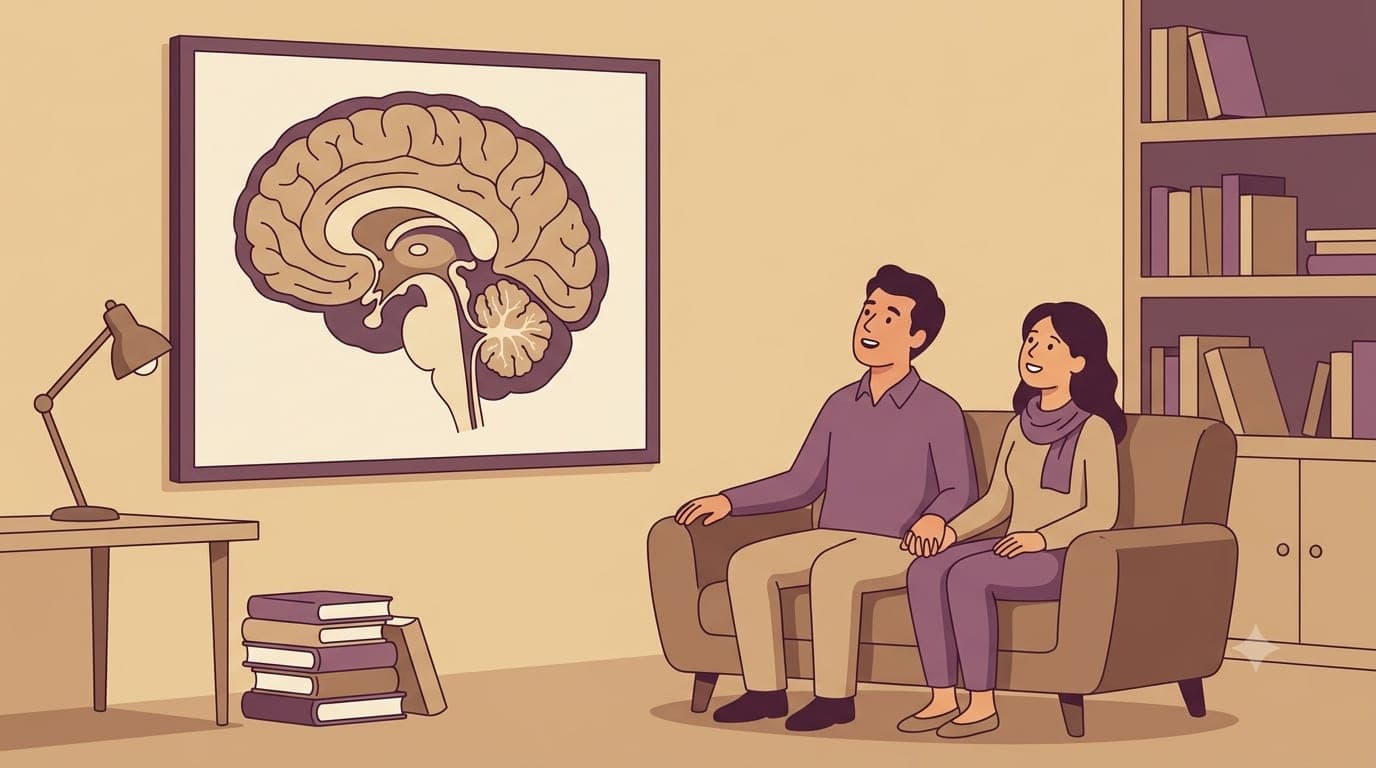
Early love is a dopamine storm centered in the brain's reward circuitry, neurochemically similar to addiction. Long-term love shifts toward oxytocin and vasopressin systems. Heartbreak activates literal pain circuits. But couples who maintain passion show both systems active simultaneously, proving that love doesn't have to fade.
Being in love feels like something is happening to you. Not in your mind as a concept or in your heart as a metaphor, but in your actual body. You can't sleep. You can't eat. You replay conversations. You check your phone compulsively. Your chest does something when they text.
Poets have described this for millennia. But in the last two decades, neuroscientists have put people who are wildly in love inside fMRI machines and watched what happens. What they've found is that the subjective experience of love, that consuming, irrational, everything-else-fades thing, has a precise neurobiological signature. And understanding it changes how you think about everything from jealousy to long-term commitment to why breakups hurt so much.
What does an fMRI show when someone is in love?
The foundational study here is Helen Fisher's. Fisher, a biological anthropologist at Rutgers University, put 17 people who reported being "intensely in love" into an fMRI scanner in a 2005 study. While inside the machine, participants looked at a photograph of their beloved alternating with a neutral photograph.
When viewing their partner's photo, two brain regions lit up consistently: the ventral tegmental area (VTA) and the caudate nucleus. Both are deep-brain structures, part of what neuroscientists call the reward system. The VTA is a factory for dopamine, and the caudate nucleus is a major target for dopamine signaling.
What Fisher didn't find was just as telling. Early romantic love didn't primarily activate the brain's emotion centers. It activated the motivation and reward circuits, the same areas that respond to food when you're starving, water when you're dehydrated, and cocaine when you're addicted. Love, at the neural level, isn't an emotion. It's a drive. It belongs in the same category as hunger and thirst, not in the same category as sadness or joy.
This distinction matters. Drives are relentless. They focus attention, distort perception, generate obsessive thinking. That's why early love feels so consuming: your brain is treating your partner as a survival-relevant reward and directing your behavior accordingly.
Why does early love feel like addiction?
Because it is, pharmacologically speaking. The dopamine system that activates during early romantic love is the same system implicated in substance addiction. The parallels are specific: focused attention on the reward, euphoria in its presence, craving in its absence, tolerance (needing more contact to achieve the same high), withdrawal symptoms when separated.
Fisher noted that rejected lovers show brain activation patterns almost identical to people going through drug withdrawal. The VTA doesn't stop producing dopamine just because the relationship ended. It keeps signaling, generating the craving and preoccupation that make heartbreak feel physically unbearable.
Donatella Marazziti, a psychiatrist at the University of Pisa, found another parallel in a 1999 study: people in the early stages of romantic love had serotonin transporter levels comparable to people with obsessive-compulsive disorder. The obsessive thinking, the inability to get someone out of your head, has a serotonin-based mechanism. Low serotonin transporter availability means serotonin hangs around in the synapses longer, which is associated with repetitive, intrusive thoughts.
So when you can't stop thinking about someone new, it's not a character flaw or a sign that they're "the one." It's your serotonin system behaving like an OCD patient's. It passes. Usually within 12-18 months.
What changes when love becomes long-term?
The dopamine storm of early love is metabolically expensive. The brain can't sustain it. Somewhere between one and three years, the neurochemistry shifts. Dopamine activity in the reward circuits settles down. Serotonin returns to normal levels. The obsessive quality fades.
What replaces it is a different chemical system: oxytocin and vasopressin. These neuropeptides are associated with bonding, trust, and attachment rather than reward and craving.
Oxytocin is released during physical touch, sex, breastfeeding, and even sustained eye contact. It promotes feelings of calm, safety, and connection. Vasopressin, which is closely related structurally, plays a stronger role in long-term pair bonding and mate guarding. Together, they're the neurochemical foundation of what researchers call companionate love, less intoxicating than early love but deeper and more stable.
This transition is normal and biological. But it creates a problem: many couples interpret the loss of the dopamine rush as "falling out of love." They miss the intensity, the butterflies, the obsessive focus. They worry something is wrong. But what's actually happening is that their brains are shifting from a drive state to a bonding state, which is exactly what's supposed to happen for the relationship to become sustainable.
What do prairie voles have to do with human love?
Quite a lot, actually. Prairie voles are one of the few mammalian species that form lifelong pair bonds. After mating, a male and female prairie vole will share a nest, co-parent, and show a strong preference for each other over other potential mates for the rest of their lives.
Thomas Insel and Larry Young at Emory University spent decades studying why. The answer centers on vasopressin receptors. Prairie voles have a specific distribution of vasopressin V1a receptors in the ventral pallidum, a brain region involved in reward processing. Their close relatives, montane voles, which are promiscuous and don't pair bond, have the same hormone but different receptor distributions.
Young's lab conducted a remarkable experiment in 2004: they inserted the prairie vole vasopressin receptor gene into montane voles. The previously promiscuous montane voles began forming partner preferences. A single gene governing receptor distribution changed their entire social behavior from promiscuous to bonded.
The implication for humans is suggestive rather than direct, since human pair bonding is far more complex. But the underlying principle holds: bonding behavior is biological, driven by specific neurochemical systems, and varies across individuals based on receptor distribution. Some people's neurochemistry makes long-term attachment easier. Others have to work harder at it. Neither is a moral category.
Does heartbreak actually cause physical pain?
Ethan Kross at the University of Michigan published a study in 2011 that answered this question directly. Participants who had recently been through an unwanted breakup were placed in an fMRI scanner and asked to look at a photograph of their ex while thinking about the rejection. In a separate condition, they received a mildly painful heat stimulus on their forearm.
The results: social rejection and physical pain activated overlapping brain regions, specifically the secondary somatosensory cortex and the dorsal posterior insula. These are areas involved in the sensory processing of physical pain, not just the emotional response to it.
This was significant because previous studies had shown that rejection activates emotional pain circuits (the anterior cingulate cortex and anterior insula), which was already noteworthy. Kross's finding went further: heartbreak activates circuits involved in the felt sensation of pain. The experience of emotional rejection isn't just metaphorically painful. The brain processes it using some of the same hardware it uses for a burn or a broken bone.
This explains why heartbreak is so physically consuming. The chest tightness, the stomach pain, the feeling of being hit: these aren't imagined. The nervous system is generating genuine pain signals. It also explains why over-the-counter painkillers (specifically acetaminophen) have been shown in some studies to reduce the sting of social rejection. The pain pathways overlap.
Can long-term couples still have the "in love" brain?
This was the question Bianca Acevedo and Arthur Aron set out to answer in their 2011 study. They scanned the brains of people who reported being in love with their long-term partner (average relationship length: 21 years) and compared the results to Fisher's data on people in early-stage love.
The results were surprising. Long-term lovers showed significant activation in the VTA, the same dopamine-producing region that lights up during early love. They still had the reward-system engagement. But they also showed something the early-love group didn't: activation in regions associated with attachment and calm, without the anxiety-related activation typical of new love.
In other words, it's possible to have both systems running simultaneously: the excitement of dopamine-driven love and the security of oxytocin-driven bonding. The couples who showed this pattern weren't extraordinary. They were ordinary people who had maintained active engagement with their partners over decades.
Aron's earlier research on self-expansion theory offers a clue about how this works. He proposed that romantic love persists when partners continue to be a source of novelty and growth for each other. Couples who do new things together, share new experiences, and continue learning about each other maintain dopamine-circuit engagement. Couples who settle into rigid routines lose it.
This aligns with Gottman's observational research: couples who stay passionate over decades aren't the ones who found a perfect match and coasted. They're the ones who kept being curious about each other, kept turning toward each other's bids, kept treating the relationship as something with undiscovered territory.
What does this mean for your relationship?
The neuroscience of love isn't just interesting trivia. It has direct implications for how you approach your partnership.
The dopamine fade is normal. If the butterflies have gone, you haven't failed. Your brain chemistry shifted from acquisition mode to bonding mode. The question is whether you're building something in the bonding phase, not whether you can recreate the acquisition phase.
Novelty is neurochemically important. The dopamine system responds to novelty and surprise. Asking your partner questions you've never asked activates the same reward circuitry as a new experience together. You don't need skydiving. You need the unexpected, and a question that reveals something you didn't know about your partner of fifteen years qualifies.
Physical touch matters at the chemical level. Oxytocin release requires physical contact (or sustained, warm social interaction). Couples who stop touching, who sit on opposite ends of the couch, who no longer hug hello, who only touch during sex, are depriving themselves of the primary bonding chemical. Non-sexual touch is a neurochemical maintenance practice.
Heartbreak needs to be taken seriously. If someone you care about is going through a breakup, "just get over it" is as helpful as telling someone with a broken arm to just stop hurting. The pain circuits are activated. Recovery takes time, social connection, and often physical activity (which helps modulate the dopamine and endorphin systems).
Your attachment style interacts with all of this. People with anxious attachment tend to have more reactive dopamine systems, riding higher highs and lower lows. People with avoidant attachment may have differences in oxytocin receptor sensitivity that make bonding experiences less reinforcing. Understanding your neurochemistry doesn't excuse behavior, but it does explain why certain relationship stages are harder for some people than others.
FAQ
Is love really just chemicals?
The neurochemistry is real, but "just chemicals" misses the point. Consciousness is "just" neurons firing, and music is "just" air vibrations, but those reductions don't capture the experience. The neuroscience of love explains the mechanisms, not the meaning. Knowing that oxytocin mediates bonding doesn't make a hug less meaningful any more than knowing how photons work makes a sunset less beautiful. The science and the experience coexist.
Can you hack your brain chemistry to fall in love?
Sort of, but probably not in the way you'd want. Arthur Aron's 36 Questions study showed that structured mutual vulnerability can accelerate closeness, and the neurochemistry backs this up: self-disclosure triggers dopamine release, and sustained eye contact boosts oxytocin. But these effects create the conditions for love, not love itself. You can put two people through the protocol and create a strong sense of connection without guaranteeing romantic love. The brain is primed by the chemistry, but the full experience requires something more that neuroscience hasn't fully captured yet.
Why do some people fall in love faster than others?
Individual differences in dopamine receptor density, serotonin transporter efficiency, and oxytocin receptor distribution all play a role. People with certain variants of the DRD4 dopamine receptor gene tend to be more sensation-seeking and may experience the early rush of love more intensely. People with higher baseline anxiety (often linked to serotonin system variations) may fixate more quickly. There's also a learned component: your attachment history shapes how quickly you allow yourself to bond, and whether the neurochemical cascade of early love feels exhilarating or terrifying.
Does the neuroscience apply differently to LGBTQ+ relationships?
The core neurochemistry of love (dopamine reward, oxytocin bonding, pain circuits in heartbreak) appears to be universal across gender and sexual orientation. Fisher's later work included participants across the spectrum and found the same VTA and caudate nucleus activation regardless of who they were in love with. Some research suggests testosterone and vasopressin play different roles in male versus female bonding patterns, but these are variations on the same systems rather than fundamentally different mechanisms.
Aperi gives couples a daily question designed to keep the discovery going, because the brain's reward system stays engaged when your partner can still surprise you. Whether you're in the dopamine rush of early love or the oxytocin depth of a long-term relationship, one honest conversation a day keeps the neural circuits of connection firing.
Aperi: one question a day
A daily question app that adapts to you and your partner, and goes deeper the more you use it.


Free to start. Available on iPhone and Android.
Explore question packs
Related articles

What attachment theory gets wrong
A balanced look at attachment theory: where the pop psychology version misleads, what the science actually supports, and how to use it without being defined by it.

Why most relationship advice is wrong
Much of what we believe about relationships is based on intuition, not evidence. Here's what longitudinal research actually shows.
Oxytocin, dopamine, and the chemistry of long-term love
The neurochemical shift from early passion to long-term bonding, and why some couples keep the spark while most lose it.
Polyvagal theory and your relationship: why your nervous system matters
How Polyvagal Theory explains your reactions during conflict, and why co-regulation with your partner changes everything.
How stress affects your relationship
How external stress spills into your relationship, what cortisol does to communication, and how dyadic coping changes the equation.
The double-blind reveal: why answering before seeing your partner's response matters
When you see your partner's answer first, you unconsciously adjust yours. Answering independently before the reveal makes conversations more honest.