Key Takeaways
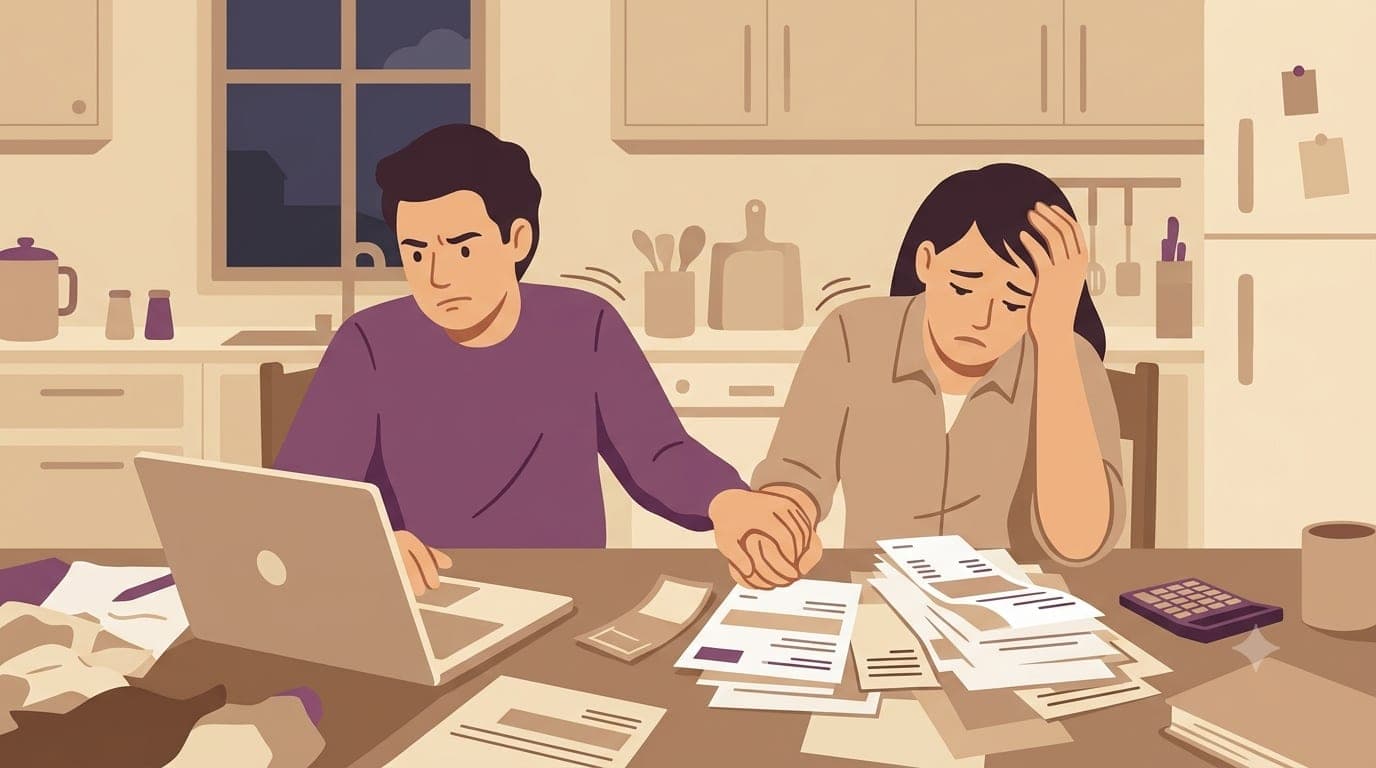
External stress doesn't stay external. It leaks into your relationship through shorter patience, worse listening, and more hostile interpretations of neutral behavior. But couples who treat stress as a shared problem rather than individual burden show significantly better outcomes.
You had a terrible day at work. Your manager gave contradictory feedback. A project deadline moved up by two weeks. You sat in traffic for an extra forty minutes. You walk through the door, and your partner says something completely benign, like "Did you remember to pick up milk?"
And you snap.
Not because the question was unreasonable. Not because your partner did anything wrong. Because your stress system was already maxed out, and that innocent question was the thing that tipped it. This pattern has a name in psychology, and it explains more about relationship conflict than most people realize.
Why does work stress follow you home?
Rena Repetti's research at UCLA, beginning with a landmark 1989 study of air traffic controllers, documented something she called "stress spillover." The idea is straightforward: stress generated in one domain of life (work, finances, health) doesn't stay contained there. It bleeds into other domains, particularly into your closest relationship.
Repetti found that on days when air traffic controllers experienced higher workload and more interpersonal conflict at work, they were significantly more withdrawn and irritable at home. Their partners hadn't done anything different. The relationship hadn't changed. But the interaction quality dropped because the stress bucket was already full.
This wasn't unique to high-pressure jobs. Subsequent research showed the same pattern across professions, income levels, and cultures. When you're stressed, you bring a worse version of yourself to your relationship. Not on purpose. Not because you don't care. Because stress literally changes how your brain processes social information.
What does cortisol actually do to your relationship?
Janice Kiecolt-Glaser and her colleagues at Ohio State have spent decades studying the physiological effects of relationship conflict. In a 2003 review with Timothy Robles, they documented the bidirectional relationship between stress hormones and relationship quality.
When cortisol is elevated, several things happen that are specifically bad for relationships:
Your threat detection system gets oversensitive. The amygdala, which processes potential threats, becomes more reactive under chronic stress. This means you're more likely to interpret your partner's neutral or slightly negative behavior as hostile. They're not attacking you. But your stressed brain reads it that way.
Your prefrontal cortex goes partially offline. The part of your brain responsible for impulse control, perspective-taking, and emotional regulation works less effectively when you're chronically stressed. This is why you say things during stressful periods that you'd never say otherwise. The brake system is compromised.
Your capacity for empathy drops. Stress is metabolically expensive. Your brain conserves resources by narrowing your focus to immediate threats and reducing the energy spent on understanding other people's perspectives. The result: you become temporarily worse at reading your partner's emotions and needs.
Your body primes for fight-or-flight, not connection. The parasympathetic nervous system (responsible for the calm, open state that makes intimacy possible) gets suppressed by chronic stress activation. You're physiologically prepared to defend yourself, not to be vulnerable with another person.
Kiecolt-Glaser's research showed something else worth noting: couples in conflictual relationships had measurably slower wound healing than satisfied couples. The stress of a bad relationship literally slowed their immune function. The relationship between stress and physiology isn't abstract. It shows up in blood work.
How does chronic stress erode a relationship over time?
A bad day creates a bad evening. That's recoverable. The real problem is chronic stress: the kind that persists for weeks, months, or years. Financial pressure, caregiving responsibilities, health problems, job insecurity. This sustained stress degrades relationship quality through several specific mechanisms.
Reduced "turning toward." John Gottman's research identified that partners constantly make small bids for attention and connection: a comment about something they saw, a touch on the shoulder, a question about your day. Gottman found that couples who eventually divorced turned toward these bids only 33% of the time, while stable couples turned toward 86% of the time. Stress reduces turning toward because you don't have the bandwidth to notice or respond to small bids when you're preoccupied with bigger threats.
Increased negative sentiment override. This is Gottman's term for the state where even positive or neutral partner behaviors get filtered through a negative lens. Under chronic stress, you develop a background assumption that your partner is being difficult or inconsiderate. Once this filter is in place, even genuine acts of kindness get dismissed or reinterpreted. "They only did that because they feel guilty."
Less investment in the relationship. Stressed people retreat. They spend less time on quality conversation, less energy on physical affection, less effort on shared activities. Not because the relationship stopped mattering, but because stress forces triage. The relationship gets deprioritized in favor of whatever's on fire.
More of the demand-withdraw pattern. One partner (usually the one who processes stress by seeking connection) pushes for conversation. The other (usually the one who processes stress by needing space) withdraws. The pursuer pushes harder. The withdrawer retreats further. This cycle, extensively documented by Andrew Christensen and colleagues at UCLA, intensifies under stress because both partners' coping strategies become more extreme.
If you've noticed this happening and aren't sure how to break through, the post on feeling disconnected from your partner covers practical approaches.
What is dyadic coping and why does it matter?
Swiss psychologist Guy Bodenmann has spent over 25 years researching how couples handle stress together. His Systemic-Transactional Model of Stress, developed through studies beginning in the early 1990s and formalized in influential 2005 publications, changed how researchers think about stress in relationships.
The core insight: stress is not an individual problem, even when it originates with one person. When one partner is stressed, the couple is stressed. The question is whether they handle it as a team or as two individuals coping separately.
Bodenmann identified three types of dyadic coping:
Positive dyadic coping. Your partner acknowledges your stress, helps you think through solutions, takes on extra household tasks so you can deal with the stressor, or simply sits with you and validates that what you're going through is hard. This requires showing up, not fixing anything.
Negative dyadic coping. Your partner dismisses your stress ("You always overreact"), provides support grudgingly ("Fine, I'll deal with dinner, but you owe me"), or offers help that's actually veiled criticism ("Maybe if you were more organized, this wouldn't happen").
Delegated dyadic coping. One partner explicitly takes over specific responsibilities ("I'll handle the kids this week so you can focus on the project deadline"). This works well when it's temporary and mutual. It breaks down when it becomes permanent and one-sided.
Bodenmann's research, replicated across Swiss, German, American, and Chinese couples, consistently shows that positive dyadic coping is one of the strongest predictors of relationship satisfaction over time. Couples who cope with stress together show higher satisfaction, lower conflict frequency, better communication, and more stable relationships over 5-year longitudinal studies.
The effect size is substantial. In some of Bodenmann's studies, dyadic coping predicted relationship quality better than individual coping skills or even the severity of the stressors themselves. How you handle stress together matters more than what you're stressed about.
Can you signal stress before it spills over?
This is one of the most practical things stressed couples can do, and it's surprisingly simple.
Gottman recommends what he calls the "stress-reducing conversation." The rules: talk about stress that's external to the relationship. Don't try to solve each other's problems unless asked. Show understanding. Take your partner's side. Express genuine solidarity. This isn't therapy. It's a 20-minute daily practice.
But there's a step before that which gets overlooked: telling your partner you're stressed before you act stressed. The difference between "I had an awful day and I'm irritable, it's not about you" and simply being irritable without explanation is enormous.
The first version gives your partner a framework. They can adjust expectations, give you space, or offer support. The second version forces them to guess what's happening, and the default guess (especially if there's any existing negative sentiment override) is usually "they're mad at me."
This is a low-effort, high-impact habit. A few practical ways to do it:
- The arrival announcement. Before you even take off your coat: "Today was a 2 out of 10. I need 15 minutes to decompress." Your partner isn't left wondering why you're being short.
- The text heads-up. On your way home: "Rough day. Going to need some quiet when I get in." This gives your partner time to adjust rather than being blindsided by your mood.
- The check-in question. Making it mutual helps. "How are you, really?" asked with actual interest, not as a perfunctory greeting, opens space for both of you to name what you're carrying. This is one reason evening rituals matter more than they seem.
Does it help to talk about the stress or just manage it?
Both, but in the right order.
Research on emotional regulation in relationships suggests that how you handle emotions together matters as much as the emotions themselves. Trying to problem-solve before the stressed partner feels heard tends to backfire. It registers as dismissal, not support.
Bodenmann's research specifically showed that emotion-focused dyadic coping (validating feelings, expressing empathy, showing solidarity) needs to come before problem-focused dyadic coping (brainstorming solutions, offering practical help). Skip the first step and the second step doesn't land.
This is hard for partners who default to fix-it mode. When someone you care about is hurting, the impulse to make it stop is strong. But "Have you tried talking to your manager about it?" when your partner just walked in the door feeling beaten down doesn't help. "That sounds genuinely awful, I'm sorry you're dealing with that" does.
The sequence: empathy first, solutions later, and only if they're requested.
When stress isn't external anymore
There's an important boundary to acknowledge. Everything above assumes the stress is external: work, money, health, family. The recommendations change when the relationship itself is the primary stressor.
If you're chronically stressed because of your partner's behavior (ongoing conflict, emotional unavailability, contempt, control), the problem isn't stress spillover. It's the relationship. Dyadic coping can't fix a fundamentally unhealthy dynamic. It's meant for good relationships under external pressure, not for managing the damage of a bad one.
Signs that the stress is relational rather than external:
- You feel relief when your partner is away
- The stress doesn't improve on vacation or during low-pressure periods
- Your partner is the person you'd normally go to for support, but going to them makes things worse
- The conflict patterns feel stuck and repetitive. If that resonates, the post on effective communication might help identify what's going wrong
In these cases, couples therapy is worth considering. A trained therapist can help determine whether the relationship stress is situational and workable or structural and potentially unfixable.
What can you actually do this week?
Knowing that stress affects your relationship doesn't reduce the stress. But it does give you options for how you handle it. Some concrete starting points:
Do the arrival announcement for one week. When you get home (or when your remote workday ends), tell your partner what kind of day it was. Scale of 1-10, one sentence about why. Just that. See what changes.
Schedule the stress-reducing conversation. Twenty minutes, three to four evenings a week. Each person gets to talk about what's stressing them that isn't about the relationship. The listener's only job is to understand and express support. No fixing.
Audit your stress load honestly. Sometimes couples are both so stressed that neither has capacity to support the other. If that's where you are, the answer might not be better coping but reducing the load. What can you drop, delegate, or postpone?
Ask better questions. Generic "how was your day?" gets generic "fine" in return. Specific, intentional questions get real answers. This is what Aperi does daily: gives couples a question that goes below the surface, so the conversation starts somewhere more honest than "fine."
Name the pattern when you see it. "I think we're doing the thing where my work stress is leaking onto us" is a sentence that can defuse an entire evening. It moves you from being inside the pattern to observing it together.
Stress will always be part of life. The question isn't whether it'll show up in your relationship. The question is whether you'll face it as two stressed individuals sharing a home or as a team that handles pressure together. The research is clear on which approach works better.
FAQ
Is it normal for stress to cause relationship fights?
Completely. Repetti's spillover research and decades of subsequent work confirm that external stress reliably increases conflict frequency and reduces interaction quality in couples. If you're fighting more during stressful periods, you're experiencing a well-documented phenomenon, not a sign that your relationship is failing. The concern starts when the pattern becomes chronic and the couple can't recover between stressful periods.
Should I hide my stress to protect my partner?
No. Research consistently shows that suppressing emotions in relationships increases rather than decreases relationship strain. Your partner picks up on the stress anyway (through tone, body language, withdrawal) but without the context to understand it. This creates more anxiety, not less. The better approach is to name the stress directly and clearly, including what kind of support you need.
Can stress actually make a relationship stronger?
Yes, if the couple handles it well. Bodenmann's research shows that couples who successfully cope with stress together often report increased relationship satisfaction afterward. Shared adversity, handled as a team, can build trust and intimacy. The key word is "together." Stress that drives partners apart weakens the relationship. Stress that brings them together strengthens it.
How do I support my partner when I'm also stressed?
This is the hardest version of the problem. When both partners are depleted, the usual advice ("be there for each other") feels impossible. Two practical approaches: take turns being the supporter on different days or for different stressors, and lower the bar for what "support" means. Sometimes support is just "I see that you're struggling and I'm not going anywhere." It doesn't have to be elaborate. It has to be genuine.
Aperi: one question a day
A daily question app that adapts to you and your partner, and goes deeper the more you use it.


Free to start. Available on iPhone and Android.
Explore question packs
Related articles
What attachment theory gets wrong
A balanced look at attachment theory: where the pop psychology version misleads, what the science actually supports, and how to use it without being defined by it.

Why most relationship advice is wrong
Much of what we believe about relationships is based on intuition, not evidence. Here's what longitudinal research actually shows.
Oxytocin, dopamine, and the chemistry of long-term love
The neurochemical shift from early passion to long-term bonding, and why some couples keep the spark while most lose it.
Polyvagal theory and your relationship: why your nervous system matters
How Polyvagal Theory explains your reactions during conflict, and why co-regulation with your partner changes everything.
The neuroscience of love: what happens in your brain
What fMRI scans, brain chemistry, and prairie voles reveal about how love works in your brain from infatuation through long-term bonding.
The double-blind reveal: why answering before seeing your partner's response matters
When you see your partner's answer first, you unconsciously adjust yours. Answering independently before the reveal makes conversations more honest.