Key Takeaways
The thirties are the decade of maximum simultaneous pressure: career advancement, potential parenthood, financial complexity, and the quiet drift into parallel lives. Twenge et al.'s research shows relationship satisfaction dips during early parenting years. Couples who maintain outside friendships, have honest money conversations, and protect intentional connection time fare better than those who let logistics replace intimacy.
Your twenties were about figuring out who you are. Your thirties are about building a life with what you've figured out. And the building happens all at once: career acceleration, maybe kids, definitely more financial complexity, aging parents, shifting friendships, and the slow realization that time is no longer an infinite resource.
Relationships in your thirties don't fail from a single crisis. They fail from accumulation. Small disconnections stacking up until one day you look at your partner across the dinner table and realize you can't remember the last time you had a conversation that wasn't about schedules.
Why do thirties relationships feel like they're running on fumes?
Because they often are. The thirties concentrate life's most demanding transitions into a single decade. You're probably at or approaching peak career intensity. You're making (or avoiding) decisions about children. Your finances are more complicated than they were at 25. Your body is changing in ways you didn't expect. Your parents might need you for the first time.
Each of these alone is manageable. Together, they create a bandwidth crisis. There's only so much energy in a day, and the relationship gets whatever's left after work, parenting, obligations, and basic self-maintenance. For many couples, what's left is almost nothing.
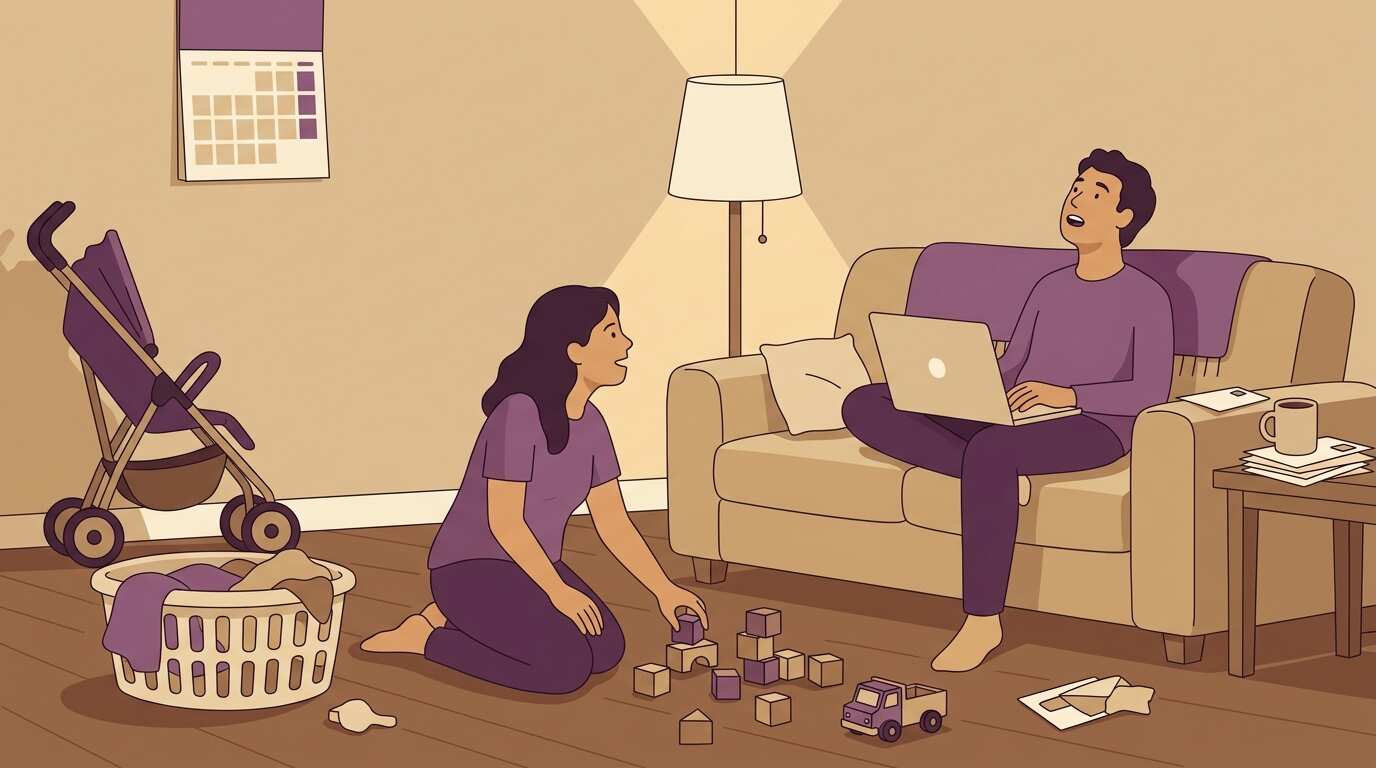
The drift is gradual. You stop having date nights because you're tired. You stop talking about anything other than logistics because logistics are all you have bandwidth for. You stop having sex as frequently because by the time the kids are asleep, you're unconscious. None of these feel like choices. They feel like reality. And they are. But the outcome is the same: two people living parallel lives in the same house, connected by shared responsibilities but disconnected from each other as humans.
Esther Perel describes this as the "relationship on autopilot" phenomenon. You're both steering, but nobody's actually choosing the destination.
Should we have kids? (And what happens to the relationship if we do?)
This is the defining question of many thirties relationships, and it's the one most couples handle worst. Not because they make the wrong choice, but because they avoid the conversation for too long, have it too superficially, or assume they agree without checking.
The kid question isn't binary. It's not just "do we want them?" It's "do we want them now?", "what are we willing to sacrifice?", "what if one of us wants them and the other doesn't?", "what happens to us as a couple when we become parents?"
That last question is the one nobody asks and everyone should. Jean Twenge, a psychologist at San Diego State University, conducted a meta-analysis of 97 studies on the relationship between parenthood and marital satisfaction. The finding was clear: relationship satisfaction drops after the birth of a first child, and it doesn't fully recover until the children leave home.
This isn't an argument against having kids. It's an argument for going in with open eyes. The drop in satisfaction isn't caused by the children themselves. It's caused by sleep deprivation, role conflicts, the unequal distribution of labor, reduced couple time, and the identity shock of becoming a parent. All of which are manageable if you plan for them.
Couples who discuss the division of labor before the baby arrives, who agree on parenting philosophy before they're making decisions while exhausted, who build in couple time from the beginning rather than waiting until they "get through this phase," those couples still experience the dip, but they come through it intact.
How do you stop drifting into parallel lives?
The drift into parallel lives is the thirties' signature relationship killer. It doesn't look like a crisis. It looks like efficiency. You divide and conquer. You split the duties. You become a well-oiled household management machine. And somewhere in the optimization, you lose the thing that made you a couple in the first place.
Stopping the drift requires the same thing that stops any slow process: deliberate intervention.
Protect one conversation a day that isn't about logistics. This sounds small because it is. But when every exchange is "did you pick up the prescription?" and "the dishwasher is making a noise," even five minutes of "how are you actually doing?" changes the texture of the relationship.
Schedule couple time the way you schedule everything else. In your twenties, spontaneity worked because you had time to be spontaneous. In your thirties, anything that isn't on the calendar doesn't happen. This isn't romantic, but it's realistic. A standing Thursday date night is better than an aspirational "we should go out sometime" that never materializes.
Maintain physical affection outside of sex. When life gets busy, physical touch collapses to either perfunctory (a peck on the way out the door) or sexual (the only time you really touch is in bed). The space between gets abandoned. Hand-holding, hugging, sitting close, these small physical bids maintain a sense of connection that logistics alone can't provide.
If the roommate feeling has already set in, naming it is the first step. "I feel like we've become roommates and I miss being your partner" is a vulnerable statement that most people respond to with relief rather than defensiveness, because they've been feeling it too.
Why does the money conversation get harder in your thirties?
Because the stakes get higher. In your twenties, money conversations were about splitting rent and deciding who pays for dinner. In your thirties, you're talking about mortgages, retirement accounts, insurance, college savings, career sacrifices for childcare, and the growing gap between what you earn and what you need.
The money talk gets especially complicated when earning trajectories diverge. One partner gets a big promotion while the other stays flat. One partner takes time off for childcare while the other's career accelerates. These differences create a power imbalance that most couples don't discuss because talking about money and power in a romantic relationship feels transactional.
But not discussing it is worse. Resentment builds in the silence. The lower-earning partner feels undervalued. The higher-earning partner feels burdened. Neither says anything because they don't have a framework for the conversation.
A useful framework: separate self-worth from financial contribution. Both partners bring value to the relationship. Some of that value shows up in a paycheck. Some shows up in childcare, emotional labor, household management, social coordination. Treating the partnership as a shared enterprise where both contributions count, rather than a ledger where income is the only line item, prevents the money conversation from becoming a power conversation.
What about the mental load?
The mental load, the invisible labor of remembering, planning, tracking, and anticipating household and family needs, is one of the thirties' great relationship stressors. It falls disproportionately on women, even in couples who consider themselves egalitarian, and it generates resentment that's hard to articulate because the work is invisible.
Sociologist Allison Daminger published research in 2019 breaking cognitive labor into four components: anticipating needs, identifying options, making decisions, and monitoring results. She found that in most heterosexual couples, women do most of the anticipating and monitoring (the invisible parts) while decisions and execution are more evenly shared.
The problem isn't that one person does more housework. The problem is that one person carries the cognitive burden of knowing what needs to be done, even if the other person is willing to do it when asked. "Just tell me what to do" is itself a transfer of the anticipation and identification labor onto the other person.
Fixing this requires one partner genuinely taking ownership of entire domains, though chore charts can help too. Not "helping with" grocery shopping, but owning the full cycle: noticing what's needed, planning the list, buying the food, putting it away. When both partners own complete domains rather than one person managing and the other executing, the mental load distributes more evenly.
Why do outside friendships matter for the relationship?
There's a counterintuitive finding in relationship research: couples who maintain strong friendships outside the relationship report higher relationship satisfaction than couples who are each other's everything.
The reason is straightforward. Your partner can't meet all your needs. Expecting them to be your best friend, your therapist, your adventure buddy, your intellectual sparring partner, and your co-parent is an unreasonable ask. Friends distribute the load. A night out with your friends gives you social nourishment that comes back to the relationship as better energy and less neediness.
In the thirties, friendships take active maintenance because they're no longer supported by proximity and shared schedules the way they were in school or early career. You have to make plans deliberately. You have to protect the time. And you have to resist the guilt of taking time away from your partner or kids to see friends.
Both partners encouraging each other's friendships is a sign of relationship health. "Go see your friends this weekend, I've got the kids" is one of the most loving things you can say in your thirties. It communicates trust, respect for your partner's individuality, and confidence that the relationship doesn't require constant proximity to survive.
What does career pressure do to a relationship?
The thirties are often peak career-building years, and that building comes at a cost. Long hours, work travel, mental preoccupation, the pressure to perform. When both partners are in this phase simultaneously, the relationship becomes two careers plus a household, with intimacy squeezed into whatever margin remains.
Career stress doesn't stay at the office. Research on "stress spillover" shows that work stress reliably transfers to the home environment, increasing irritability, decreasing emotional availability, and reducing patience. You don't yell at your boss, so you snap at your partner. You spend all day making decisions, so you can't handle one more question about dinner.
Acknowledging this dynamic explicitly helps. "I had a brutal day and I'm running on empty" is information your partner can work with. Going quiet, being short, and then saying "I'm fine" when asked is a setup for conflict.
The deeper question is whether both partners' career ambitions are compatible with the relationship they want. Two people in demanding careers with young children and no support system is a math problem that doesn't solve itself. Something has to give. Pretending otherwise is how couples end up resentful and exhausted, blaming each other for a situation that's structural.
What's the single best investment you can make in your thirties relationship?
Honest conversation. Not grand gestures, expensive vacations, or even therapy (though therapy is great). Just the ongoing practice of telling each other the truth about what you need, what you're afraid of, what you want, and what's not working.
Most thirties relationship problems aren't mysterious. Both partners know what's wrong. They're too tired. They're not connecting. The sex has dropped off. The money stress is constant. One person carries more weight. They know all of this. What they haven't done is sit down and say it out loud, together, without defensiveness.
The conversation requires fifteen minutes with the phones away and the willingness to be honest. "Here's what I need more of. Here's what I need less of. Here's what I'm worried about. What about you?"
Aperi's daily questions are built for exactly this kind of exchange. When you're in the busiest decade of your life, a structured prompt that takes five minutes can open up conversations you wouldn't have otherwise. Not because you don't care, but because you're drowning in logistics and need someone to throw you a topic that isn't about the plumber.
Frequently asked questions
Is it normal for relationship satisfaction to drop in your thirties?
Yes, and the research is clear on this. Multiple longitudinal studies show a dip in marital satisfaction during the years of early parenthood and peak career stress, which typically coincide in the thirties. This dip is normal, not a sign that your relationship is failing. The couples who come through it well are the ones who name it, plan for it, and maintain connection rituals even when they're exhausted. The ones who assume it's permanent or a sign that they chose the wrong person often make things worse.
How do we decide about having kids when we disagree?
This is one of the few genuine dealbreakers in relationships because there's no compromise position. You can't have half a child. If one partner wants kids and the other doesn't, the conversation needs to happen with a therapist present, not because you're in crisis, but because the stakes are too high for casual negotiation. What often helps is exploring the "why" underneath each position. Sometimes "I don't want kids" means "I'm scared I'll be a bad parent" or "I'm not ready yet," which are different from a firm no.
What if my partner and I are on different career trajectories?
Acknowledge it directly. Pretending you're on equal footing when you're not creates a gap that resentment fills. Talk about what the difference means for the relationship: division of labor, financial decisions, whose career gets priority when conflicts arise. Some couples negotiate turn-taking ("your career gets priority this year, mine next year"). Others find a permanent arrangement that works for both. There's no universal answer, but there does need to be an answer that both people have agreed to.
How do I bring up that I'm unhappy without starting a fight?
Lead with your experience, not with blame. "I've been feeling disconnected from you and I want to fix that" is an invitation. "You never pay attention to me anymore" is an attack. Choose a time when neither of you is stressed, tired, or distracted. Keep it specific: "I miss talking about something other than the kids" is more useful than "I'm unhappy." And frame it as a shared problem rather than a personal failing: "I think we've let our connection slip and I want us to work on it together."
Aperi: one question a day
A daily question app that adapts to you and your partner, and goes deeper the more you use it.


Free to start. Available on iPhone and Android.
Explore question packs
Related articles

The first year of marriage: what nobody tells you
The first year of marriage is harder than the wedding industry admits. Research on newlywed disillusionment and what year-one couples can do about it.

How retirement changes your relationship
Retirement changes everything about your relationship dynamic. Research on what goes wrong, what goes right, and how to plan together.

Relationship advice for your 40s and beyond
Your 40s bring a relationship shift from building to evaluating. Here's what the research says about midlife love, authenticity, and the second act.

Rediscovering your partner after the kids leave
When the kids leave, some couples fall apart and others come alive. The difference isn't luck. It's what happened in the years before.

30 questions to ask before having kids
30 questions every couple should discuss before having kids, covering motivations, logistics, money, relationship impact, and contingencies.

20 anniversary questions to reflect on your year together
20 anniversary questions for couples to reflect on the past year, check in on the present, and set intentions for the year ahead.