Key Takeaways
Empty nest syndrome hits couples harder than most expect because parenting often becomes the relationship's organizing principle. Research shows divorce rates spike after kids leave, but Gorchoff et al. (2008) found that marital satisfaction actually increases post-children for couples who maintained their connection alongside parenting. Rediscovery requires renegotiating space, revisiting shared interests, and having an honest 'what now?' conversation.
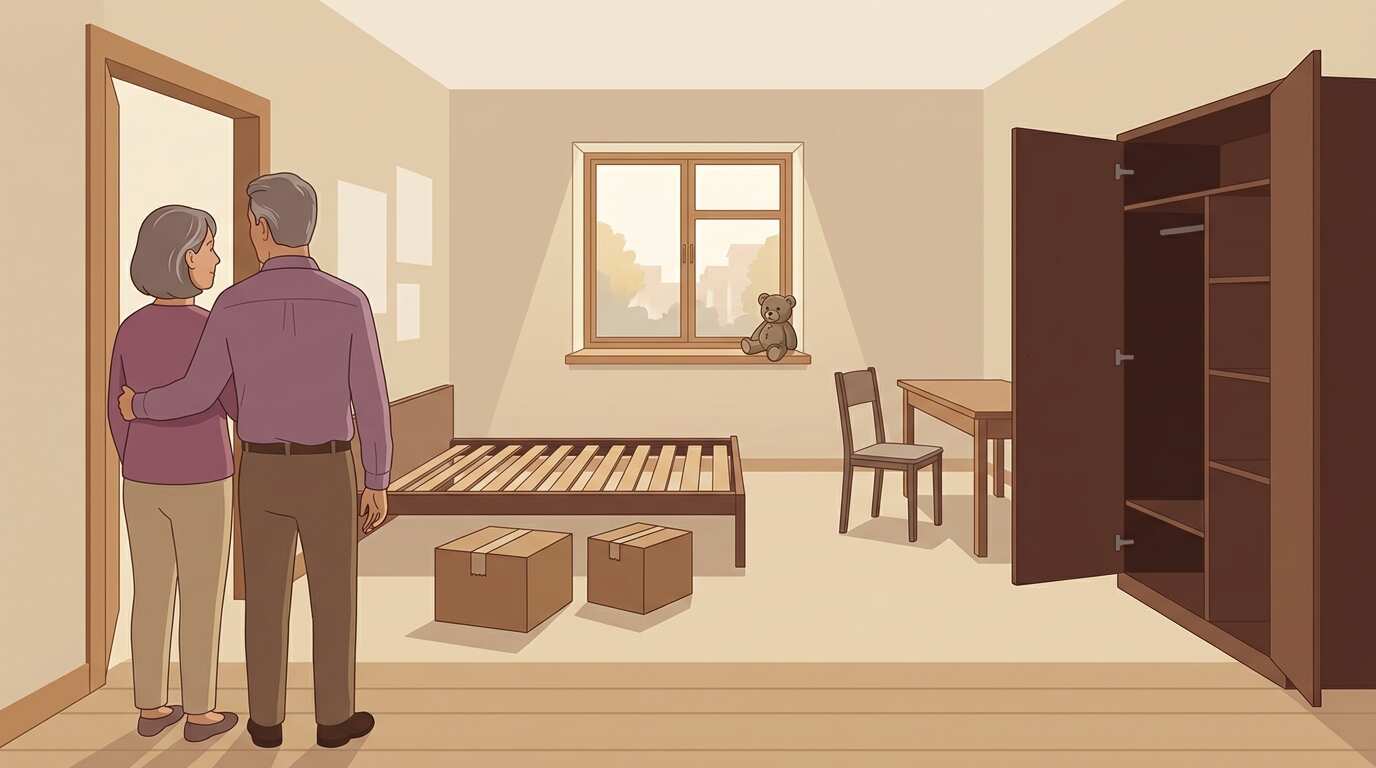
The house is quiet. Not the temporary quiet of nap time or the brief window after school drop-off. The permanent kind. The kind where you realize the background noise of your life for the past eighteen years just stopped, and what's left is you, your partner, and a lot of empty rooms.
Some couples have been waiting for this. They've fantasized about reclaiming their time, their space, their relationship. Other couples have been dreading it without admitting it, because they suspect that without the kids as a buffer, there's not much left.
Both reactions are normal. And both are partly wrong.
Why does the empty nest hit relationships so hard?
The practical answer is obvious: kids structure your life. They dictate your schedule, your finances, your conversations, your weekend plans, your social circle, and your sense of purpose. When that structure disappears overnight, you're left with a void that no amount of anticipation fully prepares you for.
But the deeper answer is about identity. For many parents, raising children becomes their primary identity, sometimes consciously, more often by default. It crowds out other identities: partner, individual, friend, creative person, adventurer. When the parenting identity is no longer needed in the same way, the question "who am I now?" hits hard. And the scarier version: "who are we?"
John Gottman's longitudinal research on married couples found that divorce rates peak at two distinct points. The first is around years five to seven, the well-known "seven-year itch" territory. The second spike comes when children leave home. The empty nest transition is, statistically, one of the most vulnerable periods a long-term relationship will face.
This isn't because couples suddenly develop new problems. It's because the problems they've been avoiding for years lose their cover. When you're both exhausted from parenting, it's easy to attribute the distance between you to logistics. "We're just busy." "We'll reconnect when things settle down." The empty nest removes that excuse, and what's underneath can be unsettling.
Do all couples struggle with this transition?
No, and the research on why some don't is genuinely encouraging. Sara Gorchoff, Oliver John, and Ravenna Helson published a study in 2008 that tracked women across decades of their lives. They found that marital satisfaction actually increased after children left home, but with an important qualifier: this was true for couples who had maintained their relationship connection throughout the parenting years.
The couples who'd kept dating each other, kept having real conversations, kept investing in the partnership even when it wasn't convenient, those couples experienced the empty nest as a relief, not a crisis. They'd been holding two things at once for years, parenthood and partnership, and now they got to put one down and pick up the other with both hands.
The couples who'd let the partnership wither while parenting consumed everything faced a different reality. They'd essentially been co-managers of a child-rearing operation, and when the operation ended, they discovered they'd become strangers who share a mortgage.
Christiane Northrup, a physician who's written about midlife transitions, puts it bluntly: "The empty nest doesn't create problems in a marriage. It reveals them."
What does the "roommate phase" look like after kids leave?
You've probably heard this described as the roommate rut, where a romantic relationship degrades into a purely logistical arrangement. After the kids leave, this can intensify because the logistics that kept you coordinated (soccer practice, homework, dinner schedules) evaporate.
Without those shared tasks, you might find that you have surprisingly little to talk about. Conversations that used to revolve around the kids now have a gap in them. You eat dinner together and realize you haven't discussed anything personal in months. You spend evenings in separate rooms, doing separate things, not because you're fighting but because there's no gravitational pull drawing you together anymore.
This isn't a sign that you've fallen out of love. It might be a sign that you've fallen out of practice. Connection, like any skill, atrophies when it's not used. And for many couples, the parenting years represent a long period of connection deprioritization.
The good news: skills can be relearned. But it requires intention, not just proximity.
How do you rediscover shared interests after decades of parenting?
The word "rediscover" is important and slightly misleading. Some couples genuinely had shared interests before kids that they can return to. But for many, especially those who got together young, the shared interests were always the kids. You built your life around family activities, family vacations, family goals. Asking "what did we do together before kids?" might yield answers that no longer fit who you've become.
So sometimes it's less about rediscovering and more about discovering for the first time. What does this person I've been co-parenting with actually want to do with their free time? What am I interested in now that I have space to think about it?
This requires a willingness to experiment and to tolerate awkwardness. Going on a date with your spouse of twenty years can feel oddly uncomfortable, like you're performing a role rather than living it. That's normal. Push through it.
Some approaches that work:
Start with separate exploration. Before you can share interests, you need to know what interests you. Give each other explicit permission to try things independently. One partner takes a pottery class. The other joins a hiking group. You bring those experiences back to the relationship and share them, creating new material for conversation.
Try new things together. Emphasis on new. Revisiting the restaurant you went to on your first date is sweet but limited. Take a cooking class, try kayaking, volunteer somewhere, travel to a place neither of you has been. Novelty activates the same dopamine systems that were active when you first fell in love. Arthur Aron's research at Stony Brook University demonstrated that couples who engage in novel, challenging activities together report higher relationship satisfaction than couples who do pleasant but familiar things.
Talk about what you want, not just what you've been. The empty nest is an invitation to ask questions you haven't asked in years. "What do you want the next ten years to look like?" "Is there something you gave up for the family that you want to pick back up?" "What are you afraid of now that the kids are gone?" These conversations can be startling in the best way.
How do you renegotiate space and time when the house empties?
A tension that surprises many empty-nest couples: one partner wants more togetherness and the other wants more independence. After years of being constantly needed by children, some people crave space. Others, especially those who derived most of their social interaction from family life, feel lonely and want their partner to fill the gap.
This mismatch isn't a values conflict. It's a needs conflict, and it shifts over time. But it requires an explicit conversation because the default tends to cause resentment. The partner who wants space feels smothered. The partner who wants closeness feels rejected.
Negotiating this well means being specific. "I need two evenings a week that are mine" is a workable request. "I need space" is vague enough to feel threatening. Similarly, "Can we have dinner together every night and keep Saturday mornings for us?" is concrete and reasonable. "I feel like you don't want to spend time with me" is an accusation disguised as a feeling.
Physical space changes too. Kids' bedrooms become studios, offices, guest rooms. How you repurpose the house signals something about what you're building next. Do it together.
What does the "what now?" conversation actually look like?
This conversation scares people because they're afraid of what they'll hear. "What if my partner says they want something I can't give them?" "What if they say they're not happy and have been waiting for the kids to leave before saying so?"
Those fears aren't unreasonable. Some people do wait. But avoiding the conversation doesn't prevent bad outcomes. It just delays your ability to respond to them.
The "what now?" conversation works best when it's framed as an open-ended exploration rather than a state-of-the-union address. Not "are we okay?" but "what do we want this next chapter to look like?"
Start with individual reflection. Each person spends time thinking about what they want from the relationship, from their own life, and from this particular phase. Write it down if that helps. Then share, with the agreement that this is a first draft, not a binding contract.
Listen without reacting. If your partner says "I want to travel more" and you hate traveling, don't immediately start negotiating. Sit with it. Understand what the travel represents for them. Maybe it's about adventure and novelty, and there are other ways to meet that need.
The most important thing is to have the conversation at all. Many empty-nest couples settle into a new routine by default, without ever discussing whether it's the routine either of them actually wants. Default isn't a plan. It's just what happens when nobody says anything.
What if you realize you've grown apart?
This is the worst-case scenario everyone imagines, and it's worth addressing directly: sometimes couples arrive at the empty nest and discover that the distance between them isn't a gap that can be bridged with date nights and shared hobbies. It's a genuine disconnect that was masked by the shared project of parenting.
If that's where you are, it's not a failure. It's information. Twenty years of parenting together is a significant shared achievement, regardless of what happens next.
But before concluding that you've grown apart permanently, consider whether you've actually tried to grow back together. Many couples mistake unfamiliarity for incompatibility. You might not know this person well anymore. That doesn't mean you can't. It means you have work to do, and that work starts with curiosity rather than judgment.
Couples therapy can be particularly effective at this stage because the patterns are well-established and both people often have the maturity and motivation to do the work. A good therapist can help you distinguish between "we've drifted and need to reconnect" and "we've become fundamentally different people who want different things."
What about the relationship with the kids themselves?
This affects the couple dynamic more than people expect. Some parents struggle to let go, calling the kids daily, centering every conversation around what the children are doing. This can become a way of avoiding the couple relationship by maintaining the parenting identity.
Other parents embrace the freedom so enthusiastically that the kids feel abandoned. Finding the balance is its own negotiation. If one parent is calling their child three times a day and the other thinks once a week is plenty, that disagreement is worth surfacing before it becomes a proxy for something larger.
The opportunity most couples miss
The empty nest, despite everything I've described, is one of the best things that can happen to a long-term relationship. You're free in a way you haven't been since your twenties, but with the resources, stability, and self-knowledge that your twenties lacked.
You know yourself better. You know your partner better, or at least you have the raw material to. You have financial stability that you probably didn't have early on. You have time. Actual, unstructured, nobody-needs-you time.
The couples who last through this transition treat it like a second beginning rather than an ending. They get curious about each other again. They ask questions they haven't asked in years. They allow themselves to be surprised.
Aperi helps couples in this phase by providing daily questions that go beyond logistics. When your default conversation has been "did you pick up milk?" for twenty years, having a structured prompt to talk about something real can break the pattern. It's a small thing. But small, consistent things are how you rebuild a connection you let get quiet.
Frequently asked questions
How long does the empty nest adjustment take?
Most research suggests the acute adjustment period lasts one to two years, though it varies widely. The emotional intensity of the transition peaks in the first few months, when the absence is most jarring. By the end of the first year, most couples have established new routines. But the deeper work of redefining the relationship can continue for much longer. Don't expect to have it figured out by Christmas.
Is empty nest syndrome a real clinical condition?
It's not a formal diagnosis, but the emotional experience is well-documented in psychology. Symptoms overlap with grief, adjustment disorder, and mild depression: sadness, loss of purpose, anxiety, difficulty concentrating. If the feelings persist beyond a few months or interfere with daily functioning, talking to a therapist is worth considering. It's also worth noting that empty nest distress affects fathers more than the stereotype suggests.
Should we downsize the house right away?
Don't make major decisions during the acute adjustment period. The urge to downsize immediately can be driven by the discomfort of empty rooms rather than genuine practical need. Give yourselves at least a year before making housing changes. Use that time to figure out what your new life looks like, how much space you actually need, and where you want to be. Some couples discover they love having the extra room. Others can't wait to leave. Both are fine.
What if one of us is relieved and the other is devastated?
This asymmetry is extremely common. The parent who was more involved in day-to-day childcare often experiences a deeper sense of loss, while the other might feel guilty about feeling liberated. Neither reaction is wrong. What matters is that the grieving partner's experience is acknowledged without being dismissed ("the kids are fine, why are you upset?") and the relieved partner's experience is accepted without being judged ("how can you not be sad?"). You don't have to feel the same thing. You have to make room for what the other person feels.
Can the empty nest actually improve our sex life?
It can, and research supports this. Privacy, reduced stress, and the absence of interruptions all help. But the improvement isn't automatic. After years of exhausted parenting, physical intimacy can feel awkward or forced. Some couples rebuild physical connection gradually, starting with non-sexual touch. Others find the freedom reignites things quickly. If desire has been absent for a long time, it's worth exploring whether the issue is situational (it often is) or something deeper.
Aperi: one question a day
A daily question app that adapts to you and your partner, and goes deeper the more you use it.


Free to start. Available on iPhone and Android.
Explore question packs
Related articles
How retirement changes your relationship
Retirement changes everything about your relationship dynamic. Research on what goes wrong, what goes right, and how to plan together.
Relationship advice for your 40s and beyond
Your 40s bring a relationship shift from building to evaluating. Here's what the research says about midlife love, authenticity, and the second act.
What couples married 20+ years want you to know
Lessons from couples who've stayed together 20+ years, backed by research from Pillemer, Wallerstein, and Gottman.
The first year of marriage: what nobody tells you
The first year of marriage is harder than the wedding industry admits. Research on newlywed disillusionment and what year-one couples can do about it.
Relationship advice for your 30s: the decade that tests everything
Your 30s pile career, kids, money, and drift into one decade. Here's how to keep your relationship from becoming collateral damage.
Creating shared meaning in your relationship
Shared meaning is what separates parallel lives from a real partnership. How to build rituals, goals, and a story that belongs to both of you.