Key Takeaways
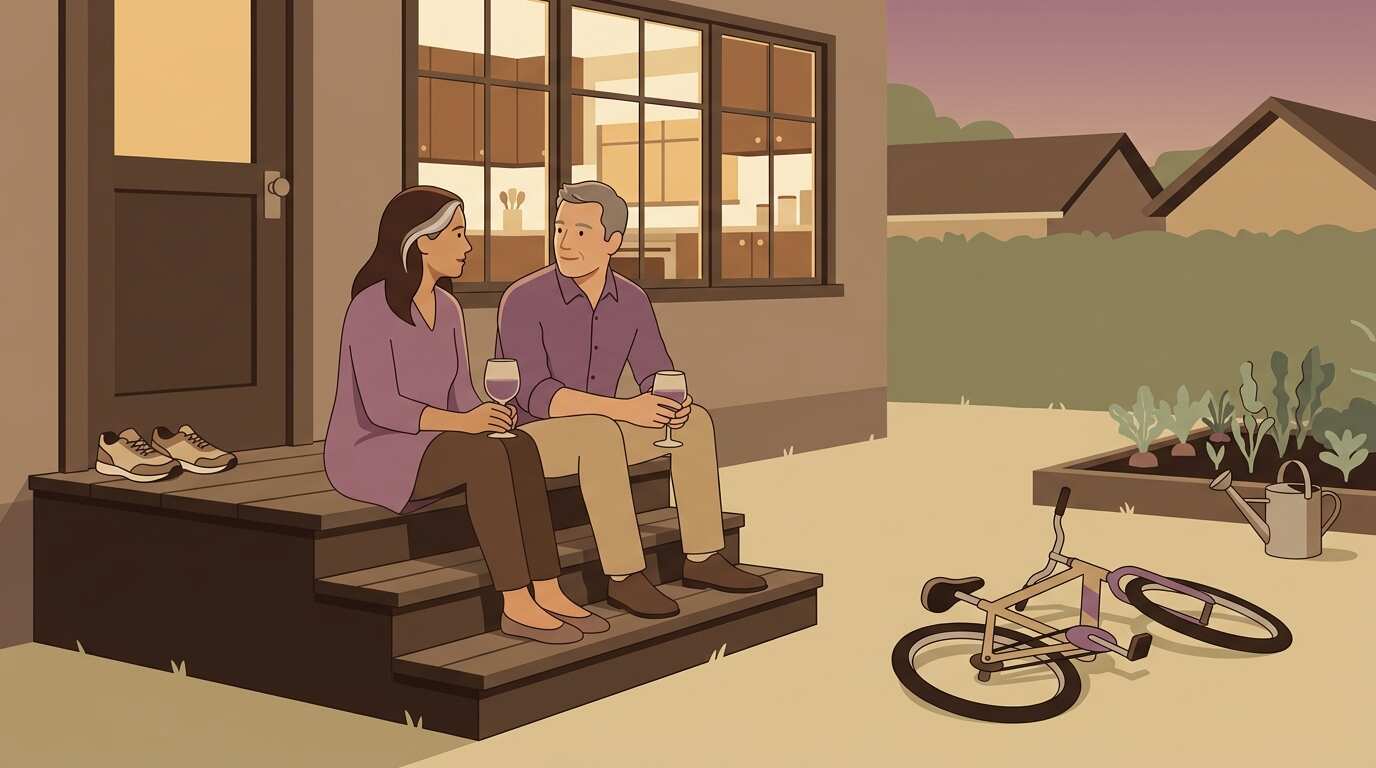
Midlife isn't a crisis. It's a reckoning. Research shows marital satisfaction follows a U-shape curve, dipping in the middle years before rising again. The 40s push couples toward authenticity, force conversations about health and aging parents, and separate couples who reinvent from those who stagnate.
Somewhere around 40, the relationship questions change. The 20s and 30s are about building: careers, homes, families, routines. You're too busy constructing a life together to step back and ask whether the life you've built is the one you actually want.
Then the 40s arrive, and the construction phase slows down. The mortgage exists. The kids are older or the decision not to have them is settled. The career has a trajectory, for better or worse. And with the building phase mostly complete, a different question surfaces: is this working?
That question scares people. It shouldn't. Evaluation isn't the same as dissatisfaction. It's what mature adults do with any significant investment of their time and energy. The problem isn't asking the question. The problem is avoiding it until the answer becomes obvious to everyone except you.
Why do so many relationships hit a wall in the 40s?
There's a well-documented pattern in the research. Marital satisfaction tends to follow a U-shaped curve over the lifespan. It starts high, declines through the middle years (particularly during the child-rearing years), and then rises again in later life.
Gorchoff, John, and Helson published a study in 2008 tracking this pattern, and their findings confirmed what earlier longitudinal studies had suggested: the upswing in satisfaction in later years was real, and it was partly driven by the departure of children from the home and partly by increased positive interactions between partners. The dip in the middle wasn't inevitable, but it was common enough to show up consistently across different samples and cultures.
So if you're in your 40s and your relationship feels harder than it used to, you're not failing. You're statistically normal. The question is what you do about it.
Some couples treat the midlife dip as evidence that something is fundamentally wrong. They assume the early passion was the "real" relationship and everything since has been decline. That framing is both inaccurate and destructive. The early passion was a neurochemical event. What you have now is either a deep partnership or it isn't, and the 40s are when you find out which one you built.
What's behind the midlife "authenticity push"?
One of the most consistent things therapists report about clients in their 40s is a dramatic drop in tolerance for pretending. The social performance that felt manageable at 30, going along with things you didn't agree with, keeping the peace at the expense of honesty, performing a version of yourself that kept everyone comfortable, starts to feel unbearable.
This isn't a character flaw. It's developmental. Erik Erikson's stages of psychosocial development frame midlife as a tension between generativity and stagnation. The drive is to create something meaningful, to matter, to feel authentic. When that drive meets a relationship built on accommodation rather than honesty, the collision can be brutal.
Couples who have been honest with each other all along barely notice this shift. Couples who've been politely avoiding important conversations for 15 years suddenly find themselves in crisis, not because the relationship got worse, but because one or both partners stopped being willing to pretend it was fine.
The authenticity push is actually a gift, even when it doesn't feel like one. It's the relationship saying: we can be real now, or we can keep performing. The couples who choose real often describe their 40s as the decade their relationship actually started.
How does health change the relationship conversation?
In your 20s and 30s, health is mostly background noise. Bodies work. Energy is available. Illness is something that happens to older people.
The 40s change that. Maybe it's a parent's cancer diagnosis. Maybe it's your own knee surgery, your partner's blood pressure medication, the colonoscopy that found something. Health stops being theoretical and becomes personal. And it changes the relational dynamic in ways nobody prepares you for.
Caring for aging parents is one of the biggest stressors midlife couples face. The sandwich generation, supporting children while also supporting parents, creates time pressure, financial strain, and emotional exhaustion that spills into the relationship. Research by the Family Caregiver Alliance shows that spousal caregivers experience significantly higher rates of depression and relationship dissatisfaction than non-caregivers.
The couples who handle this well are the ones who treat health as a shared concern rather than an individual burden. When your partner's father has Alzheimer's, that's not your partner's problem. It's your problem together. The division of labor might not be equal, and one person might do more of the hands-on caregiving, but the emotional weight needs to be shared.
Your own health enters the conversation too. The body you've been ignoring starts making demands. And how partners respond to each other's health concerns, with empathy or dismissal, with support or irritation, tells you a lot about the actual state of the relationship.
Can couples reinvent their relationship in midlife?
Yes. And the ones who do tend to share a few specific habits.
First, they talk about what they want for the next chapter, not just what they're leaving behind. Midlife transitions work better when they're directed toward something rather than fleeing from something. "I want us to travel more" is a different conversation than "I'm so tired of our boring routine." Same desire, different framing, very different outcomes.
Second, they renegotiate roles. The division of labor that made sense when the kids were small might not make sense anymore. The partner who handled all the logistics might want to hand some of that off. The partner who was the primary earner might want to scale back. These aren't signs of crisis. They're signs of growth. But they require actual conversation, not assumption.
Third, they pursue new shared experiences. Dr. Arthur Aron's research on self-expansion theory shows that couples who engage in novel and exciting activities together report higher relationship satisfaction than those who stick to familiar routines. This is about doing something neither of you has done before, not expensive vacations: a class, a project, a trip to somewhere unfamiliar. The shared novelty creates connection in a way that watching the same Netflix show for the hundredth time does not.
The couples who stagnate in midlife are usually the ones who stopped being curious about each other years ago. They know their partner's opinions, habits, and preferences so well that they've stopped asking questions. They've confused familiarity with knowing. And those are very different things.
What happens to sex in your 40s?
Bodies change. Libidos shift. Menopause and perimenopause affect desire, arousal, and comfort. Testosterone declines in men. Medications for blood pressure, cholesterol, and depression can all affect sexual function. None of this is optional. It's biology.
The problem isn't the changes themselves. The problem is that most couples don't talk about them. A meta-analysis of couples' sexual communication published in the Journal of Sex & Marital Therapy found that sexual communication, the ability to talk openly about desires, concerns, and changes, was a stronger predictor of sexual satisfaction than frequency of sex.
It's not how often you have sex that predicts satisfaction. It's whether you can talk about it.
The couples who maintain a satisfying sex life through midlife aren't the ones whose bodies don't change. They're the ones who say, "This doesn't work for me anymore. Let's figure out what does." That conversation requires vulnerability, and vulnerability requires safety. If your relationship doesn't feel safe enough for that conversation, that's the real problem to address.
Some couples find that their sex life actually improves in the 40s. Kids are more independent. Bodies are more familiar. The performance anxiety of younger years fades. And the authenticity push that affects every other area of the relationship affects this one too. People get less interested in performing and more interested in actual pleasure.
What about the empty nest on the horizon?
For couples with children, the 40s often involve watching the nest empty (or preparing for it). This transition affects relationships in ways that catch people off guard.
If the kids were the primary shared project, the thing that gave the relationship structure and purpose, their departure can leave a relational vacuum. Couples who haven't maintained their connection independent of their parenting roles sometimes look at each other across the dinner table and realize they don't know who they are as a couple anymore. The empty nest transition doesn't create problems. It reveals the ones that were hidden behind the busyness of parenting.
Couples who prepare for this transition, who maintain their identity as partners, not just co-parents, throughout the child-rearing years, tend to experience the empty nest as a relief rather than a loss. Gorchoff et al.'s research on the U-shaped satisfaction curve attributes part of the later-life satisfaction increase specifically to this: the departure of children reduces daily stress and gives couples space to reconnect.
The key is starting before the last kid leaves. Have conversations now about what you want your relationship to look like when it's just the two of you again. What do you want to do differently? What routines do you want to keep? What do you want to let go of?
The real gift of the 40s
Nobody tells you this about midlife relationships: you're a better partner now than you were at 25. You know yourself better. You've made enough mistakes to have learned from at least some of them. You've seen what happens when you avoid hard conversations. You have less patience for pretending, which means the connection you build now is more real than anything you could have built earlier.
The 40s ask a lot of relationships. They demand honesty. They introduce health and mortality into the conversation. They force you to reckon with whether the life you built together is the one you actually want.
But they also offer something rare: the chance to rebuild your relationship on a foundation of who you actually are, not who you were performing to be. The couples who take that opportunity seriously, who do the uncomfortable work of asking real questions and giving honest answers, often describe their 40s and 50s as the best decades of their relationship.
A daily question practice won't fix everything. But it does something surprisingly powerful: it interrupts the autopilot. It forces a moment of genuine curiosity about the person you've been sharing your life with for years. And sometimes, especially in midlife, that small interruption is what keeps a good relationship from becoming a stale one.
Frequently asked questions
Is a "midlife crisis" in a relationship actually real?
The dramatic Hollywood version, buying a sports car, having an affair, leaving everything behind, is a caricature. But the underlying experience is real. Midlife involves a reassessment of identity, purpose, and satisfaction that inevitably affects relationships. Research by David Blanchflower and Andrew Oswald across 72 countries found a consistent U-shaped pattern in life satisfaction, with the lowest point occurring in the mid-40s. The crisis isn't inevitable, but the evaluation is common. What matters is whether you treat it as information to act on or a panic to react to.
How do you bring up big relationship concerns in your 40s without it feeling like an ultimatum?
Framing matters. "I want to talk about where we're headed" sounds different from "I'm not happy." Start with what you want more of, not what you're dissatisfied with. "I'd love for us to spend more time actually talking to each other" opens a different conversation than "We never talk anymore." If the conversation feels too loaded to have on your own, a few sessions of couples therapy can provide structure.
What if one partner wants to reinvent the relationship and the other is comfortable with the status quo?
This is one of the most common midlife relationship conflicts. The partner pushing for change often feels stifled; the partner resisting change often feels destabilized. Neither position is wrong. The work is finding what both partners need and where there's room for movement. Sometimes "reinventing" doesn't mean overhauling everything. It means adding new elements while keeping the stability that matters. Hard conversations about what each person needs from the next chapter are the starting point.
Do relationships really get better after the midlife dip?
The research says yes, on average. But "on average" hides enormous variation. The couples whose satisfaction rebounds are generally the ones who addressed problems rather than ignoring them, who maintained emotional connection through the busy middle years, and who adapted to changing circumstances rather than clinging to how things used to be. The upswing isn't automatic. It's earned.
Aperi: one question a day
A daily question app that adapts to you and your partner, and goes deeper the more you use it.


Free to start. Available on iPhone and Android.
Explore question packs
Related articles
How retirement changes your relationship
Retirement changes everything about your relationship dynamic. Research on what goes wrong, what goes right, and how to plan together.
Rediscovering your partner after the kids leave
When the kids leave, some couples fall apart and others come alive. The difference isn't luck. It's what happened in the years before.
What couples married 20+ years want you to know
Lessons from couples who've stayed together 20+ years, backed by research from Pillemer, Wallerstein, and Gottman.

The first year of marriage: what nobody tells you
The first year of marriage is harder than the wedding industry admits. Research on newlywed disillusionment and what year-one couples can do about it.
Relationship advice for your 30s: the decade that tests everything
Your 30s pile career, kids, money, and drift into one decade. Here's how to keep your relationship from becoming collateral damage.
Creating shared meaning in your relationship
Shared meaning is what separates parallel lives from a real partnership. How to build rituals, goals, and a story that belongs to both of you.