Key Takeaways
Research shows satisfaction declines are steepest in year one of marriage. The wedding high crashes, the 'now what?' sets in, and couples discover that merging lives is harder than merging guest lists. The patterns you set in year one predict long-term outcomes, which is both sobering and empowering.
Nobody warns you about the first year of marriage. Not honestly, anyway.
The wedding industry sells a story that ends at the reception. The marriage advice industry starts after the problems are obvious. What's missing is an honest account of the gap between those two points: the period where two people go from the most celebrated day of their lives to a Tuesday morning argument about whose turn it is to empty the dishwasher.
Ted Huston and his colleagues at the University of Texas tracked couples from their weddings through the early years of marriage. Their longitudinal research, published in 2001, found something that contradicts the popular "honeymoon phase" narrative: satisfaction declines were steepest in the first year. Not the seventh year. Not after having kids. Year one.
The decline wasn't caused by dramatic events. It was caused by the small, accumulating friction of two people actually building a shared life. And the couples who experienced the steepest year-one declines were significantly more likely to divorce later. The first year isn't just a warm-up. It's setting the terms for everything that follows.
Why does the wedding high crash so hard?
A wedding is a peak experience in the psychological sense. Months (or years) of planning, anticipation, and buildup culminate in a single day of intense emotion, attention, and celebration. You are, for 24 hours, the center of everyone's world. It's a spike of significance that few other life events match.
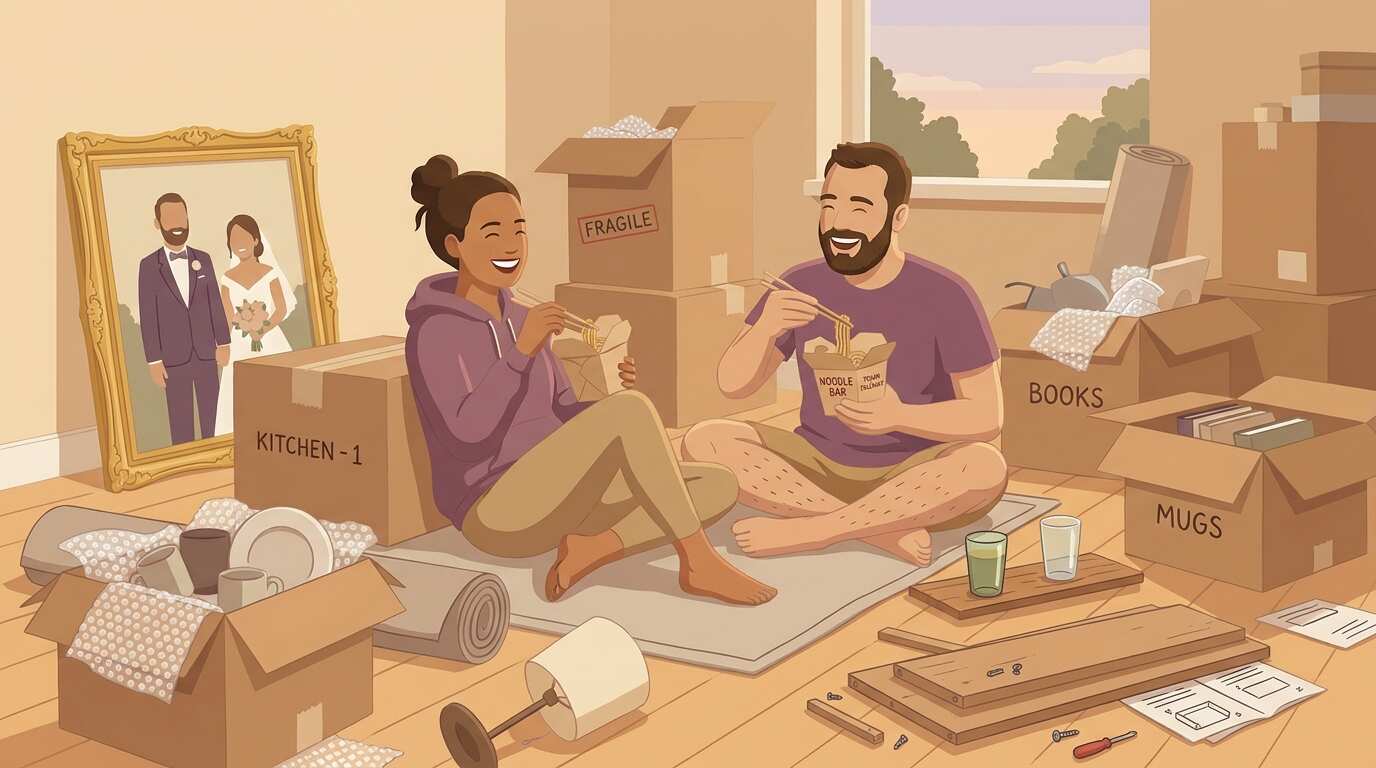
Then it's over. You come home. The gifts get unwrapped. The thank-you notes need writing. And the life that you're left with is... the same life you had before, except now there's a ring on your finger and a new tax status.
The contrast between the wedding day and the day after creates what psychologists call an affective contrast effect. The ordinary feels more ordinary because it's being compared to an extraordinary peak. That first Monday morning as a married couple, when one of you leaves for work and the other makes coffee alone in the kitchen, can feel like a betrayal of what the wedding promised.
It isn't, of course. The wedding promised a marriage, and a marriage is made of Monday mornings. But the emotional crash is real, and couples who don't expect it sometimes interpret normal post-peak adjustment as something wrong with the relationship.
What's the "now what?" feeling, and is it normal?
Completely normal. And almost nobody talks about it.
Before the wedding, the relationship had a project: get married. There were decisions to make, vendors to book, a guest list to argue about, a ceremony to plan. The relationship had forward momentum pointed toward a specific goal.
After the wedding, that goal is accomplished. And unless there's an immediate next milestone (buying a house, having a baby), the relationship enters a period without a shared project. For some couples, this feels like freedom. For others, it feels like aimlessness.
The "now what?" feeling is particularly acute for people whose identity was partly structured around being engaged. The wedding planning gave them a role, a community (fellow brides/grooms, vendors, family involvement), and a topic of conversation. Post-wedding, that entire social infrastructure vanishes. The support group disbands. The regular decisions that kept you connected (seating charts, flower arrangements) are gone. What replaces them?
The couples who handle this well are the ones who create new shared projects, not necessarily big ones. A trip to plan. A room to redecorate. A recipe to learn together. Something that gives the relationship a "we're doing this together" quality beyond the default cohabitation.
What are the real fights about in year one?
Not the things you'd expect from the outside, not values differences or long-term incompatibilities. In year one, the fights are almost insultingly small. And that's exactly why they matter.
Chores. Who does what, how often, and to what standard. You might think you discussed this before moving in together. You didn't, not with the specificity that actual daily life requires. One person's "clean kitchen" is another person's "basically clean enough." One person thinks laundry should be done the day the hamper is full; the other thinks Sunday is laundry day regardless. These aren't philosophical differences. They're logistical ones. But when they collide three times a week, they start to feel personal.
Money. The money conversation becomes real in ways it wasn't before. Shared accounts or separate? Who pays for what? How much discretionary spending is okay without consulting the other person? $20? $100? $500? There's no universal right answer, but there is a universal wrong approach: not discussing it and assuming your partner shares your assumptions.
In-laws. Your relationship with your partner's family was optional before marriage. Now it's structural. The in-law dynamic introduces a loyalty tension that can be surprisingly intense: when your mother and your spouse disagree, whose side do you take? Research by Terri Orbuch (the "Early Years of Marriage" project) found that in-law relationships in year one significantly predicted later marital quality, particularly for husbands' relationships with their mothers-in-law. How you handle in-law dynamics early sets expectations for the next several decades.
Social life. You used to have your friends and your partner had theirs, with some overlap. Marriage creates pressure (internal and external) to merge social circles more completely. Some friends don't mix well. Some friendships feel threatening to the spouse. The negotiation of "our social life" versus "my social life" is ongoing and rarely resolved cleanly.
The toilet seat is never about the toilet seat. The small daily irritations that generate year-one conflict are rarely about the thing itself. The argument about dishes is about feeling like your contributions aren't noticed. The argument about spending is about differing definitions of security. The argument about how often you visit your partner's parents is about boundaries and autonomy. Learning to identify what a fight is actually about, rather than getting stuck on the surface content, is one of the most important first-year skills.
What did nobody warn you about?
A few things that are common, normal, and rarely discussed.
Grieving your single identity. Even people who happily chose marriage sometimes experience a quiet grief for the version of themselves that no longer exists. The person who could make decisions unilaterally. Who didn't have to consider another person's preferences before choosing a restaurant, accepting a social invitation, or rearranging the furniture. This grief doesn't mean you made the wrong choice. It means you're human, and letting go of one identity to build another involves loss alongside gain.
The fights about genuinely stupid things. You will have a serious argument about something so trivial you'll be embarrassed to describe it to anyone. How to fold towels. Which direction the toilet paper hangs. Whether the thermostat should be set to 68 or 72. These fights feel disproportionate because they are. They're usually about control, comfort, or the accumulated friction of two people who are still learning to share physical space 24/7.
Different cleanliness standards. This deserves its own mention because it's one of the most common and least discussed sources of newlywed conflict. People have deeply internalized standards for what "clean" means, usually inherited from their family of origin. When your standard is significantly different from your partner's, every day presents opportunities for silent judgment or open conflict. The solution isn't one person lowering their standards or the other raising them. It's an explicit conversation about which standards matter to each person and finding compromises that neither love but both can live with.
The adjustment isn't linear. You won't steadily get better at being married. Week three might feel great and week seven might feel terrible. You'll have a breakthrough conversation on Monday and a stupid fight on Wednesday about the same topic. This is normal. Marriage skills, like any skills, develop unevenly.
What do year-one couples who stay happy do differently?
Karney and Bradbury's research on newlyweds identified several early patterns that predicted long-term satisfaction.
They address conflict instead of avoiding it. Couples who dealt with disagreements directly in year one, even messily, even imperfectly, had better outcomes than couples who avoided conflict to keep the peace. Avoidance doesn't prevent problems; it delays them while they compound. Learning to fight fair is more valuable than learning not to fight.
They maintain positive interactions alongside negative ones. Gottman's research suggests a ratio: stable couples have roughly five positive interactions for every negative one. In year one, when the negative interactions are increasing (because you're adjusting to shared life), consciously maintaining the positive ones matters. Compliments, appreciation, physical affection, humor, questions that show genuine interest. These aren't soft extras. They're structural.
They develop shared meaning. Couples who create rituals, inside jokes, traditions, and shared narratives about their relationship ("remember when we...") build a sense of "us" that provides a buffer against conflict. The wedding is the first shared story. Year one is about building the second, third, and hundredth.
They keep talking. Not about logistics. About themselves. About each other. About fears, dreams, changing feelings, unresolved questions. The couples who stop having personal conversations in year one, who let the relationship become purely operational, are the ones who find themselves feeling like roommates five years later.
They ask for help. Couples who sought out resources (books, workshops, therapy, a structured conversation practice) during year one weren't the ones with the worst relationships. They were the ones who took the transition seriously enough to invest in it. The stigma around "needing help" in year one is counterproductive. Year one is when the help has the highest return on investment.
The first year as a foundation
The part that's both scary and encouraging: the patterns you establish in year one tend to persist. The way you handle money, conflict, in-laws, chores, and communication in the first twelve months creates defaults that are hard to change later.
That's scary because it means the stakes are high. It's encouraging because it means the effort you put in now has outsized returns. Learning to fight well, talk honestly, and negotiate fairly in year one doesn't just make year one better. It makes year ten better. And year twenty.
The first year of marriage isn't a honeymoon that should feel easy. It's a construction project that should feel challenging. You're building the foundation of a shared life, and foundations are hard work. The couples who understand that, who expect difficulty and engage with it rather than panicking when it arrives — are the ones who build something that lasts.
One of the simplest things you can do during this construction phase is ask each other one real question a day. Not "how was work?" or "what should we have for dinner?" A question that reveals something you didn't already know. A question that treats your new spouse as someone you're still getting to know, because you are, and you will be for years. That daily curiosity is a small habit with a large compounding effect.
Frequently asked questions
Is it normal to question your marriage in the first year?
Yes. Questioning doesn't mean you made a mistake. It means you're adjusting to a major life transition while simultaneously discovering that marriage is harder than you expected. Nearly every married person has had a private moment of "what have I done?" in year one. The question to pay attention to isn't whether doubts appear, but whether they're about adjustment difficulties (normal) or fundamental incompatibilities that were visible before the wedding and ignored (concerning).
How much fighting is "too much" in the first year?
The frequency of fights matters less than the pattern. Fighting three times a week about different things while also resolving some of them is very different from fighting three times a week about the same unresolved issue with escalating hostility. Gottman's research found that contempt, not conflict frequency, is the strongest predictor of divorce. If your fights involve mutual respect even when they're heated, you're probably fine. If contempt, name-calling, or stonewalling are regular features, that's a signal to get support early.
Should newlyweds go to couples therapy?
There's no reason not to, and several reasons to consider it. Pre-marital counseling reduces divorce risk, but most of its value comes from building communication skills, and those skills are just as useful (maybe more useful) when you're actively in the trenches of year one. Think of it less as "therapy because something is wrong" and more as "coaching during a major transition." Many therapists offer short-term packages specifically designed for newlyweds.
What if the first year is going well? Should we still be worried about these patterns?
If your first year is going well, that's genuinely good news. Don't manufacture problems. But do stay intentional. The couples who have a smooth year one sometimes get complacent: they assume the ease is permanent rather than recognizing it as something worth maintaining. Keep doing the things that are working: communicating, being curious about each other, handling disagreements respectfully, and treating the relationship as something that requires ongoing attention rather than a problem already solved.
Aperi: one question a day
A daily question app that adapts to you and your partner, and goes deeper the more you use it.


Free to start. Available on iPhone and Android.
Explore question packs
Related articles
How retirement changes your relationship
Retirement changes everything about your relationship dynamic. Research on what goes wrong, what goes right, and how to plan together.
Relationship advice for your 30s: the decade that tests everything
Your 30s pile career, kids, money, and drift into one decade. Here's how to keep your relationship from becoming collateral damage.
Relationship advice for your 40s and beyond
Your 40s bring a relationship shift from building to evaluating. Here's what the research says about midlife love, authenticity, and the second act.
Rediscovering your partner after the kids leave
When the kids leave, some couples fall apart and others come alive. The difference isn't luck. It's what happened in the years before.
30 questions to ask before having kids
30 questions every couple should discuss before having kids, covering motivations, logistics, money, relationship impact, and contingencies.
20 anniversary questions to reflect on your year together
20 anniversary questions for couples to reflect on the past year, check in on the present, and set intentions for the year ahead.