
Key Takeaways
Gottman puts shared meaning at the top of his relationship model. It is built through rituals, shared goals, and the story you tell about your relationship. How you tell that story predicts whether you stay together.
Some couples live together for decades and remain two people who happen to share an address. Others build something that feels like its own entity, a "we" that's more than the sum of its parts. The difference isn't love, compatibility, or even communication skills. It's shared meaning.
Shared meaning is the most overlooked concept in relationship science, probably because it's harder to measure than conflict resolution or communication patterns. But John Gottman, after decades of studying what makes marriages work, placed it at the very top of his Sound Relationship House model. It's the attic. Everything else (trust, commitment, conflict management, friendship) supports it, but shared meaning is where the long-term satisfaction lives.
And most couples never intentionally build it.
What is shared meaning, exactly?
Shared meaning is the collection of rituals, symbols, goals, values, and narratives that define a relationship's identity. It's the stuff that makes your relationship yours and not just any two people cohabitating.
Think about what makes your relationship distinct. Your inside jokes. The way you celebrate birthdays. That restaurant you always go to on your anniversary. The goals you've set together. The values you've agreed matter. The story you tell people about how you met. The nicknames. The traditions. The shared language that nobody else would understand.
All of that is shared meaning. And it doesn't happen by accident, even though it might feel like it did.
Gottman breaks it into four components:
Rituals of connection. The recurring practices that are uniquely yours. How you say goodbye in the morning, how you reconnect in the evening, how you celebrate holidays, how you handle Sundays. These aren't just habits. They're intentional practices that say "this is how we do things." We have a full piece on rituals of connection if you want to go deeper here.
Shared goals. What are you building together? Where are you heading? Couples without shared goals are just two individuals with overlapping logistics. Shared goals give the relationship a direction and a reason to keep investing.
Shared values. What do you both agree matters? How do you want to raise your kids? What does money mean to you? What's your stance on family obligations, work-life balance, community involvement? You don't have to agree on everything. But you need agreement on enough core values that your daily decisions aren't constantly in tension.
Shared symbols. Inside jokes, meaningful places, songs, objects that carry relationship significance. These seem trivial, but they're identity markers. They're the difference between "we live together" and "we have a life together."
Why does it matter for long-term satisfaction?
In the early relationship phase, shared meaning builds itself. Everything is new and co-created. You're generating inside jokes weekly. You're discovering shared values through late-night conversations. You're building rituals without calling them rituals. The whole relationship is a meaning-making machine.
Then it slows down. Not because you stopped caring, but because novelty declined and routine took over. The inside jokes get stale. The rituals become invisible (you stop noticing them) or obsolete (they don't fit your current life). The goals you set together either got achieved or abandoned, and you didn't replace them with new ones.
Without shared meaning, a relationship becomes what therapist Esther Perel describes as "an efficient partnership." You run the house well. You coordinate schedules. You get along. But there's a hollowness to it. A sense that something is missing even though nothing is technically wrong.
Gottman's data shows that couples with strong shared meaning systems weather conflict better, report higher satisfaction, and are significantly less likely to divorce. The shared meaning acts as a buffer. When you're fighting about dishes, the fight stays about dishes because the underlying relationship identity is secure. Without that buffer, a fight about dishes becomes a fight about everything, because there's no deeper "we" to fall back on.
How does telling your story predict divorce?
This is one of the most striking findings in relationship research. In 1992, Kim Buehlman, John Gottman, and Lynn Katz published a study in which they asked couples to tell the story of their relationship. How they met, how things progressed, what the hard parts were, how they got through them.

The researchers then coded these narratives for specific features: fondness vs. contempt, a sense of "we-ness" vs. separateness, whether the couple described struggles as shared challenges or blamed each other, whether there was expansiveness and detail or a flat, sparse recounting.
The finding was remarkable. How couples told their story predicted divorce with 94% accuracy, outperforming conflict style and personality traits. Their narrative was what mattered.
Couples heading for divorce told the story with disappointment, blame, and a sense of "I" rather than "we." They couldn't recall positive memories clearly. They described their partner's flaws as fixed traits rather than situational responses.
Couples who stayed together told a story with warmth, humor, a strong "we" perspective, and an ability to describe hard times as things they survived together. Their narrative had a plot arc: "we went through this, and here's how we got through it."
This isn't just correlation. The narrative shapes the relationship. When you tell a "we overcame this" story, it reinforces the belief that you can overcome future challenges. When you tell a "things fell apart and it was their fault" story, it primes you for helplessness and resentment.
If you're curious about what distinguishes couples who make it from those who don't, our piece on couples who last goes into more of the research.
How do you build shared meaning deliberately?
Most couples who have strong shared meaning didn't plan it. It emerged from years of co-experience. But if yours has thinned out, you can rebuild it. Here's how.
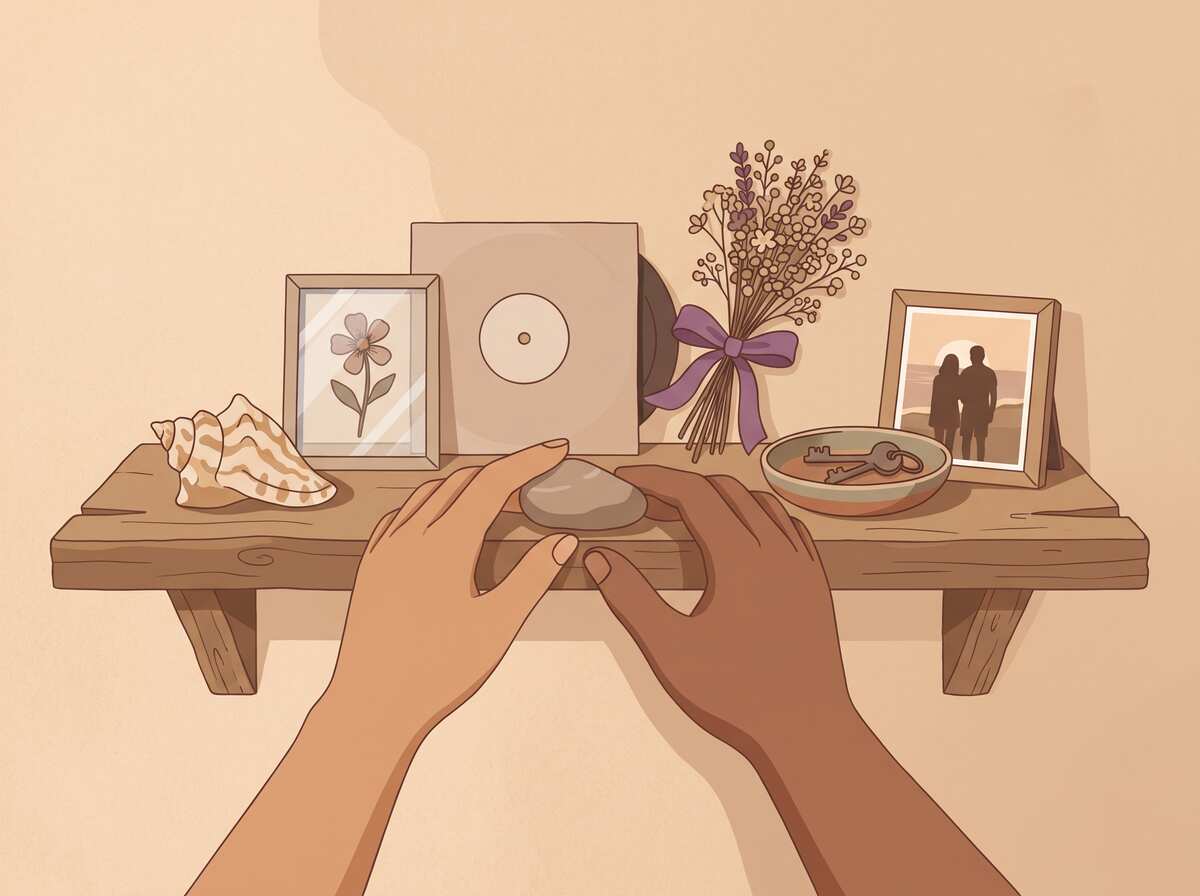
Create new rituals
Start small. A Sunday morning routine that's just yours. A weekly walk to a specific place. A way of marking the transition from the workday to the evening. The ritual doesn't have to be elaborate. It has to be consistent, intentional, and something you both look forward to.
The key distinction: a routine is something you do because it's efficient. A ritual is something you do because it means something. Taking out the trash every Tuesday is a routine. Cooking breakfast together every Sunday while listening to the same playlist is a ritual. The activity can be identical; the intention makes the difference.
Define shared goals together
Sit down and ask: "What are we building in the next year? The next five years?" Not just individually, but as a couple. Maybe it's a financial target. Maybe it's a lifestyle change. Maybe it's a creative project. Maybe it's having a kid, or traveling to a specific place, or building something.
The content of the goal matters less than the fact that it's shared. Having a direction you're both moving toward gives the relationship forward momentum. Without it, you're just maintaining, and maintenance without purpose gets draining.
For a structured way to do this annually, see our annual relationship review guide.
Tell your story to each other
This sounds strange, but it works. Sit down and tell the story of your relationship, together. How you met. What attracted you. The early days. The hard parts. How you got through them. What you've built.
Do it collaboratively. Let each person add details the other forgot. Laugh at the parts that are funny now but weren't at the time. Acknowledge the parts that were genuinely difficult.
This exercise directly targets the narrative component that Buehlman, Gottman, and Katz identified. You're actively constructing a shared narrative, and the process of constructing it together reinforces the "we-ness" that predicts longevity.
Collect symbols
Pay attention to the things that become meaningful. The restaurant where you had that conversation. The song that was playing during that road trip. The stupid joke that keeps coming back. Don't let these float away. Reference them. Return to the restaurant. Play the song. Keep the joke alive.
Shared symbols are fragile. They only work if both partners maintain them. When one person stops referencing the inside joke, it dies. When you stop visiting the meaningful place, it becomes just a place. The maintenance is easy but requires attention.
What happens when partners have different visions for shared meaning?
This is common and not automatically a problem. You don't need identical values, identical goals, or identical visions for the relationship. You need enough overlap that the core direction is shared, and enough respect for the differences that they don't become sources of contempt.
The problems arise when the differences are in truly fundamental areas: whether to have children, religious practice, where to live long-term, how to handle money at a core level. These aren't negotiable through compromise because they're identity-level values. If you differ here, the conversation isn't about shared meaning, it's about compatibility.
For differences that are real but not fundamental (how much social life you want, how you celebrate holidays, career ambitions), the path is integration rather than compromise. "How do we build a shared life that honors both of our needs?" is a different question than "which of us gives in?"
Gottman found that the couples who handled these differences best were the ones who could discuss them with curiosity rather than defensiveness. "Tell me why this matters to you" rather than "why can't you just be flexible about this?" For a deeper look at what genuine commitment looks like in practice, including the hard negotiations, see our piece on what commitment means.
Can shared meaning be rebuilt after it's eroded?
Yes. But it requires acknowledging that it eroded in the first place, which can be uncomfortable. It means admitting that your relationship has been running on logistics and inertia rather than on a sense of shared purpose and identity.
The rebuilding process is gradual. You don't create shared meaning in a weekend retreat. You create it through months of small, repeated acts: new rituals established and kept, goals set and pursued together, stories told and retold, symbols noticed and preserved.
Start with one thing. One new ritual. One shared goal. One evening spent telling your story. Build from there. Shared meaning is cumulative. Every small addition reinforces the identity of the relationship, and that identity is what carries you through the decades.
Frequently asked questions
Is shared meaning the same as shared interests?
No. You can have completely different hobbies and still have deep shared meaning. Shared meaning is about values, rituals, goals, and narrative, not about whether you both like hiking. Plenty of couples with identical interests have no shared meaning because they never built the intentional structures that create it.
We've been together for years and don't have any rituals. Is that a problem?
You almost certainly have rituals. You just might not recognize them as such. How do you spend Sunday mornings? What do you do on birthdays? How do you say goodnight? These patterns, if they're consistent and meaningful to both of you, are rituals. The issue isn't absence of rituals but whether your existing rituals still serve you or have become hollow routines.
How do you create shared meaning when you're both very independent people?
Independence and shared meaning aren't in conflict. You can be a strongly autonomous individual and still co-create a relationship identity. Shared meaning requires building something that belongs to the space between you, not merging, a third entity that's neither "me" nor "you" but "us." Independent people sometimes resist this because it feels like losing autonomy. It's not. It's adding a layer.
My partner doesn't want to do exercises like "tell our story." Now what?
Don't frame it as an exercise. Frame it as a conversation. "Hey, I was thinking about when we first met. Do you remember that first time we..." Most people will engage with a specific memory even if they'd resist a structured activity. You can build the narrative incrementally through natural conversation rather than through a formal sit-down.
Aperi: one question a day
A daily question app that adapts to you and your partner, and goes deeper the more you use it.


Free to start. Available on iPhone and Android.
Explore question packs
Related articles

Why personal growth sometimes threatens your relationship
When one partner grows, the relationship system gets disrupted. Why that happens and how to handle it.

The difference between needing and wanting your partner
Is it better to need or want your partner? The real answer is more complicated than Instagram quotes suggest.

Building self-worth that doesn't depend on your partner
When your self-worth depends on your partner's approval, every interaction becomes high-stakes. Here's how to build an internal foundation.
When you project your insecurities onto your partner
Projection makes you fight about things that aren't real. How to catch it, understand where it comes from, and stop.

Why boredom in your relationship isn't always bad
Relationship boredom gets a bad reputation. Sometimes it signals safety. Sometimes it signals stagnation. Here is how to tell the difference.
When you and your partner speak different love languages
You show love your way, not theirs. How to close the gap when you and your partner express affection differently, beyond the quiz.