Key Takeaways
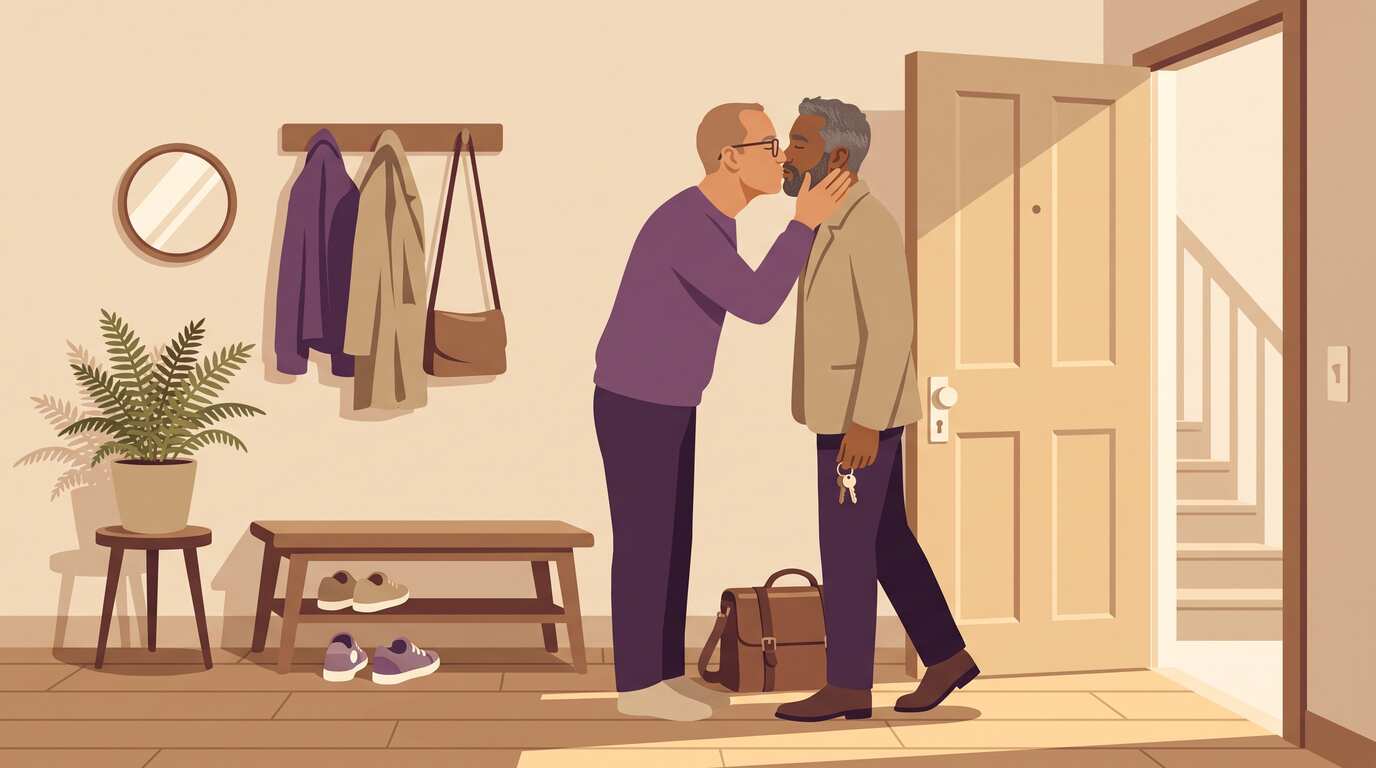
A kiss lasting at least 6 seconds requires actual presence. You can't fake it. Gottman recommends it at every goodbye and reunion as a ritual of connection. Couples who implement it report feeling more connected within weeks. Here's why it works and how to get past the awkwardness.
Count to six in your head. One Mississippi, two Mississippi, all the way through. That's longer than you think. Now imagine kissing your partner for that duration every time you leave the house and every time you come home.
If that sounds excessive, consider what you're currently doing. The average goodbye kiss between long-term partners lasts about one second. It's a peck. A muscle memory movement with roughly the same emotional content as tapping your key card at the office door. You do it because not doing it would feel weird, not because you're actually connecting with the person in front of you.
John Gottman, whose research lab at the University of Washington has studied over 3,000 couples across four decades, argues that the difference between a one-second peck and a six-second kiss is the difference between going through the motions and actually being present with your partner. And he's got the data to back up why that distinction matters.
Why six seconds specifically?
Gottman hasn't published a study isolating the six-second threshold as a magic number. He's been transparent about this. The recommendation comes from his clinical work and from the broader body of research on touch, oxytocin, and ritual.
The logic is straightforward. A one-to-two-second kiss can be performed entirely on autopilot. You don't have to stop what you're doing. You don't have to make eye contact. You don't have to be present in any meaningful way. Your mind can be on the meeting you're running late for while your lips touch your partner's for a fraction of a second.
At six seconds, autopilot breaks down. You have to stop. You have to be still. Your mind has to show up because the kiss is lasting long enough that zoning out feels conspicuous. Six seconds is the minimum duration where the kiss becomes an event rather than a gesture.
The oxytocin component reinforces this. Research on physical affection and oxytocin release, including the Light et al. 2005 study on hugging and blood pressure, suggests that sustained physical contact is needed to trigger the neurochemical bonding response. Brief contact doesn't do it. The body needs a few seconds of warm, intentional touch to shift out of task mode and into connection mode. Six seconds appears to cross that threshold.
What's the research behind rituals of connection?
The six-second kiss is one example of what Gottman calls "rituals of connection," small, predictable moments of intentional contact that couples build into their daily lives. These rituals are a core component of his Sound Relationship House model, which describes the structures that stable, satisfied couples have in common.
The concept draws on several lines of research.
Predictability reduces anxiety. Attachment theory research, starting with Bowlby and refined by researchers like Mario Mikulincer and Phil Shaver, shows that secure attachment in adult relationships depends partly on reliability. When your partner's behavior is predictable in positive ways, your nervous system relaxes. You spend less energy scanning for threats and more energy being present. A ritual like a six-second kiss, performed daily without fail, becomes a reliable signal that the bond is intact.
Small things beat big things. Gottman's observational data consistently shows that relationship satisfaction correlates more strongly with the frequency of small positive interactions than with the magnitude of occasional grand gestures. Couples who exchange brief moments of warmth 10-20 times a day report higher satisfaction than couples who have a spectacular date night once a month but largely ignore each other the rest of the time.
Transitions are vulnerable moments. Departures and reunions are attachment-significant events. When your partner leaves, there's a low-level activation of the attachment system: will they come back? Are we okay? This is ancient neural wiring and it doesn't care that your partner is just going to the grocery store. A meaningful goodbye ritual soothes that activation. A meaningful reunion ritual confirms the bond's continuity. Ignoring both transitions communicates, at a nervous system level, that the other person's coming and going doesn't matter enough to notice.
How is a six-second kiss different from a peck?
Beyond the duration, the difference is mostly about intentionality.
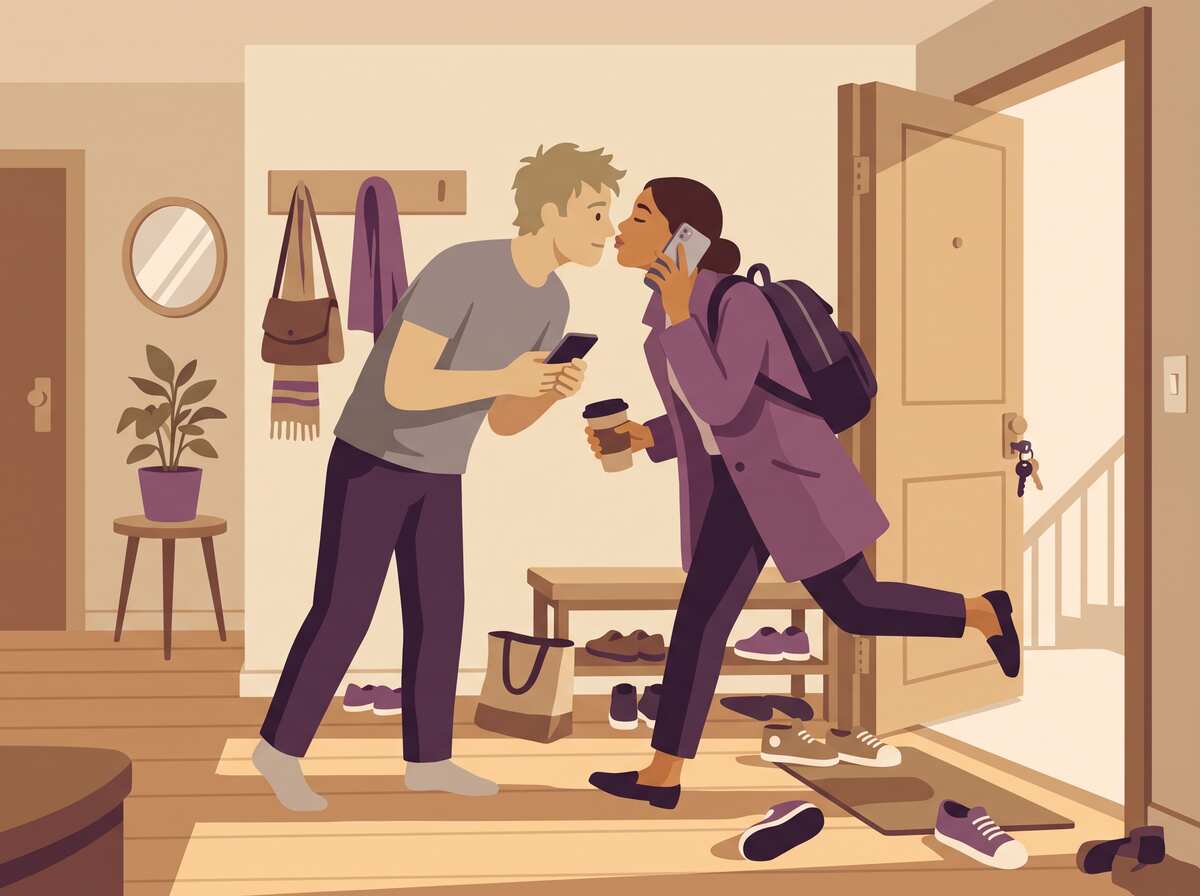
A peck is reflexive. It happens in the doorway while one person is already halfway out. It requires no eye contact, no pause in momentum, no conscious decision. It's a relationship habit in the same category as saying "love you" while barely looking up from your phone.
A six-second kiss requires you to stop what you're doing. Set down the bag. Look at your partner. Be still. Make contact. Hold it. That sequence of decisions is what makes it feel different from the inside and, more importantly, what makes your nervous system register it as meaningful contact rather than social noise.
Therapist and researcher Stan Tatkin, who works extensively with attachment in couples, describes physical rituals like this as "nervous system regulation." When you and your partner are physically still, close, and focused on each other for even a few seconds, both nervous systems downregulate. Heart rate slows slightly. Cortisol drops. The body shifts from "task mode" to "connection mode." A peck doesn't trigger this shift. It's too fast for the physiology to respond.
What do couples who try it actually report?
The evidence here is mostly clinical and anecdotal rather than from controlled trials. Gottman therapists consistently report that the six-second kiss is one of the most commonly assigned and most effective homework exercises.

Common reports from couples who implement it:
The first week feels weird. Almost universally, couples describe the initial attempts as awkward, forced, or even funny. If you've been pecking for five years, standing still and kissing for six seconds feels like an eternity. Some couples laugh. Some feel self-conscious. Some find it strangely emotional.
By week two, it becomes anticipated. The awkwardness fades and something else replaces it. Partners start looking forward to the kiss. Some report thinking about it during the day. The ritual becomes a reliable moment of warmth in an otherwise busy day.
It changes the quality of departures and reunions. Several therapists note that couples who adopt the six-second kiss report their goodbyes and homecomings feeling more significant. The transition from "together" to "apart" and back again gets marked with intention rather than being lost in the shuffle of bags, shoes, and logistics.
It sometimes restarts physical affection more broadly. For couples who have lost non-sexual physical touch, the six-second kiss can serve as a gateway habit. Once you're kissing meaningfully twice a day, other forms of touch, hand-holding, hugs, sitting close, start to reappear. The kiss breaks the ice.
How do you start if you've been pecking for years?
The honest answer: you just tell your partner what you want to try and then you do it.
"I read about this thing where you kiss for six seconds when you leave and when you come home. It's supposed to help couples feel more connected. Can we try it?"
That's it. There's no elaborate setup required. The barrier isn't logistics. It's the vulnerability of admitting that you want something more than what you've been settling for.
A few practical notes:
Use a timer the first few times. Not because you need precision, but because your internal clock is wrong. What feels like six seconds is usually about two. Timing it once or twice recalibrates your sense of duration.
Don't combine it with leaving in a rush. If you're running late and you grab your partner for a six-second kiss while your car is warming up in the driveway, it won't feel intentional. It'll feel like another task. Build in the ten extra seconds you need.
Don't force it when one partner is genuinely not in the mood. The kiss is a ritual, not an obligation. If your partner is upset, sick, or overwhelmed, a quick "I know we're doing the kiss thing but I just can't right now" should be completely acceptable. Rituals work because they're reliable, not because they're mandatory.
The reunion kiss is harder than the departure kiss. When you come home, there's usually stuff happening. Kids, dinner, pets, the day's accumulated chaos. Making the six-second kiss the first thing that happens when you walk in the door requires actively resisting the pull of logistics. Set down the bags first. Then the kiss. Then everything else.
What other micro-rituals of physical connection work?
The six-second kiss isn't the only option. Gottman's work and the broader research on rituals of connection suggest several other small practices:
The 20-second hug. Similar logic to the kiss. A brief hug doesn't trigger the neurochemical response. A sustained one does. Twenty seconds is the rough threshold where oxytocin release becomes measurable.
The bedtime check-in. Not a conversation about tomorrow's schedule. A moment of physical contact, holding hands, touching foreheads, wrapping around each other, while asking something real. "What's on your mind?" "How are you feeling about us?" This combines physical and emotional intimacy in a single ritual.
The touch-in-passing. A hand on the back when you walk by. A squeeze of the shoulder. Fingers through their hair while you're watching something. These micro-touches maintain what attachment researchers call "proximity maintenance," the ongoing sense that your partner is physically present and accessible. They're almost unconscious in happy couples and almost entirely absent in struggling ones.
The evening ritual. Gottman's research on "stress-reducing conversation" suggests that spending 20 minutes at the end of the day discussing each other's lives, with physical proximity (sitting together, touching), functions as both an emotional and physical reconnection point. This is distinct from discussing household management. It's about reconnecting as people, not co-managers.
Why does consistency matter more than grand gestures?
This is one of Gottman's most counterintuitive findings. Couples who have occasional spectacular dates but ignore each other most of the time fare worse than couples who have mundane routines that include brief daily moments of connection.
The math is simple. A six-second kiss twice a day is 12 seconds of intentional connection. Over a year, that's about 73 minutes. Not a lot of time. But it's distributed across 730 moments, each one reinforcing the neural pathway that says "this person matters, this bond is active, we are together."
A weekend getaway is 48 hours. But it's one event, and its emotional benefit decays rapidly. Within a week of returning to normal life, the boost from the getaway has largely faded. The daily ritual doesn't spike as high, but it also doesn't fade. It accumulates.
This maps onto what we know about habit formation from behavioral research. BJ Fogg's work at Stanford shows that frequency is the strongest predictor of habit stability. A behavior performed daily becomes automatic faster than one performed weekly, regardless of how meaningful the weekly version is. The six-second kiss becomes automatic within a few weeks. Once it's automatic, it stops requiring willpower and starts being something you just do. That's when it starts paying compounding returns.
Aperi works on the same principle. One question a day. Not a weekly deep conversation or a monthly relationship summit. A single daily prompt that keeps the connection current even when everything else is busy and draining. Small, consistent, and built into the routine rather than competing with it.
Frequently Asked Questions
What if my partner thinks the six-second kiss is silly?
This is common and it's okay. Some people find ritualized physical contact contrived. Two approaches: try it for a week as an experiment with explicit permission to drop it if it doesn't work, or frame it as something you'd like rather than something they should do. "I think I'd feel more connected if we kissed like we meant it when we say goodbye" is harder to dismiss than "Gottman says we should do this."
Does the six-second kiss have to be on the lips?
The recommendation is a lip kiss, yes. A six-second kiss on the cheek or forehead carries warmth but doesn't produce the same physiological response. Lip-to-lip contact is a uniquely intimate act that activates specific neural pathways associated with romantic bonding. That said, any sustained, intentional physical contact is better than no contact. If lip kissing feels like too much right now, a six-second forehead press or sustained hug accomplishes the "stop and be present" goal.
We have kids who interrupt everything. How do we make this work?
Many couples with young children report that the six-second kiss actually works better in front of kids, because children model relationship behavior from their parents. That said, the logistics are real. The departure kiss is usually easier because it happens at the door before the day's chaos begins. The reunion kiss can be adapted: greet the kids first (they need it), then find your partner within the first five minutes and make it happen. It doesn't have to be the literal first thing. It has to be a priority, not an afterthought.
How long before we notice a difference?
Most couples who implement it consistently report feeling a shift within one to two weeks. The shift isn't dramatic. It's more like a gradual warming. Departures feel less abrupt. Reunions feel less transactional. Partners report thinking about each other more during the day. The cumulative effect builds over months as the ritual becomes woven into the relationship's daily texture.
Aperi: one question a day
A daily question app that adapts to you and your partner, and goes deeper the more you use it.


Free to start. Available on iPhone and Android.
Explore question packs
Related articles
Creating a shared calendar that works for your relationship
A shared calendar isn't just logistics. It's the difference between 'I told you about that' and actually being on the same page.
Social media rules for couples
Social media creates real relationship problems. Research-backed rules for handling posts, exes, and phone time together.

Writing a love letter that doesn't sound cheesy
Most love letters fail because they're too generic. A framework for writing one that actually means something.
Different sleep schedules and how to share a bed
One of you is asleep by 10. The other is up until 1 AM. How to stop the sleep mismatch from wrecking your relationship.
68 questions to reconnect with your partner, from safe to close
Questions to reconnect with your partner when things feel distant: 68 questions sequenced from easy to close, because the way back is small, not dramatic.
What happy couples do differently
Decades of research and thousands of hours of clinical observation reveal what thriving couples actually do. Most of it is boring.