Key Takeaways
Your nervous system has specialized nerve fibers just for gentle, affectionate touch. Couples who maintain non-sexual physical contact report higher satisfaction and lower stress, but most partners touch each other less over time. You can reverse that.
Put your hand on your partner's back. Not a pat, not a squeeze. Just rest it there for ten seconds. If that feels weird, this article is for you.
Most couples touch each other a lot in the beginning. Then, gradually, the casual physical contact drops off. The hand-holding stops. The couch cuddling shrinks to opposite ends. Hugs become the quick, one-armed kind you'd give a coworker. And eventually, the only physical contact that remains is sexual, which puts an enormous amount of pressure on sex to carry the entire physical connection.
This isn't unusual. It's the default trajectory. But it's a problem, because your body doesn't distinguish between "we stopped holding hands because we got busy" and "this person is pulling away from me." The nervous system reads reduced touch as reduced safety.
What happens in your body when someone touches you gently?
In 2002, neuroscientist Hakan Olausson and colleagues at the University of Gothenburg published research that changed how we understand touch. They identified a class of nerve fibers called C-tactile afferents, which exist only in hairy skin (arms, back, scalp) and respond specifically to slow, gentle stroking at about 1-10 centimeters per second. That's roughly the speed you'd use to stroke someone's hair or run your hand down their arm.
These fibers don't process pain or pressure. They process affection. They're wired directly to the brain's insular cortex, which handles emotional processing rather than sensory mapping. When someone strokes your arm gently, your brain doesn't just register "something is touching me." It registers "someone cares about me."
This is a separate neural pathway from the one that processes sexual touch, which is why non-sexual touch and sexual touch aren't interchangeable. They literally activate different systems.
The downstream effects are measurable. Kathleen Light and colleagues at the University of North Carolina published a study in 2005 examining couples' physical affection habits. Couples who reported more frequent hugging had significantly lower blood pressure and higher oxytocin levels. The blood pressure effect was particularly strong in women, but present in both partners. This wasn't about cuddling during a lab session. It was about habitual, daily physical contact measured over time.
Why does non-sexual touch decrease in long-term relationships?
The research doesn't point to a single reason but several overlapping ones.
Habituation. Your nervous system adapts to consistent stimuli. In the early months, every touch from your partner was novel and produced a strong response. Over time, the same touch produces a smaller neurological reaction. This doesn't mean touch stops working. It means you stop noticing it working, which makes you less likely to initiate it.
The sex-touch conflation. In many relationships, particularly heterosexual ones, touch becomes coded as a precursor to sex. When one partner initiates physical contact, the other reads it as a sexual advance. This creates a dynamic where the partner who wants non-sexual touch stops initiating it to avoid sending a signal they don't intend, and the partner who wants sex feels rejected when casual touch doesn't lead anywhere. Both partners lose.
Busyness and logistics. Physical proximity without intentionality doesn't produce touch. You can share a bed, a kitchen, and a car without actually making physical contact in any meaningful way. When couples shift into operational mode, treating the relationship as a project to manage, touch falls off because it's not on the task list.
Unresolved resentment. Touch requires a baseline of emotional safety. When there's lingering anger or hurt, the body resists contact with the source of that pain. This is protective and automatic. Couples often notice that physical distance increases after conflict even when both partners consciously want to reconnect.
What's the "touch gap" and why does it matter?
Psychologist Matthew Hertenstein at DePauw University has studied touch communication extensively and his work points to a consistent finding: there's a gap between how much touch partners want and how much they actually receive.
In most couples, at least one partner wishes for more non-sexual touch than they're getting. Sometimes both do. The gap exists because neither partner talks about it. Touch is one of those relationship needs that people expect to happen organically, and when it doesn't, they interpret the absence as a statement about the relationship rather than a solvable logistics problem.
The gap grows quietly. A partner who wants more touch but doesn't ask for it starts to feel unwanted. The other partner, unaware of the need, assumes everything is fine. Over months and years, this mismatch becomes part of the relationship's baseline reality, and both partners forget it could be different.
What types of non-sexual touch actually matter?
Not all touch is equal, but it doesn't have to be elaborate either. The research supports several categories:
Sustained hand-holding. James Coan's research at the University of Virginia found that holding a romantic partner's hand during a stressful situation reduced activation in the brain's threat-response areas. The effect was strongest in high-quality relationships, but present even in mediocre ones. Hand-holding works partly because it's sustained. A quick grab and release doesn't produce the same calming effect as interlocking fingers and keeping them there.
Extended hugs. The Light et al. study specifically measured hugging frequency and duration. Brief, perfunctory hugs didn't produce the same oxytocin or blood pressure effects as hugs lasting roughly 20 seconds or longer. Twenty seconds is longer than most couples hug outside of greeting each other at an airport. Try it with a timer. It feels surprisingly long.
Casual contact during daily life. A hand on the shoulder while walking past. Feet touching on the couch. Leaning against each other while watching something. These micro-touches are easy to overlook, but they maintain what attachment researchers call "felt security," the ongoing sense that your partner is accessible and responsive.
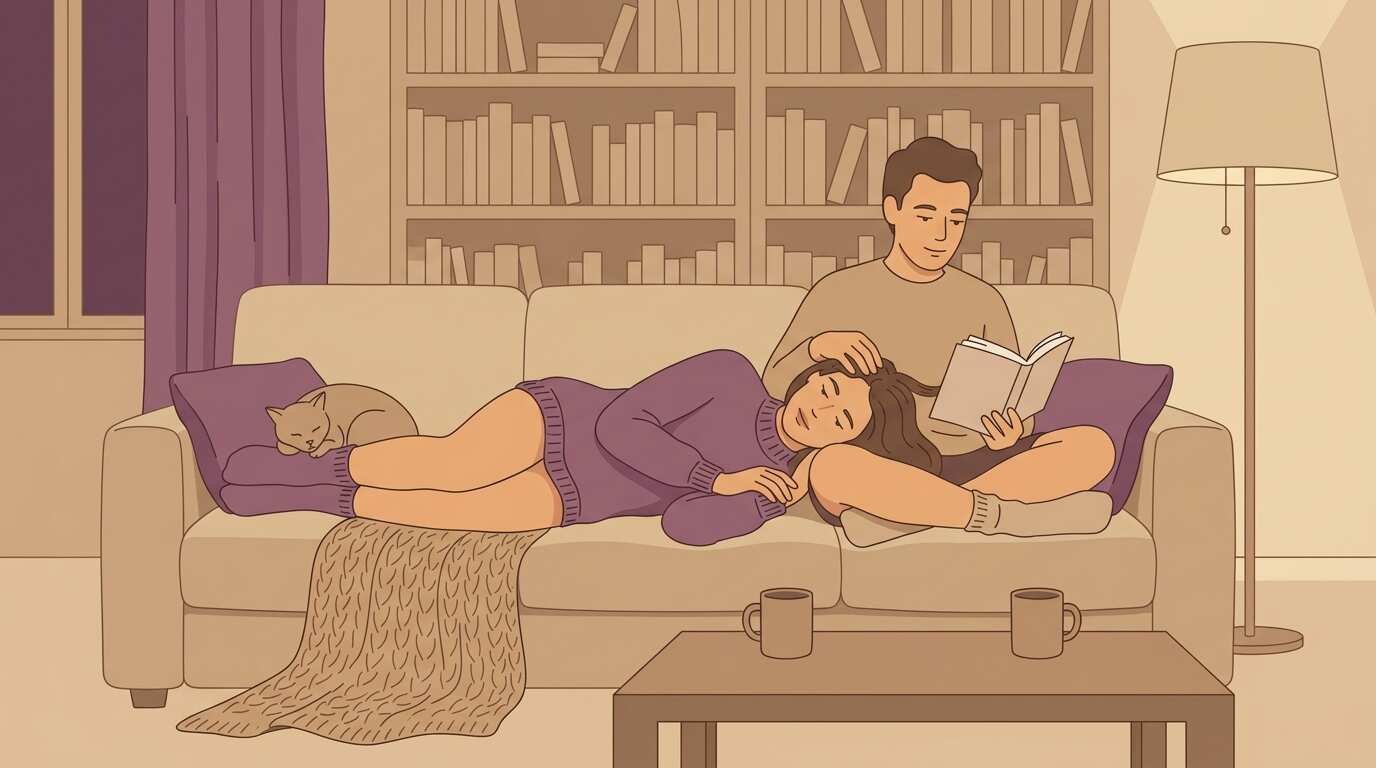
Hair stroking and scalp massage. This activates the C-tactile afferents particularly well because of the density of these nerve fibers in the scalp. It also requires a posture of vulnerability (one partner's head in the other's lap or hands), which contributes to the intimacy component.
The Gottman six-second kiss. John Gottman recommends that couples kiss for at least six seconds when saying goodbye and when reuniting. Six seconds is long enough that it requires actual presence. You can't phone in a six-second kiss. It forces both partners out of autopilot and into the moment.
How do you rebuild a touch habit when you've lost it?
If you've gone months or years with minimal non-sexual touch, you can't flip a switch and return to early-relationship levels of physical contact. The re-entry needs to be gradual, or it'll feel forced and create more resistance.
Start with proximity, not contact. Sit closer on the couch. Stand next to each other in the kitchen instead of across from each other. Share the same side of a booth at a restaurant. Proximity is the precondition for touch, and if you've drifted apart physically, you need to close the literal gap before the figurative one.
Name it. Tell your partner you want more physical touch that isn't about sex. This conversation is uncomfortable for most people, but it eliminates the ambiguity that kills touch in long-term relationships. Something as simple as "I miss holding your hand" does more work than a month of hoping they'll notice.
Attach touch to existing rituals. This is where habit research helps. Behavioral scientist BJ Fogg's work on tiny habits shows that new behaviors stick best when anchored to existing routines. Kiss for six seconds when you leave in the morning. Put your hand on their back when you're both brushing teeth. Hold hands during the first five minutes of a show you watch together. The anchor makes it automatic.
Don't keep score. If you're tracking who initiates more, you've already lost the thread. The goal is to increase the total amount of touch in the relationship, not to achieve a perfectly balanced ledger.
Accept that it'll feel awkward at first. If you haven't held hands in two years, the first time will feel strange. That's not a sign it's wrong. It's a sign you've been apart for a while. The awkwardness fades faster than you'd expect.
What if one partner needs more touch and the other needs less?
This is common and it's not a compatibility failure. Touch need varies between people for reasons including attachment style, sensory processing, past trauma, and simple individual wiring.
The mistake most couples make is treating the difference as a problem with a winner and a loser. Either the high-touch partner gets what they want and the low-touch partner feels overwhelmed, or the low-touch partner's preference wins and the high-touch partner feels starved.
The better approach is what researchers call a "negotiated middle." This means both partners move toward each other rather than one person capitulating.
For the partner who wants less touch: Identify the types of touch that feel good versus the types that feel intrusive. Most people who describe themselves as "not touchy" have specific forms of touch they actually enjoy. Maybe you don't like being hugged from behind but you like having your feet rubbed. Maybe sustained hand-holding is fine but random arm-touching while you're cooking is irritating. Specificity helps.
For the partner who wants more touch: Understand that your partner's lower touch need isn't a rejection. It's a genuine sensory preference. Pressuring them to match your level will produce compliance, not connection. The goal is willing touch, not obligated touch.
Both partners benefit from having a signal system. Some couples use a simple check-in: "Is now a good time for a hug?" It sounds clinical on paper, but in practice it removes the guesswork and prevents the cycle where one partner initiates, the other pulls back, and the first partner stops trying.
Aperi's daily questions include prompts designed to open conversations about physical and emotional intimacy needs, the kind of topics most couples think about but rarely say out loud. One question a day can close the gap between what you want and what you're willing to ask for.
Does physical touch affect emotional intimacy?
Yes, and the relationship runs both directions. Touch increases emotional closeness, and emotional closeness increases willingness to touch. This is why couples in conflict often stop touching first and stop talking second. The physical withdrawal is both a symptom and a cause.
Dacher Keltner's research at UC Berkeley demonstrated that touch communicates specific emotions, including gratitude, sympathy, love, and sadness, with accuracy rates comparable to facial expressions. Touch isn't a vague "feel-good" mechanism. It's a communication channel. When you touch your partner, you're saying something. When you stop touching them, you're saying something too.
For couples who feel emotionally distant, rebuilding touch can be a faster entry point than trying to fix communication patterns. A 20-second hug doesn't require the right words. It doesn't trigger defensiveness. It bypasses the verbal arguments entirely and speaks directly to the attachment system. It's not a substitute for working through emotional issues, but it can create enough safety for those harder conversations to happen.
The research from Light and colleagues supports this: higher physical affection correlated not just with lower blood pressure, but with higher relationship satisfaction and lower perceived stress. Touch isn't a luxury. It's infrastructure.
How do you maintain non-sexual touch over years?
The couples who maintain physical affection long-term don't do it because they're more affectionate by nature. They do it because they've built it into their daily patterns. Evening rituals that include physical proximity. Morning routines that include a real kiss. A habit of sitting close rather than apart.
The research is consistent: consistency beats intensity. One 20-second hug every day does more for your relationship than an all-day cuddle session once a month. Your nervous system responds to frequency, not magnitude.
Start where you are. If you're currently at zero non-sexual touch per day, the goal isn't to become a couple that can't keep their hands off each other. The goal is one intentional moment of physical connection per day. Then two. Then it stops being something you think about and becomes something you just do. That's when it starts working.
Frequently Asked Questions
How much non-sexual touch do couples need per day?
There's no universal number, but the research from Kathleen Light's lab suggests that multiple daily instances of affectionate touch (hugging, hand-holding, casual contact) correlate with measurable health benefits. Gottman recommends at least six deliberate touches per day, including a six-second kiss. The more useful target is "noticeably more than you're doing now," because the ideal amount varies between couples.
Can non-sexual touch replace sexual intimacy?
No. They serve different functions in the nervous system and the relationship. Non-sexual touch maintains felt security and daily connection. Sexual intimacy involves desire, arousal, and a different neurological pathway. Couples need both, though the balance varies. The problem arises when non-sexual touch disappears and sex becomes the only form of physical contact, which overloads sex with the burden of meeting all physical connection needs.
What if my partner flinches or pulls away when I try to touch them?
A flinch response usually signals one of a few things: past trauma, sensory overload, unresolved conflict, or the touch feeling like a sexual advance when they're not in that headspace. Don't interpret it as personal rejection without a conversation. Ask them directly, at a neutral time (not immediately after the flinch), what types of touch feel comfortable and which don't. If the flinch is consistent across all forms of touch, a therapist experienced in attachment or trauma work can help.
Is it normal for physical affection to decline after the first year?
Yes. Habituation is a normal neurological process, and the intensity of early-relationship touch is partly driven by novelty and elevated dopamine that naturally settles. The decline itself isn't the problem. The problem is when it declines to near-zero and neither partner addresses it. Couples who maintain physical affection long-term do so through intentional habits, not sustained passion.
Aperi: one question a day
A daily question app that adapts to you and your partner, and goes deeper the more you use it.


Free to start. Available on iPhone and Android.
Explore question packs
Related articles
Writing a love letter that doesn't sound cheesy
Most love letters fail because they're too generic. A framework for writing one that actually means something.

68 questions to reconnect with your partner, from safe to close
Questions to reconnect with your partner when things feel distant: 68 questions sequenced from easy to close, because the way back is small, not dramatic.
76 vulnerable questions to ask your partner, from shallow end to deep water
76 vulnerable questions to ask your partner, arranged from mildly open to deeply personal, built on the graduated self-disclosure behind the 36 questions.

What attachment theory gets wrong
A balanced look at attachment theory: where the pop psychology version misleads, what the science actually supports, and how to use it without being defined by it.
What happy couples do differently
Decades of research and thousands of hours of clinical observation reveal what thriving couples actually do. Most of it is boring.

Why most relationship advice is wrong
Much of what we believe about relationships is based on intuition, not evidence. Here's what longitudinal research actually shows.