Key Takeaways
Most conversation starters get one answer and stop, and the follow-up question is what turns them into a conversation. These 73 starters are grouped by the situation you are in (dinner, the car, bed, after a long day, a walk, chores, weekend coffee, texting), and each section ends with a note on the follow-up that works best there.
Most lists of conversation starters for couples are written as if you'll read them at a candlelit table with nowhere to be. Real conversations happen in less flattering places: in the car on the way to your sister's, over a dinner one of you cooked while answering emails, in bed with the lights already off. The question that works at a restaurant falls flat at 7 a.m. in traffic, and the one that's perfect for a long drive is too much for someone who just walked in from a ten-hour shift.
The other problem is that a starter gets one answer. You ask, your partner says something reasonable, and the exchange stops. Whether it turns into a conversation depends on the second question, the one that picks up a word from their answer and asks about it. Karen Huang's research at Harvard found that follow-up questions were the type most strongly linked to being liked by the person you're talking to, and we've written about the art of the follow-up question at length.
The 73 starters below are grouped by situation, and each section ends with a note on the follow-up that tends to work there. A few starters carry a suggested follow-up in italics.
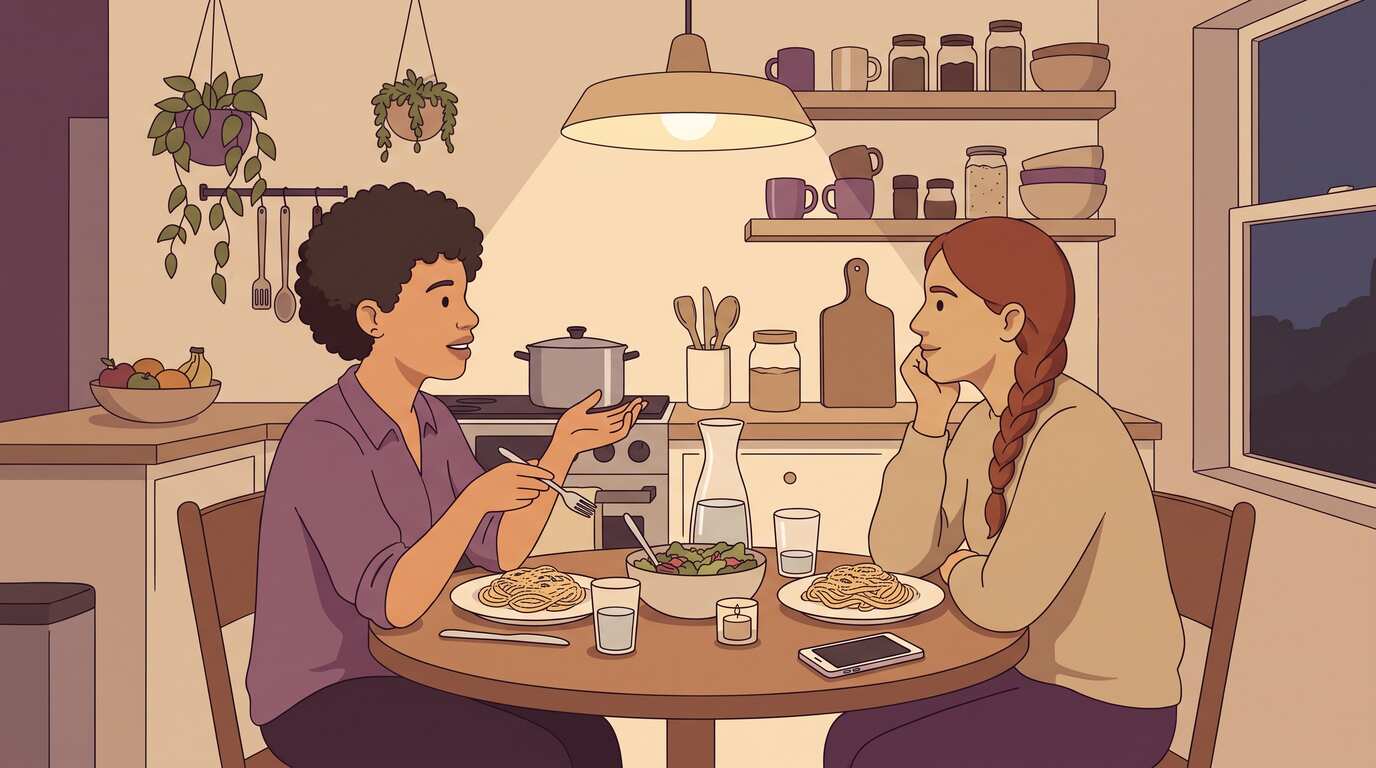
Conversation starters for couples at dinner
Dinner is where most couples talk every day, and where logistics take over fastest. These are for a weeknight meal: light enough that nobody feels ambushed, specific enough that "fine" isn't an available answer. If what you mostly need is a replacement for the end-of-day check-in, our list of questions to ask instead of "how was your day?" covers that ground.
- What's a meal from your childhood you'd want to taste again, made exactly the way it was? Follow-up: who made it, and where were you sitting?
- Which of your friends would you trust to plan our entire weekend without telling us anything?
- What's an opinion you hold that you'd defend to me but never in public?
- What's a dish you've never cooked because you're afraid of ruining it?
- What did you want to be at ten years old, and how much of that kid is still in your job?
- What's something you've gotten better at this year that nobody has noticed?
- Which restaurant from our past would you go back to, even if the food turned out worse than you remember?
- What's a rule your family had at the dinner table that you still follow without thinking?
- What's the most useful piece of advice you've ignored? Follow-up: who gave it to you, and were they right?
- What's something a coworker does that you've quietly started copying?
- What's a small thing you bought this year that improved your life more than it should have?
- What's a news story from this week you haven't stopped thinking about?
At dinner the best follow-up is usually about a person. Most of these answers involve someone, a grandmother or a coworker or an old friend, and "what were they like?" pulls in the story behind the answer.
In the car
The car is underrated for conversation. You sit side by side, nobody has to hold eye contact, and arriving gives the conversation a natural end, so you can bring something up without committing to an hour on it. Parents of teenagers know their kids talk more in the car, and adults are the same. For long drives, there's a full set of road trip questions.
- What song would you put on right now if I weren't allowed to skip it? Follow-up: when did you first hear it?
- If we kept driving past where we're going, where would you want to end up by tonight?
- Which town we've driven through would you live in for a year?
- What's a road you drove all the time when you were younger, and where did it take you?
- Who taught you to drive, and how did that go?
- What's something you've been putting off that you'd do this week if I took one of your errands?
- What's a plan you had for your twenties that didn't happen, and are you glad it didn't?
- If you had a podcast, what would the first five episodes be about?
- What's a place you'd love to show me that I've never seen?
- Which shop sign or house on this route have you always wondered about?
- What's a conversation you replayed in your head this week?
In the car, stay in the hypothetical longer than feels necessary. If your partner says they'd drive to the coast, ask what the first night there looks like and where you'd eat. A hypothetical tells you what someone wants once it has run for three or four turns; the first answer only gives you a destination.
In bed
Bedtime conversation is quieter and more honest than the daytime kind, because tiredness thins the filter that edits what people say. These are short on purpose, since nobody wants a ten-part question at 11 p.m. Our pillow talk questions go further into this window.
- What's a moment from today you'd keep if you could only keep one?
- What's the last dream you remember?
- What's something you're quietly worried about that would feel lighter if you said it out loud? Follow-up: do you want help with it, or do you just want me to know?
- What's one thing you'd like tomorrow to have in it?
- What's a sound or smell that makes you feel safe?
- What's a compliment someone gave you years ago that you still remember?
- What's a version of yourself from the past that you miss a little?
- What's something about the way I sleep that you've never told me?
- What's a small thing I could do in the morning that would make your day start better?
- What were you like as a kid at bedtime?
At night the follow-up should be shorter than the question. "Say more" works better than a new question, and so does a pause. If the answer comes back half-asleep, bring it up at breakfast instead, which tells your partner you were listening.
After a long day
When one of you comes home depleted, a hypothetical or a question about childhood asks too much. What helps is a question that requires very little and lets them choose how much to say. Some of these are closer to offers than questions.
- Do you want to talk about today, or do you want to not think about it for an hour?
- What's the one part of today you'd delete if you could?
- On a scale from "fine" to "please don't ask," where are you?
- What would make the next two hours good for you?
- Who was the most difficult person you dealt with today? Follow-up: what do you think was going on with them?
- Was there a moment today when you wished I was there?
- What are you still carrying from work that you'd like to put down?
- Is there something from today you want my opinion on, or just my sympathy?
- Who was kind to you today?
- What do you need from me tonight: company, quiet, or a distraction?
After a hard day, the follow-up shows whether you heard the request inside the answer. If your partner wants sympathy, ask "what happened next?" and say nothing about what they should do, because unrequested advice ends the conversation. If they want quiet, come back later with "you mentioned the meeting earlier, how are you feeling about it now?"
On a walk
Walking has the car's side-by-side advantage, and you're both looking at the same things. Walks suit slower questions about the future and about change.
- What's something you're more relaxed about now than you were when we met?
- If we had to move away, what would you miss most about this neighborhood?
- What's a habit you want to drop before next year, and one you want to start?
- Whose life looks good to you from the outside, and which part of it do you want?
- What's a decision from the last few years that turned out better than you expected? Follow-up: what almost made you decide the other way?
- What's something you've stopped wanting that you used to want badly?
- If you had a free year with the money covered, how would you spend the first month?
- Is there a friendship you'd like to put more into?
On a walk, the most useful follow-up is "why now?" If your partner says they want to put more into a friendship, ask what brought it up this month. There's usually something recent behind a want that surfaces on a walk.
While cooking or cleaning up
Chores occupy your hands and leave your attention free, which suits playful and slightly ridiculous questions. If one goes nowhere, you still have the dishes to do. This is also the time most often lost to podcasts, so a starter here is worth more than it looks.
- What's a kitchen habit of mine you've silently tolerated for years?
- Which ingredient do you think is overrated, and which one deserves more credit?
- If you had to teach a class on one household task, which one are you qualified for?
- What's the worst meal you've been served at someone else's house, and did you finish it?
- Which chore did your parents argue about, and do we argue about the same one? Follow-up: who do you think was right?
- If our kitchen could only have five tools, which ones are you keeping?
- What smell from this kitchen do you think you'll associate with us in ten years?
- Who's the best cook you've ever known, and what did they do that others didn't?
With lighter questions, ask for the specific moment. "Worst meal" gets a one-line answer, and "what did you say to the host?" gets the story. Some of these go further than they look: the chore your parents fought over tends to turn into a conversation about how each of you was raised.
Over weekend coffee
A weekend morning without a schedule is the closest most couples get to unhurried time. These need more thought and lean toward the relationship itself. For longer conversations in this register, our deep questions for couples are organized by depth level.
- What's something we used to do together that you'd like to bring back?
- What's a disagreement of ours that you now think I was right about? Follow-up: when did you change your mind?
- Which year of our relationship would you call the best so far, and what made it that one?
- What's something about how I grew up that you still find hard to understand?
- What's something you assume I know about you that you've never said?
- If we each wrote down three rules for how we spend weekends, what would yours be?
- What do you think our friends get wrong about us as a couple?
- Which part of our week feels most like us, and which part feels like we're running a small company?
Questions about the relationship get polished answers first. To get past them, ask "and what's the less diplomatic version?" with a smile, which gives your partner permission to say it without turning the morning into a performance review.
Over text, when you're apart
Texting is a poor place for a heavy conversation and a good place to start one. A question sent at lunch gives your partner the afternoon to think.
- Send me a photo of whatever's in front of you and tell me one thing about it.
- What's something you'd like us to talk about tonight?
- What's a memory of us that came back to you for no reason this week?
- What's one thing you're looking forward to when you get home?
- What's one word for your mood right now, and why that word?
- What did you overhear today that made you laugh?
Save the follow-up to a texted starter for when you see each other: "you said that memory came back to you, tell me about it." It shows you read the message properly and moves the conversation somewhere it can go further.
How to use these
Pick one starter for the situation you're in and leave the rest for another day, since a list read aloud turns into an interview. Answer your own question too, before or after your partner; a question you won't answer yourself reads as a quiz.
For the follow-up, take one specific word from their answer and ask about it. If the meal they miss is their grandmother's soup, ask about the grandmother or the soup, and your own grandmother can wait. Two or three follow-ups is plenty for a weeknight, and if the answers keep getting shorter, the topic is done for now.
If a starter gets "I don't know," offer your answer first. If short answers are a pattern rather than a bad evening, our guide to partners who give one-word answers covers what usually sits behind it. And if you're planning a proper night out, the separate list of conversation starters for date night is sorted by mood.
A starter that arrives every day
The hardest part of using conversation starters is remembering to. Aperi gives the two of you one question a day, matched over time to how you both answer, so the starter is already chosen before dinner. Each of you answers on your own, and your partner can't read your answer until they've written theirs. Because of that double-blind reveal, neither answer is shaped by the other, and you start the conversation with two honest answers side by side. Where they differ is usually the best follow-up you could ask.
FAQ
What are good conversation topics for couples? The topics that last are the ones where your partner's answer can still surprise you: family habits, the people in their life right now, things they've changed their mind about, and your relationship's history as each of you remembers it. Settled topics like favorite films run out quickly. The specific question matters more than the topic, so "what's a rule your family had at the dinner table?" works where "tell me about your family" doesn't.
What do couples talk about when they've run out of things to say? Usually they've stopped asking about the parts of each other that keep changing, such as current worries, new opinions and friendships. Specific questions help more than new topics, and so does a different setting, since the car or a walk often produces conversation the dinner table doesn't. If the silence has lasted months, our piece on why couples stop talking explains how the pattern builds.
How do you keep a conversation going with your partner? Ask about something specific in their answer before adding anything of your own. "What happened next?" and "why now?" cover most situations. Match the follow-up to the setting: short in bed, led by them after a long day. Stop when the answers get shorter and pick the thread up later.
How do you start a deep conversation with your partner? Start lighter than you think you need to and let the follow-ups go deeper. "What's a decision that turned out better than you expected?" often reaches fears and values within three follow-ups, without the pressure of opening with "what are you most afraid of?" Pick a time when neither of you is rushed, and answer every question you ask. When you want to go further on purpose, a list sorted by depth like our deep questions for couples lets you move up one level at a time.
Aperi: one question a day
A daily question app that adapts to you and your partner, and goes deeper the more you use it.


Free to start. Available on iPhone and Android.
Explore question packs
Related articles
50 couples therapy questions, in the order a therapist would ask them
50 couples therapy questions sequenced like a real session: history, patterns, needs, repair, future. Plus an honest look at when a list is not enough.
Questions for couples who feel stuck
30 questions for couples who feel stuck, organized by difficulty. Start with safe questions and work toward the things you have been avoiding.
Check-in questions for couples: daily, weekly, monthly, yearly
Check-in questions for couples sorted by cadence: daily two-minute rounds, weekly check-ins, monthly resets, and the annual review, each with a short script.
67 uncomfortable questions to ask your partner and the ground rules that keep them safe
Uncomfortable questions to ask your partner: 67 honest but gentle prompts, plus how to ask consent, pick your moment, and repair if one lands badly.
Hard questions to ask your partner before life asks them for you
Hard questions to ask your partner about money, family, fears, and the future: 63 serious prompts, plus how to time them so honesty builds trust.
Intercultural relationships: the conversations you can't skip
Intercultural couples face friction points most same-culture couples never think about. Here are the conversations that matter most.