Key Takeaways
Jealousy is a normal emotional signal, not proof of insecurity or possessiveness. But what you do with it matters. Attachment theory explains most jealousy patterns better than evolutionary psychology. The response differs depending on whether you're the jealous one or the partner being targeted by jealousy. The line between normal jealousy and controlling behavior is clearer than people think.
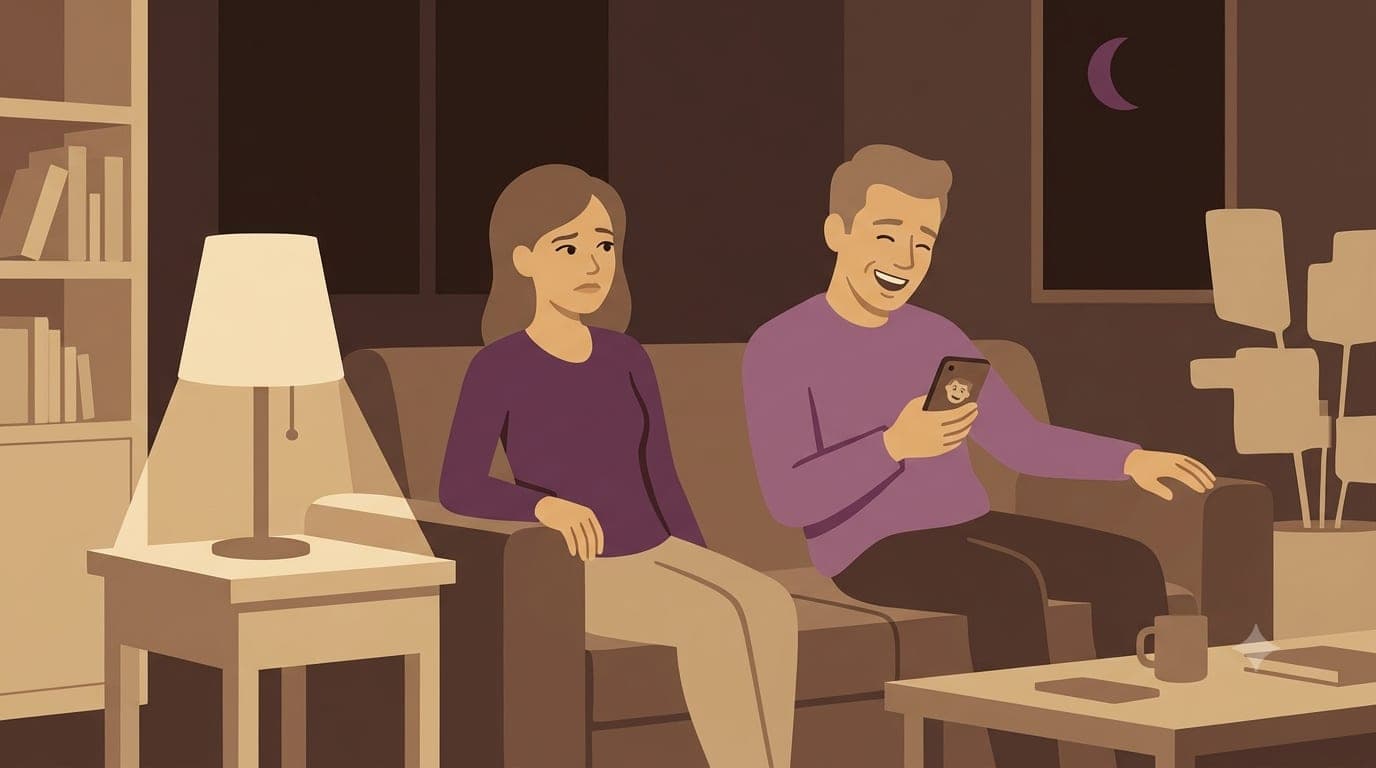
Nobody wants to be the jealous one. It feels petty, irrational, embarrassing. You see your partner talking to someone attractive and something tightens in your chest. You notice a text notification and your mind starts building scenarios. You tell yourself to stop. You know it's irrational. But the feeling doesn't care about your logic.
Or maybe you're on the other side. Your partner asks who you were talking to. Checks your phone. Gets quiet after you mention a coworker. You want to be understanding, but it feels suffocating. Where's the line between their feelings and your freedom?
Jealousy is one of the most universal human emotions and one of the least well-handled. People either suppress it (which doesn't work) or act on it (which usually makes things worse). There's a better approach, but it requires understanding what jealousy actually is and what it's trying to tell you.
Is jealousy a character flaw or a signal?
Neither camp has it exactly right. The "jealousy is natural" crowd uses it to excuse controlling behavior. The "jealousy means you're insecure" crowd pathologizes a normal emotion. The truth is somewhere more interesting.
David Buss, an evolutionary psychologist at the University of Texas, has argued since the early 1990s that jealousy evolved as a mate-retention mechanism. His research suggests it's an adaptive response to perceived threats to a valued relationship. In evolutionary terms, the cost of not being jealous (losing a partner to a rival) was higher than the cost of jealousy (occasional false alarms), so the emotion persisted.
This is intellectually interesting but practically useless. Knowing that jealousy might have evolutionary origins doesn't help you deal with it at 11pm when your partner hasn't responded to your text and you're imagining why.
Attachment theory offers a more actionable framework. Developed by John Bowlby and extended to adult romance by Cindy Hazan and Phillip Shaver, attachment theory proposes that our early experiences with caregivers create templates for how we handle closeness and threat in adult relationships. And jealousy maps directly onto these templates.
Anxiously attached people tend toward hypervigilant jealousy. Their attachment system is calibrated to detect threat at low thresholds, so they notice potential rivals faster, interpret ambiguous situations as threatening more often, and experience more intense emotional responses to perceived threats. This isn't pathology. It's a nervous system that learned early that connection is unreliable and that vigilance is necessary.
Avoidantly attached people experience jealousy too, but often differently. They're more prone to what researchers call retroactive jealousy, the painful fixation on a partner's past relationships. Since avoidant individuals tend to suppress emotional needs in the present, their jealousy often attaches to things that have already happened, where there's no action to take, only rumination.
Securely attached people feel jealousy too. But they experience it as a temporary signal rather than a chronic state. They can feel the pang and then reality-check it: "Am I actually threatened, or is this old wiring?" Understanding how attachment styles shape relationships makes this whole topic easier to work with.
What's the difference between normal jealousy and a problem?
Donatella Marazziti and Stefano Baroni, researchers at the University of Pisa, published work distinguishing between normal jealousy, anxious jealousy, and delusional jealousy. The distinctions matter because the response to each is different.
Normal jealousy is proportional and temporary. Your partner dances with someone at a party and you feel a twinge. You notice it, maybe mention it later, and it passes. The emotion matches the situation and doesn't outlast it.
Anxious jealousy is disproportionate to the trigger but the person experiencing it knows, on some level, that it's disproportionate. You see your partner like someone's Instagram post and spend the next two hours spiraling. You know you're overreacting. You can't stop. This is the most common form of problematic jealousy in otherwise healthy relationships, and it's almost always rooted in attachment anxiety.
Delusional jealousy involves fixed beliefs about infidelity that aren't supported by evidence and can't be corrected by evidence. This is a clinical concern and may involve conditions like Othello syndrome or obsessive-compulsive spectrum disorders. It requires professional intervention, not a blog post.
Most people reading this are dealing with the first or second type. The response is different for each.
What do you do when you're the jealous one?
Feeling jealous doesn't make you bad. Acting on it without reflection does. The space between feeling and action is where the work happens.
Step one: notice without judging. The feeling is data, not a verdict. "I'm feeling jealous" is an observation. "I'm such a jealous mess" is a story you're telling about yourself that makes the feeling harder to work with. Name it simply and resist the urge to either suppress it or spiral.
Step two: reality-check the trigger. What specifically set this off? Was there an actual event, or did you fill in blanks with your worst-case scenario? Jealousy thrives in ambiguity. The less you know, the more your brain invents. Often, getting specific about what actually happened (vs. what you imagined) deflates the emotion significantly.
Step three: trace it back. Is this about the current situation, or is it touching something older? If you've been cheated on before, your threshold for threat detection is lower. That's not irrational. It's learned. But the current situation needs to be evaluated on its own merits, not filtered entirely through the lens of the past.
Step four: communicate without accusing. This is the hardest part. "I felt jealous when you were talking to that person at the party, and I know that's my stuff, but I wanted to tell you about it" is worlds apart from "Why were you flirting with that person?" The first opens a conversation. The second starts a fight.
The temptation when jealous is to seek reassurance: "You're not attracted to them, right? You'd never cheat?" This works once. If it becomes a pattern, it stops working because reassurance doesn't fix the underlying anxiety. It just temporarily soothes it, and then the anxiety returns, needing more reassurance, ad infinitum. If you find yourself needing constant reassurance, the work isn't in getting more of it. It's in building internal security.
What do you do when your partner is jealous?
This is a balancing act between validation and boundaries. Too much accommodation reinforces the jealousy. Too little makes your partner feel dismissed.
Validate the emotion, not the interpretation. "I can see you're feeling anxious about this, and I take that seriously" is different from "You're right, I shouldn't have talked to that person." The first acknowledges their experience. The second confirms their fear and teaches them that jealousy gets results.
Be transparent without being controlled. If your partner asks who you had lunch with, telling them isn't capitulation. Transparency in relationships is healthy. But if they're monitoring your every interaction, requiring you to report your whereabouts, or dictating who you can spend time with, that's crossed from jealousy into control. The line is: are they seeking connection and reassurance, or are they seeking surveillance and restriction?
Don't punish them for feeling it. "You're being crazy" is the least useful sentence in this situation. Jealousy already feels embarrassing. Shaming someone for it guarantees they'll suppress it next time instead of talking about it, and suppressed jealousy comes out sideways.
Be honest about ambiguous situations. If your partner is jealous about a specific person and you know, in your honest self-assessment, that there's something there, not an affair, but a frisson of attraction, an emotionally charged friendship, a flirtation you haven't fully examined, then dismissing your partner's jealousy as irrational is gaslighting. Sometimes the jealous person is picking up on something real that you haven't been honest with yourself about.
Emotional safety is what allows both people to be honest about jealousy without it turning into an interrogation or a shutdown.
How does social media change the jealousy equation?
Amy Muise, a social psychologist then at the University of Guelph, published research in 2009 showing that Facebook use was positively associated with jealousy in romantic relationships. Not because social media creates jealousy from nothing, but because it provides a constant stream of ambiguous information that jealousy feeds on.
You see your partner liked someone's photo. You see a comment from someone you don't know. You see they're following someone new. Each of these is meaningless in isolation. But for someone with jealousy tendencies, each one is a thread to pull. And social media provides unlimited threads.
The problem is structural. Before social media, your partner's social interactions were mostly invisible to you. Now they're partially visible, which is worse than either fully visible or fully invisible. You see enough to wonder but not enough to know. That information gap is jealousy's favorite habitat.
Some couples address this with digital boundaries: agreements about what they share online, what they keep private, and how they handle ambiguous social media interactions. These work best when they're discussed proactively (before jealousy hits) and framed as mutual agreements rather than restrictions.
Others find that reducing social media surveillance helps more than any boundary could. If checking your partner's followers list has become a compulsive habit, the solution isn't a better followers list. It's breaking the checking behavior.
When does jealousy become a red flag?
There's a line, and it's not as blurry as people pretend.
Jealousy is normal when it's an internal emotional experience that the person takes responsibility for managing. It's a red flag when it becomes external behavior designed to control the partner.
Specific red flags:
- Monitoring your phone, email, or social media without permission
- Demanding to know your whereabouts at all times
- Restricting who you can see, talk to, or spend time with
- Punishing you (with silence, anger, or withdrawal) for normal social interactions
- Accusing you of infidelity without evidence, repeatedly
- Isolating you from friends and family under the guise of "wanting to be together"
These behaviors aren't jealousy. They're control. And they're associated with abusive relationship dynamics that tend to escalate over time. If this list describes your situation, the conversation is about safety, not managing jealousy. The relationship red flags guide covers this more directly.
Can a relationship survive jealousy?
Normal and anxious jealousy, yes. Plenty of happy couples include one or both partners who experience jealousy. What makes it survivable is: the jealous partner takes responsibility for their emotion rather than making it their partner's problem, both people can talk about it without defensiveness, and the response doesn't include controlling behavior.
Some couples actually report that occasional, well-handled jealousy strengthens their bond. When you tell your partner "I got jealous tonight and I wanted you to know" and they respond with warmth rather than irritation, it's a moment of vulnerability that brings you closer. The emotion itself isn't the issue. It's the container around it.
Jealousy that comes from genuine relationship threats (a partner who actually is crossing lines) is a different situation. That's not an internal management problem. It's a relationship problem that requires honest conversation and possibly difficult decisions about whether trust can be rebuilt.
Aperi includes questions designed to surface these dynamics gently. Rather than waiting for a jealousy-triggering event and trying to process it in the heat of the moment, couples who regularly discuss trust, security, and attraction in a low-stakes context build the vocabulary and safety they need for the harder conversations when they arise.
Frequently asked questions
Is it normal to feel jealous about my partner's past relationships?
Yes, and it's more common than people admit. Retroactive jealousy, the preoccupation with a partner's romantic or sexual history, affects a significant number of people. It becomes a problem when it interferes with the present: when you can't stop asking about their ex, when knowing details makes you feel worse but you keep seeking them, or when you hold their past against them. If the past isn't affecting the present relationship, the work is in accepting that your partner existed before you and that their history shaped the person you love.
My partner says I have nothing to worry about, so why do I still feel jealous?
Because jealousy isn't a rational calculation. It's an emotional response driven by your attachment system, not by the facts of the situation. Reassurance addresses the logical layer but doesn't reach the emotional one. If reassurance reliably fixed jealousy, nobody would experience it more than once. The deeper work involves understanding what the jealousy is really about: fear of abandonment, low self-worth, past betrayal, or an attachment style that keeps the threat detection system on high alert.
How do I deal with jealousy about my partner's opposite-sex friendships?
Start by separating your feeling from your demand. Feeling uncomfortable about a friendship is valid. Demanding your partner end it because you're uncomfortable is a different thing. The question is: does this friendship actually threaten the relationship, or does it trigger your insecurity? If the friendship includes secretive behavior, emotional intimacy that excludes you, or crossed boundaries, that's a legitimate concern to raise. If it's a normal friendship that makes you anxious, the work is largely yours to do, with your partner's support and transparency.
Can therapy help with jealousy?
Very much so. Cognitive-behavioral therapy (CBT) is effective for the thought patterns that drive jealousy, like catastrophizing and mind-reading. Emotionally Focused Therapy (EFT) addresses the attachment dynamics underneath. If jealousy is rooted in past relationship trauma, EMDR or trauma-focused therapy can help reduce the intensity of the threat response. A good therapist won't tell you to stop feeling jealous. They'll help you understand the feeling and change your relationship with it.
What if both of us are jealous?
This is more common than people assume, and it creates a particular dynamic where both partners are simultaneously seeking reassurance and struggling to provide it. The risk is mutual surveillance: both checking up on each other, both restricting each other's social lives, both escalating in response to the other's anxiety. Breaking this cycle usually requires at least one person to take the first step of being transparent and non-controlling, even while still feeling insecure. It's uncomfortable. But someone has to go first, and waiting for your partner to be less jealous before you are is a stalemate.
Aperi: one question a day
A daily question app that adapts to you and your partner, and goes deeper the more you use it.


Free to start. Available on iPhone and Android.
Explore question packs
Related articles
Why personal growth sometimes threatens your relationship
When one partner grows, the relationship system gets disrupted. Why that happens and how to handle it.
The difference between needing and wanting your partner
Is it better to need or want your partner? The real answer is more complicated than Instagram quotes suggest.
Building self-worth that doesn't depend on your partner
When your self-worth depends on your partner's approval, every interaction becomes high-stakes. Here's how to build an internal foundation.
When you project your insecurities onto your partner
Projection makes you fight about things that aren't real. How to catch it, understand where it comes from, and stop.
Why boredom in your relationship isn't always bad
Relationship boredom gets a bad reputation. Sometimes it signals safety. Sometimes it signals stagnation. Here is how to tell the difference.
When you and your partner speak different love languages
You show love your way, not theirs. How to close the gap when you and your partner express affection differently, beyond the quiz.