Key Takeaways
The silent treatment triggers the brain's physical pain centers, creating anxiety, self-blame, and hypervigilance in the person on the receiving end. It's different from stonewalling, which comes from emotional overwhelm rather than intent to punish. Breaking the pattern requires understanding which one you're dealing with and responding accordingly.
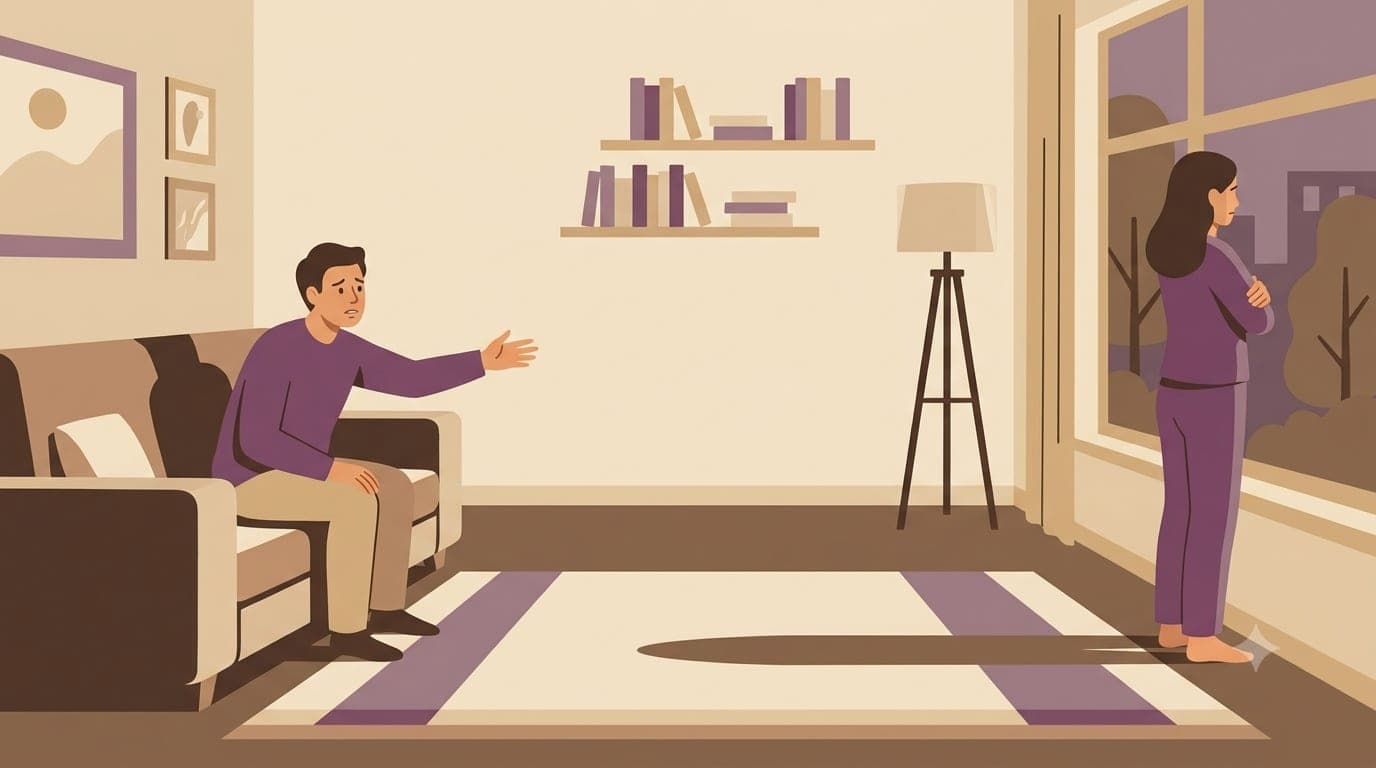
You're mid-conversation. Maybe it's about the dishes, maybe it's about something that actually matters. Your partner goes quiet. Not the pause-to-think kind of quiet. The kind where their face closes, they leave the room, and you spend the next six hours wondering what just happened and whether you should say something or wait it out.
You've just entered one of the most psychologically damaging patterns in romantic relationships. And the worst part is, most people don't recognize how much damage it does because nobody's yelling and nothing's broken.
What happens in your brain during the silent treatment?
In 2003, Naomi Eisenberger and Matthew Lieberman at UCLA ran an fMRI study that changed how psychologists think about social exclusion. They had participants play a computerized ball-tossing game while lying in a brain scanner. Partway through, the other "players" (actually controlled by the researchers) stopped throwing the ball to the participant.
The result: being excluded activated the dorsal anterior cingulate cortex and the anterior insula. These are the same regions that light up during physical pain. Not metaphorically the same. The same neural circuits, processing social rejection and a broken arm through overlapping hardware.
Eisenberger's work showed that the brain doesn't distinguish cleanly between physical and social pain. When someone you love refuses to acknowledge your existence, your nervous system processes it as a threat on par with bodily harm. This isn't weakness or oversensitivity. It's how human brains are wired.
Kipling Williams at Purdue University has spent over two decades studying ostracism specifically. His research, including dozens of experiments using a paradigm called Cyberball (similar to Eisenberger's ball-tossing setup), consistently shows that even brief episodes of being ignored produce drops in four fundamental psychological needs: belonging, self-esteem, control, and meaningful existence.
The silent treatment doesn't just make you feel bad. It makes you question whether you matter.
Is stonewalling the same thing as the silent treatment?
No, and the distinction is important. John Gottman identified stonewalling as one of the "Four Horsemen" that predict relationship failure, but he's careful to distinguish it from the silent treatment as a punishment tactic.
Stonewalling, in Gottman's framework, happens when someone becomes physiologically flooded during conflict. Their heart rate spikes above roughly 100 beats per minute, their body dumps cortisol, and their prefrontal cortex goes partially offline. They withdraw not to punish but because they literally cannot process the conversation anymore. Their system has hit a wall.
Gottman's research shows that men are more prone to flooding during conflict than women, though it happens to everyone. When someone is flooded, their capacity for empathy, active listening, and creative problem-solving drops to near zero. Continuing the conversation in that state makes things worse, not better.
The silent treatment is different. It's withdrawal as strategy. The person using it may or may not be emotionally overwhelmed, but the function of their silence is to punish, control, or communicate displeasure without saying what they actually feel. It can last hours, days, or in extreme cases, weeks.
The difference is visible: stonewalling usually comes with signs of distress. The person looks overwhelmed, agitated, shut down. They may say "I can't do this right now" or simply go blank. The silent treatment, by contrast, often involves calculated coldness. The person might function normally in every other context, talking to friends, going about their day, but pointedly excluding their partner from acknowledgment.
If your partner goes quiet during a fight and comes back 20 minutes later saying "I needed a break, I'm ready to talk now," that's healthy self-regulation. If your partner goes quiet and you spend the next two days in limbo wondering what you did wrong and whether you should apologize for something you're not sure you did, that's the silent treatment. More on how these stonewalling patterns develop and how to address them directly.
Why does the silent treatment cause so much damage?
Williams's ostracism research identifies a specific progression that happens in the person being excluded. It unfolds in three stages:
The reflexive stage. This is immediate and automatic. Pain, distress, a spike of negative emotion. It happens within seconds and it's not under conscious control. Even when participants in Williams's studies knew they were being excluded by a computer program, the pain response still fired. Knowing it's irrational doesn't stop it.
The reflective stage. This is where people try to make sense of what happened. And this is where the real psychological damage starts. The person being ignored begins to search for explanations, and because human brains have a negativity bias, the explanations tend to be self-blaming. What did I do? Was I too much? Should I have said that differently? This stage produces anxiety, rumination, and hypervigilance.
The resignation stage. If the silent treatment is chronic or repeated, people eventually stop trying to re-engage. They become depressed, withdrawn, and helpless. They learn that attempting to connect is futile, and they stop doing it. This is the stage where relationships die quietly.
The hypervigilance piece deserves emphasis. When you've been on the receiving end of the silent treatment repeatedly, you start scanning for early signs. You watch your partner's face when you say something. You monitor their tone. You notice when their texting pattern changes. This constant scanning is exhausting and it changes the fundamental dynamic of the relationship from one of emotional safety to one of threat monitoring.
Why do people use the silent treatment?
Understanding the motivation doesn't excuse the behavior, but it helps explain it.
Learned behavior. Many people who use the silent treatment grew up in households where it was the primary conflict strategy. If your parents dealt with disagreements by not speaking to each other for days, you absorbed that as normal. You might not even think of it as problematic because it's all you've ever known.
Emotional overwhelm without tools. Some people genuinely don't know how to express anger, hurt, or disappointment verbally. They weren't taught emotional vocabulary and they don't have a framework for conflict. Silence feels safer than saying something they can't take back. The problem is that this "safe" choice is actively harmful to the other person.
Control. In some cases, the silent treatment is a deliberate power move. By withholding communication, the person using it forces their partner into a submissive position: the partner has to guess, apologize, and work to re-establish contact. This dynamic puts all the power with the person who withdrew. When this is the motivation, it's a form of emotional abuse, and Williams himself has said as much publicly.
Avoidance of accountability. If you never have the conversation, you never have to take responsibility for your part in the conflict. Silence can function as a way to avoid admitting fault. The issue just... fades. Until it comes up again.
What should you do if you're on the receiving end?
The instinct is usually to chase. To send texts, to knock on the door, to apologize even when you're not sure what for. This instinct makes sense because your brain is in pain and it wants the pain to stop. But chasing often reinforces the pattern because it teaches the other person that silence gets results.
Name it, once. Say something like: "I notice you've stopped talking to me, and it's painful. I want to work this out. When you're ready to talk, I'm here." Then stop. You've communicated your willingness to engage. The ball is in their court.
Don't fill the silence with self-blame. The reflexive stage of ostracism will push you toward "What did I do wrong?" Resist that pull. You may have done something that contributed to the conflict. You didn't do anything that warrants being treated like you don't exist.
Set a time boundary. It's reasonable to give someone space to cool down. It's not reasonable to wait indefinitely for them to decide you exist again. If the silence extends beyond a day, it's appropriate to say: "I need us to talk about what happened. If you need more time, tell me when you'll be ready. But I can't just wait in limbo."
Recognize the pattern. If this happens regularly, it's not about the individual conflict. It's a pattern, and patterns don't resolve without direct intervention. Couples therapy is genuinely useful here because a therapist can help both people understand what's happening and build alternative conflict strategies. The communication guide covers the broader framework for how healthy conflict works.
How do you break the pattern if you're the one doing it?
This requires honesty about what your silence is actually doing. You might experience it as self-protection, but your partner experiences it as punishment. Both things can be true simultaneously.
Learn to say "I need a break" instead of disappearing. There's a world of difference between "I'm overwhelmed and I need 30 minutes before we continue this conversation" and walking out without a word. The first one is self-regulation. The second one is abandonment, even if temporary.
Identify what you're actually feeling. The silent treatment often substitutes for emotions the person doesn't know how to express. Underneath the silence, there's usually anger, hurt, fear, or shame. Learning to say "I'm angry about what you said and I don't know how to talk about it yet" is harder than going quiet. It's also vastly less damaging.
Commit to a re-engagement time. If you need to step away, say when you'll come back. "I need to take a walk. I'll be back in an hour and we can talk then." This gives your partner something concrete instead of the open-ended uncertainty that causes the most harm.
Examine where you learned this. If you grew up watching silent treatment as the standard response to conflict, recognizing that origin doesn't make it someone else's fault, but it does make the pattern more visible. You can't change what you can't see. Learning how to fight fair as an adult means actively replacing the conflict strategies you inherited with ones that actually work.
What does healthy withdrawal look like?
Because this is the nuance that matters: not all silence is the silent treatment. Sometimes people need quiet. Sometimes the kindest thing you can do in a heated moment is stop talking for a bit.
Healthy withdrawal has three characteristics. First, it's communicated. The person says they need a break. Second, it's time-limited. There's an explicit or implicit understanding of when re-engagement will happen. Third, it's about self-regulation, not punishment. The person withdraws to calm their nervous system, not to make their partner suffer.
Gottman recommends a minimum of 20 minutes for physiological flooding to subside, but notes that some people need longer. The key variable isn't the duration but the intent and the communication around it.
A daily practice of low-stakes conversation can also reduce the frequency of conflicts that escalate to withdrawal in the first place. When couples have a regular rhythm of connecting, the pressure on any single conversation decreases. Small disconnections get caught before they compound. Aperi's daily question is designed around this idea: one shared prompt per day, answered independently before either partner sees the other's response. It keeps the conversation channel open so that conflict isn't the only time you're trying to talk about something that matters.
Frequently asked questions
How long does the silent treatment usually last?
It varies enormously. Research by Williams and colleagues shows that even episodes lasting a few minutes produce measurable distress. In clinical settings, couples report silent treatment episodes ranging from hours to weeks. Duration matters less than frequency. A pattern of repeated short episodes can be as damaging as occasional long ones because the hypervigilance and anxiety carry over between episodes. The person on the receiving end starts living in anticipation of the next one.
Is the silent treatment always intentional?
Not always, but the impact doesn't depend on intent. Some people genuinely don't realize they're doing it. They experience their withdrawal as needing space and don't register that their partner is in distress. This is why naming the pattern is so important. Many people who use the silent treatment are surprised to learn how their partner experiences it. That surprise doesn't excuse the behavior, but it does create an opening for change.
Can you fix a relationship where the silent treatment is frequent?
Yes, but it requires both people to engage with the pattern directly. The person using the silent treatment needs to develop alternative conflict strategies and commit to communicating rather than withdrawing. The person on the receiving end needs to stop chasing and enabling the pattern. Couples therapy, particularly Emotionally Focused Therapy (EFT) developed by Sue Johnson, is effective for this because it addresses the underlying attachment dynamics that drive the cycle. The silent treatment is almost always about attachment insecurity at its root.
At what point is the silent treatment considered emotional abuse?
Williams's research and the clinical consensus both point to the same answer: when it's used deliberately and repeatedly to control, punish, or manipulate a partner. A single episode of going quiet during a fight isn't abuse. A chronic pattern of withdrawing communication to make your partner anxious, compliant, or apologetic is. The line isn't always clean, which is why professional help matters. If you're regularly on the receiving end and it's affecting your mental health, self-esteem, or sense of reality, that's enough reason to seek support regardless of whether it technically qualifies as abuse.
Aperi: one question a day
A daily question app that adapts to you and your partner, and goes deeper the more you use it.


Free to start. Available on iPhone and Android.
Explore question packs
Related articles
Why you get defensive in arguments
Defensiveness kills productive conflict. Here's why your brain does it and how to respond differently when your partner raises a complaint.
What is stonewalling, and what to do when your partner shuts down
When your partner shuts down mid-argument, it's usually not a choice. Why stonewalling happens, what's going on physically, and how to break it.
Lack of communication in a relationship is rarely a skills problem
Lack of communication in a relationship: what the breakdown looks like in practice, what causes it (rarely skills), and the scripts that rebuild it.
When you and your partner speak different love languages
You show love your way, not theirs. How to close the gap when you and your partner express affection differently, beyond the quiz.
The Zeigarnik effect: why unfinished conversations haunt your relationship
Why unresolved conflicts keep looping in your head, and how to close the open loops that create resentment.
ADHD and relationships: what both partners need to know
ADHD doesn't just affect focus. It reshapes relationship dynamics in ways both partners need to understand to stop the blame cycle.